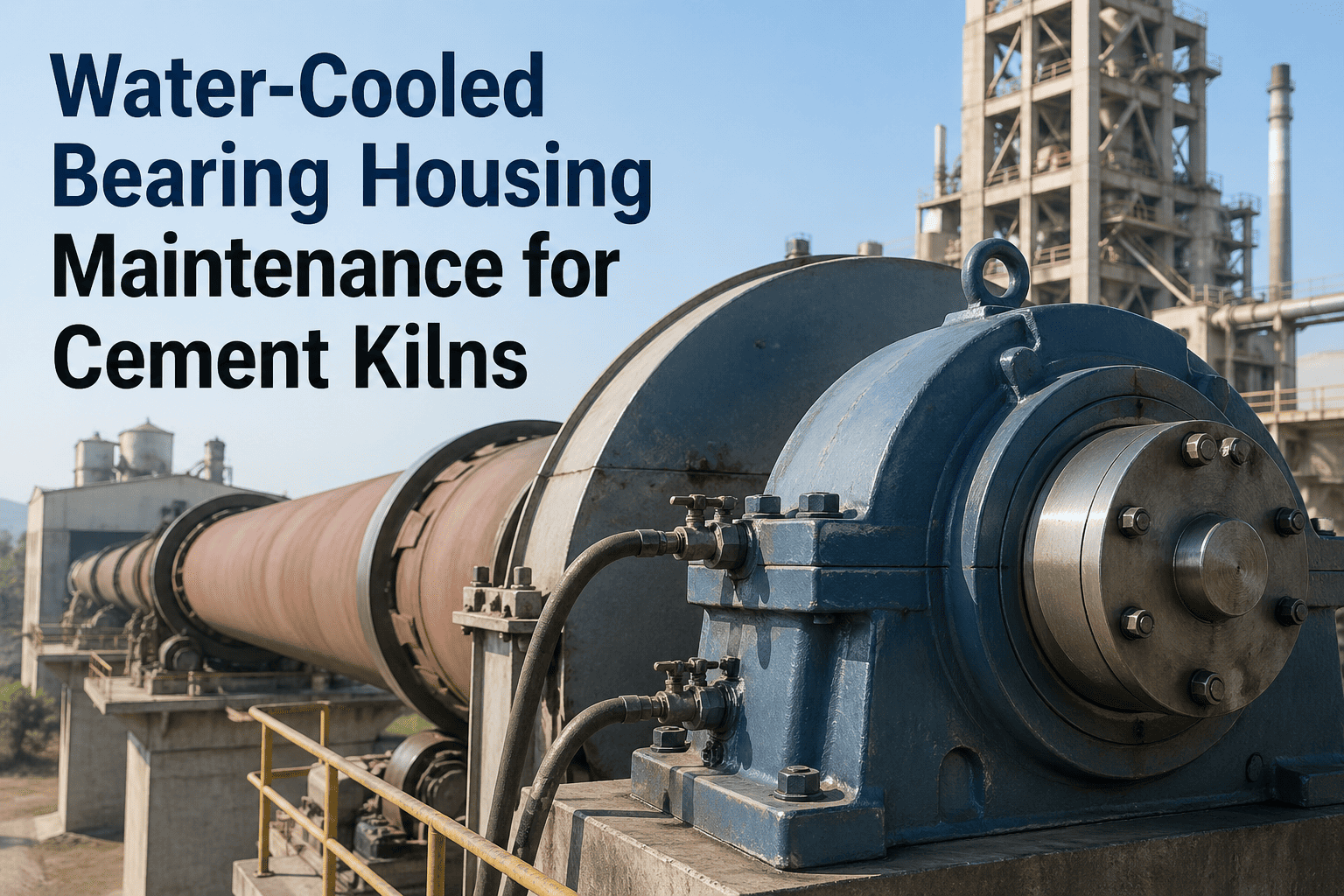
Kiln main bearing and thrust roller failures account for 18% of unscheduled cement kiln shutdowns, costing manufacturers $180,000–$380,000 per failure when catastrophic bearing seizure forces kiln thermal shutdown, bearing replacement, and system realignment—a process requiring 5–9 days of zero production and extended cooldown periods. The main bearing system—a large hydrodynamic journal bearing (typically 400–600 mm bore, supporting 150–300 metric tons of kiln weight) and a thrust roller assembly (2–4 roller bearings supporting axial kiln load)—operates under continuous rotation at 2–4 RPM, carrying loads equivalent to 500–1,200 metric tons of force. Bearing failure initiates silently through lubrication film breakdown, micro-pitting, and thermal expansion; unlike sudden fractures, bearing degradation progresses over weeks, with temperature rising gradually before catastrophic seizure occurs. Structured bearing maintenance monitors journal temperature and thrust load continuously, logs bearing temperatures weekly, performs oil analysis monthly to detect wear debris, and replaces bearings predictively when wear rates exceed thresholds—reducing bearing failure incidents by 87% and extending bearing life 35–50% beyond normal replacement intervals. OxMaint's kiln bearing module automates temperature logging, lubrication scheduling, wear debris tracking, and predictive bearing replacement—keeping rotation systems reliable and production uninterrupted.
Kiln Main Bearing & Thrust Roller Maintenance: Temperature Monitoring & Predictive Replacement
Kiln bearing failures halt production for 5–9 days and cost $180K–$380K per incident. Deploy this protocol for continuous temperature monitoring, lubrication management, wear debris tracking, bearing load trending, and CMMS-driven predictive replacement—preventing 87% of failures and extending bearing life 35–50%.
Kiln Main Bearing System Architecture: Journal Bearing, Thrust Roller Assembly & Load Distribution
The kiln main bearing system comprises two functional components working in concert. The journal bearing—a large cylindrical bearing that supports the kiln's radial weight (150–300 metric tons depending on kiln diameter and feed rate)—maintains the kiln's radial position as it rotates. The bearing is typically a hydrodynamic plain bearing (babbit-lined white metal, or rolling element bearing in modern designs), lubricated by a continuous oil circulation system (pump rate 20–60 liters per minute, oil temperature 45–65°C). The journal bearing operates under EHD (elastohydrodynamic) film conditions: at 2–4 RPM, the rotating shaft creates hydrodynamic pressure in the oil film, generating a load-carrying film 10–50 micrometers thick that separates the metal-to-metal contact. When lubrication is adequate, friction is low (coefficient <0.01) and temperature stable. When film thickness drops below critical threshold (due to low oil viscosity, contamination, or excessive load), metal-to-metal asperity contact begins, friction jumps to 0.05–0.15, and temperature rises rapidly. The thrust roller assembly—2–4 spherical roller bearings mounted radially around the kiln shaft—supports the axial load (kiln pushing or pulling along its length as material flows through and rotational forces act). Thrust load typically runs 500–800 metric tons continuously; when thrust load exceeds design capacity (due to kiln tilt, material buildup, or drive misalignment), thrust rollers experience accelerated wear and preload increases, raising temperature. Monitor your kiln bearing loads and temperatures continuously with OxMaint's integrated load cell and thermocouple data collection.
Bearing Temperature Monitoring: Continuous vs. Weekly Logging & Alert Thresholds
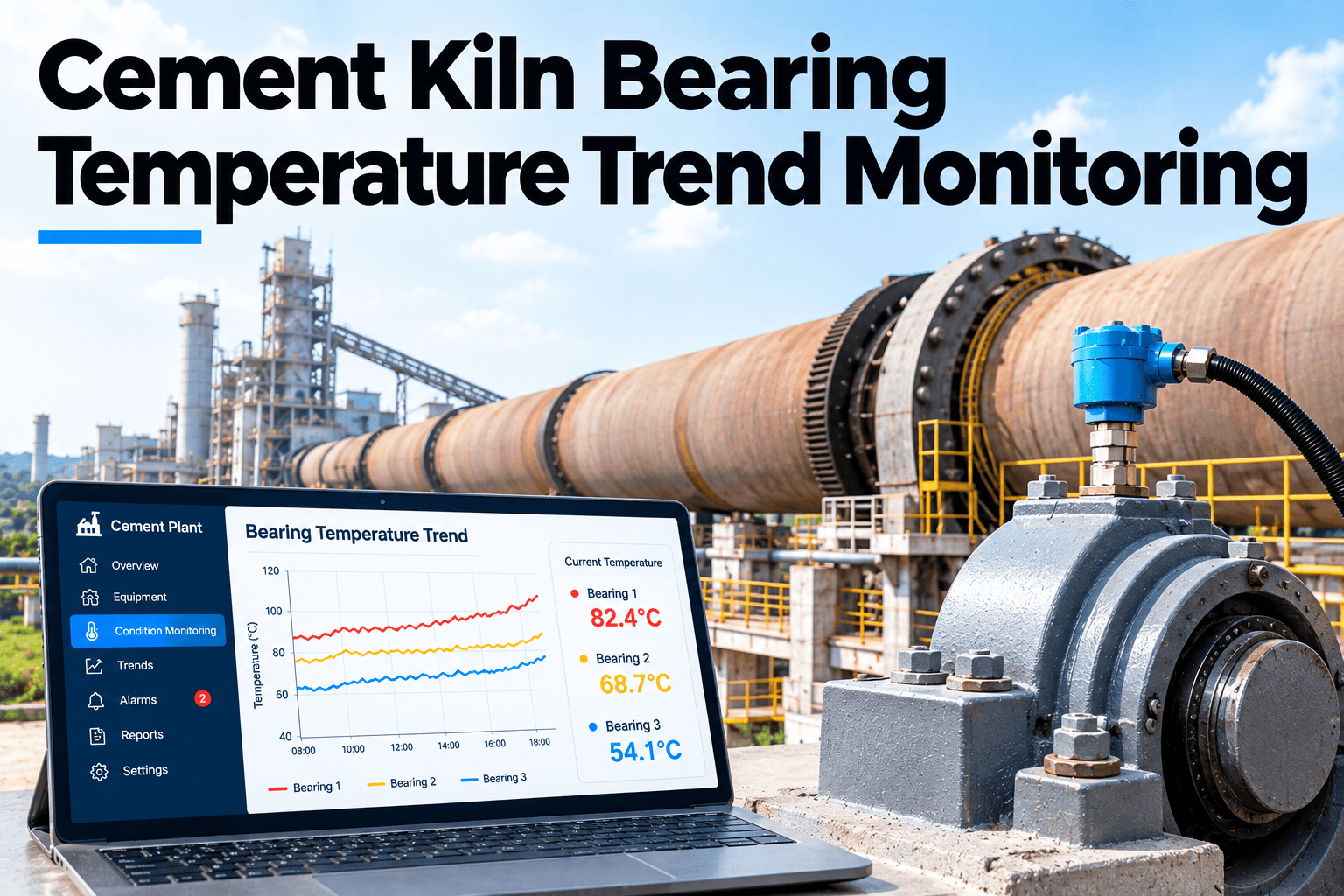
Journal bearing temperature is the primary indicator of lubrication film health and impending failure. A healthy bearing operating under normal load maintains a stable oil outlet temperature of 50–62°C (measured via thermocouple inserted into the bearing sump oil outlet). When bearing temperature rises above 65°C, hydrodynamic film thickness is declining—viscosity drops with temperature, reducing load-carrying capacity. When temperature exceeds 70°C, film thickness is critically low; metal-to-metal contact is occurring and wear rate accelerates exponentially. When temperature reaches 75–80°C, bearing seizure is imminent; kiln must shut down immediately to prevent catastrophic bearing damage. Thrust roller bearings operate 5–10°C hotter than the journal bearing (typical operating range 60–75°C) due to rolling element friction; thrust temperature above 80°C indicates preload misalignment or excessive axial load. Most industrial kilns employ two temperature monitoring strategies: (1) Continuous thermocouples with automated data logging (sample every 5–30 minutes) that allows real-time trending and trend-rate detection (e.g., "temperature rising >2°C per hour" triggers emergency alert); (2) Weekly manual temperature readings (same time each week) that are logged in CMMS and compared to baseline and trend. Continuous monitoring catches acute failure mode (sudden temperature spike) within minutes; weekly monitoring detects gradual degradation mode (slow temperature rise) over weeks. Most comprehensive programs employ both: continuous logging for emergency detection, weekly manual readings for trend confirmation and data audit. Schedule a demo to see OxMaint's real-time bearing temperature dashboard and automated alert system.
Oil Analysis Program: Particle Counting, Wear Debris Trending & Bearing Life Forecasting
Bearing wear manifests in the lubrication oil as ferrous particles (iron-based wear debris) and non-ferrous metals (copper, tin, lead from bearing alloys). Monthly oil analysis—taking a 20–30 mL sample from the bearing sump at the same location and time each month—establishes the particle size distribution and ferrous particle count. A healthy bearing generates <100 mg/L ferrous particle content per month; bearings in normal wear generate 100–300 mg/L; bearings showing accelerated wear generate 300–600 mg/L; bearings on the verge of failure generate >600 mg/L. Particle size trending is also critical: when the proportion of large particles (>10 micrometers) increases relative to small particles (<5 micrometers), it indicates surface-level spalling beginning—a predictor of imminent bearing seizure. Oil analysis also measures acid number (TAN, total acid number), which rises when oil oxidation increases—a sign of elevated bearing temperatures degrading the lubricant. An acid number rising from 0.2 mg KOH/g to 0.6+ mg KOH/g over 3–6 months signals that bearing friction and temperature elevation are oxidizing the oil; combined with rising ferrous content, this pattern predicts bearing life remaining <8–12 weeks. Start tracking bearing wear debris with OxMaint's oil analysis module and predictive bearing replacement forecasting.
Lubrication Management: Oil Viscosity, Flow Rate Optimization & Cooler Performance
Bearing lubrication performance depends on three critical variables: viscosity (oil resistance to flow, measured in centiStokes at 40°C), flow rate (volume of oil circulated per minute), and temperature (cooler setpoint and performance). The kiln bearing system typically specifies ISO VG 46 or VG 68 oil (46 or 68 centiStokes at 40°C). This viscosity range ensures hydrodynamic film formation at low RPM (2–4 RPM kiln speed) while maintaining reasonable pressure drops through the circulation system. When oil viscosity drifts <35 cSt (oil too thin, often due to contamination with lighter fluid or heat degradation), hydrodynamic film thickness drops and bearing temperature rises. When viscosity >90 cSt (oil too thick, often due to oxidation or cold storage), flow is restricted, cooler performance drops, and temperature control becomes difficult. Monthly oil viscosity testing (performed in-house via portable viscometer or via lab analysis) ensures the oil viscosity remains within ±10% of specification. Flow rate is typically 20–60 L/minute depending on bearing design and kiln load; flow is verified quarterly by measuring pump discharge into a graduated container over a timed period. A 20% drop in flow rate (e.g., from 40 to 32 L/min) signals cooler fouling or pump wear and requires immediate inspection. The bearing cooler—an oil-to-water heat exchanger—maintains oil temperature by rejecting bearing frictional heat; cooler performance is verified monthly by measuring inlet and outlet oil temperature and calculating cooling capacity (inlet temp - outlet temp, target ≥10°C delta). When cooler temperature delta drops <5°C, fouling is likely and cooler requires cleaning. Monitor your lubrication system health with OxMaint's oil properties tracking and cooler performance trending.
Bearing Preload & Clearance Measurement: Adjusting for Thermal Growth & Wear
Bearing preload—the radial clearance (or negative clearance, i.e., spring tension) between the bearing inner race and the kiln shaft—is critical to stable bearing operation. Proper preload ensures that radial load is distributed evenly across all rolling elements (in rolling element bearings) or across the bearing bore surface (in plain bearings); excessive preload generates unnecessary friction and heat; insufficient preload allows shaft runout and vibration. Radial clearance is typically 0.2–0.5 mm for new installations, measured by inserting a feeler gauge between the shaft and bearing bore at multiple locations (typically 4 locations 90° apart) and averaging. As the bearing wears and the kiln operates, bearing internal clearance increases; after 3–5 years of operation, clearance can grow to 0.8–1.2 mm, at which point a bearing clearance adjustment (shimming) is required to restore proper preload and prevent vibration-induced failures. Thermal growth also affects clearance: the kiln shaft and bearing housing expand during operation; a temperature rise from 20°C ambient to 60°C bearing operating temperature causes ~0.05 mm expansion of a 400 mm diameter shaft. Preload adjustment is typically performed annually (after cold shutdown and before kiln restart) by measuring clearance with feeler gauges and adding shims if needed. This operation requires partial kiln disassembly and typically takes 4–6 hours per bearing assembly. Book a demo to see how OxMaint tracks bearing preload measurements and schedules adjustment maintenance before vibration or failure occurs.
CMMS Bearing Management: Integrated Temperature Logging, Oil Analysis Tracking & Predictive Replacement Scheduling
Customer Case: Predictive Bearing Maintenance Prevented $280,000 Emergency Failure
Frequently Asked Questions — Kiln Bearing Maintenance & Predictive Replacement
Extend Bearing Life & Eliminate Catastrophic Failures
OxMaint automates bearing temperature logging, oil analysis tracking, wear debris trending, preload monitoring, and predictive replacement scheduling across all kiln rotation systems—so your cement plant gains 6–12 months' visibility before failure and eliminates $180K–$380K emergency bearing replacements. Free to start. Protect your kiln bearings with continuous, data-driven maintenance management.