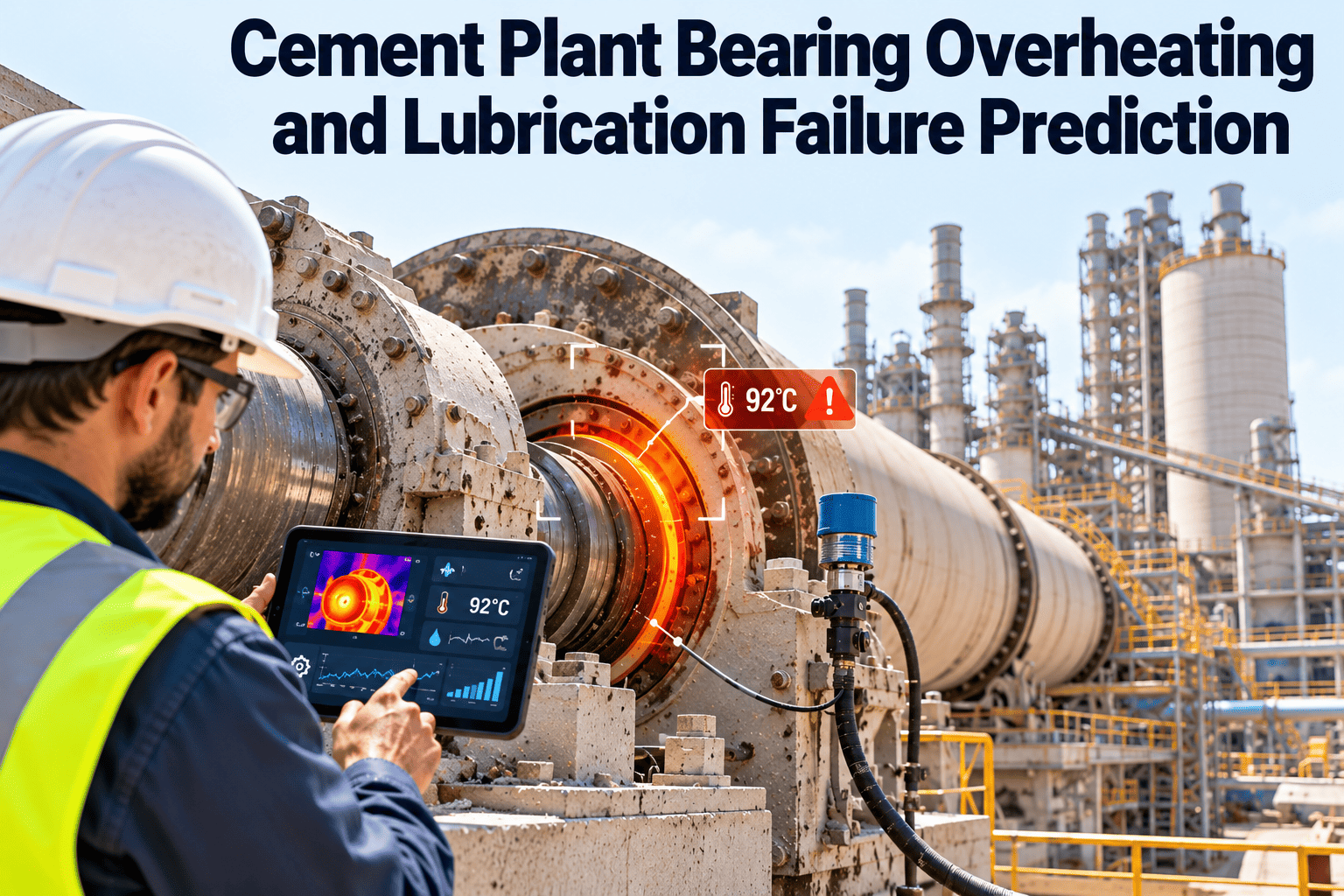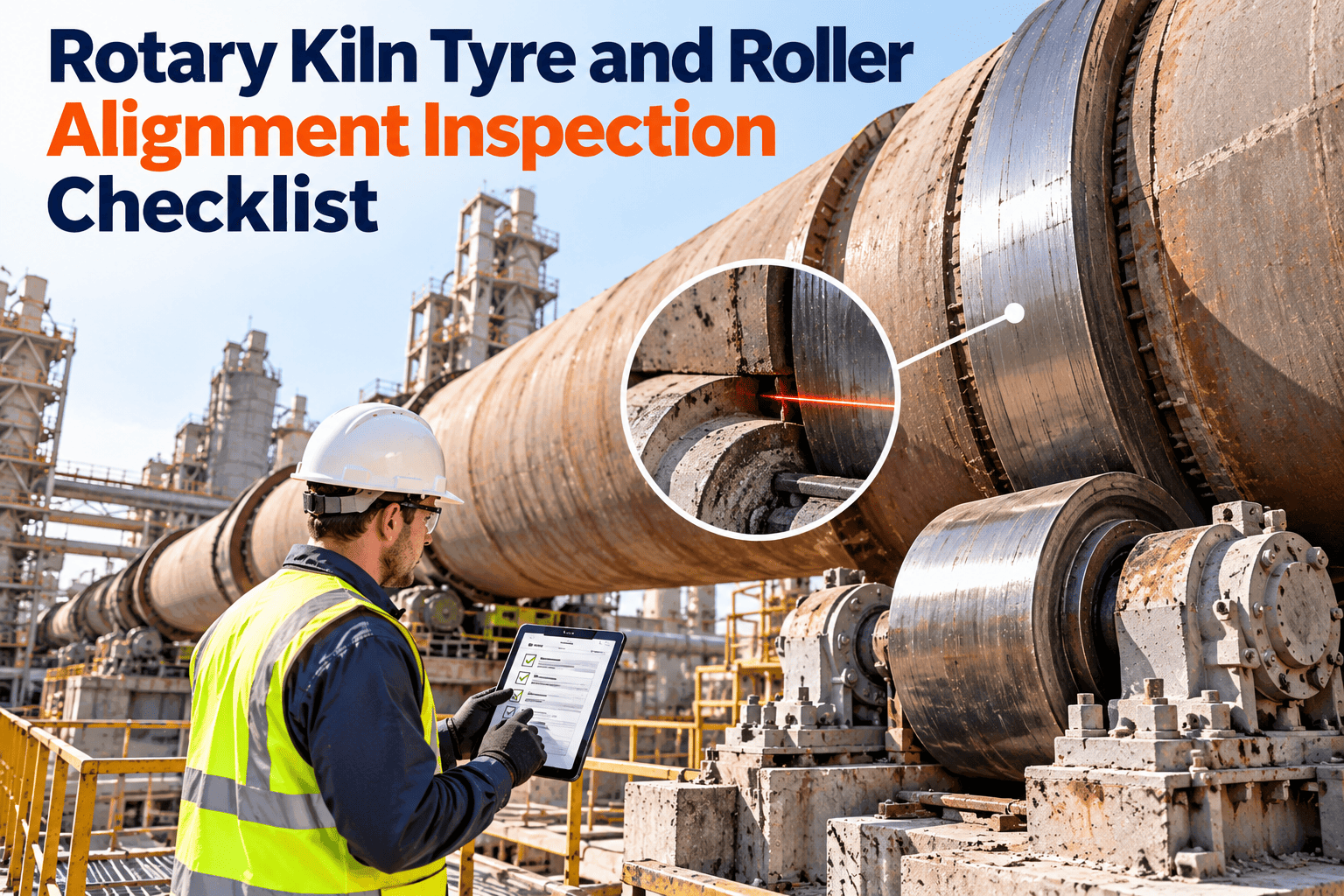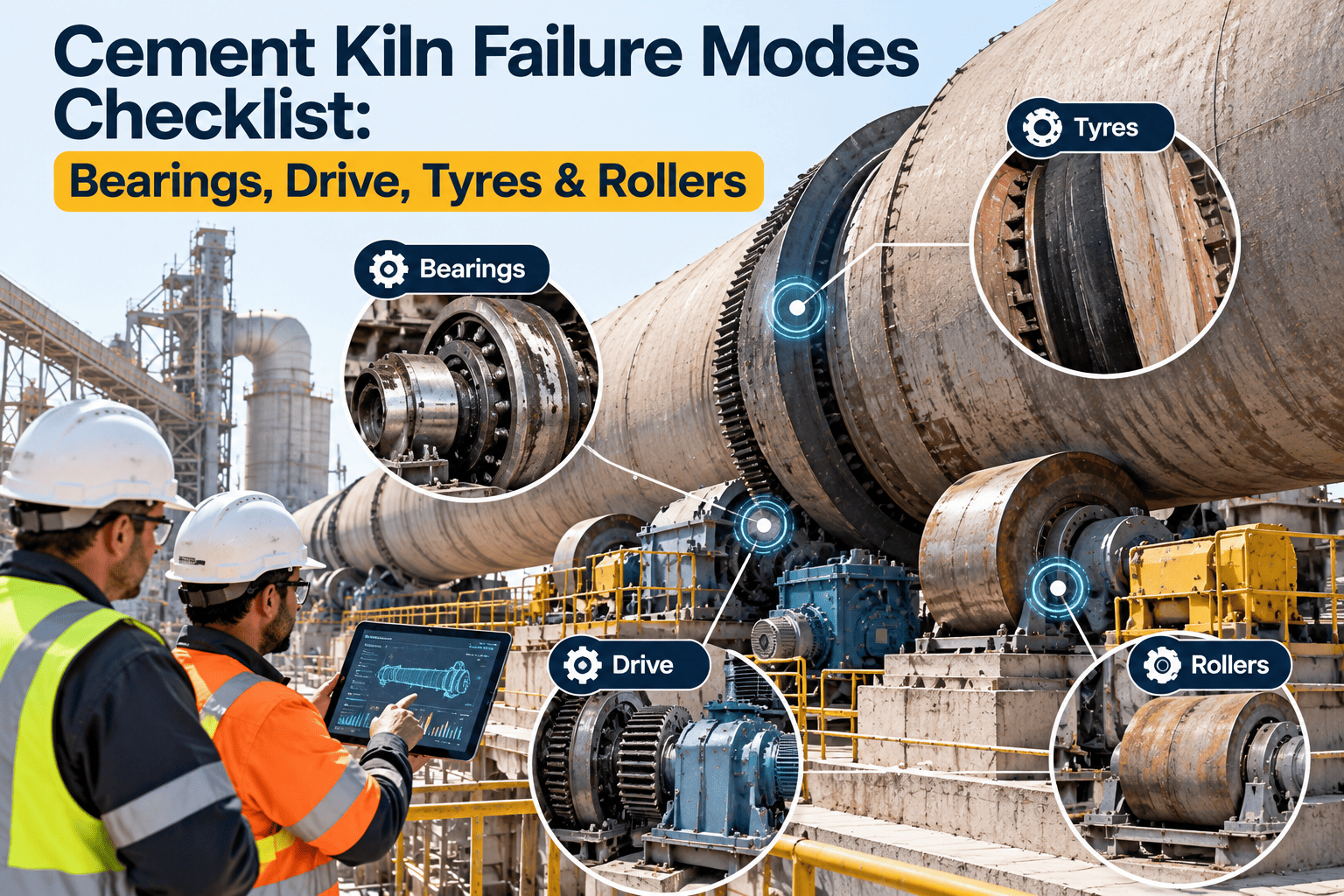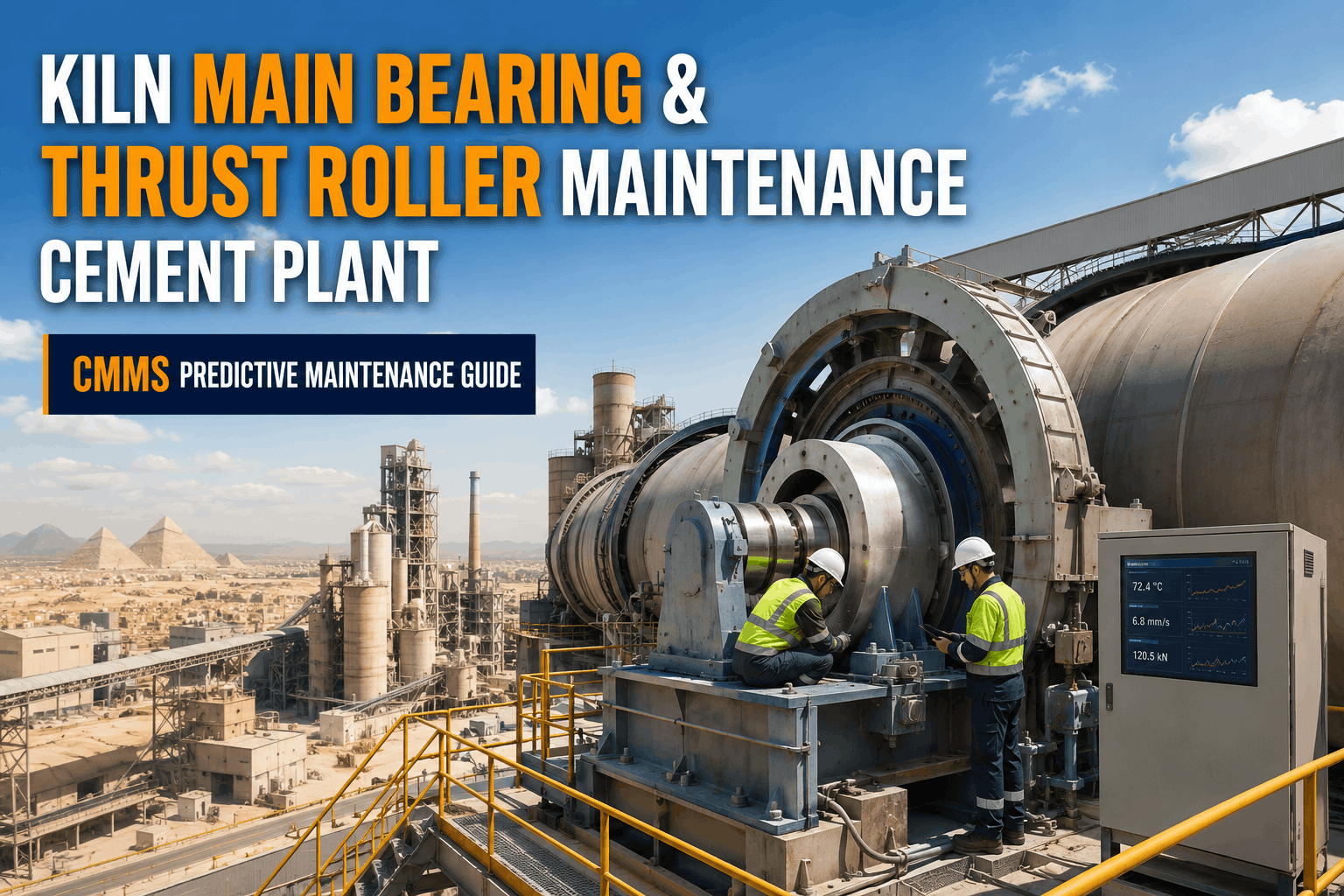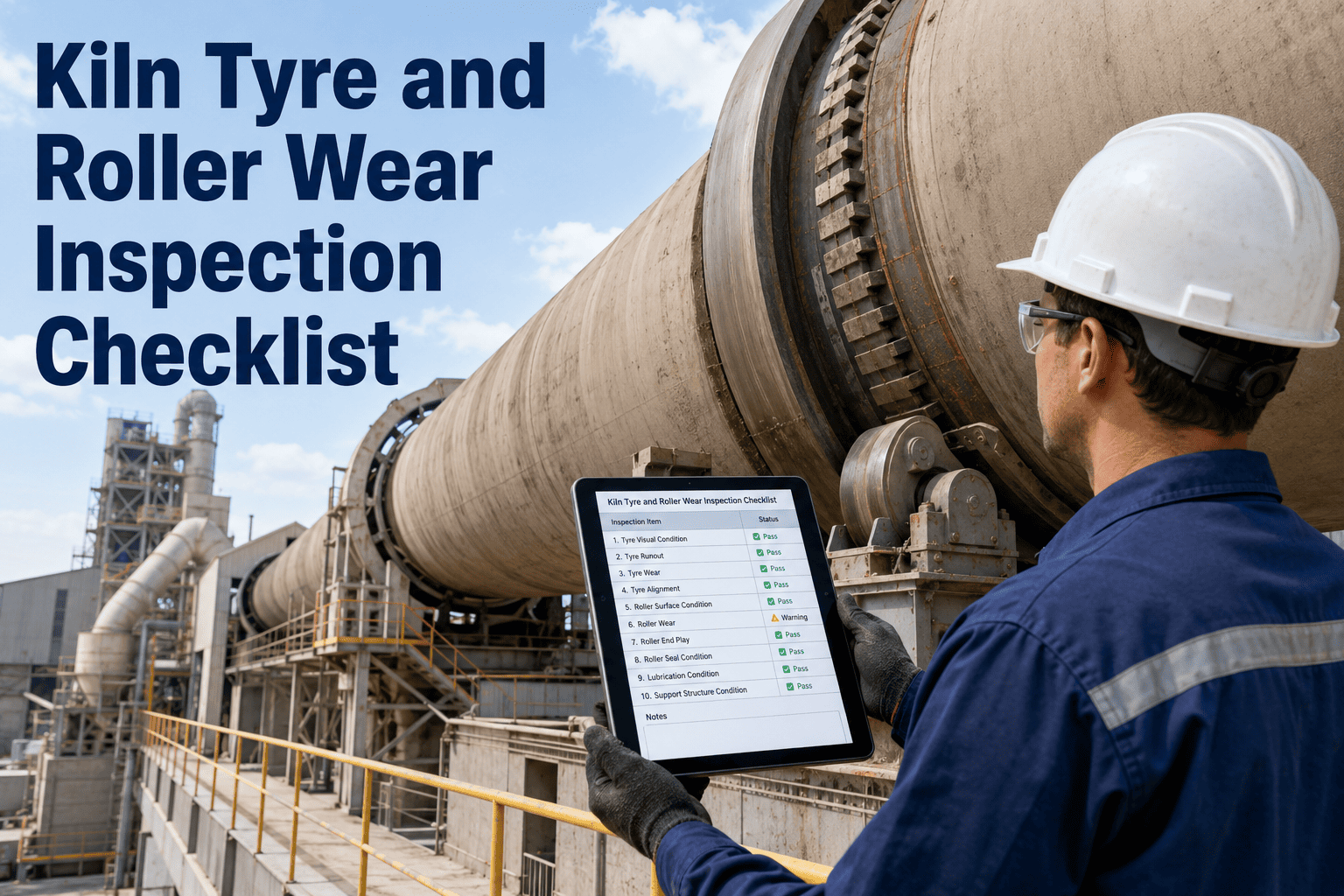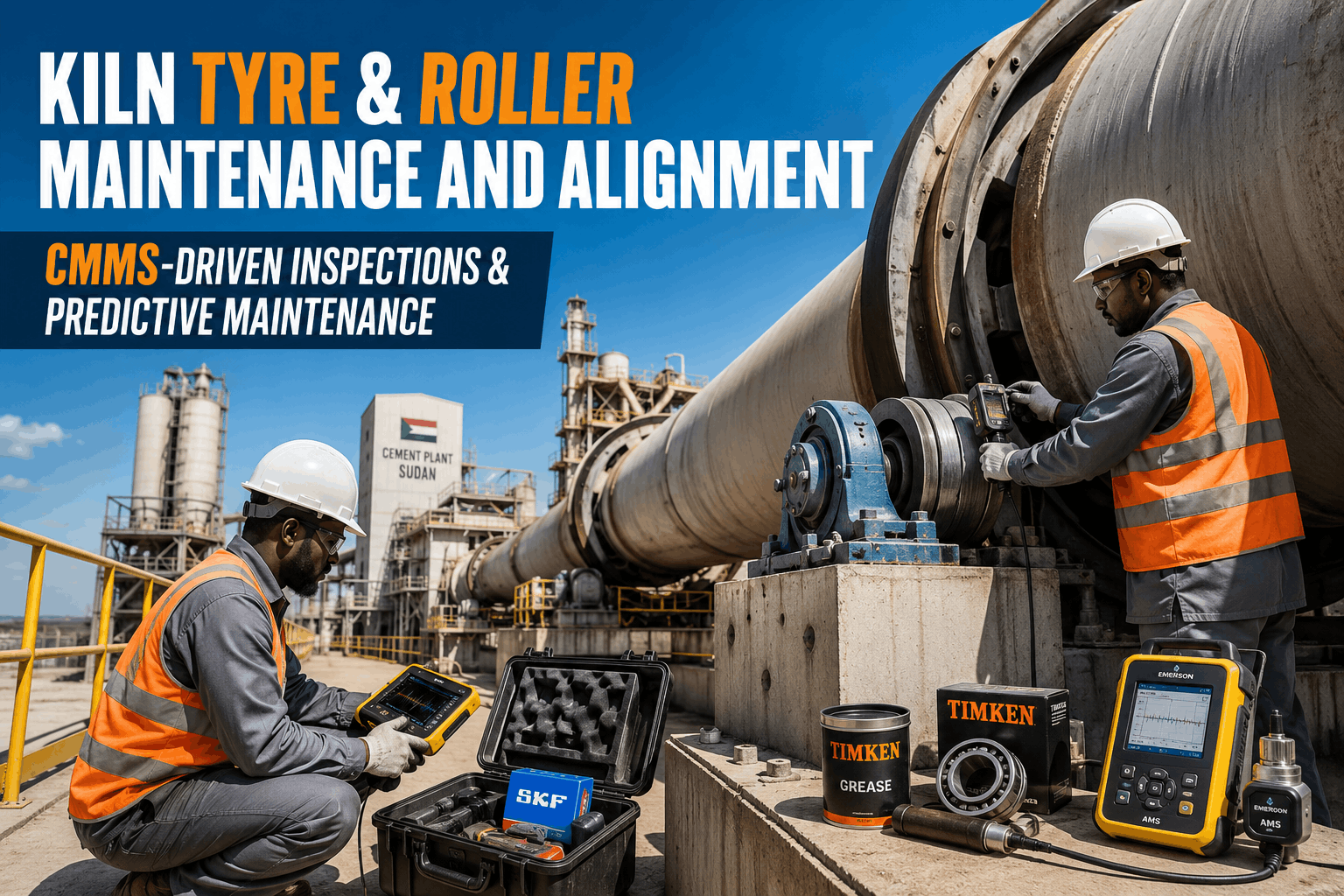
Kiln riding tyres and support rollers form the mechanical foundation that enables 2,000-tonne load rotation at 1–4 RPM under temperatures exceeding 1,100°C in the burning zone. Tyre slip (also called creep or migration) — the relative movement between the tyre and kiln shell — is inevitable but must stay within tight tolerances (4–12mm per revolution) to prevent cascading wear patterns that accelerate both tyre pad deterioration and kiln shell deformation. Support roller misalignment beyond 5mm creates uneven load distribution, causing accelerated bearing wear and shell ovality that amplifies refractory cracking and structural stress. Many cement plants treat tyre and roller maintenance as secondary to kiln bearing and girth gear work, deferring alignment checks and slip measurement for months — a decision that typically costs $180K–$320K in accelerated tyre pad wear, premature bearing replacement, and compounding refractory damage. This guide shows cement plant mechanical technicians and reliability engineers how to establish integrated tyre and roller condition monitoring programs that catch alignment drift and slip growth early, predict bearing and tyre life accurately, and coordinate replacement work into larger kiln outages rather than creating emergency maintenance events.
Understanding Kiln Tyre Migration and Its Mechanical Consequences
Tyre migration (creep) is the inevitable relative rotation between the riding tyre and kiln shell caused by the tyre's friction grip and the shell's rotational inertia. Small amounts of migration (4–12mm per revolution) are normal and actually beneficial — they distribute heat load across the tyre surface and the pads supporting the tyre underneath. Excessive migration above 20mm per revolution indicates that the tyre support pads are severely worn, allowing the tyre to float on the kiln shell rather than gripping it. This floating condition causes shell ovality deformation that amplifies in severity week after week, creating a feedback loop where deformation worsens rolling dynamics, which worsens deformation further, until sudden shell cracking failure occurs. Tyre migration is directly visible through weekly laser or mechanical measurement — making it one of the few kiln wear indicators that is both quantifiable and actionable well before failure. Sign Up Free to begin tracking tyre migration in OxMaint with automatic trend analysis and alert generation.
Normal Tyre Slip (4–12mm per revolution): Acceptable operation
Pads are intact and well-distributed. Migration remains consistent week-to-week with no increasing trend. Shell surface contact is even; no ovality detected. Bearing loads are distributed evenly across support rollers. Maintenance task: continue weekly measurement to verify continued normal operation. Scheduling priority: routine.
Elevated Tyre Slip (12–20mm per revolution): Attention required
Pad wear is advancing and reducing grip. Shell is beginning ovality deformation. Bearing temperatures on support rollers may be trending upward as load distribution becomes uneven. Maintenance task: increase measurement frequency to weekly (if monthly before); inspect pads for wear pattern. Schedule pad replacement within 8–12 weeks. Do not defer — wear accelerates exponentially once pads thin below 50mm thickness.
Critical Tyre Slip (>20mm per revolution): Urgent intervention
Pads are severely worn. Tyre is floating on shell rather than gripping. Shell ovality is measurable (dial indicator shows >5mm deformation). Support roller bearing temperatures are elevated (>75°C) and trending upward. Shell stress is accelerating. Maintenance task: pad replacement required within 30 days maximum. Delaying beyond 30 days risks permanent shell cracking damage requiring $800K+ emergency repair.
Shell Failure Imminent (>30mm or rapid acceleration): Emergency shutdown
Pad thickness <20mm. Shell ovality >10mm. Multiple support rollers showing >80°C bearing temperature. Shell cracking visible at night or detected by visual inspection. Tyre migration accelerating week-to-week (growing >5mm/week). Kiln must be shut down immediately. Shell cracking at this stage typically requires full shell replacement ($2.0M+) or emergency welding repair ($800K–$1.2M).
Support Roller Alignment and Its Impact on Kiln Bearing Life
Each kiln support roller operates under 200–400 tonne radial load while supporting the main bearing thrust load. Support rollers must be aligned within ±5mm vertical and horizontal to distribute load evenly and prevent bending stress on the kiln shell. When a support roller misaligns more than 5mm vertically (climbs above or sinks below the ideal contact line), load concentrates on the opposite side of the kiln shell, creating a bending moment that accelerates fatigue cracking. Horizontal misalignment (drift in the direction of kiln rotation) creates axial forces that distort the shell into an oval shape. Both vertical and horizontal misalignment increase main bearing load and bearing temperature — often misalignment is diagnosed only after bearing temperature begins rising unexpectedly. Book a Demo to see how OxMaint coordinates support roller alignment data with bearing temperature trending to identify and correct misalignment before bearing damage occurs.
Integrated Tyre, Roller, and Bearing Maintenance Scheduling
Mature kiln maintenance coordinates tyre slip monitoring, roller alignment checks, and bearing temperature trending into a unified maintenance schedule. These three subsystems are mechanically coupled: misalignment causes slip to accelerate and bearing temperature to rise simultaneously. When OxMaint detects the combination signal (slip increasing AND alignment drifting AND bearing temperature trending upward), it signals that a coordinated maintenance event is needed — addressing all three issues in a single kiln outage rather than creating three separate emergency stops. Sign Up Free to start integrating these three critical subsystems into your kiln maintenance program.
| Condition Indicator | Measurement Method | Frequency | Alert Threshold | Coordinated Action |
|---|---|---|---|---|
| Tyre Migration (mm/rev) | Laser or mechanical measurement at fixed location | Weekly | >20mm or >2mm/week increase | Pad replacement within 30 days |
| Support Roller Vertical Alignment (mm) | Dial indicator on bearing journal | Monthly | >5mm drift up or down | Shimming/realignment within 6 weeks |
| Support Roller Horizontal Alignment (mm) | Precision dial gauge along kiln axis | Monthly | >5mm drift in any direction | Shimming/realignment within 6 weeks |
| Shell Ovality (mm) | Diameter measurement at four positions | Quarterly (weekly if >5mm) | >10mm detected | Emergency bearing load assessment |
| Bearing Temperature (°C) | Thermocouple or RTD on bearing housing | Daily | >85°C or increasing trend >5°C/month | Investigate alignment and pad wear |
| Bearing Vibration (RMS velocity mm/s) | Accelerometer on bearing housing | Weekly | >10 mm/s or increasing trend >1 mm/s/month | Evaluate bearing replacement timeline |
Planning and Executing Tyre Pad Replacement and Roller Realignment Outages
Tyre pad replacement and support roller realignment require kiln shutdown but can be executed in 5–7 days if properly coordinated with refractory repair and other capital projects. Plants that wait until tyre slip reaches critical levels force emergency shutdowns on compressed timelines with incomplete scope — leaving misaligned rollers in place or using temporary shims that require replacement within months. Planned outages that address tyre, roller alignment, and refractory issues simultaneously reduce total downtime and improve execution quality. OxMaint's predictive scheduling coordinates these three work streams based on condition trending timelines. Book a Demo to see how OxMaint creates coordinated maintenance plans that consolidate tyre, roller, and bearing work into single outage events.
Months 1–3: Intensive Baseline Measurement and Trend Establishment
Begin weekly tyre slip measurement, monthly roller alignment checks, and daily bearing temperature monitoring. Establish trend data for your specific kiln in OxMaint. Most kilns show slip within 4–12mm and alignment within ±3mm during stable periods. Identify your normal operating bands — data above/below your baseline indicates deterioration starting. Use this baseline to predict when maintenance will be needed.
Months 4–8: Early Warning Implementation and Maintenance Scheduling
As trends develop (slip increasing, alignment drifting, bearing temperature rising), OxMaint flags early-warning alerts at Stage 2 (slip 12–20mm, alignment >5mm). At this point, maintenance can be scheduled 8–12 weeks ahead — time to procure tyre pads, plan outage with other capital projects, and coordinate contractor scheduling. Early warning enables planned maintenance; without this data, you're forced into reactive response.
Months 9–12: Coordinated Outage Execution
Execute coordinated maintenance: tyre pad replacement (3–4 days), support roller realignment (2–3 days), and integrated bearing/alignment verification before kiln restart. Total outage: 5–7 days if coordination is tight. Post-outage, slip drops to 4–8mm, alignment returns to ±2mm, bearing temperature declines 5–10°C. Document all work in OxMaint; reset trending baselines for next cycle.
Months 13+: Continuous Monitoring and Extended Maintenance Intervals
With tyre pads and rollers renewed, slip and alignment measurements stabilize at healthy levels. Bearing temperature may remain slightly elevated if bearing is aging (>8 years) — use this extended period to plan bearing replacement for the next planned capital outage. Continuous measurement prevents secondary deterioration from going unnoticed; many plants see problems re-accelerate if monitoring lapses after outage.
Frequently Asked Questions: Kiln Tyre and Roller Maintenance
What is normal tyre slip for a cement kiln?
Normal slip is 4–12mm per revolution when tyre pads are in good condition. Slip is measured at a fixed point by marking the shell and tracking rotational position. Consistent slip within 4–12mm band indicates healthy pads. Slip <4mm indicates excessive pad thickness or bearing load issues; slip >12mm indicates pad wear advancing.
How often should tyre migration be measured?
Weekly measurement is best practice for early detection of wear acceleration. Monthly measurement misses rapid deterioration cycles. OxMaint enables rapid data capture (5-minute measurement per cycle) and automatic trend analysis. If slip is stable in normal range (4–12mm) for 8+ consecutive weeks, measurement frequency can reduce to bi-weekly with active escalation thresholds.
What does shell ovality tell you about bearing health?
Shell ovality indicates that support rollers are carrying uneven load. Ovality >5mm signals misalignment; >10mm indicates urgent misalignment or bearing degradation. Ovality paired with bearing temperature increase (>85°C) suggests bearing load concentration from misalignment. Correcting alignment typically reduces bearing temperature by 3–8°C within 48 hours; temperature that doesn't drop after alignment correction suggests bearing wear is primary cause.
How much does tyre pad replacement cost and what is downtime required?
Tyre pad replacement (6–8 pads per tyre, typically 2–3 tyres per kiln line) costs $120K–$180K including parts, labor, and equipment. Downtime: 3–4 days for kiln-in-place pad replacement without removing tyre. Cost of delaying pad replacement when slip exceeds 20mm: $180K–$320K in accelerated wear on shell, bearings, and rollers.
Can support roller alignment be corrected without kiln shutdown?
Minor alignment corrections (<3mm) using shim adjustments can be done with kiln running at reduced speed if pads underneath rollers are accessible. Major realignment (>5mm) requires kiln shutdown to prevent bearing damage during adjustment. Realignment typically takes 2–4 hours per roller station when kiln is stopped. Total realignment of four roller stations: one shift (8 hours) is usually sufficient.
What happens if tyre slip is ignored and reaches Stage 4?
Ignoring slip beyond 20mm results in accelerating shell deformation. By Stage 4 (>30mm or rapid growth), shell cracking is imminent — typically within 1–3 weeks. Kiln must be stopped to prevent catastrophic failure. Emergency shell repair (welding or sections replacement) costs $800K–$2.0M+. Planned pad replacement at Stage 2 cost ($120K–$180K) avoids emergency shell repair entirely.
How do you know when a support roller bearing needs replacement?
Support roller bearing replacement is indicated by: (1) bearing temperature >80°C sustained under normal load, (2) vibration at bearing location increasing >1 mm/s/month, (3) audible noise or grinding sound from bearing. Typical bearing life is 8–12 years; after 10 years, monitor more closely. Replacement cost: $80K–$120K per bearing. Delaying replacement after these signs appear risks sudden bearing seizure forcing emergency kiln stop.
Is kiln speed adjustment an effective response to elevated tyre slip?
Reducing kiln speed (lower RPM) temporarily reduces slip magnitude but does NOT address underlying pad wear. Slip will resume increasing when speed is normalized. Kiln speed reduction is a short-term mitigation only — use it to buy time while planning pad replacement, not as a permanent solution. Prolonged speed reduction (>2–3 weeks) typically reduces production and extends total downtime cost.