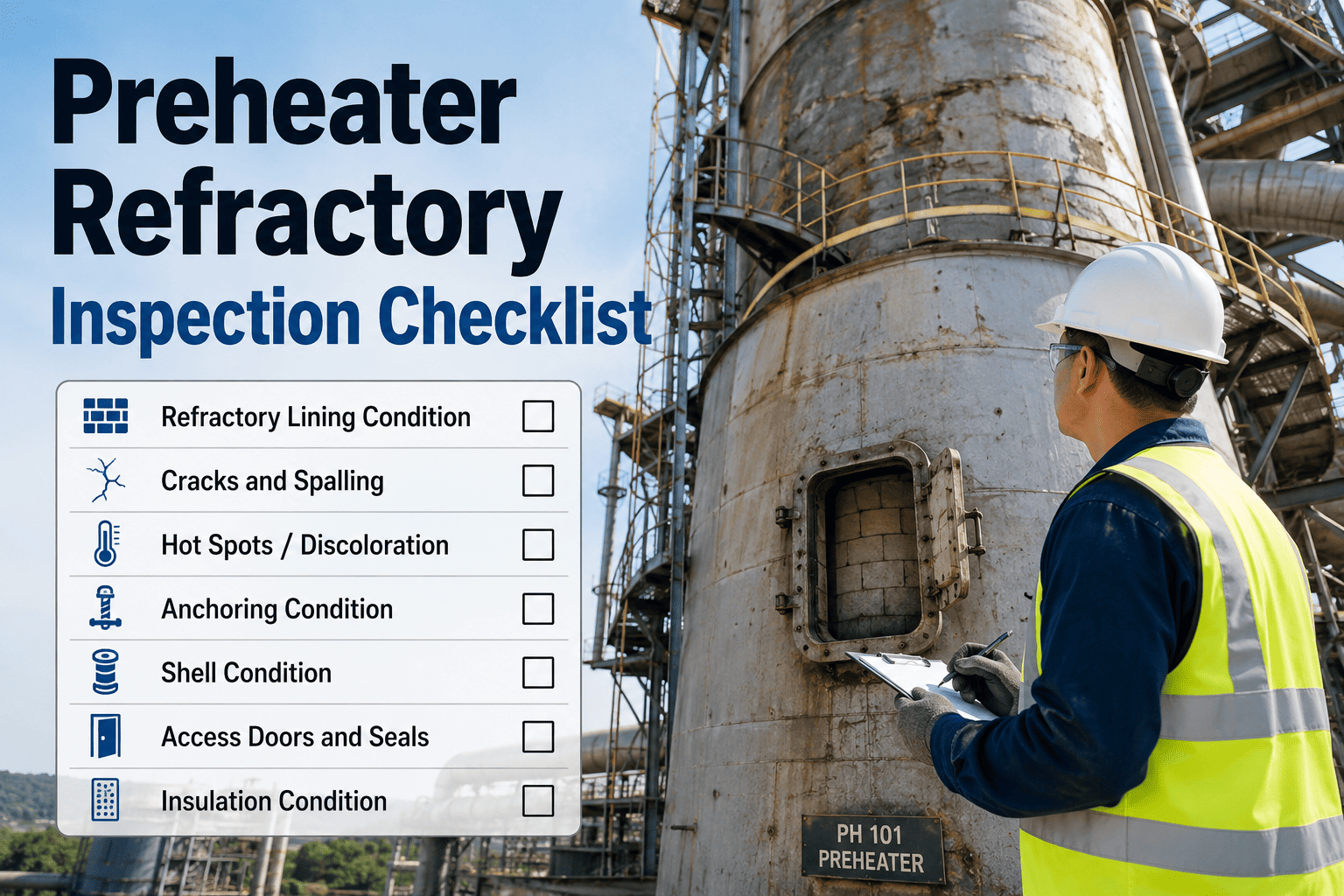
Every unplanned rotary kiln stop costs between $18,000 and $45,000 per hour. Plants without documented shutdown checklists spend 35 to 60 percent more per outage than those running structured digital procedures. Book a demo to see Oxmaint's digital checklist library running against your kiln equipment.
Priority:
Critical Safety-critical, must not be skipped
High Impacts equipment or compliance
Standard Required before phase completion
PHASE 1
Pre-Stop Isolation Checklist
1.1 Production and Feed System Shutdown
| # | Task | Acceptance Criteria | Priority | Sign-Off | |
|---|---|---|---|---|---|
| 1.1.1 | Notify production control room of planned kiln stop. Confirm clinker stockpile is above the 72-hour minimum shutdown buffer. | Stockpile above 72-hr minimum. Control room acknowledgement logged in shift record. | High | ________ | |
| 1.1.2 | Reduce raw meal feed rate to zero on a controlled ramp of 10 percent per 15 minutes. Confirm raw mill feed conveyor stopped at belt scale zero. | Belt scale at zero. Feed conveyor drive current at no-load baseline. Logged in DCS. | Critical | ________ | |
| 1.1.3 | Reduce coal mill feed to zero. Confirm burner primary air damper in purge position. Verify coal dust purge cycle is running to empty the burner pipe. | Burner pipe confirmed clear. Primary air in purge position confirmed on BMS panel. | Critical | ________ | |
| 1.1.4 | Confirm clinker cooler throughput at zero. Verify cooler grate drive in low-speed purge mode. Confirm all clinker conveyor drives running to empty before stopping. | Conveyor belt empty confirmed at belt sensor. Cooler grate in purge mode. | High | ________ | |
| 1.1.5 | Reduce kiln firing to idle flame. Confirm burner management system enters post-purge sequence. Log final kiln inlet and outlet temperature readings. | Burner in post-purge. Inlet temperature below 900°C. Readings logged with timestamp. | Critical | ________ |
1.2 Energy Isolation and Lockout / Tagout
| # | Isolation Point | Verification Method | Priority | Sign-Off | |
|---|---|---|---|---|---|
| 1.2.1 | Main kiln drive motor: isolate at main disconnect, apply lockout device, attach personal danger tag with technician name and date. | Voltage at zero with calibrated tester. Lock applied. Tag signed and dated. | Critical | ________ | |
| 1.2.2 | Auxiliary drive motor: isolate at MCC. Confirm auxiliary drive engaged in slow rotation before isolation if shell temperature is above 200°C. | Auxiliary drive confirmed engaged before MCC isolation. MCC panel locked with tag. | Critical | ________ | |
| 1.2.3 | Girth gear lubrication system: isolate pump circuit at MCC, depressurise spray bar, lock supply header valve at lubrication skid. | Spray bar pressure at zero on local gauge. Supply valve locked with danger tag. | High | ________ | |
| 1.2.4 | Preheater fan and ID fan: isolate at main breaker, apply lock and tag. Confirm fan wheel stationary before fitting blank flange to inlet duct. | Fan current at zero. Wheel stationary confirmed by direct observation. Blank flange fitted. | Critical | ________ | |
| 1.2.5 | Burner fuel supply: close and lock manual isolation valve at burner block. Apply lockout to fuel pump MCC. Depressurise burner line and confirm pressure gauge reads zero. | Fuel line pressure at zero. Manual valve locked. Pump MCC locked out with tag. | Critical | ________ | |
| 1.2.6 | Tyre and roller station hydraulic systems: depressurise all circuits. Isolate hydraulic power unit. Confirm all circuit pressures at zero on local gauges. | All hydraulic pressures at zero. HPU locked and tagged. | High | ________ |
1.3 Contractor Mobilisation and Permit Pre-Authorisation
| # | Task | Acceptance Criteria | Priority | Sign-Off | |
|---|---|---|---|---|---|
| 1.3.1 | Confirm refractory inspection crew on-site and briefed. Verify all crew hold valid confined space entry permits and current medical clearance certificates. | Crew roster confirmed. Permits current. Certificates sighted and filed against work order. | Critical | ________ | |
| 1.3.2 | Pre-authorise all hot work permits for refractory repair scope. Confirm fire watch assignment, extinguisher positioning, and work area boundaries marked. | Hot work permits signed and issued. Fire watch assigned by name. Boundaries marked. | High | ________ | |
| 1.3.3 | Confirm all spare parts in the CMMS shutdown work pack are staged at the equipment laydown area and reconciled against the parts manifest. | Parts manifest signed off. All critical path items confirmed on-site before kiln stops. | Standard | ________ |
GATE 1
All Phase 1 tasks signed off. Supervisor authorisation required. Phase 2 cannot begin until this gate is cleared.
Oxmaint CMMS
Phase 1 isolation records, lockout logs, and permit documentation captured automatically — audit-ready without any manual assembly. Book a demo to see isolation checklist compliance tracking live.
PHASE 2
Cooldown Procedure and Temperature Monitoring
Record shell temperature at each checkpoint. If rate exceeds 20°C/hr between any two readings, engage auxiliary rotation and notify the shift supervisor immediately. Do not advance without a confirmed reading and sign-off at each point.
2.1 Cooldown Rate Control Checkpoints
| Point | Target Shell Temperature | Rate Limit & Recorded Reading | Priority | Sign-Off | |
|---|---|---|---|---|---|
| 2.1.1 | 4 hrs after stop: shell below 1,200°C | Max 20°C/hr Recorded: ______°C | Critical | ________ | |
| 2.1.2 | 8 hrs after stop: shell below 1,000°C. 2-hr hold required for basic brick grade. | Max 20°C/hr Recorded: ______°C | Critical | ________ | |
| 2.1.3 | 16 hrs after stop: shell below 600°C. Auxiliary rotation every 30 minutes to prevent shell ovality from thermal bowing. | Max 20°C/hr. Rotation log entries every 30 min. Recorded: ______°C | Critical | ________ | |
| 2.1.4 | 24 hrs after stop: shell below 350°C. Ovality check recommended at this stage. | Max 15°C/hr below 400°C Recorded: ______°C | Critical | ________ | |
| 2.1.5 | 48 hrs after stop: shell below 150°C. Auxiliary rotation reduced to every 60 minutes. | Max 10°C/hr below 200°C Recorded: ______°C | High | ________ | |
| 2.1.6 | Safe entry confirmation: shell below 70°C at all monitored points. Atmosphere gas test completed before any person enters. | All readings below 70°C. Gas test passed. Recorded: ______°C | Critical | ________ |
2.2 Atmosphere and Confined Space Pre-Entry Checks
| # | Check Item | Pass Criteria & Recorded Result | Priority | Sign-Off | |
|---|---|---|---|---|---|
| 2.2.1 | Oxygen level measured at entry point, mid-shell, and outlet end with calibrated multi-gas detector before any person enters. | 19.5 to 23.5% at all three points. Recorded: ______% | Critical | ________ | |
| 2.2.2 | Carbon monoxide level tested at entry point and mid-shell with calibrated multi-gas detector. | Below 35 ppm at all points. Recorded: ______ ppm | Critical | ________ | |
| 2.2.3 | Explosive gas percentage of lower explosive limit tested at entry point before any technician enters. | Below 10% of LEL value. Recorded: ______% | Critical | ________ | |
| 2.2.4 | Rescue team confirmed on standby at entry point with rescue equipment, breathing apparatus, and radio communication fully operational. | Rescue team signed in. Equipment checklist complete. Radio communication confirmed. | Critical | ________ |
GATE 2
Shell below 70°C at all points. Gas tests passed. Rescue team confirmed on standby. Phase 3 entry cannot begin until this gate is cleared and signed by the Shift Engineer.
41% Shorter Shutdowns
Cement plants using Oxmaint digital cooldown checklists reduce total shutdown duration by 41% versus unplanned outage baseline. Cooldown rate breaches trigger automatic supervisor alerts — no missed checkpoints. See the cooldown monitoring workflow live.
PHASE 3
Refractory Inspection and Mechanical Assessment
Inspect each zone from kiln outlet (Z-01) toward inlet. Record brick thickness at 12 o'clock, 4 o'clock, and 8 o'clock per zone. Enter the lowest measured value. Photo documentation required for any zone below 80% of nominal thickness.
3.1 Refractory Zone-by-Zone Condition Assessment
| Zone | Zone Description and Inspection Focus | Min Thickness & Measured Value | Priority | Sign-Off | |
|---|---|---|---|---|---|
| Z-01 | Kiln outlet zone: cooling zone brickwork adjacent to outlet seal and clinker cooler transition. Check seal clearance and outlet nose ring condition. | Min 100 mm Measured: ______ mm | High | ________ | |
| Z-02 | Transition zone: fireclay brick between cooling zone and lower burning zone. Inspect joint condition and mortar integrity. | Min 120 mm Measured: ______ mm | High | ________ | |
| Z-03 | Lower burning zone: magnesia-spinel brick under maximum thermal load. Inspect for spalling and coating loss exposing brick surface. | Min 140 mm. Replace if coating loss exposes brick face. Measured: ______ mm | Critical | ________ | |
| Z-04 | Upper burning zone: directly behind burner tip. Highest thermal shock exposure. Check for spalling, cracking, and joint gaps above 5 mm. | Min 150 mm. Joint gap above 5 mm requires replacement before restart. Measured: ______ mm | Critical | ________ | |
| Z-05 | Calcining zone: alumina silicate brick with coating build. Inspect for calcite ring formation. Measure ring protrusion and assess delamination. | Min 120 mm. Ring protrusion above 80 mm requires mechanical removal before restart. Measured: ______ mm | High | ________ | |
| Z-06 | Inlet zone: insulating brick near inlet seal. Check seal clearance, nose ring integrity, and refractory anchor condition at kiln feed end. | Min 100 mm. Inlet seal clearance within manufacturer specification. Measured: ______ mm | High | ________ |
3.2 Shell Plate and Ovality Inspection
| # | Inspection Item | Pass Criteria & Recorded Value | Priority | Sign-Off | |
|---|---|---|---|---|---|
| 3.2.1 | Walk full kiln shell externally. Physically locate all hot spots identified from thermal scanner records during previous campaign. Confirm location against zone map. | All campaign hot spots located. Hot spot above 320°C triggers full zone investigation. | Critical | ________ | |
| 3.2.2 | Measure shell plate thickness at each hot spot and at any zone where refractory is below minimum. Record against shell plate asset record in CMMS. | Above 12 mm nominal. Below 10 mm requires engineering assessment before restart. Measured: ______ mm | Critical | ________ | |
| 3.2.3 | Measure shell ovality using cross-diameter measurement at tyre positions and mid-span. Compare against previous campaign ovality record in CMMS asset history. | Below 0.5% of shell diameter. Trend increase above 0.1% per campaign triggers structural review. Measured: ______ mm | High | ________ |
3.3 Girth Gear, Tyre, and Roller Station Assessment
| # | Measurement Item | Acceptance Criteria & Recorded Value | Priority | Sign-Off | |
|---|---|---|---|---|---|
| 3.3.1 | Girth gear backlash: measure at four positions 90 degrees apart using feeler gauge. Calculate average and record against asset history in CMMS. | Within manufacturer range. Action threshold typically 10 to 12 mm. Measured: ______ mm | Critical | ________ | |
| 3.3.2 | Tyre migration: mark tyre and shell at reference position, rotate one full revolution, measure displacement between marks. Record against tyre asset record. | Below 30 mm acceptable. Above 50 mm requires tyre retaining block replacement before restart. Measured: ______ mm | Critical | ________ | |
| 3.3.3 | Roller station bearing inspection: check housing for cracking, oil seal condition, and bolt torque at all four roller stations. Record findings per station. | No cracking. Seals intact with no leakage. Bolts at specified torque per equipment manual. | High | ________ | |
| 3.3.4 | Pinion alignment check: measure root clearance at four positions and compare against last alignment record in CMMS. | Within 10% of design value. Above 15% variation requires full alignment survey before restart. Measured: ______ mm | High | ________ |
GATE 3
All zones inspected and recorded. All zones above minimum, or refractory repair completed and signed off. Mechanical measurements within criteria. Phase 4 cannot begin until this gate is cleared by both Refractory Inspector and Mechanical Engineer.
78% Scope Accuracy
Refractory zone thickness trends, hot spot coordinates, and girth gear measurements stored against your kiln asset record — feeding the next shutdown scope automatically without paper records or verbal handoffs. Book a demo to see zone inspection data in Oxmaint.
PHASE 4
Refractory Curing Schedule and Controlled Restart
Pre-heat rate must not exceed 15°C/hr through the moisture elimination phase (ambient to 350°C). Hold periods are mandatory at each stage and must not be shortened under production pressure. Skipping any hold voids the refractory manufacturer warranty worth $180,000 to $650,000 per kiln section.
4.1 Refractory Curing Temperature Ramp
| Stage | Temperature Range and Ramp Rate | Mandatory Hold & Start Temp | Priority | Sign-Off | |
|---|---|---|---|---|---|
| C-01 | Ambient to 150°C at max 15°C/hr using low-fire burner or auxiliary heat source only. | Hold 4 hrs at 150°C. Free water elimination. Start: ______°C | Critical | ________ | |
| C-02 | 150 to 350°C at max 15°C/hr. Chemically bound water elimination phase. Steam emission from kiln will be visible. | Hold 6 hrs at 350°C. Confirm steam ceased before advancing. Start: ______°C | Critical | ________ | |
| C-03 | 350 to 650°C at max 20°C/hr. Refractory dimensional stabilisation phase. Inspect shell externally for new hot spots during this stage. | Hold 4 hrs at 650°C. External shell inspection required before advancing. Start: ______°C | Critical | ________ | |
| C-04 | 650 to 900°C at max 25°C/hr. Sintering phase for castable and repair mortar. Shell scan required if new refractory was installed. | Hold 3 hrs at 900°C. Shell scan reviewed by Process Engineer. Start: ______°C | Critical | ________ | |
| C-05 | 900 to 1,100°C at max 30°C/hr. Approach to operating temperature. Begin kiln rotation at minimum operational speed during this stage. | Hold 2 hrs at 1,100°C. Rotation confirmed at minimum speed. Drive performance normal. Start: ______°C | Critical | ________ | |
| C-06 | 1,100°C to operating temperature at normal startup ramp per Process Engineer instruction. Introduce raw meal feed at minimum rate when inlet temperature confirms readiness. | First clinker sample within specification 2 hrs after feed introduction. Start: ______°C | Critical | ________ |
4.2 Restart Authorisation Milestones
| # | Authorisation Milestone | Required Before / Authorised By | Priority | Sign-Off | |
|---|---|---|---|---|---|
| 4.2.1 | All lockout/tagout devices removed and isolation log cleared. Removal confirmed by original isolating technician or named authorised deputy. | Required before any drive system is energised. Auth: ________ | Critical | ________ | |
| 4.2.2 | Girth gear lubrication system commissioned. Spray bar pressure confirmed at operating set point. Oil level confirmed in gearbox and all bearing housings. | Required before main drive motor is energised or rotation above auxiliary speed. Auth: ________ | Critical | ________ | |
| 4.2.3 | All refractory repair sign-off forms filed against shutdown work order. Contractor departure confirmed. Hot work permits cancelled and closed in the permit system. | Required before curing phase begins. No hot work during curing ramp. Auth: ________ | High | ________ | |
| 4.2.4 | Process Engineer sign-off confirming curing schedule complete, shell scan reviewed, and first clinker quality sample within specification. Production ramp-up formally authorised. | Required before raw meal feed above 40% of design capacity. Auth: ________ | Critical | ________ | |
| 4.2.5 | Full shutdown close-out report completed in CMMS: inspection findings, scope changes, contractor costs, parts consumed, and outage duration recorded against kiln asset history. | Required within 48 hrs of first clinker. Feeds next annual shutdown planning cycle. Auth: ________ | Standard | ________ |
COMPLETE
All four phases signed off. Curing complete. First clinker quality confirmed. Close-out report filed in CMMS. Kiln authorised for full production ramp-up.
Continue Reading
Connected resources in the cement plant maintenance management cluster
Pillar Resource
Cement Plant Annual Shutdown Planning with CMMS
Build a 12-week pre-outage planning programme from CMMS condition data — scope definition, contractor mobilisation, parts procurement, and budget accuracy for kiln and mill shutdowns.
Read This Guide →
Core Resource
Contractor Management for Cement Plant Shutdowns
Pre-booking refractory crews, girth gear teams, and NDT contractors using CMMS scope documentation. Covers cost tracking, sign-off workflow, and invoice reconciliation across outage events.
Read This Guide →
Authority Resource
Cement Plant Maintenance KPIs: MTBF, OEE and Availability Tracking
Track kiln availability, overall equipment effectiveness, mean time between failure, and PM compliance rates as live CMMS performance indicators across your full cement plant asset base.
Read This Guide →
Spoke Resource
Root Cause Analysis for Cement Plant Equipment Failures
Use shutdown checklist findings to drive structured root cause analysis and eliminate repeat failures across refractory, girth gear, and drive equipment in subsequent kiln campaigns.
Read This Guide →
Deploy This Checklist Digitally
Replace Paper Kiln Shutdown Procedures with Oxmaint
Every task, gate, and sign-off captured on mobile. Records archived automatically against your kiln asset history. Phase gate enforcement prevents out-of-sequence progression. Book a 30-minute demo with your kiln outage team and see the full checklist workflow configured for your equipment profile.
Digital Phase Gates
Mobile Sign-Off
Cooldown Rate Alerts
Auto CMMS Archiving