Cement kilns with preheater and precalciner systems consume 70–80% of a plant's total thermal energy budget, yet most facilities operate 15–20% above the theoretical minimum of 2.9 GJ per tonne of clinker. The global industry average hovers around 3.1–3.4 GJ/t, meaning hundreds of thousands of dollars in fuel costs are lost annually through degraded cyclone efficiency, false air infiltration, and poor heat exchange performance. A single percentage point increase in false air raises exhaust heat loss by approximately 3 kcal/kg of clinker — a silent drain that compounds every hour the kiln runs. Proactive maintenance of preheater towers and precalciner chambers is the single highest-leverage action a cement plant can take to close this energy gap. Start tracking preheater maintenance with Oxmaint to digitize inspections, automate work orders, and drive measurable thermal efficiency improvements across your pyroprocessing line.
This guide breaks down the critical maintenance strategies, performance benchmarks, and diagnostic techniques that separate best-in-class preheater/precalciner operations (below 3.0 GJ/t) from underperforming lines burning excess fuel. Every section is built around actionable data your maintenance and process teams can implement during the next planned shutdown.
How Preheater and Precalciner Systems Drive Thermal Efficiency
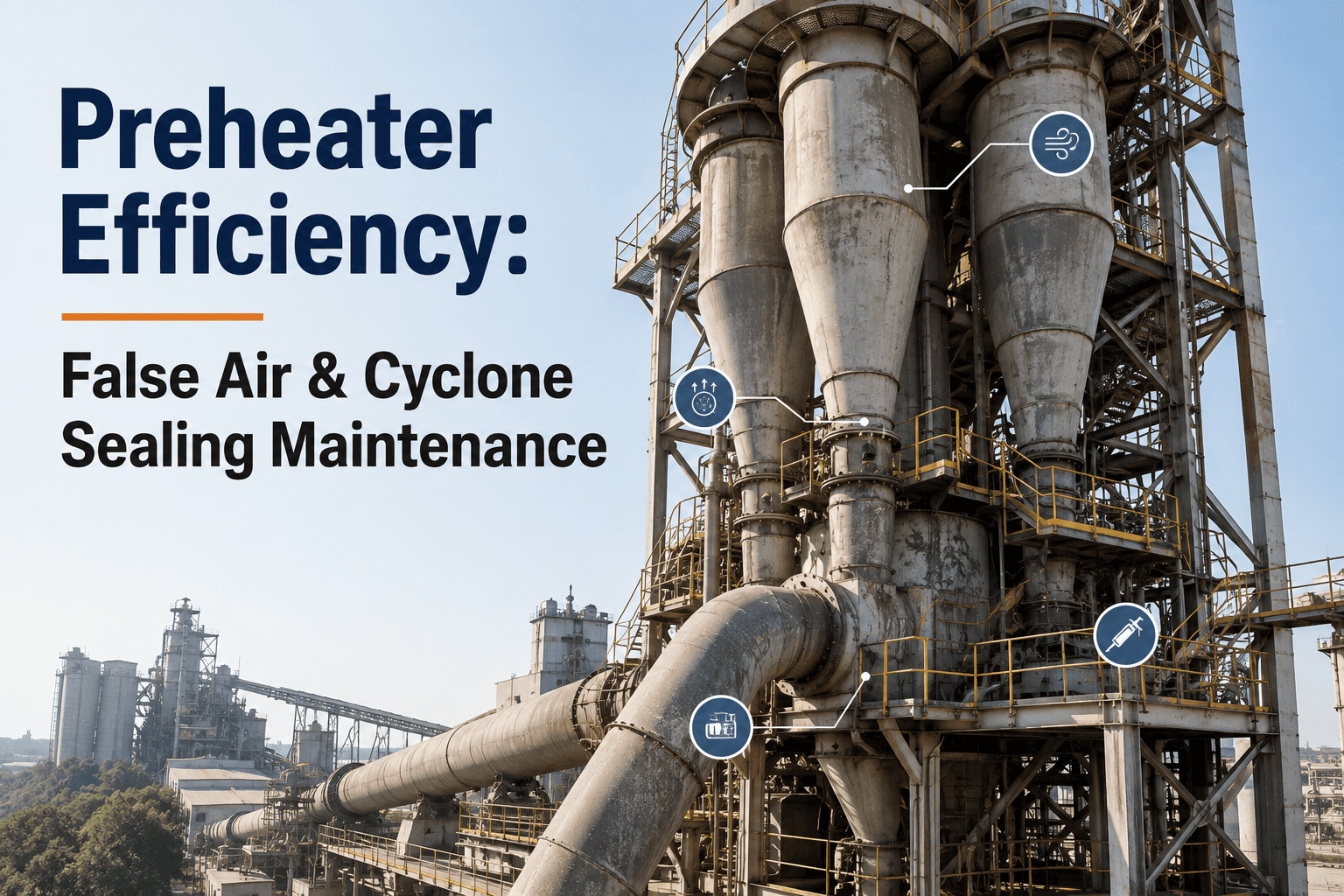
The cyclone preheater tower performs 40–60% of the total calcination work before raw meal even enters the rotary kiln. Each cyclone stage raises the material temperature by 150–250°C through suspension heat exchange with counter-flowing hot gases. In a well-maintained 5-stage preheater system, raw meal reaches approximately 800°C before entering the precalciner — where an additional 60–75% of fuel combustion occurs in a turbulent chamber designed for rapid CaCO₃ decomposition. The precalciner essentially functions as a second firing zone, decoupling kiln capacity from single-point fuel injection limits.
When these systems degrade through refractory erosion, buildup accumulation, false air leakage, or poor meal distribution, the rotary kiln must compensate with additional fuel to reach sintering temperatures. This compensation is invisible on daily logs until it shows up as elevated specific heat consumption on monthly reports. Sign up for Oxmaint to link equipment condition data directly to energy KPIs and catch efficiency losses before they become structural problems.
The 6 Silent Energy Killers in Preheater Systems
Maintenance teams often focus on the rotary kiln while preheater degradation silently adds 5–15% to fuel consumption. Each of these failure modes is detectable through structured inspection protocols and correctable during planned shutdowns.
False Air Infiltration
Cold ambient air entering through unsealed cyclone doors, cracked expansion joints, and degraded meal pipe seals. Every 1% increase in false air at the preheater exit raises O₂ by ~0.5% and wastes approximately 3 kcal/kg clinker. Target: keep total false air below 5% of preheater gas volume.
Cyclone Buildup & Coating
Alkali-sulfur condensation creates crusty deposits inside cyclone walls and riser ducts, reducing effective heat transfer area. Buildups in Stage 3 and 4 are especially damaging because they restrict gas flow in the highest-temperature exchange zones.
Dip Tube & Splash Plate Wear
Worn dip tubes (thimbles) inside cyclones reduce gas-solid separation efficiency below the critical 92% threshold. Poor separation means fine particles bypass heat exchange stages entirely, exiting with exhaust gas and wasting both material and energy.
Uneven Meal Distribution
When feed pipes are positioned too high or spreading mechanisms fail, raw meal channels through one side of the riser duct instead of dispersing uniformly. Gas channeling reduces contact time and lowers the temperature gain per stage by 30–50°C.
Refractory Degradation
Worn refractory lining in the precalciner and lower cyclone stages causes shell hot spots, increased radiation losses, and structural risk. Thermal conductivity rises from 1.4 W/m·K to over 3.0 W/m·K in severely eroded zones.
Flap Valve Leakage
Internal air leakage from loose or worn flap valves allows exhaust gas to recirculate between cyclone stages. When internal leakage exceeds 2%, separation efficiency drops measurably and thermal efficiency of the entire tower decreases.
Stop Losing Fuel to Preventable Preheater Failures
Oxmaint's CMMS digitizes your preheater inspection checklists, tracks false air measurements over time, and triggers automated work orders when thermal KPIs drift. Maintenance teams using Oxmaint report catching efficiency losses weeks before they appear on energy reports.
Preheater Maintenance Checklist — Shutdown & Running Inspections
The most effective preheater maintenance programs split inspections into two categories: tasks performed during planned shutdowns (every 6–12 months) and monitoring activities that run continuously between stops. Book a demo with Oxmaint to see how digital checklists eliminate missed inspection items and build a historical record for trend analysis.
Planned Shutdown Inspections
Continuous Monitoring Activities
Thermal Efficiency Benchmarks — Where Does Your Plant Stand?
Benchmarking specific energy consumption against industry standards reveals exactly how much improvement potential exists. Plants operating above 3,500 MJ/t typically have significant optimization potential from a combination of false air issues, degraded cyclone internals, and combustion inefficiencies in the precalciner. Sign up for Oxmaint to build automated benchmark tracking dashboards that compare your line's thermal performance against target values in real time.
| Configuration | Best-in-Class (MJ/t) | Industry Average (MJ/t) | Underperforming (MJ/t) |
|---|---|---|---|
| 6-Stage PH + Precalciner | 2,800–2,900 | 3,000–3,200 | 3,400+ |
| 5-Stage PH + Precalciner | 2,900–3,100 | 3,100–3,400 | 3,600+ |
| 4-Stage PH (no precalciner) | 3,200–3,400 | 3,500–3,800 | 4,000+ |
| Long Dry Kiln (no PH) | 3,800–4,200 | 4,200–4,800 | 5,000+ |
Preheater Energy Loss Breakdown — Typical 5-Stage System
Precalciner Maintenance — Maximizing the Second Firing Zone
The precalciner handles 60–75% of total fuel input in modern cement plants, making it equally critical as the rotary kiln for energy performance. A well-maintained precalciner delivers 90–95% raw meal calcination before the kiln inlet, meaning the rotary kiln only needs to raise material to sintering temperature. When precalciner performance drops below 85% calcination, kiln fuel demand spikes, refractory stress increases, and clinker quality becomes inconsistent.
Burner & Fuel Supply Lines
Inspect burner tips for erosion and alignment quarterly. Blocked fuel injection nozzles cause localized hot spots and incomplete combustion. For alternative fuel systems (tire chips, biomass), verify feed rate consistency and particle size distribution to maintain 3–5 second residence time in the calciner chamber.
Refractory Lining Integrity
Precalciner refractory faces sustained 850–900°C temperatures with abrasive particle loading. Schedule full thickness surveys during every major shutdown. Thermal conductivity of alumina brick is 1.4 W/m·K at operating temperature — when wear reduces lining below 60% thickness, shell surface temperatures climb above 250–320°C, indicating urgent replacement.
Airflow Distribution
Uneven airflow inside the precalciner creates dead zones where fuel burns incompletely and live zones where temperatures spike. Tertiary air duct damper calibration, CFD-guided flow diverter installation, and regular duct condition inspections prevent short-circuiting and ensure the gas-solid contact needed for full calcination at minimum fuel input.
Sensor & Control Calibration
Temperature probes, O₂ analyzers, and pressure transmitters drift over time, causing operators to make adjustments based on inaccurate data. Calibrate all precalciner instrumentation quarterly. A 20°C temperature measurement error can lead to 2–3% excess fuel use as operators unknowingly compensate for phantom deviations.
Waste Heat Recovery — Turning Preheater Losses into Power
Preheater exhaust gas and clinker cooler vent air together carry roughly 32% of total thermal input energy at temperatures ideal for power generation. Modern waste heat recovery (WHR) systems convert this otherwise wasted energy into 25–35% of a cement plant's total electrical demand. The two primary technologies are Organic Rankine Cycle (ORC) systems for smaller plants at 1–3 MW capacity with a 3–5 year payback, and Steam Rankine Cycle systems for larger installations at 5–15 MW capacity with a 4–6 year ROI. Book a demo to explore how Oxmaint's asset management module helps plan and execute WHR system maintenance alongside your pyroprocessing line schedule.
CMMS Integration — Connecting Maintenance to Energy Performance
The most impactful shift a cement plant can make is connecting equipment health data to thermal performance metrics within a single system. When a degrading cyclone dip tube or leaking preheater expansion joint affects fuel consumption, the energy impact appears on process reports days or weeks before maintenance detects the root cause. Oxmaint bridges this gap by linking work order completion to energy KPI trends, so your reliability and process teams see the same picture in real time.
Ready to Cut Your Kiln System's Thermal Energy Bill?
Cement plants using Oxmaint track preheater inspections, schedule cyclone maintenance during optimal windows, and correlate equipment condition with specific heat consumption — all from a single dashboard. Eliminate the gap between your process and maintenance teams.
Frequently Asked Questions
What is the optimal preheater exit temperature for a 5-stage system?
Best-in-class 5-stage preheater systems maintain exit temperatures below 310°C. Every 10°C above this baseline typically indicates 1.5–2% excess fuel consumption. Exit temperatures consistently above 340°C suggest false air infiltration, poor cyclone separation, or buildup restricting heat exchange surface area. Continuous temperature trending with a CMMS helps identify gradual drift before it translates into significant fuel waste.
How does false air infiltration increase fuel consumption in preheater kilns?
Cold ambient air entering the preheater system through unsealed doors, cracked expansion joints, and worn meal pipe connections dilutes the hot gas stream. This reduces gas temperature available for heat exchange with raw meal and forces the kiln to burn additional fuel to compensate. Each 1% increase in false air at the preheater exit adds approximately 3 kcal/kg clinker in heat loss. Industry best practice targets total false air infiltration below 5% of preheater gas volume, measured as the O₂ differential between kiln inlet and preheater exit.
What percentage of fuel should be burned in the precalciner versus the kiln?
In modern air-separate precalciner systems, 60–75% of total fuel is burned in the precalciner chamber. This allows the raw meal entering the kiln to be nearly 100% calcined, meaning the rotary kiln only needs to raise the material to sintering temperature (1400–1450°C). This split maximizes system capacity because kiln throughput is no longer limited by single-point fuel injection. Plants with outdated fuel split ratios (below 50% in the precalciner) often have undersized calciners or restricted tertiary air supply.
How often should preheater cyclone internals be inspected?
Full internal inspections — including refractory thickness measurement, dip tube condition assessment, and buildup mapping — should occur during every planned major shutdown, typically every 6–12 months depending on operational hours. Between shutdowns, continuous monitoring of stage-by-stage pressure drops, O₂ profiles, and exit gas temperature provides early warning of internal degradation. Weekly infrared shell scans of the precalciner and lower cyclone stages supplement the monitoring program.
What energy savings can be expected from upgrading a 4-stage to a 6-stage preheater?
Adding stages to a preheater tower reduces exhaust gas temperature by capturing more heat from the gas stream before it exits. A 4-stage to 6-stage upgrade, combined with precalciner addition, can reduce specific heat consumption by 0.8–1.4 GJ/t clinker depending on existing system efficiency. In documented cases, Italian plant conversions achieved 11–14% fuel savings while simultaneously increasing capacity by 80–100%. The economics depend on raw material characteristics, fuel type, and existing infrastructure reuse potential.
How does a CMMS improve preheater maintenance and energy efficiency?
A CMMS digitizes preheater inspection checklists, ensures no items are missed during shutdowns, and builds a historical database of equipment condition over time. More importantly, it links maintenance work orders to energy performance KPIs — so when a cyclone dip tube is replaced or expansion joints are resealed, the resulting improvement in specific heat consumption is tracked and documented. This creates a feedback loop where maintenance teams see the direct energy impact of their work, prioritizing high-ROI tasks over routine replacements.
What is the ROI on waste heat recovery for a cement plant preheater system?
Waste heat recovery systems for cement plants typically cost $15–25 million for 5–10 MW generation capacity and achieve payback in 4–6 years at current electricity prices. ORC systems for smaller installations (1–3 MW) offer faster payback of 3–5 years due to lower capital requirements. The recovered energy can supply 25–35% of a plant's total electrical demand. Plants in energy-constrained markets (particularly Europe) increasingly treat waste heat as a core utility that cushions against volatile electricity prices while advancing decarbonization targets.