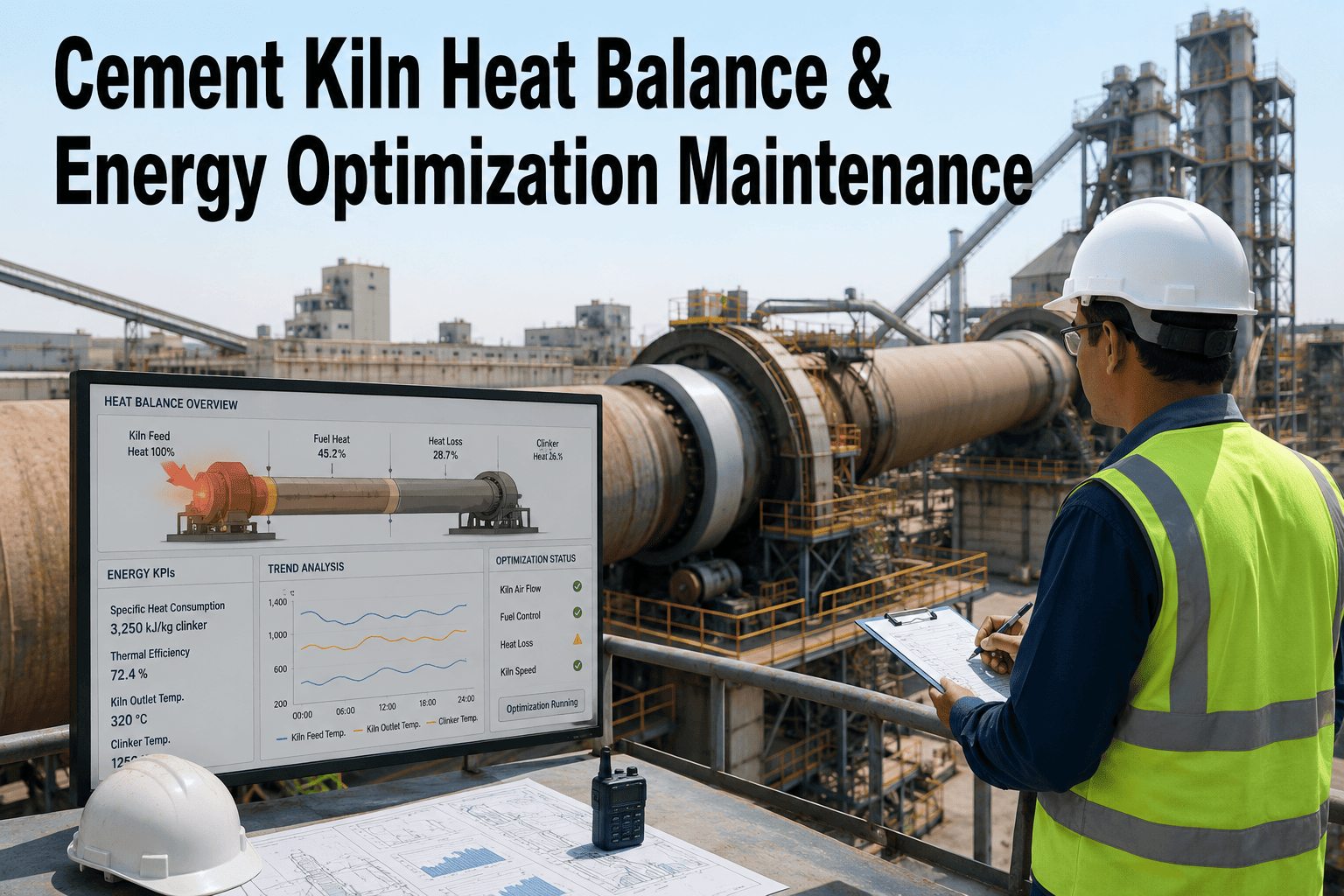
Cement Kiln Energy Optimization: Reducing Fuel Consumption
By Alice Walker on February 27, 2026
Fuel accounts for 30–40% of total cement production cost—and the kiln consumes over 90% of that fuel. For a plant producing 1.5 million tonnes of clinker annually, even a 3% improvement in kiln thermal efficiency translates to $1.2–1.8 million in annual fuel savings. Yet most cement plants operate 10–15% above their theoretical minimum energy consumption, leaving millions of dollars burning in the kiln every year. The gap between current performance and best-in-class isn't a mystery—it's a maintenance and optimization problem. This guide covers every lever available to cement plant teams for reducing kiln fuel consumption, from quick operational wins to long-term capital investments, with practical benchmarks for measuring progress.
3,000–3,400
MJ/t clinker
Industry Average SEC
2,800
MJ/t clinker
Best-in-Class Target
30–40%
of production cost
Fuel Share of Total Cost
$1.5M+
annual savings
From 5% Efficiency Gain
Energy optimization isn't a one-time project—it's a continuous discipline that requires consistent monitoring, data-driven decisions, and maintenance excellence. Start your free OXmaint trial to track kiln energy KPIs and link efficiency data directly to your maintenance workflows.
Where Does Kiln Energy Go? The Heat Balance
Before optimizing, you need to know where the energy is being lost. A typical cement kiln heat balance reveals that only about 50% of input energy goes into the clinker formation reaction. The rest is distributed across exhaust gases, shell radiation, and other losses—each representing an optimization opportunity.
Typical Kiln System Heat Balance — Where Every MJ Goes
~50%
Useful Heat (Clinker Formation)
Productive
~22%
Preheater Exhaust Gas
Recoverable
~10%
Cooler Exhaust Air
Recoverable
~8%
Kiln Shell Radiation
Reducible
~5%
Raw Material Moisture Evaporation
Reducible
~5%
Dust Loss, Incomplete Combustion, Other
Reducible
Key takeaway: Up to 32% of kiln input energy is in recoverable or reducible loss streams. Even capturing a fraction of this represents hundreds of thousands of dollars in annual fuel savings.
7 Optimization Levers to Reduce Kiln Fuel Consumption
Each lever below is ranked by implementation complexity and typical savings potential. Start with the quick wins (Levers 1–3) that require minimal capital, then progress to the higher-investment strategies.
01
3–8%
Fuel Savings
LOW EFFORT
Combustion Optimization
Incomplete combustion wastes fuel directly. Optimizing excess air, flame shape, and fuel fineness are the fastest paths to savings with minimal capital investment.
Excess oxygen control: Maintain O₂ at kiln inlet at 1.5–2.5%. Every 1% excess O₂ above optimal wastes ~0.5% fuel heating unnecessary air.
Coal fineness: Target <10% residue on 90μm sieve. Coarse coal particles leave the burning zone before complete combustion, wasting 2–5% of fuel energy.
Flame shape optimization: Short, intense flame improves heat transfer to clinker. Long, lazy flames heat refractory instead of material.
CO monitoring: CO >0.1% at kiln inlet indicates incomplete combustion. Real-time gas analysis enables immediate burner adjustment.
02
2–5%
Fuel Savings
LOW EFFORT
Preheater Efficiency Improvement
The preheater tower does 40–60% of the calcination work. Even small efficiency losses here require the kiln to compensate with additional fuel.
False air reduction: Seal all cyclone stage doors, expansion joints, and meal pipes. Every 1% false air increases exhaust heat loss by ~3 kcal/kg clinker.
Cyclone efficiency: Maintain separation efficiency >92% at each stage. Check dip tubes and splash plates during every shutdown.
Meal distribution: Ensure uniform feed across riser ducts. Uneven distribution causes gas channeling and poor heat exchange.
Buildup prevention: Alkali/sulfur buildups reduce effective heat transfer area. Regular air cannon maintenance keeps cyclones clean.
03
2–6%
Fuel Savings
LOW EFFORT
Clinker Cooler Optimization
The cooler recovers 70–75% of clinker sensible heat and returns it to the kiln as secondary and tertiary air. Poor cooler performance is one of the most overlooked energy drains.
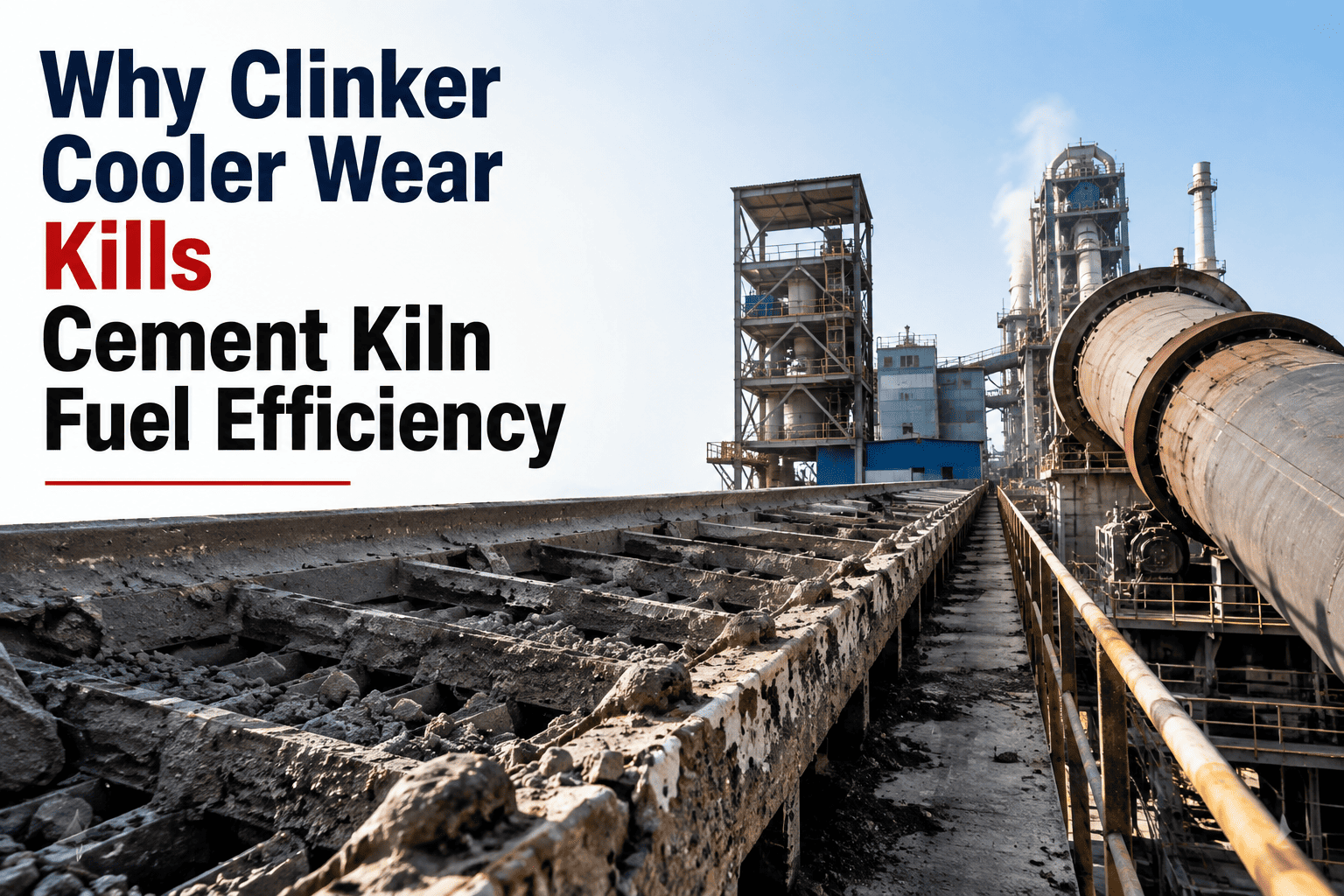
Grate plate maintenance: Worn or missing plates cause uneven air distribution and poor heat recovery. Replace at <80% coverage.
Air flow optimization: Maximize secondary air temperature (>900°C target). Every 50°C drop in secondary air temp costs ~5 kcal/kg clinker.
Clinker bed depth: Maintain uniform bed depth across cooler width. Red rivers indicate poor air distribution and wasted cooling capacity.
04
5–15%
Fuel Savings
MEDIUM EFFORT
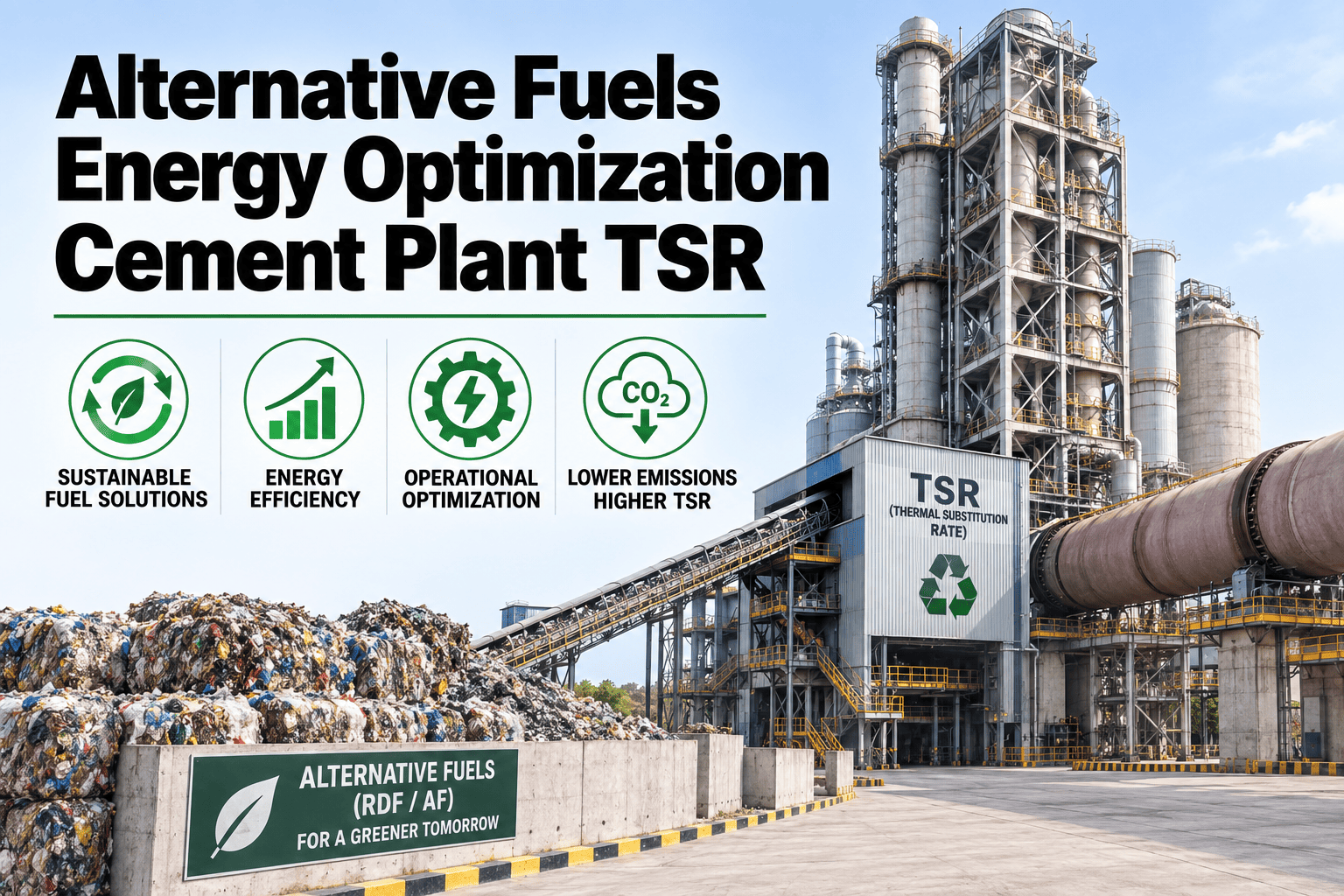
Alternative Fuel Substitution
Replacing coal/petcoke with alternative fuels (AF) reduces fossil fuel cost while often maintaining—or improving—kiln thermal efficiency. Leading plants achieve 50–80% thermal substitution rates.
Tire-derived fuel (TDF): Calorific value 30–35 MJ/kg. High substitution rates possible through kiln inlet or main burner. Requires feed system investment.
Refuse-derived fuel (RDF): 12–18 MJ/kg. Variable quality requires robust quality control and storage. Best introduced at calciner.
Biomass (rice husk, sawdust): 14–17 MJ/kg. Carbon-neutral fuel that reduces CO₂ emissions. Moisture control critical for efficiency.
Waste oils and solvents: 25–40 MJ/kg. High calorific value but requires storage, handling, and environmental permits.
05
2–4%
Fuel Savings
MEDIUM EFFORT
Raw Mix & Burnability Optimization
The raw mix directly determines how much energy the kiln needs. Harder-to-burn mixes demand higher temperatures and longer retention—both of which consume more fuel.
Lime saturation factor (LSF): Reducing LSF by 1 point saves ~5–8 kcal/kg clinker without affecting cement quality if compensated with blending.
Raw meal fineness: Coarser particles require more energy to calcine. Target <12% residue on 90μm for optimal burnability.
Mineralizers: Adding fluorite (CaF₂) or zinc compounds can lower sintering temperature by 50–100°C, directly reducing fuel demand.
06
3–7%
Fuel Savings
HIGH EFFORT
Waste Heat Recovery (WHR)
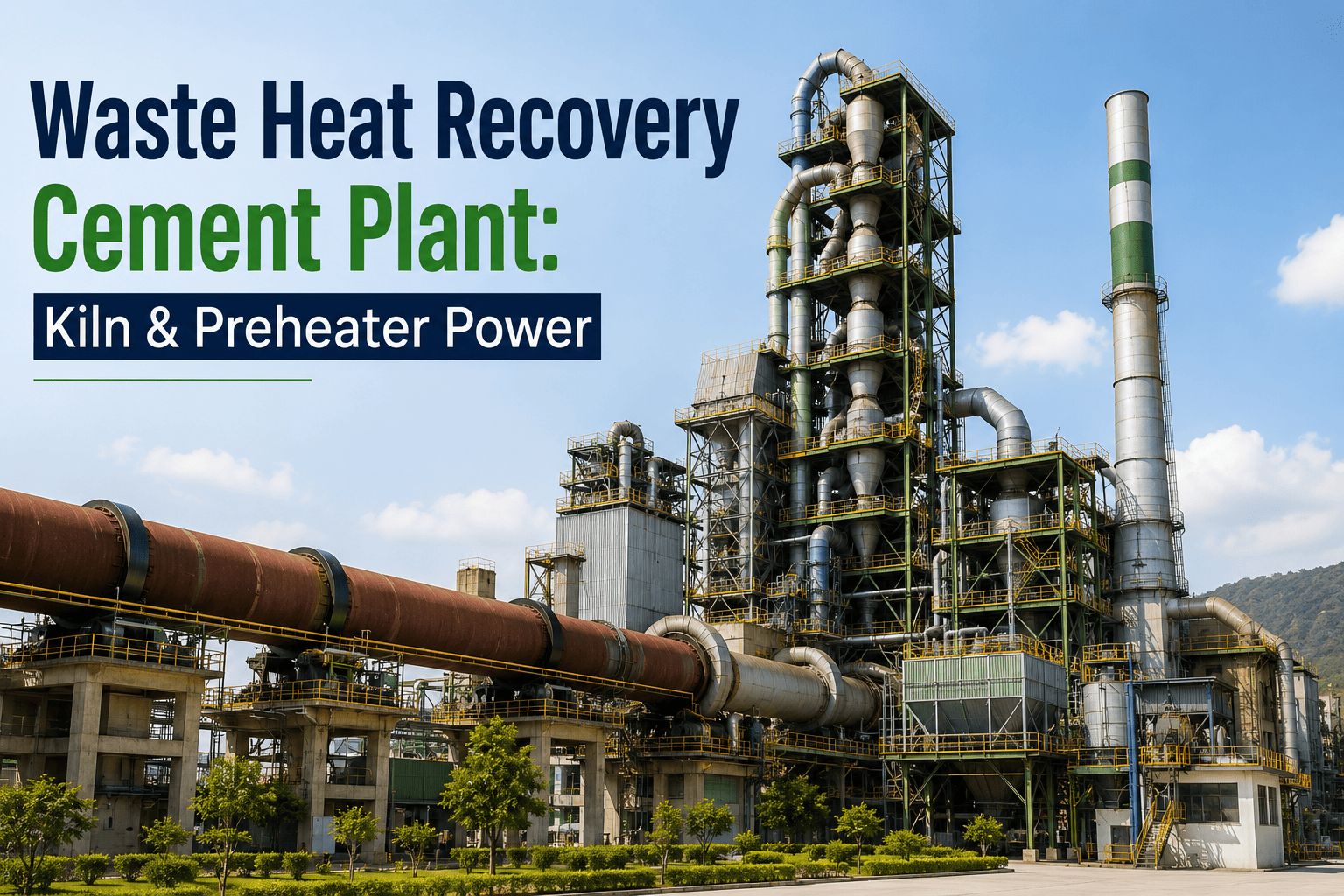
Preheater exhaust and cooler exhaust carry ~32% of input energy at temperatures ideal for power generation. WHR systems convert this waste heat into 25–35% of plant electrical demand.
Organic Rankine Cycle (ORC): Best for smaller plants. 1–3 MW capacity. Lower temperature threshold. ROI typically 3–5 years.
Steam Rankine Cycle: For larger plants. 5–15 MW capacity. Requires higher gas temperatures. ROI 4–6 years with fuel cost savings.
Preheater bypass heat capture: If a bypass system exists, recovering bypass gas heat can add 0.5–1.5 MW of additional generation capacity.
07
4–10%
Fuel Savings
HIGH EFFORT
AI-Based Kiln Control & Digital Optimization
Advanced process control (APC) and AI-driven optimization continuously adjust dozens of kiln parameters faster than any human operator, maintaining the kiln at its efficiency sweet spot 24/7.
Model predictive control (MPC): Anticipates process changes and adjusts fuel, feed, and draft proactively rather than reactively.
AI combustion optimization: Machine learning models optimize excess air and fuel rate based on real-time kiln conditions, reducing variability by 40–60%.
Digital twin integration: Simulates kiln behavior under different scenarios, enabling teams to test optimization strategies without risking production.
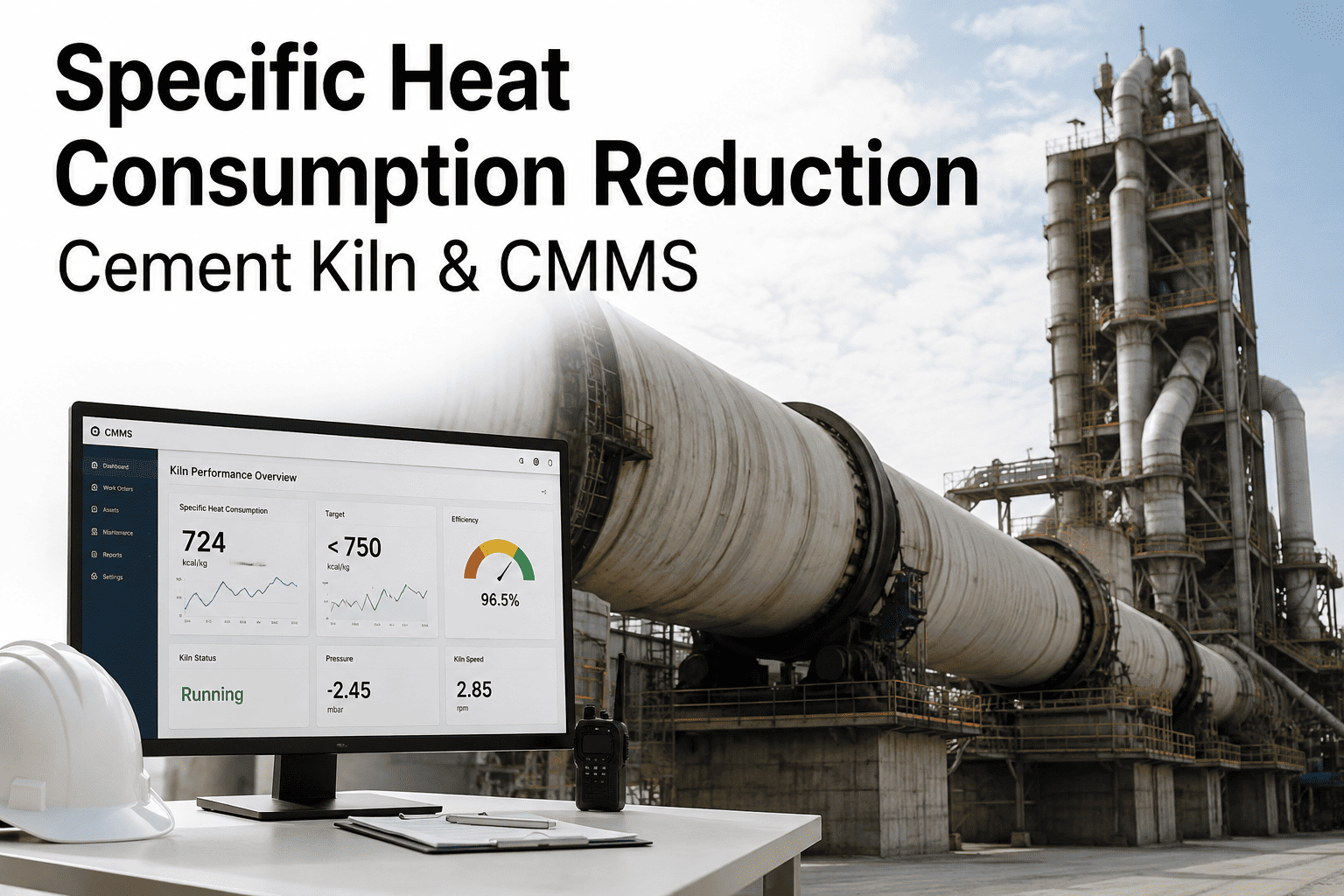
CMMS integration: Link equipment health data to energy performance. A degrading cooler or leaking preheater affects fuel consumption before it causes a breakdown.
Link Equipment Health to Energy Performance
Track kiln efficiency KPIs alongside maintenance work orders—catch efficiency drops before they become breakdowns
Use these benchmarks to assess your plant's thermal efficiency. The ranges account for different kiln technologies, raw material characteristics, and fuel types.
Specific Energy Consumption (SEC) Benchmarks — MJ per tonne clinker
World Class
2,800
Best Practice
3,000
Industry Average
3,200
Below Average
3,500
Needs Attention
3,800+
2,6003,0003,4003,8004,200
The Maintenance–Energy Connection: What Breakdowns Cost in Fuel
Equipment degradation silently increases fuel consumption long before it causes a breakdown. These are the maintenance issues that show up on the energy bill before they show up on a work order.
+15–25
kcal/kg clinker
Preheater Air Leaks
Worn expansion joints, unsealed doors, and cracked cyclone walls allow false air in-leakage. Each 1% increase in false air raises exhaust heat loss by ~3 kcal/kg. Plants typically accumulate 5–8% false air between shutdowns.
Maintenance fix: Inspect and replace expansion joint seals every shutdown. Install pressure monitoring to detect leaks between outages. Log false air % in CMMS and trend against fuel consumption.
+10–20
kcal/kg clinker
Worn Cooler Grate Plates
Damaged or missing grate plates allow clinker to fall through and create uneven air distribution. Secondary air temperature drops by 30–80°C, forcing the burner to compensate with additional fuel.
Maintenance fix: Track grate plate coverage % and replace when below 85%. Use thermal imaging to identify dead zones in cooler. Schedule plate replacement during every major shutdown.
+8–15
kcal/kg clinker
Refractory Deterioration
Thinner refractory = higher shell radiation losses. A 50% reduction in lining thickness can increase shell heat loss by 30–40% in that zone, bleeding energy that should stay in the clinker.
Maintenance fix: Correlate shell scanner data with fuel consumption trends. When shell temperatures rise >30°C above baseline, quantify the energy impact and factor it into reline timing decisions.
+5–12
kcal/kg clinker
Burner Tip Wear / Misalignment
Worn or damaged burner tips distort flame shape, lengthening the flame and reducing heat transfer efficiency. The kiln compensates by burning more fuel to achieve target clinker quality.
Maintenance fix: Inspect burner tips every shutdown. Replace annually at minimum. Track fuel consumption changes after burner maintenance—a well-maintained burner swap typically saves 5–8 kcal/kg immediately.
+10–30
kcal/kg clinker
Kiln Stops & Cold Startups
Every kiln stop/restart cycle wastes 50–150 tonnes of fuel in the heat-up process alone. Frequent unplanned stops can add 10–30 kcal/kg to the annualized SEC—invisible in daily data but devastating over a year.
Maintenance fix: Preventive maintenance to eliminate unplanned stops is the single highest-ROI energy investment. Track SEC impact of each kiln trip in CMMS to quantify the true cost of every breakdown.
The hidden cost: A typical cement plant accumulates 40–80 kcal/kg of excess fuel consumption from deferred maintenance alone—equivalent to $600,000–$1.2M in annual fuel waste that never appears on a single work order.
Connecting maintenance data to energy performance is where CMMS transforms from a work order tool into a profit driver. Sign up for free and start correlating equipment condition with kiln SEC today.
Quick-Win Savings Estimator
These are the most common opportunities with their typical savings range for a 5,000 TPD clinker plant using coal at $120/tonne.
Primary KPI. Track daily, weekly, and per-campaign. Break down by fuel type if using alternative fuels. Compare against your own baseline, not just industry averages.
Preheater Exit Temperature
Target: <330°C
Directly reflects preheater efficiency. Every 20°C above target represents ~10 kcal/kg wasted energy. Rising trend indicates cyclone fouling or false air ingress.
Secondary Air Temperature
Target: >900°C
Measures cooler heat recovery effectiveness. Below 850°C signals worn grate plates, improper air distribution, or excessive cooler speed.
Quality-energy balance indicator. High free lime means under-burning (save fuel but poor quality). Too low means over-burning (wasting fuel for no quality benefit).
Kiln Shell Heat Loss
Target: <250 kcal/kg
Calculate from shell scanner data. Rising heat loss indicates refractory deterioration—link to refractory tracking in CMMS for integrated lifecycle management.
Frequently Asked Questions
What is the ideal specific energy consumption for a cement kiln?
Best-in-class cement kilns with modern 5–6 stage preheaters and precalciners achieve 2,800–3,000 MJ/t clinker. The global industry average ranges from 3,100–3,400 MJ/t. Plants above 3,500 MJ/t have significant optimization potential, typically from a combination of false air, cooler inefficiency, and combustion issues.
How much can alternative fuels reduce energy costs?
Alternative fuels can reduce fossil fuel costs by 15–50% depending on substitution rate and local AF availability. Leading European plants achieve 80%+ thermal substitution. The key economics depend on AF procurement cost versus fossil fuel cost, but most plants see positive ROI even at 15–20% substitution rates when handling/storage costs are factored in.
What is the ROI on waste heat recovery for a cement plant?
WHR systems for cement plants typically cost $15–25 million for 5–10 MW capacity and achieve payback in 4–6 years at current electricity prices. A 5,000 TPD plant can generate 7–12 MW of electricity, covering 25–35% of plant electrical demand and saving $3–5 million annually in grid electricity costs.
How does maintenance affect kiln energy efficiency?
Deferred maintenance typically adds 40–80 kcal/kg to specific energy consumption through accumulated false air leaks, worn cooler components, degraded refractory, and burner wear. For a 5,000 TPD plant, this translates to $600K–$1.2M in annual excess fuel cost—often more than the maintenance spend required to fix the underlying issues.
Can AI really improve kiln energy efficiency?
Yes. AI-based advanced process control (APC) systems consistently deliver 3–7% fuel savings by continuously optimizing fuel rate, excess air, and kiln speed based on real-time conditions. The key advantage over manual control is consistency—AI maintains optimal settings 24/7 while human operators naturally introduce variability across shifts and fatigue cycles.
How does a CMMS help with energy optimization?
A CMMS connects the dots between equipment condition and energy performance by tracking maintenance events alongside energy KPIs. When a preheater seal replacement coincides with a 5 kcal/kg SEC drop, the CMMS captures that correlation—turning anecdotal knowledge into repeatable, data-backed maintenance decisions that drive continuous energy improvement.
Ready to Cut Your Kiln Fuel Bill?
Get started in under 10 minutes. Free forever for small teams.