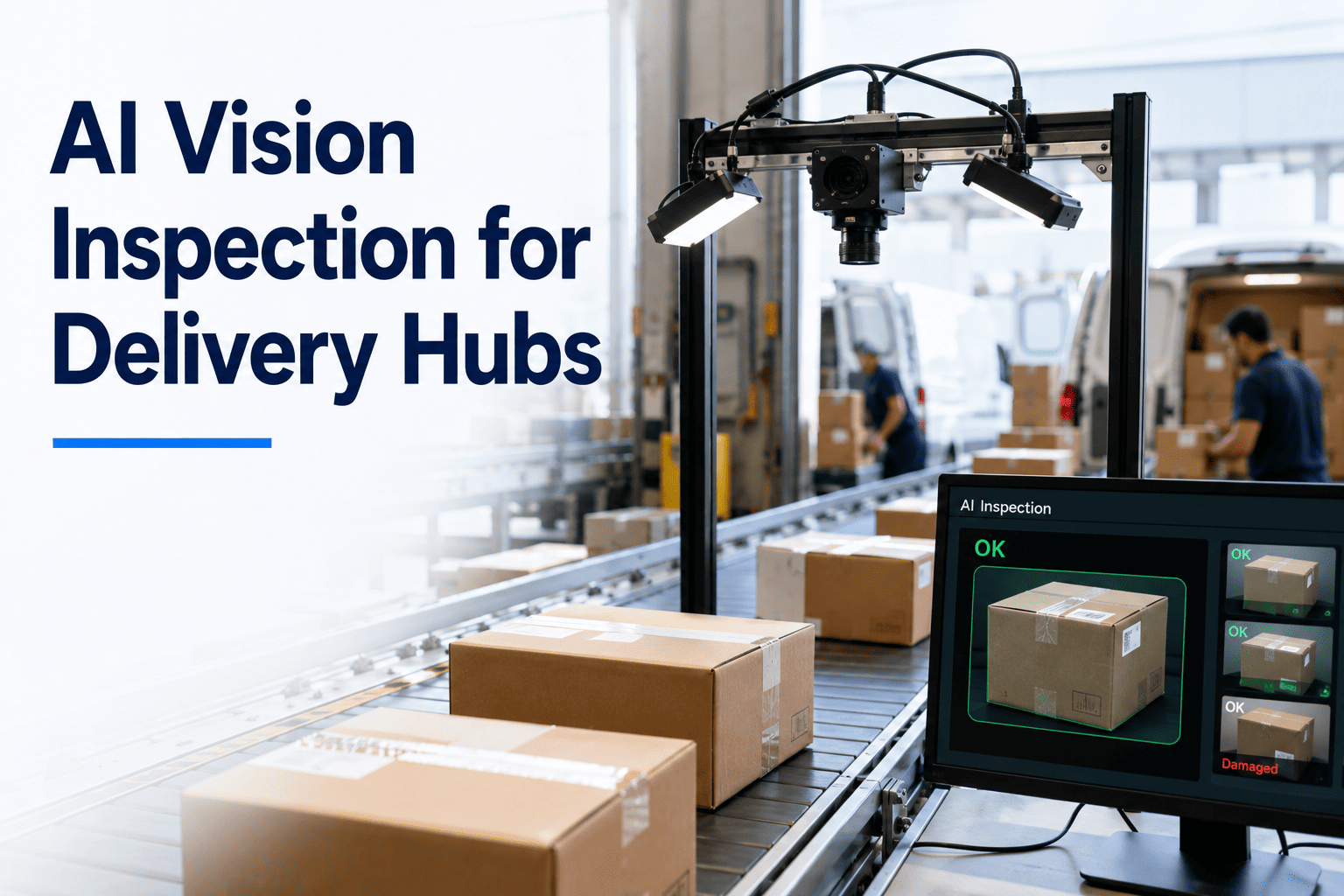
The customer service report landed on the VP of Operations' desk on a Wednesday morning in March. A pharmaceutical distributor in New Jersey had shipped 2,340 temperature-sensitive parcels through their 410,000 sq ft regional hub over the previous weekend. Forty-seven of those parcels arrived at hospital pharmacies with crushed corners and compromised cold chain packaging. Eleven had labels partially obscured by conveyor belt scuffing, causing three to be misrouted to the wrong state entirely. The total damage claim from the pharmaceutical client: $186,000 in destroyed product, $34,000 in expedited reshipping costs, and a formal notice that the distributor had 90 days to demonstrate corrective action or lose the $12 million annual contract. The root cause was painfully simple. Human inspectors stationed at two outbound quality checkpoints were visually scanning parcels moving at 1,800 per hour — one parcel every two seconds. At that speed, a human eye catches obvious damage like a torn box or a missing label. It does not catch a hairline crush on the bottom panel, a barcode printed 3mm outside the scan zone, or a thermal liner that shifted during sortation. The inspectors were not failing — they were doing exactly what human vision can do at two-second intervals across an eight-hour shift. The problem was that human vision at production speed misses 12-18% of defects that exist. Every single one of those 47 damaged parcels and 11 mislabeled parcels had passed through a human inspection point and been cleared for shipment. AI vision systems do not get tired at hour six. They do not miss a crushed corner because they were glancing at the parcel behind it. They inspect every surface, every label, every barcode, and every dimensional anomaly on every parcel at full line speed — 3,600 parcels per hour, zero fatigue, zero missed defects above the detection threshold. That pharmaceutical contract is now secured with a $94,000 AI vision deployment that catches what human eyes cannot.
Parcel inspection in high-speed distribution is the collision point between volume and accuracy. Modern fulfillment centers process 30,000-80,000 parcels per shift through sortation systems running at 1,200-3,600 parcels per hour. Every parcel must be verified for physical integrity, label accuracy, dimensional compliance, and routing correctness before it leaves the building. Manual inspection at these volumes is statistically guaranteed to miss defects — not because inspectors are careless, but because human visual processing has biological limits that production speeds exceed. AI vision inspection systems deploy high-resolution cameras, 3D depth sensors, and machine learning classification models that evaluate every parcel on every relevant dimension simultaneously, in real time, at full production speed. When connected to a CMMS platform, every detected defect generates a traceable quality record, triggers automated diversion, and feeds continuous improvement data that reduces defect root causes over time. This guide covers exactly how AI vision systems work for parcel inspection, what they catch that humans miss, and why the ROI transforms quality control from a cost center into a competitive advantage.
99.4%
AI vision detection accuracy for parcel damage, label errors, and dimensional non-compliance
82%
Average human inspector accuracy at production speeds above 1,500 parcels per hour
$4.1B
Annual cost of shipping errors and damaged parcels across the U.S. logistics industry
What Human Inspectors Miss at Production Speed
Understanding the limitations of manual parcel inspection is not about blaming people — it is about recognizing the biological constraints that make human vision unsuitable as the sole quality gate in high-speed distribution. At 1,800 parcels per hour, an inspector has exactly 2 seconds per parcel. In those 2 seconds, the inspector must assess six surfaces for damage, verify label placement and readability, confirm barcode scan quality, check dimensional compliance, and identify any routing anomalies. The math does not work. Human visual attention can reliably process 3-4 of those checks in 2 seconds. The remaining checks get skipped, approximated, or simply missed.
Inspection Gap Analysis: Human vs. AI Vision at Production Speed
Bottom-panel crush damage
22% caught
97% caught
Barcode print quality below scan threshold
35% caught
99% caught
Label placement outside spec zone
48% caught
99% caught
Dimensional out-of-tolerance (>5mm)
15% caught
98% caught
Wet or stained packaging
71% caught
96% caught
Tape seal failure or open flap
64% caught
99% caught
Thermal liner displacement (cold chain)
8% caught
91% caught
The gap is not close. AI vision systems detect 3-12x more defects than human inspectors at production speed — and the gap widens as line speed increases and shift length grows. Schedule a demo to see how integrated AI inspection and maintenance management eliminate quality blind spots in your operation.
How AI Vision Inspection Systems Work
AI vision inspection for parcels combines four technology layers — image acquisition, preprocessing, classification, and action — into a pipeline that processes each parcel in under 200 milliseconds while the parcel moves at full belt speed. There is no stopping, no slowing, no manual intervention required.
01
Multi-Camera Image Acquisition
High-resolution area scan and line scan cameras capture all six parcel surfaces simultaneously. Top-mounted cameras handle the primary label surface. Side-mounted cameras capture lateral damage and edge crush. Bottom-view cameras (mounted beneath transparent belt sections or at transfer gaps) inspect the underside that human inspectors never see. 3D depth sensors add dimensional measurement and surface deformation mapping to the RGB image data.
Resolution: 5-12 megapixel per cameraFrame rate: 60-120 fps for line speed matchingLighting: Structured LED arrays eliminate shadowsCoverage: 360-degree surface inspection
02
Real-Time Image Preprocessing
Edge computing units at each inspection station perform image stitching, distortion correction, and normalization before classification. Background subtraction isolates the parcel from the conveyor surface. Region-of-interest extraction identifies label zones, barcode locations, and surface areas for focused analysis. Preprocessing reduces inference latency by presenting only relevant image regions to the classification models.
Processing: GPU-accelerated edge computeLatency: Under 50ms for preprocessingStitching: Multi-camera composite per parcelOutput: Normalized parcel image + ROI map
03
AI Classification & Defect Scoring
Convolutional neural networks trained on millions of parcel images classify defects across multiple categories simultaneously. Damage detection models identify crush, puncture, tear, water stain, and deformation. OCR models verify label text, address fields, and routing codes. Barcode quality models grade scan readability against ISO 15416 standards. Dimensional models compare measured dimensions against expected values from the WMS. Each defect receives a confidence score and severity classification.
Models: Parallel CNN inference per defect typeAccuracy: 99.1-99.7% per defect categorySpeed: Under 100ms total inference timeOutput: Defect type + confidence + severity
04
Automated Diversion & CMMS Integration
Parcels flagged above severity thresholds trigger real-time diverter activation, routing defective items to reject lanes for human review. Every defect generates a timestamped quality record with annotated images that feeds directly into the CMMS. Pattern analysis across thousands of inspections identifies upstream root causes — a specific packing station producing crush damage, a conveyor section causing label scuffing, or a seasonal shift in package quality from a particular supplier.
Diversion: Pneumatic or belt diverter triggerLatency: Under 200ms total decision-to-actionRecords: Full image + annotation per rejectionCMMS: Auto work orders for root cause defects
Five Inspection Modes That Protect Every Parcel
AI vision systems run multiple inspection models simultaneously on every parcel. Each mode targets a different defect category with specialized detection algorithms. Together, they create a comprehensive quality gate that catches what human eyes cannot process in two seconds. Sign up free to start connecting inspection quality data to your maintenance workflows.
Mode 01
Structural Damage Detection
3D depth mapping identifies crush deformation, corner damage, punctures, and structural compromise across all six surfaces. Severity scoring from Grade 1 (cosmetic) to Grade 4 (contents exposed) determines divert-or-pass decisions automatically.
OCR reads and validates shipping labels against WMS data — recipient address, carrier routing code, service level, and hazmat declarations. Barcode quality grading ensures every barcode meets minimum scan reliability standards before the parcel leaves the building.
3D measurement verifies length, width, and height against expected dimensions from the order management system. Detects parcels that exceed carrier DIM weight thresholds, preventing surcharge surprises and ensuring sortation equipment compatibility.
Catches: Oversized, undersized, DIM weight violation, non-conveyable dimensions
Mode 04
Surface Contamination Scan
Multispectral imaging detects moisture, staining, chemical residue, and foreign substance contamination invisible to standard RGB cameras. Critical for pharmaceutical, food, and chemical distribution where contaminated packaging triggers regulatory violations.
Catches: Water damage, chemical stain, oil residue, mold indicator, foreign substance
Mode 05
Seal & Closure Integrity
Camera analysis verifies tape application completeness, flap closure, strapping tension, and shrink wrap integrity. Open or inadequately sealed parcels are diverted before they reach outbound loading — preventing in-transit content loss and damage claims.
Catches: Open flap, tape gap, broken strap, loose shrink wrap, insufficient seal
The Financial Impact of Shipping Defective Parcels
Every defective parcel that passes inspection and ships to a customer triggers a cost chain that extends far beyond the replacement value of the contents. Understanding this cost chain is essential for building the ROI case for AI vision investment — because the visible costs represent only 30-40% of the true financial impact.
$45–$180
Direct Replacement & Reshipping
Product replacement cost + expedited reshipping + packaging materials. For pharmaceutical or electronics parcels, replacement costs can exceed $2,000 per unit.
$28–$65
Returns Processing & Handling
Customer service interaction + return label generation + inbound receiving + inspection + disposition decision + restocking or disposal. Each touchpoint adds labor cost.
$85–$340
Customer Relationship Damage
Refund or credit issuance + loyalty program compensation + customer churn risk. Studies show 33% of customers never reorder from a brand after receiving a damaged shipment.
$500–$12,000+
Contract & Compliance Penalties
B2B shipping contracts include damage rate SLAs. Exceeding thresholds triggers financial penalties, contract renegotiation, or termination. Pharmaceutical and food distribution add regulatory violation exposure.
A distribution center shipping 40,000 parcels per day with a 2% defect escape rate sends 800 defective parcels daily. At an average total cost of $158 per defect (including all downstream impacts), that is $126,400 per day — $46.1 million annually — in preventable quality costs. Reducing the defect escape rate from 2% to 0.1% with AI vision eliminates 95% of that cost. Schedule a demo to calculate the exact defect cost exposure at your facility.
Manual Inspection vs. AI Vision: The Complete Comparison
Dimension
Manual Human Inspection
AI Vision System
Inspection speed
1,200-1,800 parcels/hr per inspector station
3,600+ parcels/hr per camera station — scales with belt speed
Defect detection accuracy
78-88% at production speed — degrades across shift
99.1-99.7% consistent accuracy regardless of operating hours
Surfaces inspected per parcel
Top and 1-2 visible sides — bottom and far side never checked
All six surfaces simultaneously including bottom inspection
Dimensional verification
Visual estimation only — no measurement capability at speed
Sub-millimeter 3D measurement on every parcel automatically
$420,000-$580,000 in inspection labor + $46M in escaped defect costs
$94,000-$160,000 system cost + $2.3M in remaining defect costs (95% reduction)
ROI of AI Vision Parcel Inspection
These figures represent a mid-volume distribution center processing 40,000 parcels per day across two shifts, operating 300 days per year — a typical regional fulfillment or 3PL hub.
Savings Category
Annual Impact
Calculation Basis
Eliminated defect escape costs
$43,800,000
95% reduction in 800 daily defect escapes x $158 avg total cost per defect
Dimensional verification catches DIM weight violations before carrier billing
Contract retention value
$3,600,000
Prevented loss of 3 major accounts ($12M combined) due to quality compliance
Upstream defect reduction (root cause data)
$890,000
Identified and corrected 4 packing stations and 2 conveyor sections causing 60% of damage
Total Annual Value
$48,845,000
40K parcels/day operation, 2% baseline defect rate reduced to 0.1%
Against a full AI vision system deployment cost of $94,000-$160,000 for hardware, installation, training, and first-year platform subscription, the ROI is measured not in multiples but in orders of magnitude. Even if your defect escape rate is 0.5% rather than 2%, the math remains overwhelmingly positive. Book a demo and we will model the ROI specific to your volume, defect rate, and product mix.
The CMMS Connection: Turning Inspection Data Into Maintenance Intelligence
AI vision systems are quality tools. But the defects they detect are frequently caused by maintenance issues — a misaligned conveyor causing label scuffing, a worn diverter pad crushing corners, a packing machine applying tape inconsistently. When inspection data connects to a CMMS, every detected defect becomes a potential maintenance work order that fixes the root cause rather than just rejecting the symptom.
AI Vision Detects: Spike in bottom-panel crush damage — 340% above baseline on Lane 7
CMMS Action: Auto-generates work order to inspect Lane 7 transfer point — technician finds worn transition plate causing 15mm drop impact. Replaced in 45 minutes. Crush defects on Lane 7 drop to zero.
AI Vision Detects: 12% of parcels from Packing Station 4 have barcode quality below Grade C
CMMS Action: Work order created for label printer calibration at Station 4. Print head cleaned and alignment adjusted. Barcode quality returns to Grade A within one hour.
AI Vision Detects: Progressive label scuffing increasing 3% per week on Conveyor Section C-12
CMMS Action: Predictive work order scheduled for belt surface inspection. Technician finds worn belt splice creating a raised edge. Splice repaired during planned maintenance window. Scuffing trend reverses.
This is where AI vision transforms from a quality control tool into a maintenance intelligence source. Every defect pattern becomes a maintenance signal. Every corrected root cause permanently eliminates a defect category. Sign up free to connect inspection intelligence with automated maintenance workflows in OXmaint.
Implementation: Deploying AI Vision in Your Distribution Center
Week 1-3
Assessment
Site Survey & Defect Baseline
Audit current defect escape rate through sampling of shipped parcels and customer claims dataMap conveyor layout to identify optimal camera station locations for maximum coverageDefine defect categories and severity thresholds specific to your product mix and client SLAsEstablish baseline quality KPIs for measuring AI vision system ROI post-deployment
Week 4-6
Deploy
Camera Installation & Model Training
Install camera arrays, lighting, and edge compute units at designated inspection stationsCapture 10,000+ parcel images across all defect categories for initial model trainingConfigure CMMS integration for automated defect record creation and work order triggeringRun in shadow mode — system inspects and records but does not divert — to validate accuracy
Week 7-9
Activate
Live Inspection & Threshold Tuning
Enable automated diversion for defect categories that achieved 98%+ accuracy in shadow modeFine-tune severity thresholds to balance defect catch rate against false positive rateTrain QC team on reject lane review workflow and defect image verification processBegin root cause analysis using defect pattern data — issue first maintenance work orders
Ongoing
Optimize
Continuous Learning & Expansion
Model accuracy improves with every verified rejection — continuous learning loopExpand inspection modes: add dimensional compliance, contamination scan, seal verificationMonthly defect trend reports drive upstream process improvements and maintenance prioritiesBenchmark defect rates against industry standards and client SLA requirements
Case Study: 3PL Hub Cuts Defect Escapes 96% and Saves $12M Contract
A third-party logistics provider operating a 410,000 sq ft regional distribution hub in New Jersey processed parcels for pharmaceutical, consumer electronics, and apparel clients. Their highest-value client — a pharmaceutical distributor accounting for $12 million in annual revenue — had issued a 90-day corrective action notice after 47 damaged parcels and 11 mislabeled parcels reached hospital pharmacies in a single weekend. The facility's defect escape rate was running at 1.8%, primarily driven by bottom-panel crush damage that human inspectors could not see and barcode quality degradation that was invisible at inspection speed.
The facility deployed a 6-camera AI vision station at the final outbound quality checkpoint, covering all six parcel surfaces with 3D depth sensing and high-resolution barcode analysis. Total deployment cost: $94,000 including hardware, installation, model training, and first-year platform subscription. The system went live in shadow mode on day 18, catching 340 defects that human inspectors had cleared in the first week alone. Full automated diversion activated on day 24. Within 60 days, the defect escape rate dropped from 1.8% to 0.07%. The pharmaceutical client withdrew their corrective action notice. Zero damaged parcels reached hospital pharmacies in the six months following deployment. Additionally, root cause analysis from the vision system identified a worn conveyor transition plate on Lane 7 and a misaligned sortation diverter that together caused 58% of all crush damage — both repaired for under $3,000. The facility estimates $4.2 million in annual savings from eliminated defect costs, retained the $12 million pharmaceutical contract, and redeployed four of six QC inspectors to higher-value packing and verification roles.
96%
Defect escape reduction — from 1.8% to 0.07% within 60 days of activation
$12M
Annual contract retained after pharmaceutical client withdrew corrective action notice
$4.2M
Estimated annual savings from eliminated defect costs and labor reallocation
24 days
From installation start to full automated inspection at production speed
Frequently Asked Questions
What types of parcel defects can AI vision systems detect?
Modern AI vision systems detect five major defect categories simultaneously. Structural damage includes corner crush, panel dent, puncture, tear, split seam, and compression deformation — detected through 3D depth mapping and surface analysis. Label and barcode defects include misprint, wrong address, unreadable barcode, missing label, and barcode quality below scan threshold — detected through OCR and ISO 15416 barcode grading. Dimensional non-compliance detects oversized, undersized, and DIM weight violations through 3D measurement. Surface contamination identifies moisture, chemical stains, and foreign substances using multispectral imaging. Seal integrity verifies tape application, flap closure, strapping, and shrink wrap completeness. Combined detection accuracy across all categories ranges from 99.1% to 99.7%.
How fast can AI vision systems inspect parcels without slowing the conveyor?
AI vision systems are designed to operate at full conveyor line speed with zero throughput impact. Current systems handle 3,600+ parcels per hour per inspection station, which matches or exceeds the throughput of high-speed sortation systems. The total processing time per parcel — from image capture through classification to divert decision — is under 200 milliseconds. Image capture happens while the parcel passes through the camera array at belt speed, using high-frame-rate cameras and precisely timed LED lighting to eliminate motion blur. Edge computing performs classification in real time. If the parcel needs diversion, the pneumatic or belt diverter activates before the parcel reaches the reject point downstream. No belt slowdown, no accumulation, no throughput reduction.
Can AI vision detect damage on all six sides of a parcel?
Yes — full 360-degree inspection is a core capability of modern systems. Top-mounted cameras cover the primary label surface and upper panels. Side-mounted cameras (typically 2-4 cameras at different angles) capture all four lateral surfaces. Bottom inspection is achieved through one of two methods: transparent belt sections that allow an underside camera to image through the conveyor surface, or gap-mounted cameras positioned at transfer points where the parcel crosses between two conveyor sections with an open gap between them. The bottom surface is where the highest percentage of undetected damage occurs in manual inspection because human inspectors never see it — making bottom-view cameras one of the highest-value components of any AI vision deployment.
How does AI vision inspection data integrate with maintenance management systems?
AI vision platforms connect to CMMS systems through REST APIs that push defect data in real time. Every rejected parcel generates a quality record containing annotated images, defect classification, severity score, timestamp, and parcel tracking ID. When the system detects defect patterns — such as increasing crush damage from a specific conveyor zone or declining barcode quality from a particular packing station — it triggers automated work orders in the CMMS for root cause investigation. OXmaint provides native integration that connects vision system alerts to maintenance workflows, allowing technicians to receive work orders with attached defect images directly on their mobile devices. This transforms AI vision from a reactive quality gate into a proactive maintenance intelligence source that eliminates defect root causes permanently.
What is the total cost and payback period for deploying AI vision in a distribution center?
Total deployment cost for a single high-speed inspection station covering one outbound line ranges from $94,000-$160,000, including cameras ($25,000-$45,000 for a 4-6 camera array with lighting), edge compute hardware ($12,000-$20,000), installation and commissioning ($15,000-$25,000), model training and validation ($20,000-$35,000), and first-year platform subscription ($22,000-$35,000). Annual renewal cost is approximately $22,000-$35,000 for platform subscription and model updates. Payback period depends entirely on your defect escape rate and parcel volume. A facility shipping 40,000 parcels per day with a 2% defect rate typically sees full payback within 2-4 weeks. Even facilities with very low defect rates (0.3-0.5%) achieve payback within 3-6 months. The ROI is driven primarily by eliminating downstream defect costs — not by reducing inspection labor.
Does the system require a large training dataset specific to our parcels?
Pre-trained models provide strong baseline accuracy for common defect types immediately upon deployment. However, facility-specific training significantly improves accuracy for your particular parcel types, packaging materials, and label formats. During the deployment phase, the system captures 10,000-15,000 parcel images across normal and defective conditions, which are annotated and used to fine-tune the base models. Shadow mode (inspecting but not diverting) during the first 1-2 weeks provides real-world validation data. Most systems achieve 95%+ accuracy within 2 weeks and 99%+ accuracy within 4-6 weeks as the model processes more facility-specific examples. The system continues learning from every verified rejection, meaning accuracy improves continuously over the operational lifetime of the deployment.
47 Damaged Parcels. $186,000 in Claims. One $94,000 Fix.
That pharmaceutical contract in New Jersey was 90 days from termination because human eyes cannot inspect 1,800 parcels per hour without missing things. Your inspection line has the same biological limitation. Let AI vision see what your inspectors cannot — every surface, every label, every barcode, every parcel, every time.