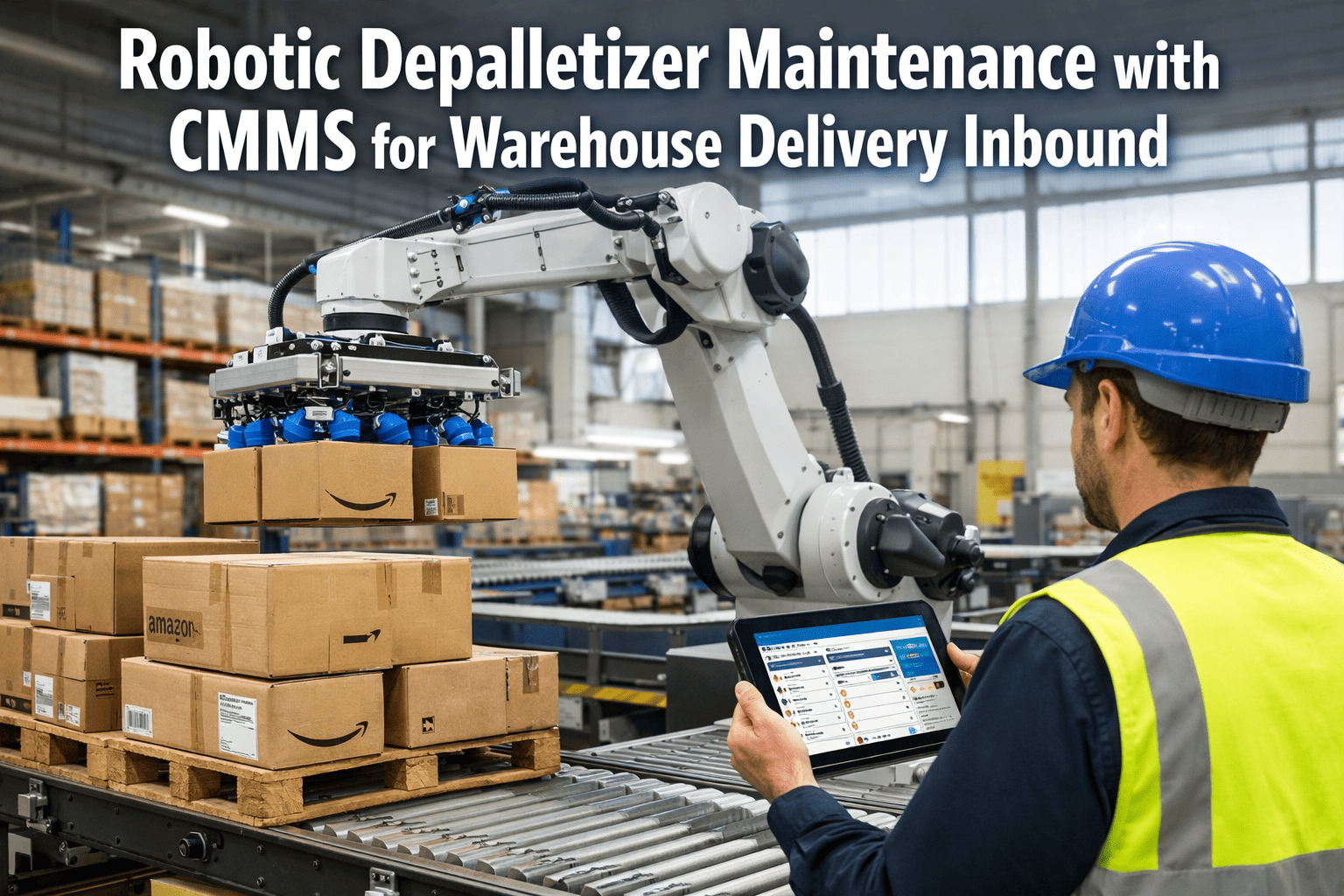
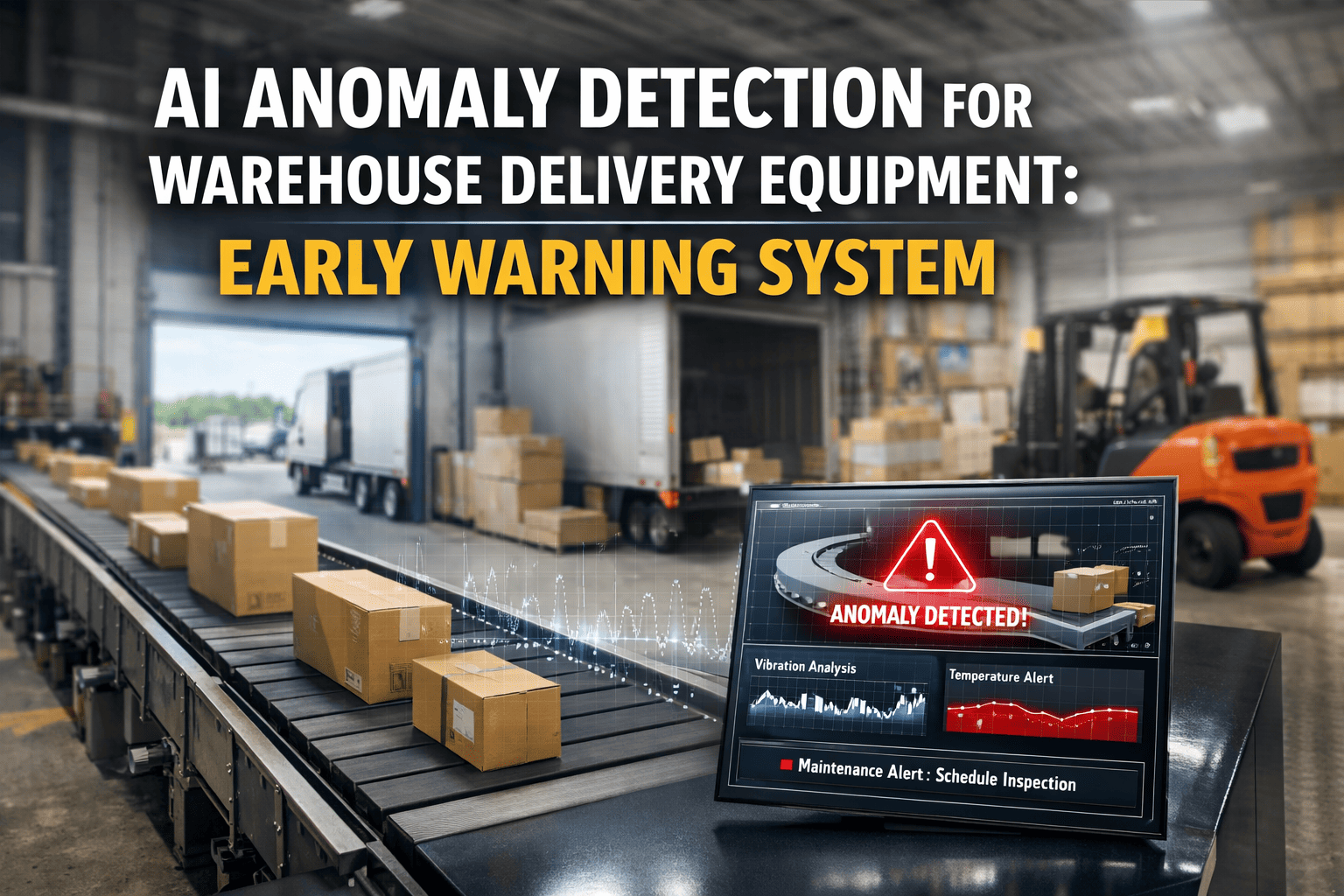
The robotic palletizer on Line 3 at a frozen food plant in Memphis dropped a 40-pound case of chicken tenders at 2:14 AM on a Friday. Then it dropped three more. The upstream conveyor backed into the case packer within four minutes and the entire line went down. The root cause was two cracked vacuum suction cups — visible damage that a 90-second daily inspection would have caught weeks earlier. Nobody inspected the grippers on a schedule. Nobody tracked suction pressure trends. That single unplanned stop cost $34,200 in lost throughput, $2,800 in damaged product, and an emergency callout at triple overtime. The replacement suction cups cost $47. The palletizer that runs flawlessly is never the one built by the best manufacturer — it is the one maintained by the best maintenance program. In 2026, that program runs through a CMMS.
Automated palletizers are the final critical link in every packaging line. Whether robotic arm, gantry, or layer-forming, these machines handle thousands of cycles per shift with grippers, sensors, servo drives, and safety systems working in precise coordination. The global palletizer market is projected to exceed $2.6 billion by 2035, yet most maintenance programs remain fully reactive — waiting for the gripper to fail or the sensor to drift before anyone opens a work order. This guide covers the maintenance domains that matter most, the optimization strategies that extend uptime, and how CMMS integration transforms palletizer care from emergency firefighting into precision asset management.
$860M
Global palletizer market value in 2025 — growing 6.3% CAGR
99%
Uptime achievable with structured preventive maintenance
$5K/hr
Average cost of unplanned palletizer downtime
The Six Subsystems That Keep a Palletizer Running
Every automated palletizer is built from six interdependent subsystems. Neglecting any single one eventually brings the entire machine down — a drifting sensor causes the gripper to misplace, which overloads the servo, which triggers a safety fault. Effective palletizer maintenance means maintaining all six in coordinated cycles.
01
End-of-Arm Tooling / Grippers
Vacuum cups, clamps, bag grippers — the highest-wear component. Gripper failure causes 35-40% of all unplanned stops.
02
Servo Drives and Motion Control
Motors, reducers, encoders that move the arm. Overheating and encoder drift cause positioning errors that cascade into dropped product.
03
Sensor Array and Vision Systems
Photoelectric, proximity, barcode, and camera systems. Calibration drift is gradual and invisible until stacking quality deteriorates.
04
Infeed Conveyors
Belt conveyors, diverters, timing controls. Synchronization failures cause jams and double-feeds that trigger full-line stoppages.
05
Safety Systems and Guarding
Light curtains, area scanners, e-stops. Nuisance trips from dirty lenses erode OEE just as effectively as mechanical failures.
06
Pallet Handling and Discharge
Dispensers, slip-sheet applicators, wrappers. Second most common downtime cause — the palletizer cannot build without a pallet.
When all six are maintained through coordinated CMMS schedules, the palletizer achieves 99%+ uptime. Schedule a demo to see how OXmaint tracks every subsystem with automated work orders.
Gripper Inspection Schedule by Type
If you maintain nothing else, maintain the gripper. It contacts product every single cycle — up to 12,000 times per shift. Gripper failures account for 35-40% of all unplanned palletizer stops across industries.
| Gripper Type | Daily (90 sec) | Weekly | Monthly | Failure if Missed |
|---|
| Vacuum Cups | Visual check for cracks and debris | Vacuum pressure test vs. baseline | Replace cups exceeding 500K cycles | Dropped product, layer instability |
| Mechanical Clamps | Check pad condition, full travel | Clamp force measurement vs. spec | Replace pads, lubricate pivots | Product crushing, pallet lean |
| Bag Grippers | Finger alignment, residue buildup | Gripping force test on sample bags | Replace wear strips, recalibrate | Bag tears, line stoppage |
| Fork/Shovel | Fork alignment, worn edges | Product release test — no sticking | Replace wear plates, check actuators | Product damage, incomplete layers |
Track every gripper inspection digitally. CMMS-driven inspections with photo documentation and pressure readings predict failures before they happen.
Sign Up Free
Reactive vs. Preventive vs. Predictive Maintenance
Most facilities operate somewhere between fully reactive and partially preventive. The cost difference is dramatic.
| Dimension | Reactive | Preventive | Predictive + CMMS |
|---|
| Typical OEE | 65-78% | 82-90% | 92-99% |
| Unplanned stops/month | 8-15 | 2-5 | 0-1 |
| Average repair time | 2-6 hours | 30-90 min | 15-30 min |
| Annual cost per palletizer | $45K-$85K | $18K-$30K | $12K-$22K |
| Product damage rate | 1.2-3.5% | 0.3-0.8% | Under 0.1% |
| Gripper replacement | After product drop | Time-based schedule | Condition-based on vacuum trend |
Moving from reactive to predictive requires a CMMS that automates work orders based on cycle counts, sensor readings, and condition thresholds. Sign up free to start building the preventive foundation your palletizers need.
ROI of Structured Palletizer Maintenance
Based on a facility operating three robotic palletizers across two shifts — a typical mid-size food, beverage, or consumer goods plant.
$142,000
Avoided Unplanned Downtime
6 major stops prevented per year
$54,000
Maintenance Cost Reduction
Reactive $72K to predictive $18K per unit
$38,000
Reduced Product Damage
Damage rate 1.8% down to 0.15%
$27,000
Changeover Time Savings
Recipe-based cuts 25 min per changeover
Total Estimated Annual Savings (3 Palletizers)
$296,000
Against $15K-$25K platform cost — first-year ROI exceeds 12x
Book a demo and we will model the ROI specific to your palletizer fleet.
Downtime Cost by Industry
Food and Beverage$4,800-$7,200/hr
Product spoilage from conveyor backup into temperature-controlled zones. Food safety violations if hold-time limits exceeded.
Pharmaceuticals$8,000-$15,000/hr
Batch documentation breaks requiring full review or rejection. GMP compliance deviations triggering CAPA investigations.
Consumer Goods / CPG$3,500-$6,000/hr
Missed shipment windows causing retailer chargebacks. Overtime labor costs to clear production backlog.
E-Commerce / 3PL$2,500-$5,000/hr
SLA violations with major marketplace clients. Cascading delays across multiple fulfillment queues.
Manual Management vs. CMMS-Driven Operations
Without CMMS
Gripper inspections skipped — nobody tracks completion
Fault codes on sticky notes, lost at shift change
Sensor calibration last done "sometime last year"
Same servo fault repeats monthly — nobody connects pattern
Spare cups out of stock at midnight — 4-hour wait
VS
With OXmaint CMMS
Daily gripper inspection auto-assigned, completion tracked
Every fault logged with timestamp, location, resolution
Calibration work orders auto-generated per interval
Failure pattern analysis flags recurring root causes
Spare parts auto-reorder at minimum stock level
Every item on the left is costing your facility money right now. Sign up free and start closing those gaps on your very first shift.
Case Study: 87% Downtime Reduction in 90 Days
A beverage distributor in Charlotte, NC operated four robotic palletizers averaging 11 unplanned stops per week. MTTR was 3.2 hours because root causes were never documented and failures repeated monthly. Annual unplanned downtime cost: $486,000.
They implemented a CMMS-driven maintenance program in a 90-day rollout. Gripper inspections became automated daily tasks. Vacuum pressure was trended weekly — three grippers replaced proactively before any product dropped. Every fault code was captured, creating failure pattern data for the first time.
11/week
1.4/week
Unplanned Stops
$486K
$63K
Annual Downtime Cost
Frequently Asked Questions
How often should palletizer grippers be replaced?
Vacuum suction cups typically last 300,000 to 600,000 cycles — roughly 3 to 6 months in a two-shift operation. Mechanical clamp pads last 6 to 12 months. The most effective approach is condition-based replacement driven by CMMS-tracked metrics. When vacuum pressure drops 10-15% below baseline, the system generates a replacement work order before any product is dropped.
What daily checks prevent most palletizer failures?
Six checks, 15 minutes total: visual gripper inspection, safety device verification, infeed conveyor tracking, sensor operation confirmation, HMI alarm review, and pallet dispenser function check. These address root causes of over 80% of palletizer failures.
How does CMMS integration improve palletizer uptime?
It automates work order generation based on cycle counts and condition triggers, captures every fault code for pattern analysis, trends vacuum pressure and servo current over months, and manages spare parts inventory. The combined effect is typically 60-85% reduction in unplanned downtime within 90 days.
Can one CMMS manage palletizers from different manufacturers?
Yes. Facilities commonly run FANUC, ABB, KUKA, and Universal Robots simultaneously. A manufacturer-agnostic CMMS registers each as an asset with specific PM templates, spare parts lists, and alarm mapping — creating portfolio-level visibility across mixed-vendor fleets.
What ROI can we expect from a palletizer maintenance program?
A three-palletizer facility typically sees $250,000 to $300,000 in annual savings against $15,000 to $25,000 in platform and program costs. First-year ROI exceeds 10x. The single highest-impact saving is avoiding even one emergency stop per quarter.
$47 Suction Cups or $34,200 Downtime. Your Palletizer Decides Every Shift.
Your palletizers are running right now with grippers wearing, sensors drifting, and servos heating. Let OXmaint put every subsystem on a maintenance schedule that prevents failures instead of reacting to them.