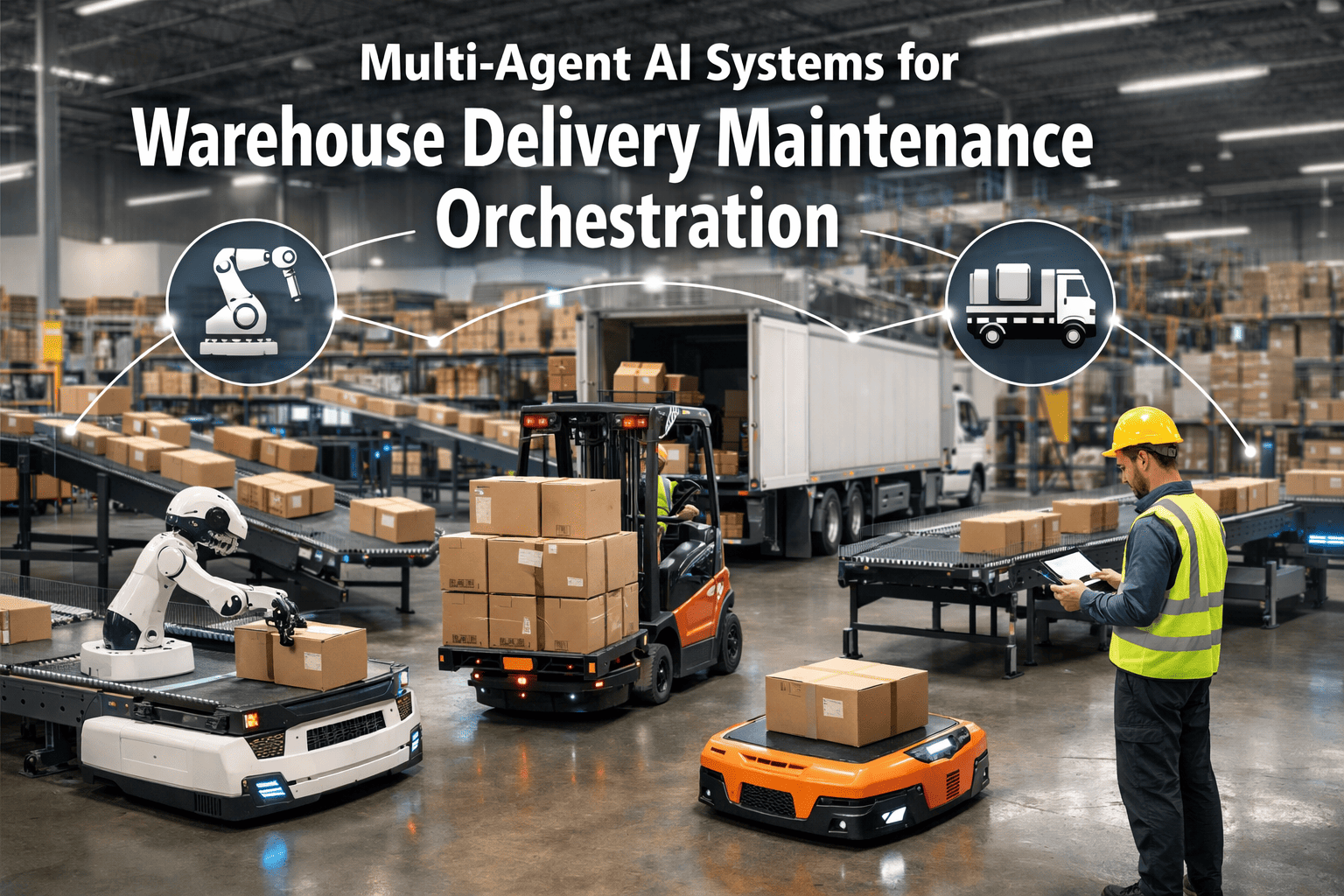
Inside a modern distribution center, a conveyor motor's vibration signature is drifting, a sortation robot is throttling its own speed due to a misaligned wheel, and a dock leveler is showing hydraulic pressure decay — three signals from three systems, none of them talking to each other. By the time a human supervisor connects the dots, a late truck has already cascaded into a missed delivery window. This is the blind spot multi-agent AI is built to close. Specialized AI agents — one watching conveyors, one watching robotics, one watching docks — communicate continuously through an orchestration layer that routes intelligence across the entire warehouse floor. Start your free multi-agent maintenance pilot on OxMaint or explore how orchestration transforms reactive maintenance with a 30-minute demo.
Agentic AI / Warehouse Operations
Multi-Agent AI Systems for Warehouse Delivery Maintenance Orchestration
Single AI models miss cross-system failure cascades. Multi-agent AI — where specialized agents for conveyors, robotics, and dock systems communicate continuously — creates a self-optimizing warehouse maintenance ecosystem that acts before disruption reaches the customer.
40%
Logistics delay reduction reported by early multi-agent adopters
42%
Of warehouse downtime traces back to equipment failure
40%
Of enterprise apps will embed task-specific AI agents by end of 2026
45%
Faster problem resolution with multi-agent vs single-agent AI
The Blind Spot
Why Single-Model AI Fails in Modern Warehouses
A conveyor is fine. A robot is fine. A dock system is fine. But when a conveyor slows 3%, a robot reroutes through a secondary aisle, and a dock door takes an extra 40 seconds to cycle — those three "fine" readings combine into a throughput collapse. Traditional AI monitors each system in isolation. Failure cascades hide in the gaps between models.
01
Conveyor Subsystem
Vibration sensor detects bearing wear early-stage. AI flags it for maintenance in 72 hours. The model sees a single component issue, not a network effect.
Individually: Low Risk
leads to
02
Robotics Subsystem
AMR throttles speed to avoid the degrading conveyor zone. Task completion time climbs. The robotics AI sees a routing adjustment, not a downstream crisis.
Individually: Normal
leads to
03
Dock Subsystem
Outbound truck waits as pallets arrive late. Dock leveler logs repeated cycles that strain hydraulics. The dock AI sees elevated usage, not a system-wide cascade.
Individually: Fine
leads to
04
Customer Impact
Delivery window missed. SLA penalty triggered. Customer trust eroded. No single AI saw the full picture — the cascade completed without interception.
Collectively: Critical
Multi-agent orchestration changes this by having each agent share its observations with the others — so conveyor wear, robot rerouting, and dock strain become one coordinated signal, not three disconnected ones.
Architecture
The Agent Ecosystem: Who Watches What
A multi-agent warehouse system is not one large AI — it is a coordinated team of specialized agents, each with a narrow scope and deep expertise. They communicate through an orchestration layer that enforces shared context, policy, and governance.
Agent 01
Conveyor Health Agent
Monitors vibration, motor current, belt tension, bearing temperature across all conveyor zones. Predicts mechanical failure 48–96 hours in advance.
Data inputsVibration, current, tension, temp
Reports toOrchestrator + Maintenance Agent
DecisionsFlag, throttle, emergency stop
Agent 02
Robotics Coordination Agent
Tracks AMR and AGV fleet health — battery cycles, wheel alignment, navigation drift, load balancing. Reroutes around degraded zones autonomously.
Data inputsBattery, odometry, task logs
Reports toOrchestrator + Workforce Agent
DecisionsReroute, rebalance, recall fleet
Agent 03
Dock & Door Systems Agent
Watches dock leveler hydraulics, door cycle counts, seal integrity, and trailer-to-dock alignment. Flags bottlenecks before they impact outbound schedules.
Data inputsHydraulic pressure, cycle logs
Reports toOrchestrator + Dispatch Agent
DecisionsReassign door, pre-schedule repair
Agent 04
Maintenance Workflow Agent
Receives predictions from equipment agents, generates structured work orders, assigns technicians by skill and availability, tracks closure and feeds outcomes back to learning models.
Data inputsAgent predictions, CMMS data
Reports toOrchestrator + CMMS system
DecisionsCreate WO, assign, escalate
Agent 05
Delivery Dispatch Agent
Synthesizes readiness signals from all equipment agents to dynamically re-sequence outbound loads, reassign carriers, and protect high-priority SLAs when disruption is detected upstream.
Data inputsAgent readiness, SLA data, TMS
Reports toOrchestrator + Supervisor
DecisionsRe-sequence, reassign, alert
Orchestrator
Central Coordination Layer
Routes messages between agents, enforces policy and compliance rules, maintains shared memory, resolves conflicts, and surfaces decisions requiring human oversight — the operating system of the fleet.
Data inputsAll agent outputs + policy layer
Reports toWarehouse supervisor + CMMS
DecisionsRoute, escalate, govern
For Warehouse Operations Leaders
Stop Chasing Symptoms. Start Orchestrating Prevention.
OxMaint coordinates equipment signals from across your warehouse — conveyors, robotics, docks, forklifts — into a single maintenance intelligence layer. The same CMMS that captures work orders now also captures cross-system context, so your team sees the cascade before it starts.
Comparison
Single-Model AI vs Multi-Agent Orchestration
The architectural choice is not cosmetic — it determines whether your warehouse sees failures in isolation or sees them as part of a connected system. Here is how the two approaches behave when stressed.
| Capability Dimension |
Single-Model AI |
Multi-Agent Orchestration |
| Failure cascade detection |
Sees components in isolation; misses cross-system effects |
Agents share context; cascade visible within seconds |
| Response to novel events |
Degrades when conditions drift from training data |
Specialized agents adapt within their domain; orchestrator reroutes |
| Scaling to new equipment |
Requires retraining the central model |
Add a new agent; orchestrator handles integration |
| Failure recovery |
Model outage halts all dependent processes |
Agent failure is isolated; others continue; human review flagged |
| Governance and audit |
Opaque — single model decisions are hard to trace |
Every agent action is logged and governed by the orchestrator |
| Cross-domain reasoning |
Context degradation as complexity grows |
Each agent reasons deeply within scope; orchestrator synthesizes |
| Continuous learning |
Single update cycle; slow improvement |
Agents share learnings; one improvement benefits the whole fleet |
Scroll horizontally on mobile to see all columns
In Motion
A Day in the Life of a Multi-Agent Warehouse
Walk through one real operational scenario: a Tuesday morning shift where a conveyor bearing is starting to fail. Here is how the agents coordinate the response before a single pallet is late.
06:42
Conveyor Health Agent
Detects vibration anomaly on Zone 4 main conveyor. Pattern matches bearing wear signature — 94% confidence, estimated failure window 72 hours.
06:42
Orchestrator
Broadcasts anomaly context to Robotics, Dock, and Maintenance agents. Tags Zone 4 as "degrading — plan around" for the next 6 hours.
06:43
Robotics Agent
Reroutes AMR fleet to use Zone 3 and Zone 5 for heavy-pallet tasks. Preserves Zone 4 for lightweight loads only, reducing bearing stress.
06:44
Maintenance Agent
Auto-generates work order in CMMS. Checks spare parts inventory — bearing in stock. Assigns to next available technician with conveyor certification.
06:45
Dispatch Agent
Reviews outbound schedule. Shifts two non-critical loads originally staged through Zone 4 to alternate staging lanes. Protects the 09:00 priority delivery.
08:15
Technician + Maintenance Agent
Scheduled repair completes during a 40-minute natural lull. Conveyor returns to full capacity. All agents receive "cleared" signal. No missed deliveries, no emergency overtime.
Impact Metrics
What Orchestration Delivers in Measured Terms
Multi-agent systems are not theoretical. Early enterprise adopters — from global logistics networks to distribution center operators — are reporting consistent gains across the metrics that matter most to operations leaders.
30–40%
Reduction in unplanned downtime
Predictive maintenance powered by coordinated agents catches equipment degradation days earlier than reactive models. Repairs happen during planned windows, not in the middle of peak throughput.
60%
More accurate outcomes
Multi-agent architectures consistently outperform single-model systems on complex cross-domain tasks — agents specialize, the orchestrator synthesizes, and blind spots close.
10x
ROI potential on predictive maintenance
Industry analysis shows predictive maintenance programs delivering up to 10x returns — with 95% of adopters reporting positive outcomes within the first twelve months of implementation.
25%
Maintenance cost reduction
When equipment is maintained before failure instead of after, emergency repair premiums disappear. Parts are ordered on schedule, not rushed overnight. Overtime budgets shrink.
72 hr
Failure prediction lead time
Best-in-class agentic AI systems predict equipment failures up to 72 hours in advance with 95% accuracy — enough lead time to source parts, schedule skilled technicians, and avoid disruption.
20%
Equipment lifespan extension
When degradation is caught early and addressed with proper components, assets last 20–40% longer. That directly impacts capital budgets and delays replacement cycles.
Implementation Path
How to Build Toward Multi-Agent Orchestration
No warehouse goes from reactive maintenance to full multi-agent orchestration overnight. The proven path is phased — each stage delivers standalone value while building the foundation for the next.
Phase 1
Centralize Data
Months 1–3
Connect equipment telemetry, CMMS, WMS, and work order history into a single platform. Without clean unified data, no AI agent — single or multi — can function. OxMaint's integration layer handles the common warehouse stack out of the box.
Outcome: Unified asset view, structured work order history, baseline KPIs established
Phase 2
Deploy First Agent
Months 3–6
Start with the highest-impact single agent — typically Conveyor Health or Robotics Coordination. Validate against historical failure data. Measure false-positive rates. Build trust with the maintenance team before expanding.
Outcome: One agent in production, documented prediction accuracy, team confidence
Phase 3
Add Orchestration
Months 6–9
Introduce the coordination layer and deploy the Maintenance Workflow Agent. Now equipment agents talk to the CMMS automatically. Work orders generate, assign, and close with structured context — no more spreadsheet limbo.
Outcome: Closed-loop equipment-to-workorder flow, audit-ready decision trail
Phase 4
Expand the Fleet
Months 9–18
Add Dock Systems Agent and Dispatch Agent. Cross-system cascades are now visible. The orchestrator starts making trade-off recommendations that span equipment, workforce, and delivery priority — the true multi-agent state.
Outcome: Full ecosystem live, measurable reduction in SLA misses and emergency repairs
Frequently Asked
Common Questions About Multi-Agent Maintenance AI
How is multi-agent AI different from traditional predictive maintenance?
Traditional predictive maintenance watches one asset class at a time. Multi-agent AI has specialized agents for each class, plus an orchestrator that sees how failures in one subsystem affect others.
See it in action with a free OxMaint trial.
Do we need to replace our existing CMMS to adopt this?
No. Multi-agent orchestration works alongside your CMMS — in fact, the Maintenance Workflow Agent generates structured work orders directly into your existing system, making the CMMS more useful, not obsolete.
What kind of data do agents need to function reliably?
Equipment telemetry (vibration, temperature, cycle counts), work order history, and real-time asset status. Most modern warehouses already capture this — it just needs to be centralized before agents can reason across it.
How do we maintain human oversight with autonomous agents?
The orchestrator enforces policy rules defined by your operations team. Critical decisions are surfaced for human review, agent actions are logged, and any agent can be paused instantly.
Book a demo to see the governance model.
What is a realistic timeline to see operational results?
Phase 1 unified data delivers clarity in weeks. First-agent pilots show measurable results in months 3–6. Full multi-agent orchestration impact on SLAs and downtime typically emerges between months 9 and 12.
Start Today
Your Warehouse Already Has the Signals — It Needs an Orchestrator
OxMaint is built for teams moving from reactive maintenance toward agentic, coordinated operations. Centralize your equipment data, deploy your first predictive agent, and start building toward the multi-agent warehouse — without ripping out what already works. Join warehouse operators closing the gap between equipment intelligence and delivery reliability.