A pallet rack rarely fails without warning. It leans a little after a forklift clip, a beam sags under a load nobody weighed, or a base plate loses an anchor bolt, and the damage sits unreported for months. In a fulfillment or delivery warehouse running fast pick cycles, that small defect becomes a collapse risk with people underneath. This guide explains how to build a pallet racking inspection program around ANSI MH16.1 practice, clear damage classes, and records you can manage inside a maintenance system instead of a binder.
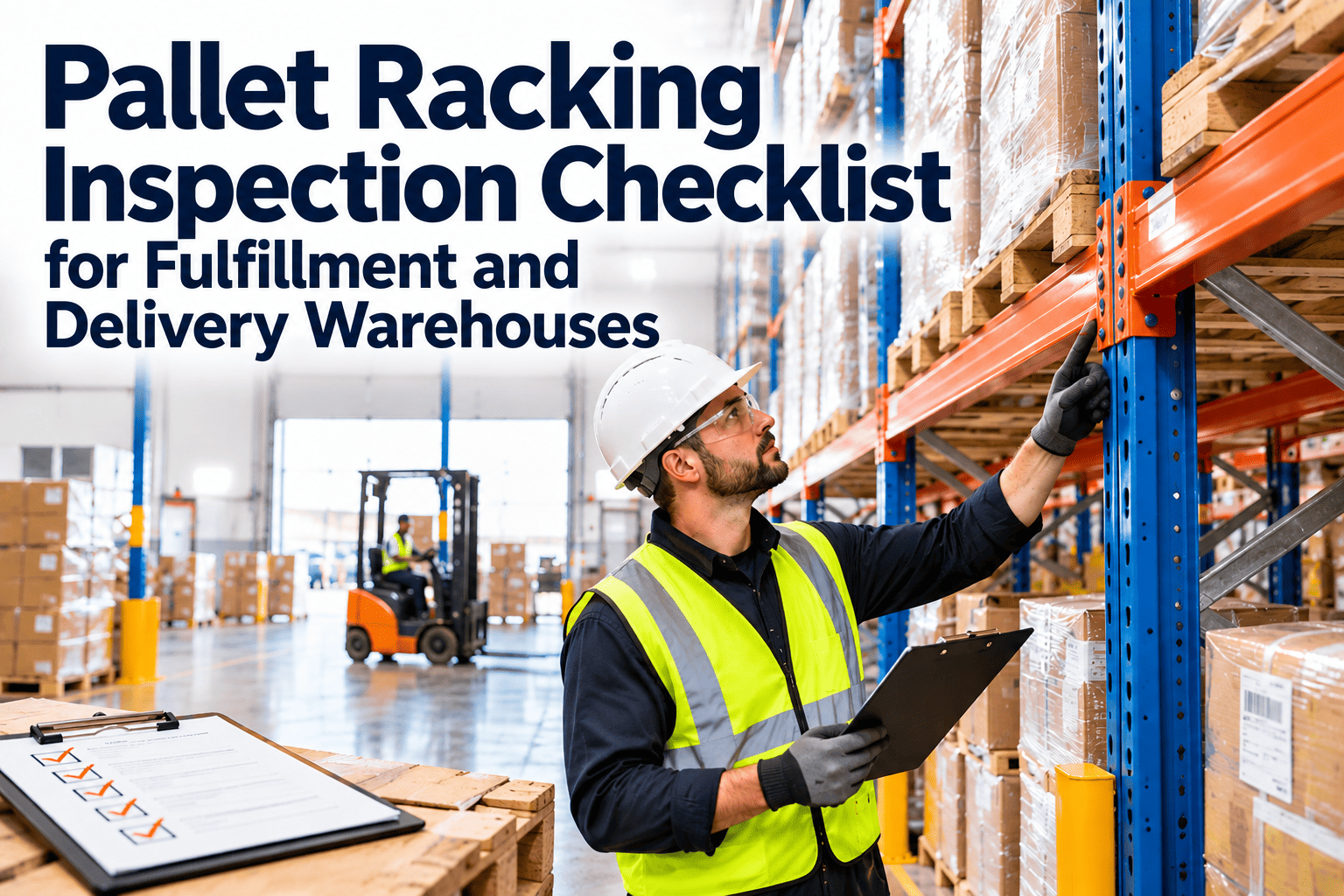
Pallet Racking Inspection Checklist for Fulfillment and Delivery Warehouses
Pallet Rack Inspection Checklist: Print It, Tick It, Sign It
- Impacts reported. Every forklift or pallet contact is logged with aisle, bay, and level before the shift ends.
- Uprights look straight. No visible lean, kink, or fresh paint scrape at fork height.
- Loads sit fully on beams. Pallets are centered, not overhanging, and not touching the upright.
- Pallets are sound. No broken boards or damaged pallets in a rack position.
- Aisle ends protected. Column guards and end barriers are in place and not crushed.
- Nothing unusual. No new noise, shifting loads, or objects wedged in the structure.
- Upright frames. Plumb, straight, no dents or torn perforations. Stop if bent or kinked.
- Beams and connectors. Level, fully engaged, safety clips present. Stop if sagging or clips missing.
- Base plates and anchors. Anchor bolts present and tight, no plate lifting. Stop if loose or missing.
- Bracing. Horizontal and diagonal braces intact and bolted. Stop if bent or cracked.
- Row spacers. Back-to-back rows tied together. Stop if missing or bent.
- Decking. Wire decks seated and undamaged, no sagging panels.
- Floor condition. No cracking or settling around uprights and anchors.
- Capacity plaques. Posted, legible, and matching the installed beam levels.
- Stop use. Keep people and traffic away from the affected bay.
- Check the neighbors. Inspect adjacent bays and the full upright frame.
- Photograph and record. Capture location, damage, load details, and who was involved.
- Rate the damage. Assign green, amber, or red using your written criteria.
- Unload if red. Unload safely, tag out, and keep the area closed.
- Open a work order. Assign repair, parts, and a due date, then verify before reopening.
- Full-installation inspection. Every aisle reviewed against layout drawings.
- Configuration matches plaques. Beam heights and loads match posted capacity.
- Open findings reviewed. Every amber and red item has an owner and a date.
- Records ready. Prior year's inspections, photos, and repairs exported.
- Training refreshed. Operators and inspectors reminded of reporting and rating rules.
- Reconfiguration approved. Any moved beams or added levels signed off before use.
Sign-off block for each inspection
Why Pallet Racking Inspection Cannot Wait for an Incident
- Racking carries static load all day, so small structural losses reduce capacity without any visible sign of stress.
- Forklift contact is the most common source of damage, and most impacts are never reported by the operator.
- Peak season adds tighter aisles, more temporary labor, and faster travel, which raises impact frequency.
- A single failed upright can transfer load to neighboring bays and start a chain reaction.
What the regulations expect
OSHA has no standard written only for pallet racking. Inspectors typically rely on the General Duty Clause and the material storage rules in 29 CFR 1910.176, so a documented program is your best evidence of reasonable care.
Three Layers of a Rack Inspection Program
Each layer catches different problems. Operators see fresh impacts, internal walk-throughs see trends, and experts judge structural significance.
Classify Damage Before Anyone Debates It
A shared rating system removes guesswork. Many warehouses use a three-color approach, and your engineer or rack supplier should confirm the exact thresholds for your racking.
Repairs need engineering approval
Do not straighten, weld, or patch load-bearing rack parts on the floor. Replace damaged components with parts matching the manufacturer specification, or obtain written approval for a repair method.
Common Root Causes Behind Rack Damage
Load Capacity Plaques and Configuration Control
- Post a plaque at each aisle end showing the maximum load per beam level and per bay.
- Match each plaque to the actual beam heights and upright frames installed.
- Update the plaque and the record whenever beams are raised, lowered, or swapped.
- Train supervisors so no one adds a level or changes a bay without approval.
- Check that unit loads, including pallet weight, stay inside the posted limits.
From Finding to Fix: The Damage Response Workflow
Before and After: Paper Logs Versus a Maintenance System
- Inspection dates slip with no reminder.
- Damage notes lack photos and exact locations.
- Open red items are hard to track across shifts.
- Audit prep means hunting for old forms.
- Recurring inspection work orders per aisle or zone.
- Mobile findings with photos tied to the rack asset.
- Priority and due dates drive repair follow-up.
- Searchable history ready for auditors and insurers.
How Oxmaint Supports a Racking Inspection Program
Oxmaint maintenance management software gives warehouse teams one place to schedule inspections, record findings, and close repairs.
- Register each aisle, bay, or rack run as an asset with its capacity information.
- Use preventive maintenance schedules to generate weekly, monthly, and annual inspection tasks.
- Give inspectors a mobile checklist so findings are captured at the rack, not after the shift.
- Convert a damage finding into a corrective work order with priority and due date.
- Track spare beams, clips, and column guards in inventory so repairs are not delayed.
- Report on overdue inspections, repeat damage locations, and time to close red items.
Use repeat damage as a design signal
When the same aisle end keeps producing impacts, the fix may be a guard, a wider turn radius, or a traffic rule. Reports that group damage by location make that pattern obvious.
KPIs to Track for Rack Safety
Getting Started: A Practical 30-Day Plan
- Week one: walk the building, map aisles and bays, and photograph existing damage.
- Week two: write the checklist and rating criteria with your safety lead and rack supplier.
- Week three: train operators on reporting and inspectors on rating, then load assets and tasks into your system.
- Week four: run the first full inspection cycle, close red items, and schedule the formal expert review.
Where Damage Concentrates in Fulfillment and Delivery Operations
| Zone | Why it is exposed | Inspection focus |
|---|---|---|
| Receiving and put-away aisles | Heavy pallets, frequent reach-truck and counterbalance traffic, high-level placement | Beam clips, upright bases, overhanging loads |
| Pick aisles | Constant movement, narrow turns, order pickers working at height | Lower upright faces, guards, deck seating |
| Cross-dock and staging lanes | Temporary pallets, rushed placement, outbound waves | Floor-level beams, end frames, barrier condition |
| Returns and overflow storage | Mixed pallet quality, irregular loads, unplanned reconfiguration | Capacity plaques, load stability, beam changes |
| Dock-adjacent racking | Trailer movement, door traffic, impacts from loading equipment | End-of-run protection, anchors, bracing |
Operator Reporting: The Cheapest Safety Control You Have
- Make reporting a no-blame event so operators disclose impacts immediately.
- Give operators a short mobile or kiosk form that takes under a minute.
- Ask for aisle, bay, level, and a photo, nothing more.
- Acknowledge every report quickly so people see the report leads to action.
- Review impact trends by shift and area, and coach on the process, not the person.
Train the people who see the rack most
Short refresher sessions on spotting leaning uprights, missing clips, and overloaded levels often matter more than a thick manual. Repeat them before peak season and after onboarding temporary labor.
After an Impact: A Simple Response Protocol
Preparing for Annual Formal Inspections and Audits
- Keep a current layout drawing showing aisles, bays, and rack types.
- Store manufacturer documentation and capacity information with the asset record.
- Export the previous year of inspection and repair history before the visit.
- List every open amber finding with its owner and due date.
- Share insurer and auditor requests with the same record, so no one rebuilds history by hand.
A complete history also helps with insurance conversations, because it shows the warehouse finds and fixes problems consistently.
Condition-Based Signals Worth Adding
- Repeat impact locations that suggest a layout or traffic change.
- Beams that return to amber after repair, which can indicate recurring overloading.
- Seasonal spikes in damage reports tied to temporary staffing or volume.
- Aisles with rising inspection findings, which can justify guards or wider turning space.
Setting Inspection Frequency by Risk
| Risk level | Example conditions | Suggested rhythm |
|---|---|---|
| Higher | Narrow aisles, heavy forklift traffic, many temporary operators, dock-adjacent racks | Weekly walk-through plus daily operator observation |
| Moderate | Standard aisles, stable staffing, mixed picking and put-away | Monthly walk-through plus annual formal review |
| Lower | Low-traffic reserve storage, few pallet moves | Quarterly walk-through plus annual formal review |
Treat these as starting points and adjust them after a few cycles, using your own damage and impact data.
Mistakes That Undermine a Racking Safety Program
Connecting Racking Safety to Throughput
- Planned repairs during low-volume windows cost less than emergency unloading during a peak wave.
- Faster closure of red findings shortens the time that storage locations sit blocked.
- Fewer impacts mean fewer damaged pallets, fewer product losses, and fewer pick path interruptions.
- Clean records reduce the time managers spend preparing for audits and insurer reviews.
What a Good Rack Inspection Record Contains
- Inspector name, date, and the aisle, bay, and level covered.
- Component checked and the finding, with a green, amber, or red rating.
- Photographs that show the damage and its position on the rack.
- Load restriction applied, if any, and who approved it.
- Linked work order, repair date, parts used, and verification sign-off.
- Follow-up actions on traffic, layout, or training when impacts repeat.
Keep the record tied to the asset
When each bay has its own history, you can see which racks keep returning to amber and decide whether repair, protection, or redesign is the better investment.