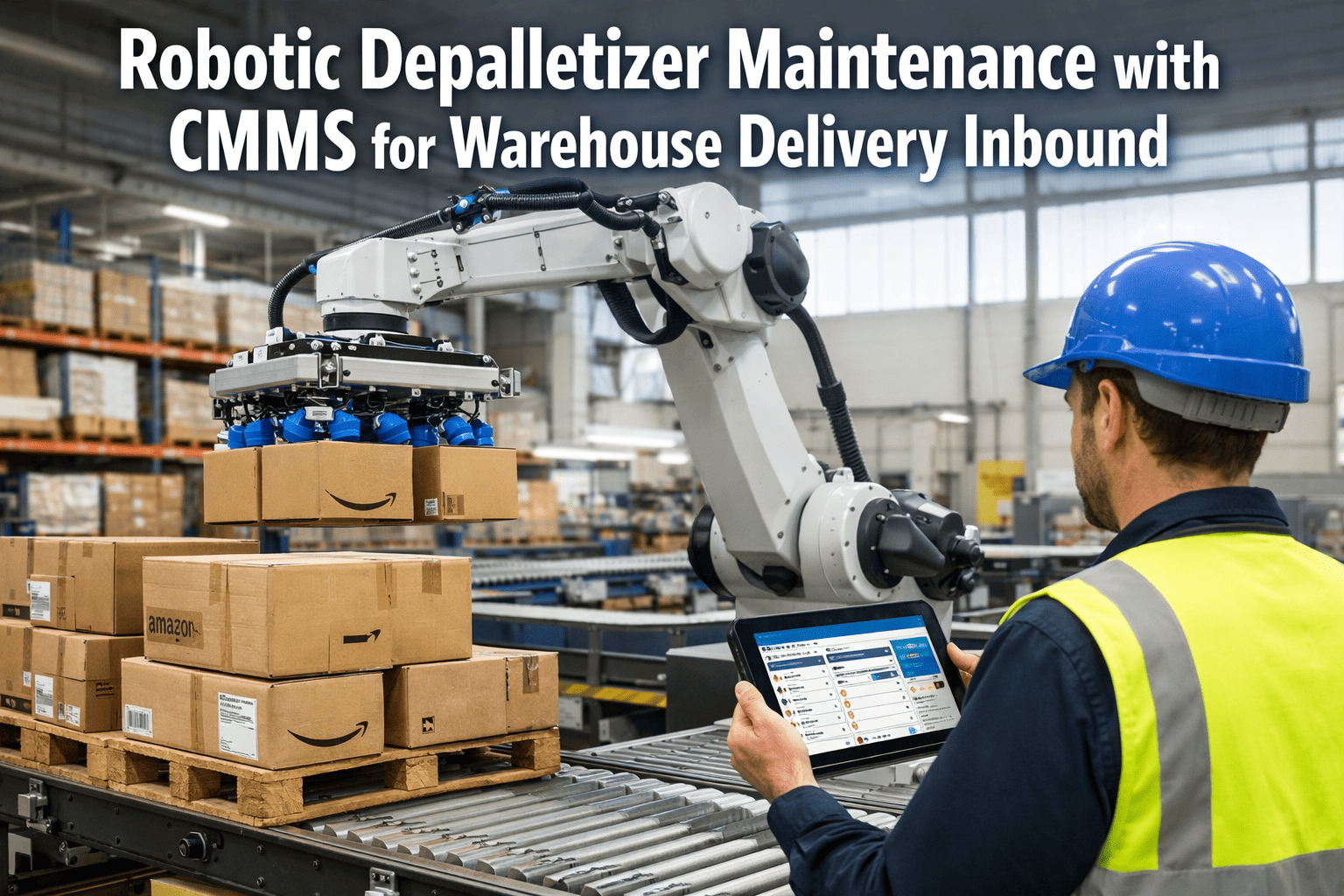
Robotic package handling systems are the physical backbone of every delivery operation—picking, placing, palletizing, depalletizing, and singulating millions of packages daily at speeds human workers cannot match. When a robotic arm drops a pick rate from 1,200 to 900 cycles per hour, or a palletizer jams during the overnight sort wave, the downstream impact cascades through every delivery route the next morning. In 2026, the delivery operations maintaining 98%+ handling equipment uptime have moved beyond calendar-based maintenance into CMMS-driven predictive programs that track gripper wear, servo load curves, vision system clarity, and structural fatigue in real time. Schedule a consultation to build a predictive maintenance program for your package handling robots.
Critical Package Handling Equipment Types
Delivery operations deploy distinct robotic handling systems at different stages of the package flow—each with unique mechanical stresses, wear patterns, and maintenance requirements. Understanding what breaks on each system type is the foundation of effective CMMS-driven maintenance. Consult with our experts to map your handling equipment maintenance needs.
Robotic Arm Pickers
6-axis articulated arms with suction or mechanical grippers for singulation, pick-and-place, and parcel induction at 800-1,500 picks/hr.
Palletizers / Depalletizers
High-payload robots stacking or unstacking packages onto pallets at 20-60 cycles/min with layer-pattern precision.
AMR Package Transporters
Autonomous mobile robots moving packages between zones—inbound dock to sort, sort to outbound staging, returns processing.
Singulation Systems
Robotic systems that separate touching or overlapping packages on conveyors for barcode scanning and downstream sorting.
Automated Dimensioners
Robotic measurement stations that scan package dimensions, weight, and barcode at line speed for routing decisions.
Robotic Loading Systems
Automated truck/container loading robots that pack outbound vehicles with optimized package placement patterns.
Track Every Handling Robot in One Platform
See how Oxmaint CMMS unifies maintenance for pickers, palletizers, AMRs, and loading systems into a single dashboard with automated work orders.
Component Failure Modes and Detection
Robotic package handling equipment fails in predictable patterns. Knowing which components degrade, how to detect degradation early, and what CMMS triggers to set is the difference between planned maintenance and emergency shutdowns. Oxmaint's platform ingests sensor data from all component types into unified maintenance workflows.
Grippers and End Effectors
Suction cups lose compliance, mechanical fingers wear contact surfaces, and vacuum generators lose pressure over millions of pick cycles—the #1 failure source.
Servo Motors and Joints
Joint servo motors accumulate bearing wear proportional to cycle count and payload. Current draw increase and vibration signature changes precede failure by weeks.
Vision and Sensing Systems
Camera lens fouling, LED aging, and calibration drift silently reduce pick accuracy and package identification rates before triggering obvious failures.
Structural and Frame Components
Robot bases, mounting frames, and linear rails accumulate fatigue stress from continuous high-speed operation, especially in palletizing applications with heavy payloads.
Maintenance Approach Comparison
The gap between reactive and predictive maintenance is wider for robotic handling equipment than almost any other delivery operation asset—because downtime cascades through every downstream process immediately.
Predictive maintenance requires upfront investment in sensors and CMMS integration but delivers the lowest total cost of ownership within 6-10 months for most delivery operations.
Move from Reactive to Predictive
See how Oxmaint connects gripper sensors, servo monitoring, and vision analytics into automated work orders that prevent failures before they stop your line.
CMMS Capabilities for Package Handling Robots
Effective maintenance of robotic handling equipment requires CMMS features purpose-built for high-cycle, multi-component robotic systems. Schedule a demo to see these capabilities configured for your equipment.
Cycle-Based PM Scheduling
Trigger maintenance by actual pick cycles, palletize counts, and operating hours rather than calendar dates. A picker running 1,200 cycles/hr needs service far sooner than one running 400.
Gripper Lifecycle Tracking
Track suction cup compression, mechanical finger wear, and vacuum pressure per gripper across its entire lifecycle. Predict replacement timing from wear curves rather than discovering failures through dropped packages.
Servo Health Trending
Monitor current draw, temperature, vibration, and backlash for every servo joint. Trend analysis reveals progressive bearing wear weeks before catastrophic motor failure.
Vision System Performance Dashboard
Track barcode read rates, package detection accuracy, dimensional measurement consistency, and camera image quality. Auto-generate cleaning and calibration work orders when metrics degrade.
Parts Consumption Forecasting
Link gripper, belt, bearing, and sensor replacement rates to throughput volumes. Predict parts needs 60-90 days ahead and prevent stockouts during 300-400% peak season surges.
Maintenance Window Optimization
Analyze package flow schedules to identify optimal gaps between handling waves. Schedule work orders to minimize throughput impact while maximizing technician wrench time.
Maintenance Interval Reference
These intervals represent starting points based on typical delivery hub operating conditions. CMMS condition monitoring adjusts intervals dynamically based on actual equipment health data.
High-utilization equipment (20+ hrs/day) should use accelerated intervals. CMMS adjusts automatically when cycle-based triggers fire before calendar-based schedules.
Implementation Process
Deploying CMMS-driven predictive maintenance for package handling robots follows a structured rollout. Oxmaint's implementation team guides every phase to ensure zero disruption to ongoing operations.
Equipment Audit and Baseline
Inventory all handling robots, establish vibration and performance baselines, build CMMS asset hierarchy with parent-child component relationships.
Sensor Integration
Deploy vibration, current, pressure, and vision quality sensors. Connect robot PLC data to CMMS via API. Configure automated alert thresholds.
Team Rollout
Launch mobile technician app, activate digital inspection checklists, integrate spare parts inventory with auto-reorder rules.
Full Predictive Operations
Activate AI failure prediction models, enable maintenance window optimization, establish continuous improvement feedback loops.
ROI and Business Impact
Predictive maintenance for robotic handling equipment delivers fast ROI through eliminated unplanned downtime, reduced emergency repair premiums, extended component lifespans, and sustained peak throughput. Get a customized ROI analysis for your facility.
Typical Payback Period
Most delivery operations achieve full ROI within 9 months through eliminated emergency repairs, sustained throughput during peak, and extended equipment lifespans.
Keep Every Handling Robot Running at Peak
Your delivery throughput depends on every picker, palletizer, and loader operating at rated capacity. Oxmaint CMMS connects to your handling robots' sensors and PLCs—automating work orders from real-time data, predicting failures before they stop your line, and optimizing maintenance around your package flow schedule.
Frequently Asked Questions
Which package handling robot component fails most often?
Grippers and end effectors account for 47% of all handling robot failures. Suction cups degrade from millions of pick cycles, losing compliance and vacuum seal integrity. CMMS tracking of pick success rates catches degradation weeks before complete failure. Mechanical grippers experience contact surface wear and alignment drift. The fix is straightforward—cycle-based replacement scheduling in CMMS rather than running to failure.
How does CMMS know when a servo motor is about to fail?
CMMS connects to vibration sensors and current monitors on every servo joint. Healthy servos have characteristic vibration signatures and current draw profiles. As bearings wear, vibration patterns shift and current draw increases. Machine learning models detect these subtle changes 2-4 weeks before failure, generating work orders timed to the next planned maintenance window.
Can CMMS handle robots from multiple manufacturers?
Yes. Oxmaint creates manufacturer-specific asset profiles for FANUC, ABB, KUKA, Yaskawa, Universal Robots, and other platforms. Each profile includes OEM-recommended PM schedules, parts catalogs, firmware tracking, and warranty management. The system provides unified fleet-wide reporting while respecting each manufacturer's unique maintenance requirements.
How to schedule maintenance without stopping the handling line?
CMMS maintenance window optimization analyzes your package flow schedule—identifying gaps between inbound waves, shift transitions, and planned operational pauses. For multi-robot cells, one robot can be taken offline while others absorb the workload. Work orders auto-schedule into these windows with estimated completion times to ensure the robot is back online before the next handling wave begins.
How to prepare handling equipment for peak season?
CMMS uses historical data and consumption trends to predict parts needs 60-90 days before peak. The system generates pre-peak maintenance campaigns—replacing all grippers within 20% of end-of-life, pre-staging critical servo motors and vision system spares, and completing all deferred maintenance. During peak, the system shifts to monitoring-only mode where only critical alerts generate work orders to maximize handling availability.
Precision Handling, Zero Unplanned Downtime
From single robotic cells to facility-wide handling systems, Oxmaint has the expertise to transform your maintenance from reactive firefighting into predictive operations. Every pick, place, and palletize—running at full capacity, every shift.