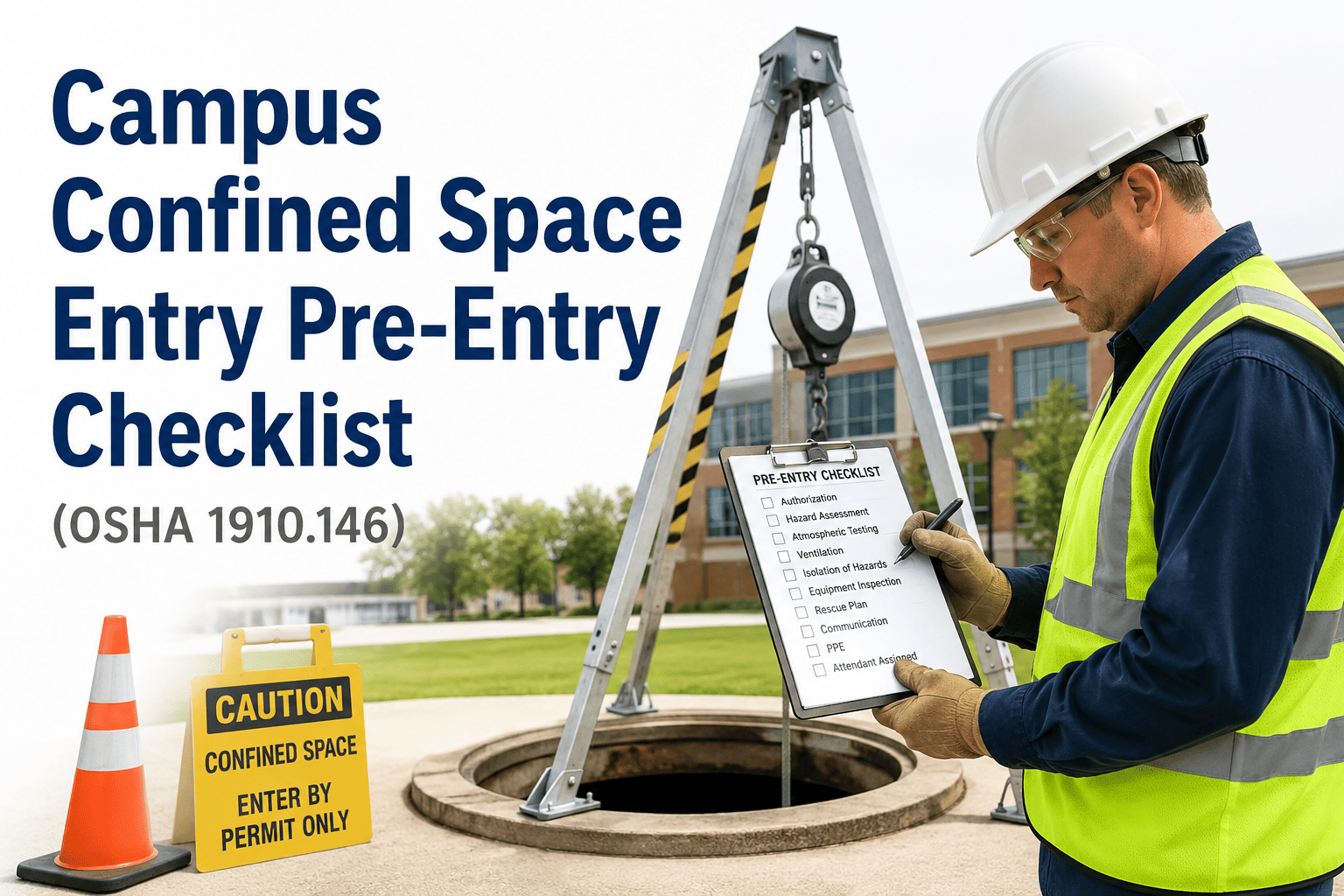
Campus Confined Space Entry Pre-Entry Checklist (OSHA 1910.146)

By Stephen King on June 5, 2026

campus-confined-space-entry-pre-entry-checklist-osha-1910-146

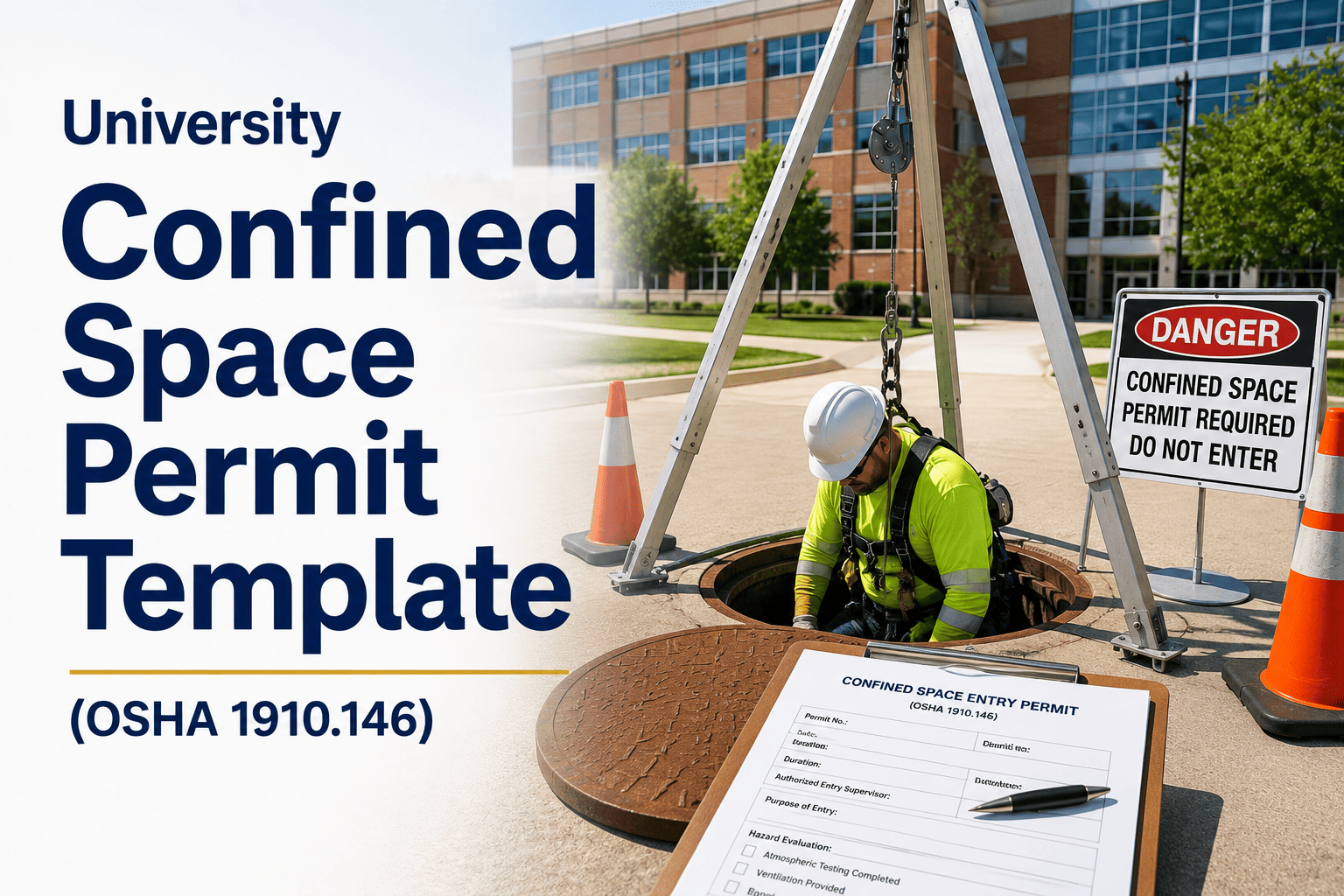
Campus facilities teams face serious legal exposure every time a worker enters a boiler room, utility vault, storm drain, or mechanical pit without a completed confined space permit. OSHA 29 CFR 1910.146 mandates a documented permit program for every permit-required confined space on university and college campuses — no exceptions for routine maintenance or short-duration entries. This checklist covers the complete pre-entry procedure: space identification, permit issuance, atmospheric testing, isolation and lockout, rescue planning, communication systems, PPE verification, and attendant duties to deploy it in OxMaint and generate a traceable permit work order before every campus confined space entry. Book a Demo to see how university facilities teams track open permits, atmospheric test logs, and rescue plan documentation fleet-wide. Every campus building, every entry, every permit — documented and auditable in one place. eliminate paper permit risk today. Whether your campus manages dormitories, utility tunnels, or research lab infrastructure to see OSHA 1910.146 compliance built into every work order. Facilities managers who Sign Up Free can configure permit templates per space type and see how OxMaint's CMMS keeps campuses audit-ready at all times.

Campus Confined Space Entry Pre-Entry Checklist
OSHA 1910.146 compliant pre-entry procedure for university and college campus buildings — permit issuance, atmospheric testing, isolation, rescue plan, PPE, attendant duties, and communication verification. Required before every permit-space entry.
9
Inspection zones

65+
Checklist items

OSHA
1910.146 compliant

Free
CMMS import
How to Use This Checklist
Complete every section before any authorized entrant crosses the plane of a permit-required confined space. Items marked Stop Entry are conditions that prohibit entry — the permit must be cancelled and the entry supervisor notified immediately. Items marked Document Only must be recorded on the permit but do not automatically cancel the entry. All completed permits must be retained for at least one year per OSHA 1910.146(e)(6).

1. Space Identification and Classification

Before issuing any permit, the entry supervisor must confirm the space classification and verify that the university's confined space inventory record is current. Campus buildings accumulate reclassified spaces over time — a utility vault added to a building renovation may not appear on the original confined space register. Verify every time.

Pre-PermitSpace Classification Verification
Entry SupervisorAuthorization Confirmation
Space Register Auto-Linked to Every Permit in OxMaint
OxMaint maps each confined space as an asset in the campus inventory. Every permit work order auto-populates the space's hazard profile, prior atmospheric test history, and previous entry records — entry supervisors work from a complete picture, not a blank form.

2. Permit Issuance and Documentation

A confined space permit is not a formality — it is the legal record that an entry supervisor evaluated every hazard, established every control, and authorized entry with full knowledge of conditions at the time. Any entry without a current, signed permit is an OSHA violation regardless of duration or task scope.

Before OpeningPermit Form Completion

3. Atmospheric Testing

Atmospheric testing is the most safety-critical step of every campus confined space entry. Oxygen deficiency, flammable vapors, and toxic gases are invisible — a space that tested acceptable during a prior entry may have changed conditions within hours due to utility leaks, decomposition, or adjacent operations. Testing must occur in the order below before any entrant approaches the opening.

Before EntryInitial Atmospheric Test — Remote Sampling Required
InstrumentMonitor Calibration and Continuous Monitoring
VentilationForced-Air Ventilation Requirements

4. Isolation and Energy Lockout

Engulfment, mechanical, and energy hazards are responsible for a significant share of confined space fatalities. Every energy source — electrical, pneumatic, hydraulic, gravity, chemical — that could affect conditions inside the space must be isolated and locked out before the first entrant enters. Campus utility tunnels and mechanical rooms have complex multi-source energy profiles that require documented LOTO procedures, not informal verbal clearances.

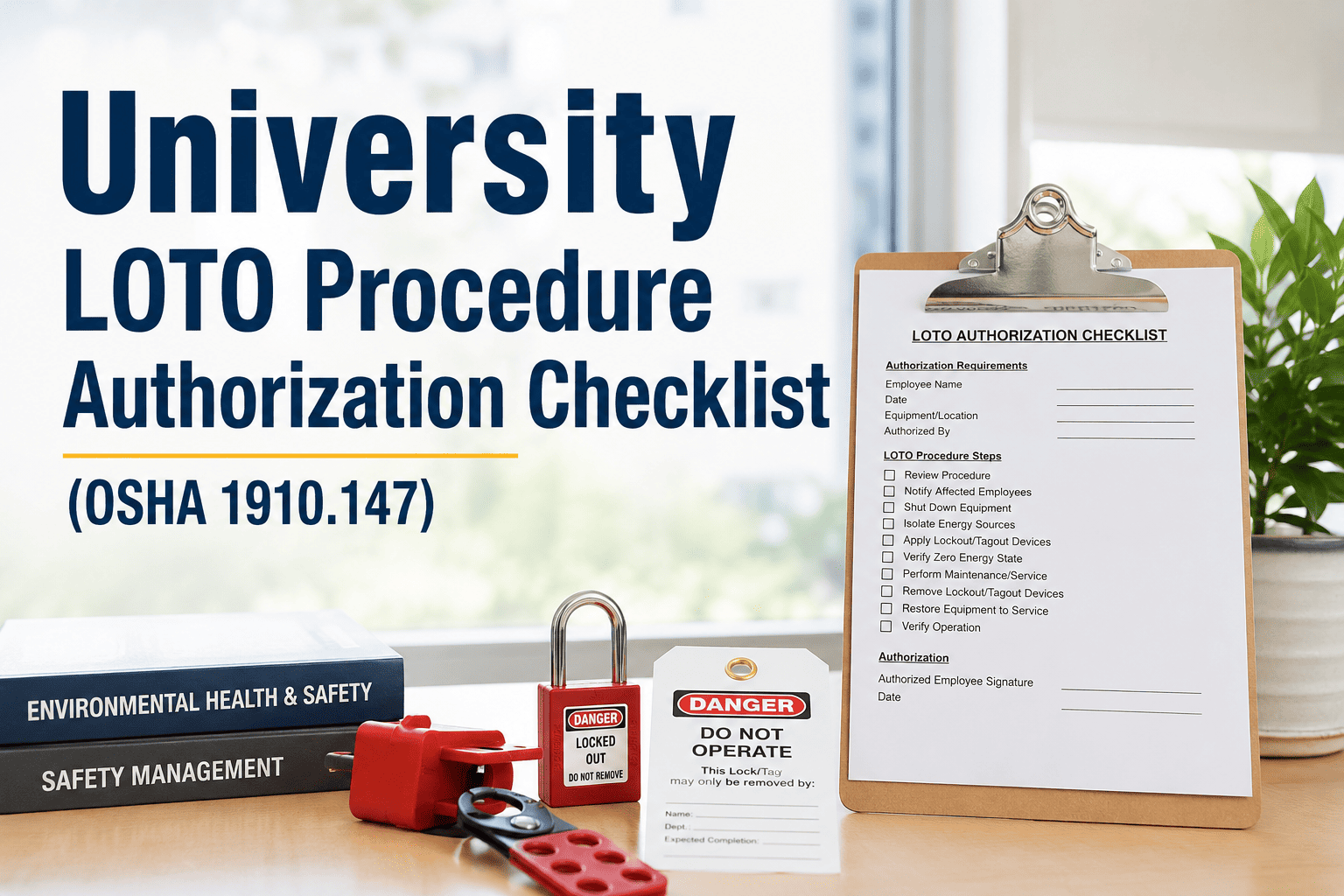
Before EntryLockout / Tagout Verification
EngulfmentEngulfment Hazard Elimination
Atmospheric Readings and LOTO Status Captured on Every OxMaint Permit
OxMaint's confined space permit template captures gas readings, isolation verification, and LOTO procedure reference in a single digital record. Entry supervisors sign off on mobile — the permit is timestamped, stored against the space asset, and immediately retrievable for OSHA inspection or incident review.

5. Rescue Plan Verification

OSHA 1910.146(d)(9) requires that a rescue plan be in place before any entry begins — not written after an incident occurs. For campus confined spaces, this typically means a designated campus rescue team or a standing arrangement with the local fire department. The entry supervisor must confirm that the rescue capability matches the specific hazards of the space being entered.

Pre-EntryRescue Capability Confirmation
EquipmentRetrieval and Rescue Equipment Check

6. PPE Verification

PPE selection for campus confined space entry must be matched to the specific hazard profile of each space — not a generic confined space kit. A utility tunnel with residual steam risk requires different protection than a dry electrical vault. The entry supervisor must verify PPE before authorizing each entrant to enter.

Every EntrantRespiratory and Body Protection
LightingLighting and Tools

7. Attendant Duties Confirmation

The outside attendant is the entrant's primary safety contact — they must remain at the entry point for the full duration of the entry, maintain an accurate count of entrants, and initiate rescue without hesitation if conditions change. An attendant who leaves the post or divides attention between the entry and another task is a leading cause of confined space fatalities.

Before EntryAttendant Briefing and Post Setup

8. Communication Systems

Communication failures inside campus confined spaces — utility tunnels, sub-basement vaults, and concrete enclosures — are predictable. Radio signals degrade, voice communication becomes impossible with PPE in place, and cellular coverage is often absent. Every entry must verify that the communication method works in the specific space before entrants descend.

Pre-Entry TestCommunication Verification

9. Entry Close-Out and Permit Cancellation

Every confined space entry must have a formal close-out process — all entrants accounted for, permit cancelled, space secured, and records filed. An open permit with no close-out record creates legal exposure and prevents the space inventory from reflecting current conditions for the next entry supervisor.
After EntryClose-Out Procedure
Campus EHS — OxMaint CMMS
Replace Paper Confined Space Permits With a Digital System Built for Campus EHS Teams
OxMaint's campus CMMS integrates confined space permit issuance, atmospheric test logging, LOTO verification, and annual program review into a single platform. Entry supervisors work on mobile. EHS managers see open permits in real time. Every record is OSHA-ready.
Digital permit issued before every campus confined space entry
Atmospheric test readings captured and time-stamped on permit
Full permit history per space — OSHA-ready at any time
Open permit alerts visible to EHS manager in real time
Frequently Asked Questions
What makes a campus space a permit-required confined space under OSHA 1910.146?
A space is permit-required if it is large enough to enter and perform work, has limited or restricted entry/exit, and contains or has the potential to contain a hazardous atmosphere, a material that could engulf an entrant, an internal configuration that could trap or asphyxiate, or any other recognized serious safety or health hazard. Most campus utility vaults, tunnels, crawlspaces, and storage tanks meet this definition.
How long must campus confined space permits be retained?
OSHA 1910.146(e)(6) requires cancelled permits to be retained for at least one year. If an incident or near-miss occurred during an entry, the permit for that entry should be retained indefinitely. OxMaint stores all permit records against the space asset with no manual filing required.
Can a campus work one person serve as both entrant and attendant?
No. OSHA 1910.146 requires a dedicated outside attendant who remains at the entry point for the full entry duration. The attendant cannot also be an entrant. A single worker cannot legally perform both roles simultaneously — this is one of the most common citations in campus confined space inspections.
Does OSHA 1910.146 apply to all university and college campuses?
Yes. OSHA 1910.146 applies to all general industry employers, including universities and colleges. Public institutions in states with state-plan OSHA programs may be governed by equivalent state regulations, but the substantive requirements are identical or more stringent. Campus EHS programs must maintain a written confined space program, a complete PRCS inventory, and documented training records.
What atmospheric test order is required before a campus confined space entry?
OSHA and the ANSI Z117.1 standard specify testing in this order: oxygen content first, then flammable gases and vapors, then toxic air contaminants. Oxygen must be tested first because many combustible gas meters are inaccurate in oxygen-deficient atmospheres. All readings must be taken before any entrant approaches the opening.
How does OxMaint support campus confined space compliance?
OxMaint manages confined spaces as assets in the campus maintenance system. Each space has a hazard profile, permit history, atmospheric test log, and associated LOTO procedure stored against it. Before every entry, a digital permit work order is issued — capturing all pre-entry checks, entrant assignments, and supervisor sign-off. Records are retained automatically and exportable for OSHA audits or EHS program reviews.
Campus Confined Space — OxMaint CMMS
Every Campus Entry. Every Permit. Documented and Auditable.
OSHA
1910.146 compliant

<2 min
Permit retrieval

Real-time
Open permit alerts

Free
to start today

Share This Story, Choose Your Platform!