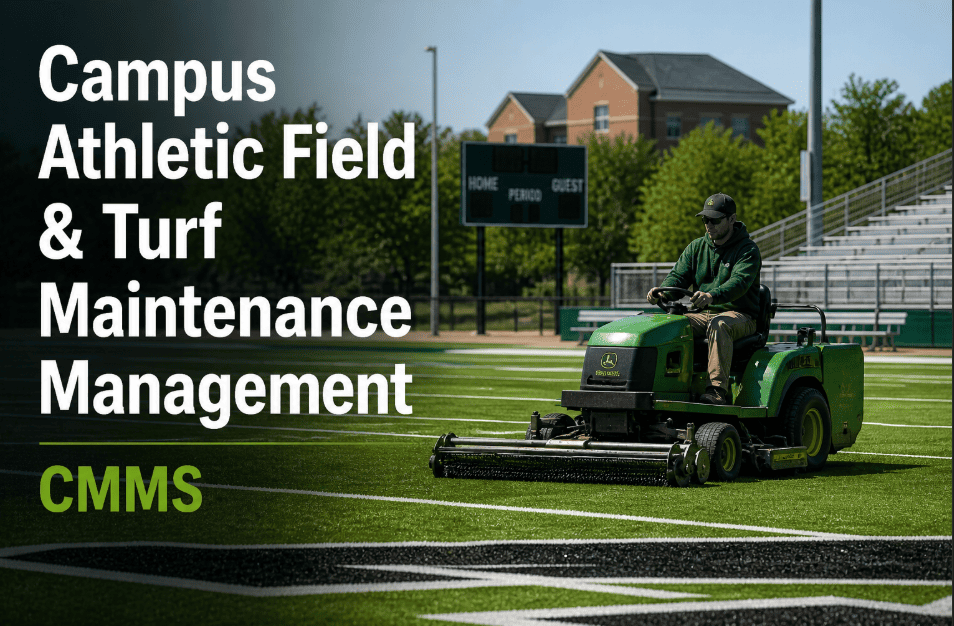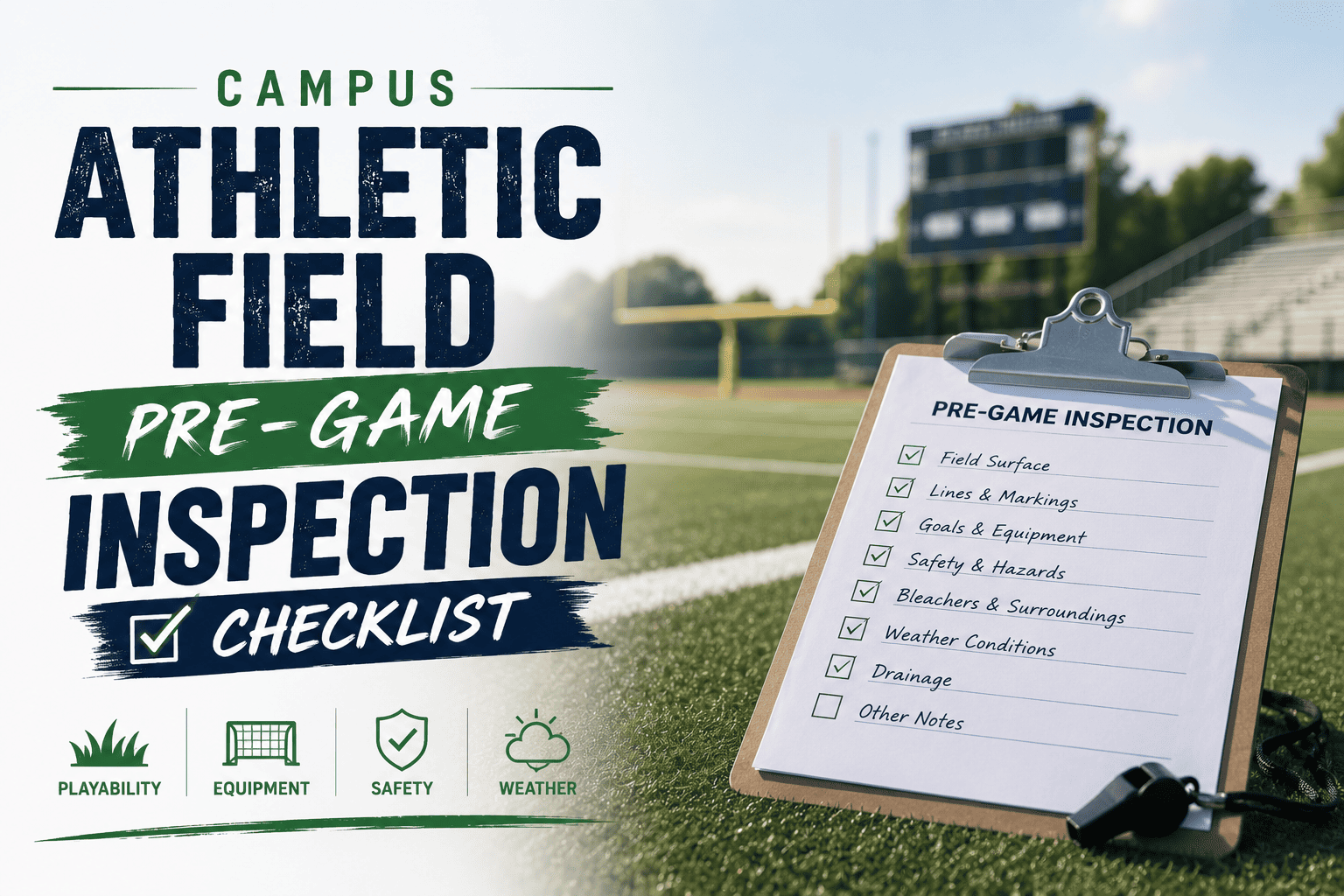
Campus athletic field pre-game inspections are a non-negotiable compliance and safety obligation for college athletics programs — covering playing surface integrity, goal anchor torque verification, field marking accuracy, lighting lux compliance, scoreboard functionality, and emergency access clearance before any NCAA-sanctioned or recreational event. A missed defect in any one of these categories can expose student athletes to injury risk, trigger NCAA compliance flags, or delay game-day operations across facilities that serve multiple sports in a single day. Sign Up Free to digitize your campus athletic field inspection workflow in Oxmaint and replace paper-based pre-game checklists with structured, CMMS-tracked sign-offs. Book a Demo to see how university athletics facilities teams use Oxmaint to manage field inspections, track defect closure, and maintain audit-ready documentation per field, per event, and per responsible staff member.
Manage Campus Athletic Field Inspections in Oxmaint
Oxmaint gives university athletics and facilities teams a guided pre-game inspection workflow covering surface condition, goal anchors, field markings, lighting, scoreboards, and emergency access — with every check recorded, assigned, and auditable per field location and event date.
Campus Athletic Field Pre-Game Inspection — Phase Sequence
Pre-game field inspection follows a five-phase sequence from surface walk-through to final event clearance. Each phase must reach sign-off status before the field is released for warm-ups or competition — inspecting out of sequence creates liability gaps and delays same-day multi-sport scheduling.
1. Playing Surface and Turf Condition Checklist
Surface integrity is the first mandatory inspection category in any campus athletic field pre-game walkthrough. Undetected divots, standing water, loose turf seams, or debris on the playing surface are the most common causes of non-contact lower-limb injuries during warm-ups. Sign Up Free to assign surface inspection tasks in Oxmaint and log defect photos with GPS-tagged field coordinates the moment an issue is identified.
Full field debris walk — foreign objects, glass, and hardware cleared from playing surface
Walk every grid section of the playing surface before warm-up access is granted. Construction debris, broken equipment hardware, and field irrigation components left post-maintenance are the leading source of pre-event lacerations. Required — pre-access sweep
Natural turf divot and bare patch assessment — areas flagged and roped off if unsafe
Areas with exposed soil greater than six inches in diameter or divots deeper than one inch must be repaired or marked with visible boundary before the field is released to athletes. Defect — rope off until repaired
Synthetic turf seam integrity — no lifted edges, bubbling, or anchor stitch failures
Synthetic turf seam failures at field seams and end zones are trip hazards that do not self-resolve during play. Raised seam edges must be anchored or the affected zone roped off pending repair work order. Required — seam inspection every event
Field drainage verified — no standing water in playable zones or sideline corridors
Standing water in sideline corridors is both an athlete slip hazard and an NCAA field condition violation that may trigger postponement. Drainage inlets must be clear of debris before each event on natural grass surfaces. Hold — NCAA may order postponement
Infield skin and warning track condition confirmed — no ruts, cracking, or irrigation head exposure
Baseball and softball infield skins require drag and moisture check within two hours of first pitch. Retracted irrigation heads that fail to seat flush are ankle-injury hazards that are not visible at walking speed. Required — drag within 2h of event
2. Field Markings, Boundary Lines, and Goal Hardware Checklist
Field marking accuracy and goal hardware stability are regulated dimensions in NCAA facility standards — incorrect yardage lines, faded boundary markers, or unsecured goal post anchors can result in officiating disputes, athlete injuries, or NCAA compliance findings. Book a Demo to see how Oxmaint routes goal hardware inspection tasks to the correct facilities crew and holds field release until torque verification is recorded.
All boundary lines and yard markers painted to NCAA specification width and visibility
Field markings must be repainted if rainfall or morning dew has reduced paint visibility below four inches of legible contrast. Faded hash marks in high-visibility scoring zones are an officiating accuracy risk. Defect — repaint before warm-ups
Goal post plumb verified — post vertical within NCAA tolerance, no visible lean
Goal posts must be inspected for vertical alignment after each use event, high-wind condition, or maintenance activity. Posts outside vertical tolerance must be reset before any field goal or kicking practice begins. Required — plumb check every event
Goal post anchor bolt torque verified to manufacturer specification — hardware log updated
Anchor bolt torque must be verified with a calibrated torque wrench and recorded to manufacturer spec per event. Loose anchor hardware is the primary cause of structural goal post failure during athlete collision events. Required — torque wrench verification
Goal post and upright padding intact — no tears, displacement, or exposed hardware
Foam padding on posts and uprights must fully cover contact surfaces without displacement. Exposed hardware or torn padding sections must be replaced before field release — tape repairs are not acceptable substitutes for damaged pad units. Defect — replace pad before event
Soccer, lacrosse, or field hockey net anchors secured — no loose ground staples or peg exposure
Net anchor pegs that are not fully seated are ankle injury hazards on ground contact. All net frame connections must be inspected and all ground anchors verified flush before warm-up access is granted. Required — anchor flush check
3. Lighting, Scoreboard, and Facility Systems Checklist
Lighting system and scoreboard operability are event-management compliance categories that are frequently underdocumented in university athletics facilities — a single failed lighting pole circuit or a scoreboard communication dropout discovered at warm-up time creates last-minute vendor escalations with no audit record. Sign Up Free to track lighting lux readings, scoreboard test results, and PA system verification in Oxmaint before every scheduled event.
Field lighting system energized and all pole circuits confirmed — no dark zones on playing surface
All lighting circuits must be tested at full power a minimum of two hours before event start to confirm pole-level circuit health. Single-circuit failures on multi-fixture poles can create shadow zones that are not visible until full system load. Required — full circuit test T-minus 2h
Lux level measurement at center field, end zones, and sidelines — NCAA minimum footcandles confirmed
NCAA lighting standards require minimum maintained footcandle levels at playing surface. Lux meter readings must be logged at five field positions before any evening or night competition is approved for play. Hold — below NCAA lux minimum
Scoreboard power, clock communication, and operator console functionality tested
Scoreboard operator console must be tested for clock synchronization, period/inning reset, and remote communication before warm-up. Communication failures discovered at game time require vendor escalation that cannot be resolved within event windows. Required — test T-minus 2h
Public address system audio quality confirmed — press box, sideline, and spectator zone coverage
PA audio coverage must be tested from three spectator zones before event. Poor coverage in emergency announcement zones is a life-safety risk during weather or security events requiring rapid crowd communication. Defect — PA failure is life-safety risk
Emergency medical access routes clear — EMS vehicle path to field unobstructed and gates unlocked
EMS vehicle ingress to the nearest field access point must be physically confirmed before athlete warm-ups begin. Vendor vehicles, equipment staging, and tailgate setups frequently block EMS corridors on multi-event days without a documented access check. Required — physical access confirmation
Technology Streamlining Campus Athletic Field Inspection
Campus athletic field pre-game inspection spans groundskeeping, facilities, athletics operations, and IT — four departments each requiring documented sign-off before an event can proceed. Manual checklists create gaps when inspection forms are incomplete, defect photos are lost, or lighting test results exist only on paper with no CMMS record. Book a Demo to see how Oxmaint connects every pre-game inspection step into a single auditable workflow. Sign Up Free and digitize your first field inspection checklist today.
Digitize Your Athletic Field Pre-Game Inspection Workflow
Oxmaint gives university athletics and facilities teams a single platform for surface inspection, goal hardware verification, lighting compliance, scoreboard testing, and event clearance — with every phase tracked, assigned, and auditable per field location.
Frequently Asked Questions
Common questions from university athletics directors, facilities managers, and groundskeeping supervisors about campus athletic field pre-game inspection, NCAA compliance, and CMMS-tracked field clearance documentation.
Surface and goal hardware inspections should begin at least two to four hours before event start — lighting system testing requires a minimum two-hour lead time to confirm full circuit load before competition lighting is needed.
NCAA sport-specific playing rules define boundary line widths, end zone dimensions, and hash mark placement for each sport. Markings must meet minimum paint visibility standards — faded lines in scoring zones are an officiating accuracy violation.
Yes. Anchor bolt torque must be verified with a calibrated torque wrench and logged to manufacturer specification before every contact-sport event — loose anchor hardware is the primary structural failure mode in goal post incidents.
NCAA standards require minimum maintained footcandle levels for sanctioned night competition. Failure to meet lux minimums may result in delayed start, event postponement, or officiating crew refusal to begin play under substandard lighting conditions.
This question is outside the scope of athletic field inspections. For CMMS-tracked biosafety cabinet decommissioning, refer to Oxmaint's lab decommissioning workflows.
Oxmaint provides phase-gated field inspection checklists, defect photo documentation with GPS coordinates, lighting and scoreboard test logging, and automated work order routing to groundskeeping and facilities — all recorded per field location and event date.
Audit-ready compliance documentation should include completed inspection checklists with staff sign-off timestamps, goal post torque log entries, lux meter readings per zone, and defect photo records — all linked to the specific event date and field in your CMMS.
We were running pre-game inspections across seven campus athletic fields with paper sign-off sheets and email notifications — defect photos were stored on personal phones, lighting test results were never formally recorded, and we had no audit trail when an NCAA site visit asked for field inspection documentation going back two seasons. After deploying Oxmaint's inspection workflow, every check is timestamped, every defect photo is attached to a work order, and our compliance documentation is pull-ready within minutes.
— Athletics Facilities Manager, Division I University, North America
Every Field Check. Every Sign-Off. Fully Documented.
Oxmaint tracks surface condition, goal hardware, field markings, lighting compliance, and event clearance in one place — so no inspection phase is skipped and no athletic field is released for competition without documented sign-off.