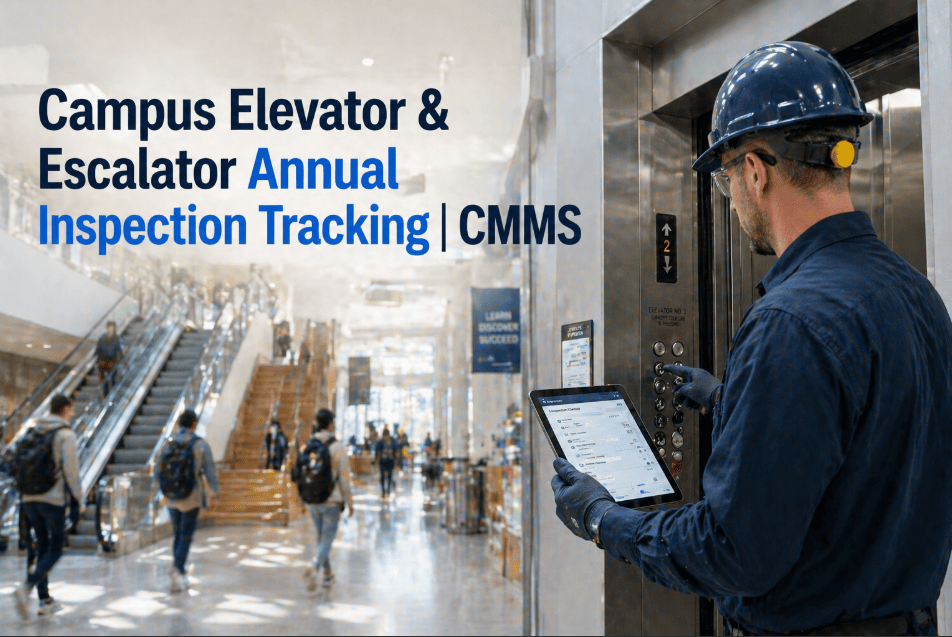
A flagship state university with 78 elevators across 31 buildings discovered six elevator certificates had expired between three and twenty-one days when the new associate vice president for facilities asked for a portfolio compliance summary. The university had been operating those six elevators every day during the gap — moving students, faculty, visitors, and disability services riders. The state inspector had not yet flagged it because the cycle hadn't come around. The estimated penalty exposure under state law was $100 per day per elevator — and the ADA exposure if a disability access claim had been filed during that window would have been catastrophic. None of the technicians who maintained those elevators had done anything wrong. Nobody had a system reminding the right person, on the right day, that the next certificate was due in 60 days. Elevator compliance is unforgiving in exactly that way. If your campus tracks elevator certificates on a wall calendar or a spreadsheet, sign up to try Oxmaint free for 30 days or book a demo.
Campus Elevator Compliance —
A Single Expired Certificate Can Trigger Shutdown Orders, ADA Findings, and Per-Day Fines That Compound Daily
$100/day
Massachusetts per-elevator fine
For each day operated without valid certificate — capped at $20,000 per unit
$1K–$5K
Texas per-unit penalty range
Per violation depending on severity and recurrence — TDLR may also order power lockout
12 months
Standard certificate validity
Cat 1 annual inspection cycle in most states — Cat 5 (load test) every five years
30 days
Violation correction window
Typical state requirement to correct cited deficiencies — failure-to-correct adds further penalties
The Annual Elevator Compliance Cycle Every Campus Has to Run
Elevator compliance is not a single event — it is a recurring annual cycle with clear milestones, hard deadlines, and consequences that escalate the longer they're missed. Campuses that pass clean inspections every year run all four phases on schedule. Campuses that get blindsided run them reactively. Book a demo to see how the cycle is automated.
Q-90
Pre-Inspection Preparation
90 days before certificate expiration, schedule the registered elevator inspection agency. In several states (e.g. Massachusetts), applications are due 90 days prior. Mechanical contractor performs pre-inspection walkthrough — defects found now are repairable before the inspector arrives.
Renewal applications filed
Day 0
Annual Cat 1 Inspection
Qualified Elevator Inspector (QEI) performs the no-load safety test. Door operators, brakes, governors, emergency communications, ride performance, leveling accuracy, structural integrity. Inspector issues a written report within five days documenting every defect found.
QEI inspection conducted
+30
Defect Correction Window
All cited violations must be corrected within 30 days (or under contract for correction). Affidavit of Correction filed with the licensing department. NYC-style jurisdictions allow 90 days but require AOC filing within 14 days of correction — late filings become Failure-to-Correct violations.
Defects resolved & AOC filed
+45
Certificate Issuance & Posting
After successful inspection report submission, the licensing department issues the new annual Certificate of Compliance. Certificate must be posted in conspicuous location in or near the cab. Failure to post is itself a cited violation under most state codes.
Certificate posted in cab
Four Compliance Failures That Trigger Campus Elevator Shutdowns
01
Certificate Expirations Discovered After the Fact
The most common failure pattern: nobody on the facilities team is responsible for tracking individual elevator certificate expiration dates across a 30+ unit portfolio. The first sign of a problem is an inspector noticing the expired posting in a cab — by which time the per-day fine clock has been running.
02
Cat 5 Five-Year Tests Missed Entirely
Annual Cat 1 inspections happen routinely. The Cat 5 full-load safety test only comes around every five years — long enough that the team that scheduled the last one has rotated out, and long enough that the deadline drops off the institutional calendar. Missed Cat 5 tests trigger automatic failure-to-file violations.
03
Defect Correction AOCs Not Filed in Time
Defects get corrected. Then the Affidavit of Correction sits on someone's desk for five weeks because nobody knows whose job it is to file it. The repair was done. The compliance was not. The violation upgrades from "defect cited" to "failure to correct" with stiffer penalties attached.
04
ADA Documentation Gaps During Investigations
When the Department of Education Office for Civil Rights opens an ADA accessibility complaint involving a campus elevator, maintenance documentation is the first thing they request. Gaps in the maintenance log become evidence the institution was not maintaining accessible routes — a finding that survives well past the underlying complaint.
Built for Multi-Elevator Compliance Reality
Every Certificate. Every Cat 1, Cat 3, Cat 5. Every AOC Filing. Tracked Automatically.
Oxmaint runs the full annual elevator compliance cycle for every elevator on campus — Cat 1 annual, Cat 3 periodic, Cat 5 five-year, AOC filings, defect correction work orders, certificate posting verification — with alerts that fire well before any deadline approaches.
How Oxmaint Manages Campus Elevator & Escalator Compliance
01
Elevator Registry With Certificate Tracking
Every elevator and escalator on campus registered with type (passenger, freight, hydraulic, traction, escalator), location, capacity, manufacturer, and current certificate expiration date. Portfolio dashboard shows compliance status across all units at a glance.
All campus units in one compliance dashboard
02
Auto-Scheduled Renewal Alerts
Cat 1 annual, Cat 3 periodic, Cat 5 five-year, monthly Maintenance Control Program checks — all auto-scheduled per jurisdiction. Alerts fire at 90, 60, 30, and 7 days before expiration. The certificate gap that almost happened never happens again.
Certificate expiration surprises eliminated
03
Defect-to-Work Order Conversion
When the QEI report comes in with cited defects, every defect converts automatically to a tracked work order with the correction deadline locked. The Affidavit of Correction filing is itself a tracked workflow — nothing sits on a desk waiting for someone to remember.
AOC filings completed within 14-day window
04
Code-Specific Inspection Templates
Pre-built ASME A17.1, EN 81, CSA B44, and AS 1735 inspection templates for the relevant jurisdiction. Monthly MCP checklists, ADA-specific audit templates (door timing, control placement, Braille markings), fire service operation testing — deployed across the elevator fleet in days.
Code-aligned inspections without manual checklist creation
05
Maintenance Log & Certificate Storage
Every monthly MCP, every Cat 1 report, every Cat 5 test, every contractor service visit logged against the elevator record. Current and historical certificates stored digitally — five-year retention or permanent retention depending on jurisdiction requirements.
Complete audit trail with timestamped evidence
06
Audit-Ready Compliance Export
When the state inspector arrives, when the OCR investigator opens an ADA file, when insurance underwriters request maintenance verification — the complete elevator compliance package exports as a structured PDF in minutes. Inspector portal access available for direct review on request.
Audit response time reduced from days to minutes
State Elevator Inspection Quick Reference — Common Campus Jurisdictions
| Jurisdiction | Cat 1 frequency | Cat 5 frequency | Penalty for non-compliance | Filing window |
|---|
| Massachusetts | Annual | Five-year | $100/day, capped at $20,000/unit | 90 days pre-expiration application |
| Texas (TDLR) | Annual (12 months) | Five-year | $1,000–$5,000/unit, plus $10/30-day late fee | 30 days post-inspection report submission |
| New York City | Annual Cat 1 + Periodic | Five-year Cat 5 | Civil penalty + Failure-to-Correct compounding | 14 days for AOC filings; 21 days for Cat 5 |
| California | Annual | Five-year load test | Per Cal/OSHA enforcement schedule | 30 days post-inspection |
| Federal (ASME A17.1) | Annual Cat 1 | Five-year Cat 5 | State enforcement varies | State-specific filing windows |
Frequently Asked Questions
How does Oxmaint handle the difference between state and city elevator codes?+
Each elevator in the registry is mapped to its specific jurisdiction — state code as baseline, city amendments layered on top. NYC's biannual periodic inspections, Chicago's accelerated cycle, California's amendments to ASME A17.1 all auto-applied based on elevator location. Multi-state university systems see each campus running on its specific code without manual configuration.
Book a demo to see jurisdiction-specific scheduling.
Can third-party elevator service contractors update records directly?+
Yes. Contractor portal access lets the elevator service company log MCP visits, attach inspection reports, and submit defect corrections directly. The university maintenance team retains oversight without becoming the data entry layer. Contractor accountability also improves — every visit is logged with technician credentials and timestamps that the contractor cannot retroactively edit.
What about escalators and accessibility lifts on the same platform?+
All vertical conveying systems — passenger elevators, freight elevators, escalators, moving walkways, accessibility lifts (LULAs, VPLs, wheelchair lifts), dumbwaiters, and material lifts — are tracked with type-specific inspection cadences. Massachusetts wheelchair lift exemptions, ASME A17.5 escalator requirements, ADA lift rules all configurable per asset.
How does the platform support ADA compliance investigations?+
During an OCR ADA investigation, the elevator maintenance documentation is one of the first records requested. Oxmaint generates a full ADA-relevant compliance package — cab dimension measurements, door timing tests, control placement verification, Braille marking inspections, audible signal tests, and complete maintenance history — exportable as a single PDF. The complete documentation strengthens the institution's response significantly.
What happens to historical elevator records during the rollout?+
Existing inspection certificates and maintenance contracts are imported during setup. Most campuses load the current certificate, last two annual reports, and any open defect documentation — enough to establish the compliance baseline. Older paper records remain archived per state retention requirements (5-year minimum to permanent in some jurisdictions). Forward from go-live, every record is digital and timestamped.
Campus Elevator Compliance — Oxmaint
No More Expired Certificates. No More Missed Cat 5 Tests. No More Lost AOC Filings.
Every elevator certificate tracked, every inspection auto-scheduled, every defect correction monitored, every AOC filed within the window. The compliance gap that exposes a campus to fines, shutdowns, and ADA findings — closed, permanently.
100%
Certificate compliance across portfolio
90/60/30/7
Day alert windows before deadlines
14 days
AOC filing window tracked automatically
Minutes
Audit package export response time