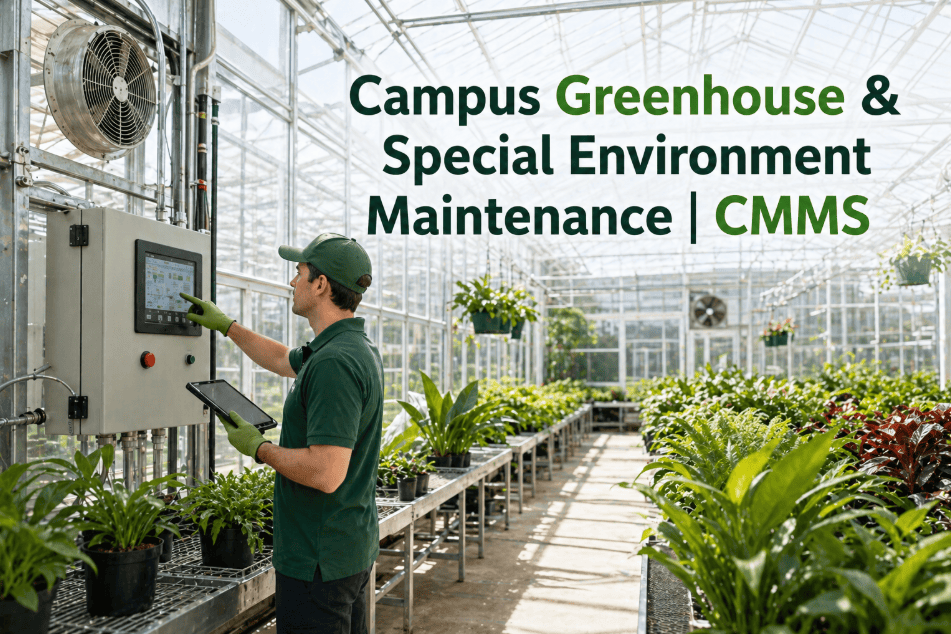
A research greenhouse running at 78°F with 65% relative humidity for tropical plant studies cannot deviate by more than 3°F or 8% RH without compromising six months of grant-funded research. A vivarium housing a federally regulated mouse colony loses USDA certification if HVAC fails for 90 minutes. A campus cleanroom drifts above ISO 7 particulate counts and the entire semiconductor research program halts until validation re-runs. These are not facilities — they are research instruments. Standard preventive maintenance schedules built for classroom HVAC will not protect them. This guide covers how purpose-built CMMS sensor monitoring and condition-based PM schedules keep campus greenhouses, cleanrooms, and vivariums operating within research-grade tolerances 24/7. Sign up for a free OxMaint account to evaluate against your specific environments.
Special Environment Maintenance · 2026
Greenhouse, Cleanroom & Vivarium Maintenance — Without Risking Research
Why standard campus PM programs fail special environments — and how CMMS sensor integration, environment-specific PM schedules, and audit-grade documentation keep research-critical facilities operating within tolerance year-round.
$2.4M
Avg. lost grant value per environment failure
90 min
USDA vivarium recovery window
3°F / 8%
Greenhouse research tolerance
ISO 7
Cleanroom particulate threshold
Three Environments — Three Completely Different Maintenance Standards
Each special research environment has its own physics, its own regulatory regime, and its own definition of "failure." A CMMS that treats them all like office HVAC will miss the failures that actually destroy research outcomes. The breakdown below shows what each environment requires, what it costs when it fails, and which sensors must report into your CMMS in real time.
Research Greenhouse
Plant biology · Crop research · Genetic studies
Temperature±3°F tolerance
Humidity±8% RH tolerance
CO2 levels400-1,500 ppm controlled
Light cyclesPhotoperiod-precise
IrrigationTied to plant lifecycle
If failure: $50K-$2M in destroyed research material per incident
Research Cleanroom
Semiconductor · Nanotech · Photonics labs
ParticulateISO 5-8 class controlled
PressurePositive differential
HEPA filters99.97% efficiency required
Air changes240-720 ACH
Static control±5% humidity range
If failure: 2-4 weeks of research validation re-runs to recertify
Vivarium Facility
Animal research · Federal-regulated colonies
Temperature68-79°F species-specific
Humidity30-70% RH controlled
Air changes10-15 ACH minimum
PressureNegative for biocontainment
HVAC redundancyN+1 required
If failure: 90-min recovery window, USDA AAALAC re-accreditation
The Sensor Stack That Must Report Into Your CMMS in Real Time
Standard reactive PM cycles fail special environments because failures unfold in minutes, not weeks. The CMMS must ingest sensor data continuously, evaluate against environment-specific thresholds, and trigger work orders before a deviation becomes a research-destroying excursion. Book a demo to see how OxMaint integrates with the sensor types below.
01
Temperature & Humidity Probes
Modbus / BACnet / OPC-UA · 30-second polling
Continuous T&H monitoring with deviation alerts before tolerance breach. CMMS auto-generates work orders when readings trend toward threshold for 3 consecutive cycles.
02
Particulate Counters
0.3μm / 0.5μm / 1.0μm channels · ISO 14644 reporting
Cleanroom particulate monitoring tied directly to ISO classification thresholds. Auto-flags HEPA filter loading at 80% of replacement curve to prevent breach.
03
Differential Pressure Sensors
±0.001" WC accuracy · Magnehelic-grade
Maintains positive (cleanroom) or negative (vivarium biocontainment) pressure differentials. Triggers technician dispatch the moment differential drops below threshold.
04
CO2 & Gas Sensors
NDIR detection · ppm-level accuracy
Greenhouse CO2 enrichment control and laboratory hazardous gas detection. Critical for plant research protocols requiring specific atmospheric compositions.
05
Light Spectrum & PAR Meters
Photosynthetically Active Radiation · μmol/m²/s
Greenhouse photoperiod and PAR monitoring tied to research protocols. CMMS schedules supplemental lighting maintenance based on actual usage hours, not calendar.
06
Backup Power & UPS Status
Generator runtime · ATS state · UPS load
Continuous monitoring of backup power systems with automated runtime testing schedules. Vivariums and research-critical environments require N+1 redundancy verification weekly.
Protect Your Research with Real-Time Environmental Monitoring
OxMaint integrates with all major sensor protocols — BACnet, Modbus, OPC-UA, MQTT — and ships with environment-specific PM templates for greenhouses, cleanrooms, and vivariums. Free tier with no time limit.
PM Schedule Comparison — Standard HVAC vs Special Environments
| Maintenance Task | Standard HVAC | Greenhouse | Cleanroom | Vivarium |
|---|
| HEPA filter inspection | N/A | Quarterly | Monthly + DOP test | Monthly + N+1 verify |
| Differential pressure check | Annual | Quarterly | Daily automated | Continuous + weekly audit |
| Temperature probe calibration | Annual | Quarterly | Quarterly | Quarterly + redundancy test |
| Backup power test | Quarterly load | Monthly | Monthly | Weekly + monthly full transfer |
| Air change rate verification | Annual | Bi-annual | Quarterly | Monthly |
| Particulate sampling | N/A | N/A | Monthly ISO 14644-2 | Quarterly |
| Humidity calibration | Annual | Quarterly | Quarterly | Monthly |
| Documentation requirement | Internal log | Grant audit-ready | ISO recertification | USDA AAALAC ready |
The Cost of Getting It Wrong — Real Numbers from Campus Research Facilities
$2.4M
Greenhouse Failure
Average lost research grant value when six-month plant biology study is destroyed by 12-hour temperature excursion. Plant material cannot be reconstituted.
$680K
Cleanroom Recertification
Cost to revalidate ISO 7 cleanroom after particulate breach: HEPA replacement, DOP testing, sampling, recertification, and 2-4 weeks of research downtime.
$1.8M
Vivarium AAALAC Loss
Cost of losing AAALAC accreditation: federal grant suspension, animal colony relocation, 6-12 month re-accreditation cycle, and reputation damage.
$95K
CMMS Annual Cost
Total annual OxMaint deployment for a research-intensive university covering all greenhouse, cleanroom, and vivarium facilities — a fraction of one failure.
Frequently Asked Questions
Why do standard campus PM schedules fail in special environments?+
Standard PM schedules are calendar-based — quarterly filter checks, annual calibrations, monthly inspections. Special environments fail in minutes, not months. A cleanroom HEPA filter that's "on schedule" for replacement next quarter can breach particulate thresholds today if loading reaches 80%. The fundamental shift is from calendar-based to condition-based maintenance — sensors report continuously, CMMS evaluates against environment-specific thresholds, and work orders generate automatically before tolerance is breached.
Try OxMaint free to evaluate condition-based PM for your facilities.
Can OxMaint integrate with our existing BAS or building automation system?+
Yes — OxMaint supports BACnet, Modbus, OPC-UA, and MQTT protocols natively, allowing direct integration with Siemens, Honeywell, Johnson Controls, Schneider, and Distech building automation systems. Sensor data flows into asset records, condition scoring updates automatically, and PMs trigger based on sensor thresholds rather than calendar dates. Integration typically takes 2-4 weeks for a research-intensive campus.
What documentation does OxMaint generate for AAALAC, USDA, or ISO audits?+
OxMaint generates audit-ready documentation including: complete PM history per asset with timestamps and technician signatures, calibration records with traceability, deviation logs with root cause and corrective action, sensor data exports for any time period, and digital signatures meeting 21 CFR Part 11 standards. AAALAC site visits, USDA inspections, and ISO 14644 recertifications all draw from the same audit trail.
How quickly can OxMaint generate work orders from sensor deviations?+
Sensor data ingestion is real-time (sub-30-second polling). Threshold evaluation runs continuously. When a 3-cycle deviation pattern is detected, work orders generate within 60-90 seconds, route to the on-call technician based on asset/zone assignment, and surface in the mobile app with full asset context, recent sensor history, and standard repair procedures.
Book a demo to see the workflow live.
Does OxMaint handle multiple environments at the same site?+
Yes — OxMaint's hierarchy structure (Portfolio → Property → System → Asset → Component) is designed for complex research campuses with multiple environment types. A single site can manage 12 greenhouses, 4 cleanrooms, and 2 vivariums under unified PM scheduling, with each environment running its own sensor thresholds, PM templates, and audit documentation requirements. Cross-environment reporting rolls up to portfolio level for facilities leadership.
Special Environment CMMS · Built for Research
Research-Grade Environmental Maintenance — Without the Risk.
OxMaint integrates with your sensor stack, runs environment-specific PM templates, and generates audit-ready documentation for AAALAC, USDA, and ISO inspections. Free tier with no time limit, no credit card required.
Real-time
Sensor monitoring & alerts
Audit-ready
AAALAC · USDA · ISO 14644
$8/u/mo
Paid plan after free tier
3-5 days
Live deployment timeline