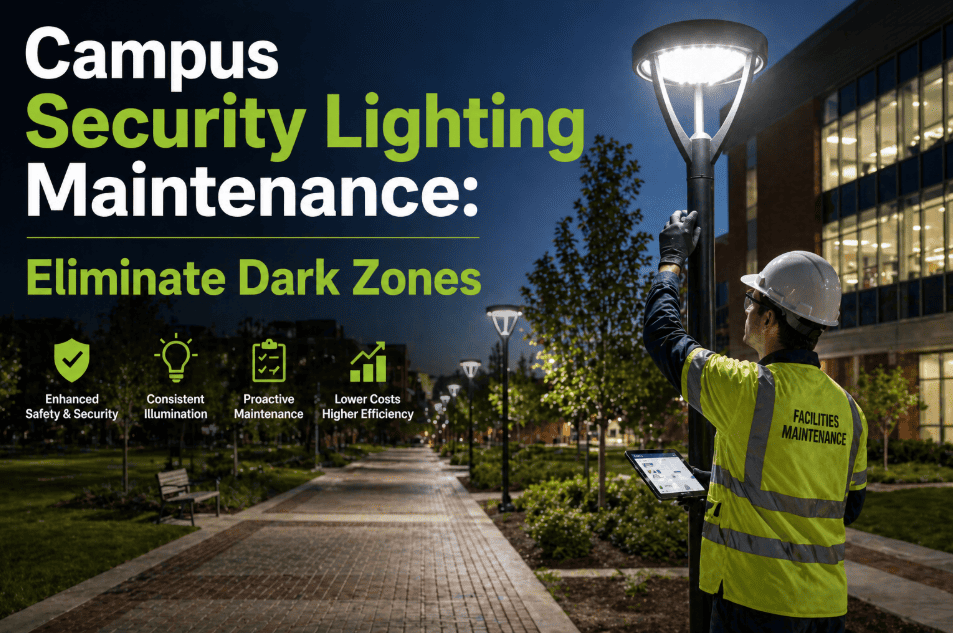
Campus Security Lighting Maintenance: Eliminate Dark Zones
By Jamie lanister on April 27, 2026
The Clery Act requires every U.S. campus to publish an annual security report — and crime statistics consistently correlate with lighting failures more than any other facility variable. A 2024 IES study found that pathways with illumination below 1.0 footcandle experienced 4.7× the assault rate of pathways at or above the IES recommended 5.0 footcandles. The fix is not complicated: keep the lights working. The execution is what fails. Most campuses have hundreds of pole lights, wallpacks, bollards, and pathway fixtures across hundreds of acres — and a single burned-out 250W metal halide on a side path at 11 PM creates the dark zone where the assault happens. Manual inspection cycles miss outages for days. By the time a student emails facilities about it, the institution already has Title IX exposure. A modern CMMS like OxMaint integrates with photocell sensors, scheduled night-walks, and student reporting portals to detect outages within hours and dispatch repairs before the next dark cycle.
Campus Security Lighting · Dark Zone Elimination
Eliminate Campus Dark Zones Before They Become Liability Events
CMMS-driven outage detection, IES-compliant illumination tracking, and sensor-triggered work orders that ensure every pathway, parking lot, and perimeter zone stays fully lit — every single night.
4.7×
Higher assault rate in dark zones below 1.0 fc
5.0 fc
IES minimum for campus pedestrian pathways
72 hrs
Avg detection time on manual inspection
2-4 hrs
Detection time with sensor-integrated CMMS
Visualizing Campus Lighting Status — Where Dark Zones Form
The diagnostic below shows how dark zones develop on a typical residential campus quad. Even with 95% of lights operational, the 5% of failed fixtures create gaps in continuous illumination — and those gaps cluster in predictable risk locations: side paths, parking lot perimeters, building backsides, and stair landings.
Typical Campus Lighting Coverage Map
Quad Center
8.4 fc
COMPLIANT
Main Pathway
6.2 fc
COMPLIANT
Library Approach
3.4 fc
DEGRADED
Dorm Entrance
12.1 fc
COMPLIANT
East Side Path
0.6 fc
DARK ZONE
Parking Lot A
5.8 fc
COMPLIANT
Lot A Perimeter
2.1 fc
DEGRADED
Recreation Center
7.2 fc
COMPLIANT
Stair Landing 4B
0.3 fc
DARK ZONE
Bus Stop Plaza
6.7 fc
COMPLIANT
Library Backside
2.8 fc
DEGRADED
Health Services
9.3 fc
COMPLIANT
Compliant: at or above IES minimum
Degraded: trending toward dark zone
Dark zone: critical liability exposure
The Four Lighting Failure Modes Your CMMS Must Catch
01
Lamp End-of-Life
42% of failures
Lamps reach rated life and either fail outright or degrade below threshold. Detection requires scheduled photometric inspection or sensor-based output monitoring. Scheduled group relamping at 80% of rated life eliminates this failure mode.
02
Driver/Ballast Failure
28% of failures
LED drivers and HID ballasts fail before lamp life — typically due to thermal stress, voltage transients, or moisture intrusion. CMMS tracks driver replacement separate from lamp replacement to predict failure curves.
03
Photocell & Control Failure
18% of failures
Photocells stick on or off, dimming controls fail, time clocks drift. Lights either don't activate at sunset or burn 24/7 wasting energy. CMMS sensor integration catches both conditions automatically.
04
Physical Damage & Vandalism
12% of failures
Vehicle strikes on poles, lens vandalism, stolen fixtures, weather damage. Photo-based reporting through student portal accelerates detection. CMMS routes to electrical contractors for pole replacement workflows.
IES Illumination Standards — The Compliance Targets
Campus Zone Type
IES Minimum (fc)
Avg/Min Ratio
Liability Risk if Below
Major Pedestrian Pathways
5.0 fc
3:1
High — Title IX, Clery Act, civil suit
Minor Pathways & Side Paths
2.0 fc
4:1
High — most assault risk locations
Parking Lots (Activity Level 4)
5.0 fc
4:1
High — vehicle break-ins, assaults
Parking Garage Interior
10.0 fc
4:1
Critical — enclosed space, low visibility
Building Entrances
5.0 fc
4:1
Moderate — face recognition for security cameras
Stairs & Steps
5.0 fc
3:1
High — slip/fall liability + assault risk
Bicycle Paths
2.0 fc
4:1
Moderate — accident liability
Sports/Athletic Field Perimeter
1.0 fc
6:1
Moderate — event-related crowd safety
The CMMS Detection Workflow — Sensor to Repair in 4 Hours
Manual lighting inspection cycles average 72 hours from outage to detection. Sensor-integrated CMMS workflows compress this to 2-4 hours — the difference between a single dark night and a documented liability gap. Book a demo to see the workflow live.
T+0 min
Sensor Detects Outage
Photocell, current sensor, or daylight harvesting controller reports fixture not drawing expected load at programmed activation time.
T+90 sec
CMMS Generates Work Order
Auto-generated WO with fixture ID, location, last service history, lamp model, and asset GPS coordinates. Routes to on-call electrical technician.
T+15 min
Technician Acknowledged
Mobile push notification, technician acknowledges, route plotted in mobile app. Spare lamp/driver pulled from vehicle stock or central storeroom.
T+2-4 hrs
Repair Complete & Verified
Technician completes repair, photo evidence uploaded, sensor verifies fixture back online. Asset record updated with new lamp install date and driver life clock reset.
Eliminate Dark Zones — Before Your Next Clery Report
OxMaint integrates with major lighting control systems (Lutron, Wattstopper, Acuity nLight, Cree CR Series), generates work orders from sensor outage events, and tracks IES compliance at the zone level. Free tier with no credit card required.
Documented lighting failure on a campus pathway preceding sexual assault. Settlements escalate when prior complaints about lighting were on file but unaddressed.
Slip-and-Fall Liability
$180K-$1.2M
Dark stair landings or pathways causing injury. Insurance typically caps at policy limit; institution carries excess. Maintenance records become the central evidence.
Insurance Premium Impact
+18-32%
Premium increase after documented lighting-related incidents. Compounds across renewal cycles for 5-7 years. Risk management score drops at the institutional level.
Clery Act Penalty
$67K/violation
Federal penalty per Clery Act reporting violation. Multiple violations from same lighting deficiency compound. Student safety section under increased federal scrutiny.
Frequently Asked Questions
Does OxMaint integrate with our existing lighting control system?+
Yes — OxMaint integrates with major commercial lighting control platforms including Lutron Quantum/Vue, Acuity nLight, Wattstopper Digital Lighting Management, Cree CR Series, Hubbell wiSCAPE, and Philips Dynalite. Integration uses BACnet, Modbus, or vendor APIs. Outage events flow into OxMaint as work order triggers, and PM history flows back to the lighting control system for energy reporting. Try OxMaint free to validate integration with your specific platform.
What about campuses without sensor-integrated fixtures?+
Many campuses still run pre-sensor lighting infrastructure. OxMaint supports a hybrid workflow: scheduled night-walk PMs assigned to public safety officers (who already patrol the campus at night), student/staff outage reports through a branded portal with photo upload, and energy meter integration to detect aggregate failures. The detection time is longer than full sensor integration (typically 24-48 hours vs 2-4 hours), but still drastically better than purely reactive maintenance.
How does OxMaint handle the Clery Act documentation requirement?+
OxMaint maintains complete maintenance history per fixture with timestamps, technician signatures, and photo evidence. Annual security report compilation pulls maintenance compliance metrics directly from the system: percentage of fixtures meeting IES standards, average outage detection time, repair completion rates, and corrective action turnaround. The Clery Compliance Officer accesses this data through a dedicated reporting view. Most campuses report cutting Clery report compilation time from 3-4 weeks to 5-7 days.
Can OxMaint schedule group relamping campaigns?+
Yes — group relamping is significantly more cost-efficient than spot replacements (40-60% labor savings). OxMaint tracks rated life per fixture, calculates the aggregate replacement curve, and schedules group relamping campaigns at 80% of rated life. The system handles parts ordering, contractor coordination if outsourced, route optimization across the campus, and post-campaign verification. Most campuses run group relamping every 3-5 years for HID and 8-12 years for LED. Book a demo to see the planning workflow.
How does the student/staff reporting portal work?+
OxMaint includes a branded, mobile-friendly reporting portal that students and staff access via a campus URL. Reports include location pin (auto from GPS or campus map selection), photo upload, optional comments. Reports route into the CMMS as work orders without needing the reporter to have a CMMS account. Anonymous submissions are supported (important for some incident types). Reporters get email/text updates when work is completed. Most campuses see 60-80% of dark-zone outages caught through the portal within 6 hours.
Campus Security Lighting · CMMS-Driven
Every Pathway Lit. Every Outage Caught. Every Night.
OxMaint integrates with your lighting controls, runs IES-compliant inspection schedules, generates work orders from sensor outages, and produces Clery-ready documentation. Free tier available — no credit card required.