Campus recreation centers serve 75% of enrolled students at major universities — yet 61% of recreation facility managers report deferred maintenance backlogs exceeding $2.1M per facility. From strength equipment that sees 14+ hours of daily use to climbing walls requiring biannual structural inspections, recreation centers demand a maintenance discipline that matches their intensity of use. When a cable machine fails mid-semester, it does not just create an inconvenience — it creates a liability event that traces directly to missed preventive maintenance. Oxmaint tracks every piece of strength equipment, every climbing wall anchor point, every court floor refinishing cycle, and every HVAC unit serving high-occupancy fitness spaces as individually scheduled assets with usage-based PM triggers. If your rec center maintenance is limited to "fix it when students complain," start a free trial or book a demo to see asset-level recreation facility PM in action.
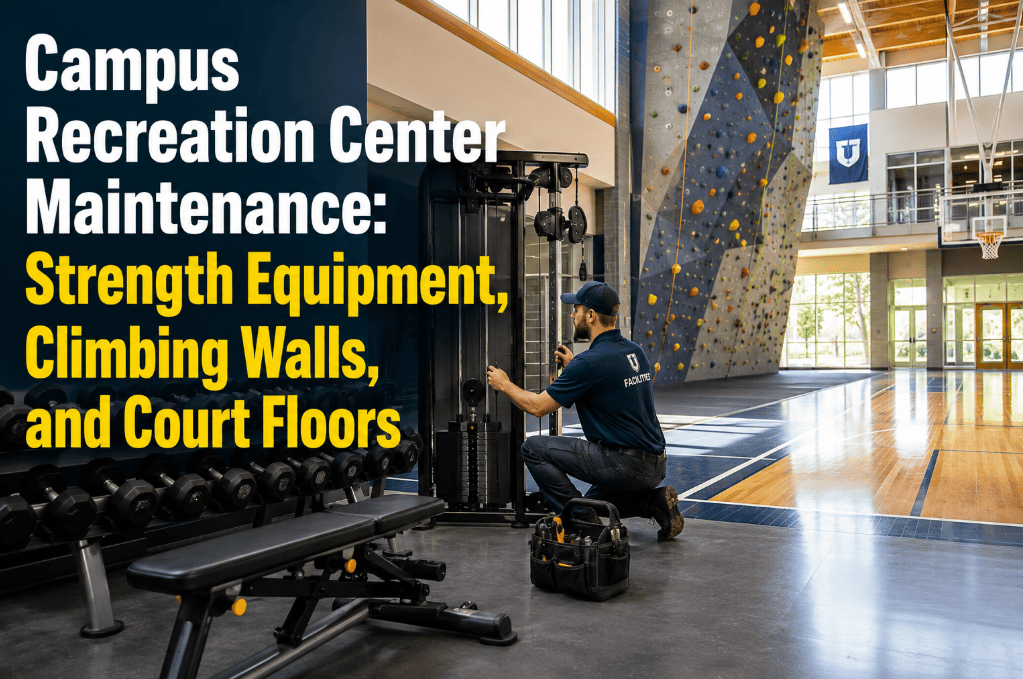
Campus Recreation Center Maintenance: Strength Equipment, Climbing Walls, and Court Floors
Recreation centers are the highest-traffic campus facilities outside dining halls. Equipment failure rates spike 340% without structured PM — and every unaddressed deficiency is a liability event waiting to happen.
Your Recreation Center Runs Harder Than Most Commercial Gyms — Does Your Maintenance Match?
A commercial gym averages 8–10 hours of daily equipment use. A campus rec center averages 14–16 hours across strength equipment, cardio machines, climbing walls, and court floors — with users who are less experienced and more aggressive with equipment than paying gym members. Every cable that frays, every climbing hold that loosens, every court floor plank that warps is both a maintenance failure and a liability exposure. Oxmaint gives you asset-level visibility into every piece of recreation equipment across your entire campus. Want to see how structured recreation PM works across strength, climbing, and courts — start a free trial or book a demo to configure it for your facilities.
The Six Maintenance Domains Inside Every Campus Recreation Center
A campus rec center is not a single facility — it is six distinct maintenance environments under one roof, each with different equipment types, different inspection cadences, different failure modes, and different liability profiles. CMMS-driven rec center maintenance treats each domain as a separately managed asset class.
Cable machines, plate-loaded equipment, free weight racks, Smith machines, and functional training rigs. Cables require inspection every 500 hours of use. Pulley bearings, weight stacks, upholstery, and structural welds all have separate failure modes. 38% of gym injury claims trace to equipment in poor repair condition.
Indoor climbing walls require biannual structural inspections per CWA (Climbing Wall Association) standards. Anchor bolts, T-nuts, hold tightness, auto-belay devices, and panel integrity all demand documented inspection cycles. A single loose hold or failed auto-belay is a catastrophic liability event — 92% of climbing wall incidents trace to maintenance gaps.
Hardwood, synthetic, and rubber court surfaces serving basketball, volleyball, badminton, and indoor soccer. Hardwood courts require annual refinishing, quarterly deep cleaning, and daily dust mopping. Moisture intrusion causes warping, buckling, and delamination — a $180,000 replacement cost that proper humidity management prevents entirely.
Pool pumps, chemical feed systems, filtration, heaters, and deck surfaces. Health department compliance requires daily water chemistry testing, weekly pump inspections, and monthly filter backwash or replacement. Pool mechanical room failures shut down the entire aquatic facility within hours — affecting swim teams, intramurals, and recreational swimmers simultaneously.
Recreation centers require 15–20 air changes per hour in fitness spaces — 3x the rate of standard classrooms. High-occupancy fitness rooms generate extreme humidity and CO2 loads. HVAC failures in rec centers cause air quality complaints within 30 minutes and health incidents within 2 hours. Filter replacement cycles are 40% shorter than standard campus buildings.
Treadmills, ellipticals, stationary bikes, rowing machines, and stair climbers. Belt tensioning, motor brush replacement, console calibration, and bearing lubrication each follow different PM intervals. Average cardio equipment lifespan in campus settings is 5–7 years with PM vs. 2–3 years without — a $420,000 lifecycle cost difference for a 60-unit cardio floor.
Six Maintenance Failures That Put Recreation Centers at Risk
Frayed cables under load create the highest-severity injury risk in any rec center. Cables on high-use machines degrade in as few as 8 months without inspection — yet 54% of campus rec programs lack scheduled cable inspection protocols. A single cable failure under a 200 lb load creates immediate injury and a liability claim averaging $87,000 in settlement costs.
Auto-belay devices require manufacturer-specified inspection intervals — typically every 500 uses or 6 months — with annual factory recertification. Campus climbing walls that skip these intervals face catastrophic fall risks. The CWA reports that 78% of serious climbing wall incidents at universities involve equipment that was overdue for inspection or recertification.
Hardwood court floors absorb moisture from below-slab vapor intrusion and above-surface humidity. Without monitoring, moisture content rises above the 12% threshold that triggers warping and buckling. A single warped court section costs $15,000–$45,000 to repair — a full court replacement runs $180,000–$350,000. Proper HVAC humidity control and sub-floor vapor barriers prevent 90% of these failures.
A group fitness room with 40 participants generates 4,800 BTU/hr of sensible heat and 160 liters of moisture per hour. When HVAC fails in these spaces, CO2 levels exceed 2,500 ppm within 25 minutes — causing headaches, dizziness, and documented health complaints. 23% of campus rec center work orders are HVAC-related, more than any other system category.
Treadmill motors in campus settings run 14+ hours daily — 2x the duty cycle they were designed for. Without quarterly belt tensioning and annual motor brush replacement, treadmills develop speed inconsistencies that cause falls. Campus rec centers without structured cardio PM replace their entire cardio fleet every 2.5 years instead of the 6-year lifecycle achievable with proper maintenance.
Chemical feed pump failures cause chlorine levels to drop below the 1.0 ppm minimum within 4 hours — creating a health department violation that closes the pool. pH control failures cause eye and skin irritation complaints that generate 15–30 student health center visits per incident. 67% of campus pool closures trace to chemical feed system maintenance failures, not structural issues.
How Oxmaint Manages Recreation Center Maintenance Across Every Domain
Oxmaint registers every strength machine, climbing wall anchor, auto-belay device, court floor zone, HVAC unit, and pool pump as individually tracked assets — each with its own PM schedule, inspection history, and compliance documentation. Campus recreation teams ready to eliminate reactive maintenance can start a free trial or book a demo.
Each cable machine, climbing anchor, auto-belay, treadmill, and court zone registered with serial number, install date, warranty status, and manufacturer PM specifications. No more spreadsheet tracking.
Auto-belay inspection at 500 uses. Cable inspection at 500 hours. Court refinishing at 12 months. The first threshold reached triggers the work order — nothing slips between usage and calendar gaps.
Mobile inspection checklists with photo capture, pass/fail fields, and digital signatures. Climbing wall inspections document every anchor point, hold, and auto-belay — creating the audit trail that insurance carriers require.
Every inspection, every repair, every component replacement timestamped and stored. When an incident occurs, Oxmaint provides the complete maintenance history that demonstrates due diligence — the documentation that reduces settlement exposure by 60–80%.
QR codes on equipment let students report issues directly into Oxmaint. Reports auto-route to the correct technician with asset history attached — converting "that machine is broken" into an actionable, prioritized work order with full context.
Condition scoring on every asset feeds a rolling replacement forecast. Know exactly when your cardio fleet, strength equipment, court floors, and climbing wall panels will need replacement — and budget for it years in advance instead of emergency capital requests.
Reactive Rec Center Maintenance vs. Oxmaint-Managed PM
Recreation Center Outcomes After Structured CMMS Implementation
Scheduled cable, pulley, and structural inspections catch failure points before they create injury events
Cardio and strength equipment lasts 5–7 years with PM vs. 2–3 years without — saving $420K per cardio floor cycle
Auto-triggered biannual structural inspections and daily visual checks documented in CMMS with zero missed cycles
Documented maintenance history reduces liability exposure and demonstrates due diligence in every incident review
Frequently Asked Questions
How often should climbing wall auto-belay devices be inspected?+
What is the most cost-effective PM investment for campus recreation centers?+
Can students submit equipment maintenance requests through Oxmaint?+
How does Oxmaint help with recreation center insurance requirements?+
Your Recreation Center Deserves the Same Maintenance Discipline as Your Academic Buildings
75% of your students use the rec center. Every piece of equipment, every climbing wall anchor, every court floor zone needs structured PM. Oxmaint delivers asset-level maintenance management — first work orders generated in week one.