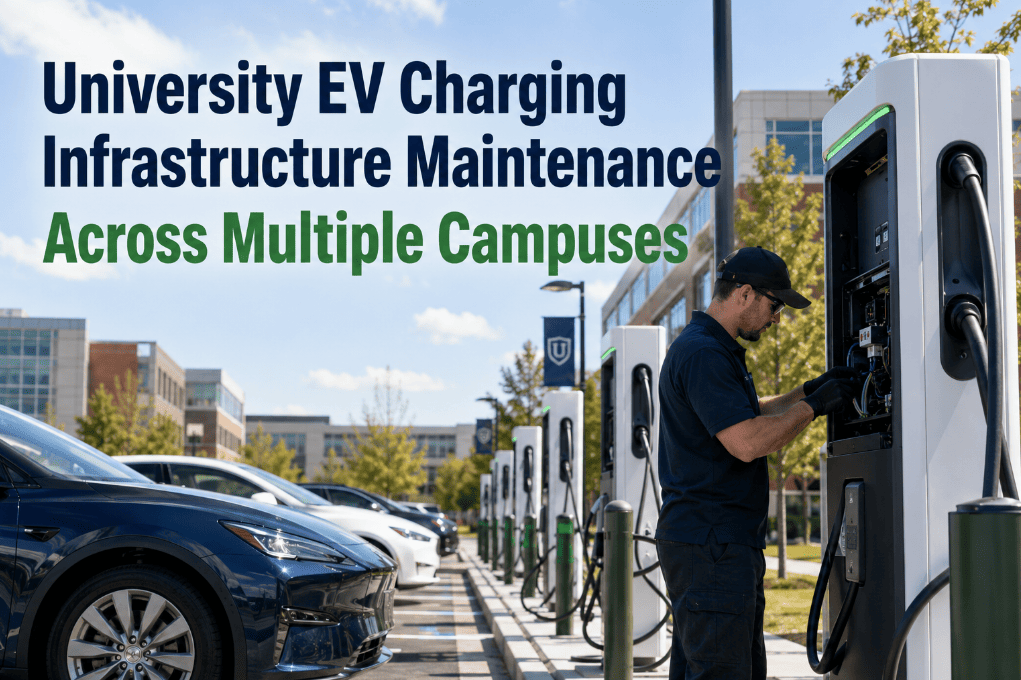
University EV charging stations average only 78% uptime across multi-campus networks — meaning 1 in 5 chargers is unavailable at any given time due to connector damage, communication faults, payment system errors, or electrical component failures. With campus EV adoption growing 42% year-over-year and universities committing to electrified fleets, charging infrastructure has become mission-critical campus utility, not an optional amenity. Yet 63% of university EV programs have no formal charger maintenance protocol beyond "call the vendor when it breaks." Oxmaint tracks every Level 2 pedestal, every DCFC unit, every EVSE connector, and every network controller as individually scheduled assets with uptime monitoring and SLA compliance tracking across all campus locations. If your EV charging maintenance strategy is reactive vendor calls, start a free trial or book a demo to see CMMS-managed EV infrastructure across your campuses.
University EV Charging Infrastructure Maintenance Across Multiple Campuses
Campus EV adoption is growing 42% year-over-year — but charger uptime averages only 78%. Structured EVSE maintenance turns charging infrastructure from an unreliable amenity into dependable campus utility.
An EV Charger That Does Not Work Is Worse Than No Charger at All
A broken EV charger does not just inconvenience one driver — it erodes confidence in the entire campus EV program. Faculty who arrive at a dead DCFC with 15% battery revert to gasoline vehicles permanently. Students who find broken Level 2 stations stop using campus charging and leave negative reviews that affect recruitment perception. The DOE's NEVI program sets a 97% uptime target for public charging — yet most campus networks operate 19 points below that threshold. Oxmaint bridges that gap with structured EVSE maintenance across every campus. Ready to bring your charger uptime above 97% — start a free trial or book a demo to configure your multi-campus EV network.
Six EV Charger Failure Patterns That Drive Campus Uptime Below 80%
J1772, CCS, and NACS connectors endure 8–15 daily insertion cycles in campus settings. Cable jacket abrasion, pin contamination, and latch mechanism wear cause intermittent charging failures and ground faults. Connector inspection every 30 days catches 89% of cable-related failures before they take the station offline.
OCPP and proprietary network connections drop due to cellular modem failures, SIM card issues, and firmware bugs. A charger with a dead network connection cannot process payments, report status, or receive remote commands — it appears "available" on the app but fails to initiate sessions. 31% of charger "outages" are communication issues, not hardware failures.
DC fast chargers contain power conversion modules rated for 50–350 kW. Thermal cycling, capacitor aging, and fan filter clogging reduce output power gradually — a 150 kW charger delivering only 80 kW charges take 87% longer but the station still shows "available." Without power output testing at PM intervals, degradation goes undetected for months.
Credit card readers, RFID scanners, and mobile payment integrations fail independently of charging hardware. A charger that works perfectly but cannot process payment is effectively offline for all users without network accounts. Payment system PM requires quarterly reader cleaning, firmware updates, and PCI compliance verification.
Breaker trips, transformer overloading, and ground fault interruptions account for 18% of charger downtime events. Campus electrical panels serving EV chargers require annual thermographic scanning to detect hot connections — a $150 inspection that prevents $12,000+ in electrical fire damage and multi-week charger outages.
Outdoor campus chargers endure weather exposure, UV degradation, ice damage, and vandalism. Screen damage, bollard impact, water intrusion, and cable theft create downtime events that require physical site visits to diagnose. Monthly physical inspection of outdoor units catches environmental damage before it cascades into electrical faults.
How Oxmaint Manages EV Charging Infrastructure Across Multiple Campuses
Oxmaint registers every EVSE unit — Level 2 pedestals, DCFC cabinets, connectors, network modules, and electrical panels — as individually tracked assets with location-specific PM schedules and SLA compliance tracking. Universities ready to achieve 97%+ charger uptime can start a free trial or book a demo.
Level 2 and DCFC units registered by campus, parking structure, lot, and stall number. Each unit tracked with make, model, connector type, install date, warranty status, and vendor SLA terms. Portfolio-level uptime reporting for administration.
ChargePoint, EVgo, Blink, and other vendor SLAs tracked per work order. Response time, resolution time, and parts availability documented — giving procurement the data to hold vendors accountable and renegotiate underperforming contracts.
Connector inspection monthly. Payment system testing quarterly. Electrical panel thermographic scan annually. Each PM type auto-scheduled and assigned to the correct technician or vendor based on scope and certification requirements.
Campus-level and portfolio-level uptime metrics updated from work order data. Identify which campuses, lots, and charger models have the lowest uptime — and allocate maintenance resources to the locations that need them most.
QR codes on each station let EV drivers report failures directly into Oxmaint. Reports include station ID, issue type, and optional photo — converting "the charger on level 3 is broken" into an actionable, routed work order with asset context.
Federal NEVI and state EV infrastructure grants increasingly require 97% uptime documentation. Oxmaint generates the maintenance and uptime records that demonstrate compliance — protecting grant funding that can exceed $500K per installation.
Reactive Vendor Calls vs. CMMS-Managed EV Infrastructure
EV Charging Outcomes After CMMS-Managed Infrastructure PM
Up from 78% average — meeting DOE NEVI reliability standards through structured PM and faster fault resolution
Scheduled quarterly PM at $280/unit prevents emergency service calls costing $3,800+ per incident with expedited parts
Proactive PM catches connector, payment, and communication failures before users encounter them
NEVI and state grant uptime documentation requirements satisfied with CMMS-generated compliance records
Frequently Asked Questions
How often should campus EV chargers be physically inspected?+
Can Oxmaint track vendor SLA compliance for ChargePoint or other EVSE providers?+
What uptime documentation do NEVI grants require?+
How does Oxmaint handle EV charger maintenance across multiple campuses?+
Your EV Program Is Only as Good as the Charger Uptime That Supports It
Every broken charger erodes confidence in campus electrification. Oxmaint schedules every connector inspection, tracks every vendor SLA, and documents every uptime metric — first PM work orders generated in week one.



![university-custodial-workloading-appa-levels-issa-612-cmms-mobile[1]](./manage-post-2k26/uploads/university-custodial-workloading-appa-levels-issa-612-cmms-mobile[1].png)
![university-sustainability-initiatives-carbon-tracking-scope-1-2-3-cmms[1]](./manage-post-2k26/uploads/university-sustainability-initiatives-carbon-tracking-scope-1-2-3-cmms[1].png)

