A school lab maintenance record is only valuable to the extent it can be produced on demand. When an OSHA inspector walks through a chemistry lab, the first question is rarely about the chemicals on the shelf — it is about the fume hood face velocity test from six months ago, the eyewash weekly activation log, the autoclave statutory inspection certificate, and the chemical hygiene plan revision date. A school district can have perfectly functioning equipment and still fail an inspection because the documentation does not exist or cannot be found. Worse, in any chemical-exposure injury claim, the absence of equipment maintenance records is treated as evidence of negligent operation under the prudent-person test. The federal Laboratory Standard (29 CFR 1910.1450) and ANSI Z358.1 specify what must be tested, on what frequency, and what must be documented. This page gives you the full record structure, the per-equipment inspection schedules, and the CMMS workflow that turns scattered paper into a single audit-ready trail. Build your lab equipment records in OxMaint or book a demo to see how districts manage lab compliance across multiple schools without binders or spreadsheets.
AI Predictive Maintenance
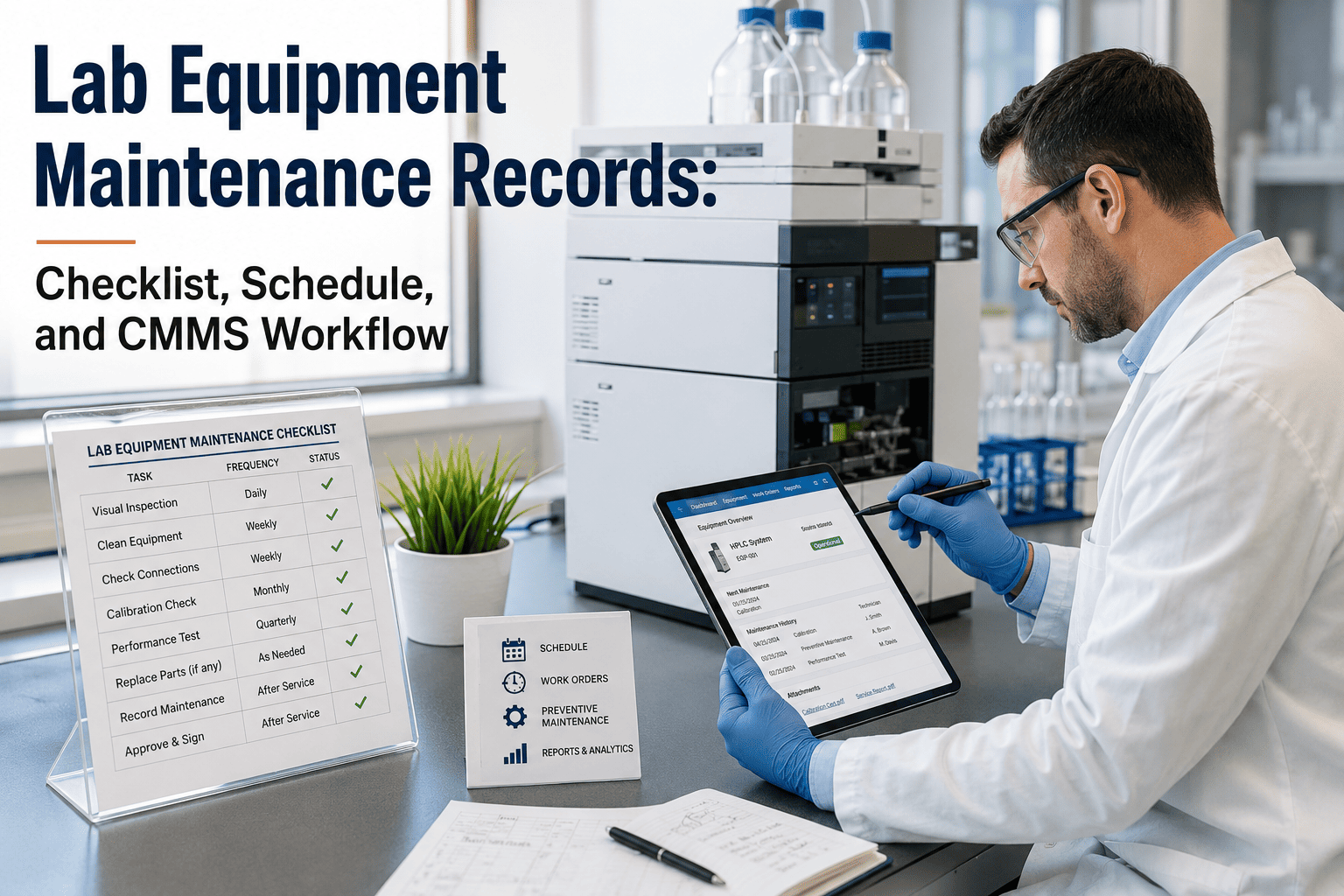
Lab Equipment Maintenance Records: Checklist, Schedule, and CMMS Workflow
Every fume hood test, every eyewash flush, every autoclave certificate — timestamped, attached to the equipment asset, and exportable in minutes for any inspection or claim.
100 fpm
minimum fume hood velocity
Weekly
eyewash flush required
14 mo
max LEV test interval
CHP
annual review required
What This Guide Covers
Before You Begin
Laboratory equipment maintenance is governed by OSHA 29 CFR 1910.1450, ANSI Z358.1 (eyewash and showers), NFPA 45 (lab fire safety), and ANSI/AIHA Z9.5 (lab ventilation). Items marked Certified require a credentialed technician or chemical hygiene officer. Items marked Record must be logged in the CMMS with date, reading, and signature — an untested fume hood with no record is treated the same as one that failed.
01
No Chemical Hygiene Officer (CHO) Assignment
OSHA requires a designated, named CHO with the training and authority to manage the chemical hygiene plan. Many districts have the role on paper but not in practice — and no record of training, plan reviews, or annual inspections gets produced.
02
Eyewash Stations Never Flushed
ANSI Z358.1 requires weekly activation to clear standing water and verify operation. An eyewash that has not been flushed for six weeks fails to deliver tepid water on the moment it is needed. Missed flushes are the most-cited audit finding in school labs.
03
Fume Hood Face Velocity Drift
A hood drawing below 80 fpm at the sash provides false protection while exposing the operator. Without scheduled six-monthly face velocity tests on a five-point grid, hood failure is detected after a chemical incident, not before.
04
Outdated Safety Data Sheets
Every chemical in the lab needs a current SDS within reach. Chemicals five years old, no longer in the curriculum, or without SDS are flagged for hazardous waste disposal. Inventories that do not reconcile with SDS files are the second-most-common citation.
Before Each Lab SessionTeacher and CHO Pre-Check
WeeklyANSI Z358.1 Activation Test
Every Lab Asset, Every Test, Every Signature
In OxMaint each fume hood, eyewash, shower, autoclave, gas valve, and biosafety cabinet is its own asset with manufacturer, install date, last test result, and full inspection history. Daily, weekly, six-monthly, and annual tasks auto-generate against each asset. When OSHA asks for last quarter's eyewash flush records, the CHO produces them in seconds.
Every Six MonthsFume Hood Face Velocity and LEV
AnnualChemical Hygiene Plan and Inventory
1
Immediate — First 15 Minutes
Eye or skin exposure: flush at eyewash or shower for at least 15 continuous minutes. Do not stop early. Call 911 for chemical exposure to eyes, large areas of skin, ingestion, or inhalation. Provide chemical name and current SDS to emergency responders.
2
Within 1 Hour — Document the Scene
Photo the affected workbench, chemical container, any spilled material, and the activated eyewash or shower. Pull the current SDS for the chemical involved. Note exposure duration, body areas affected, and treatment administered.
3
Within 24 Hours — Records Pull
Export from CMMS: last 12 months of eyewash and shower activation logs, last fume hood test certificate, chemical hygiene plan and revision history, CHO training record, and incident report. This is the defence package.
4
OSHA and Insurance Notification
Notify OSHA per recordable injury timeline. Provide insurance carrier with full records package. CHO leads internal investigation; corrective work orders generated for any control gap identified. CHP updated as needed.
Per-Equipment Assets
Every fume hood, eyewash, emergency shower, autoclave, biosafety cabinet, gas valve, and fire extinguisher is its own asset with manufacturer, install date, test history, and corrective work order log.
Auto-Scheduled Tests
Daily pre-session checks, weekly eyewash flushes, six-monthly fume hood face velocity tests, and annual CHP reviews are auto-generated as work orders against each asset. No item depends on a teacher remembering to do it.
Mobile Pre-Check
Science teachers complete the lab session pre-check on the mobile app — confirming fume hood status, eyewash access, and gas-tap position. Timestamped evidence that safety controls were verified before student exposure.
Chemical Inventory
Every chemical container is tracked with quantity, SDS link, storage location, and disposal date. Quantities update with use; alerts trigger when stock approaches NFPA 45 limits or when SDS approaches its review date.
Pass Certificates
Fume hood, autoclave, and other tested-equipment pass certificates upload against the equipment asset with next-due-date alerts at 60 and 30 days before expiration. No expired certificate ever gets found by an inspector first.
Audit Export
When OSHA, an insurance carrier, or district legal asks for proof of lab compliance, the CHO exports the full record package — eyewash flush logs, hood certificates, training records, CHP — in minutes, not days.
OSHA 1910.1450 requires testing at installation and after relocation or major repair. ANSI/AIHA Z9.5 recommends annual testing at minimum, with the UK COSHH framework requiring LEV examination within 14 months. Best practice for school hoods given continuous student use is every 6 months on a 5-point face velocity grid. Schedule all hood tests in OxMaint.
ANSI Z358.1 requires weekly activation of all eyewash and emergency shower stations for at least 3 minutes, with documented records. Annual inspection covers flow rate, water temperature within tepid range, signage, and access path. Missing weekly records disqualify the defence in any chemical exposure injury claim.
Blocked or obstructed eyewash and emergency shower stations — storage boxes, equipment carts, or temporary signage placed in front of stations is the first thing an OSHA compliance officer looks for. Second-most-cited: chemicals without current SDS, often inherited from prior staff and never reconciled to the active inventory.
Yes. Every lab asset at every school is tracked individually with its own inspection schedule, test history, and certificate archive. The district CHO sees compliance across every lab in one view; building leads see only their own equipment. Book a demo to see multi-school lab compliance tracking live.
OSHA 1910.1450 requires exposure measurement and medical consultation records to be retained for 30 years. Equipment test records, eyewash activation logs, and chemical hygiene plan revisions should be retained for at least 7 years for insurance and litigation purposes. OxMaint stores all records indefinitely against the equipment asset.
OxMaint CMMS — Laboratory Compliance
Audit-Ready Lab Records, Every Test, Every Day
Per-equipment maintenance schedules, ANSI Z358.1 eyewash logs, fume hood pass certificates, chemical inventory with SDS links, and a CHO dashboard — built for K-12 and higher education science labs.
Auto-scheduled daily, weekly, six-monthly, and annual lab tests per asset
Mobile pre-session checks with timestamped evidence before student exposure
Chemical inventory with SDS links and NFPA 45 quantity alerts
Full audit export for OSHA, insurance, and district legal in minutes