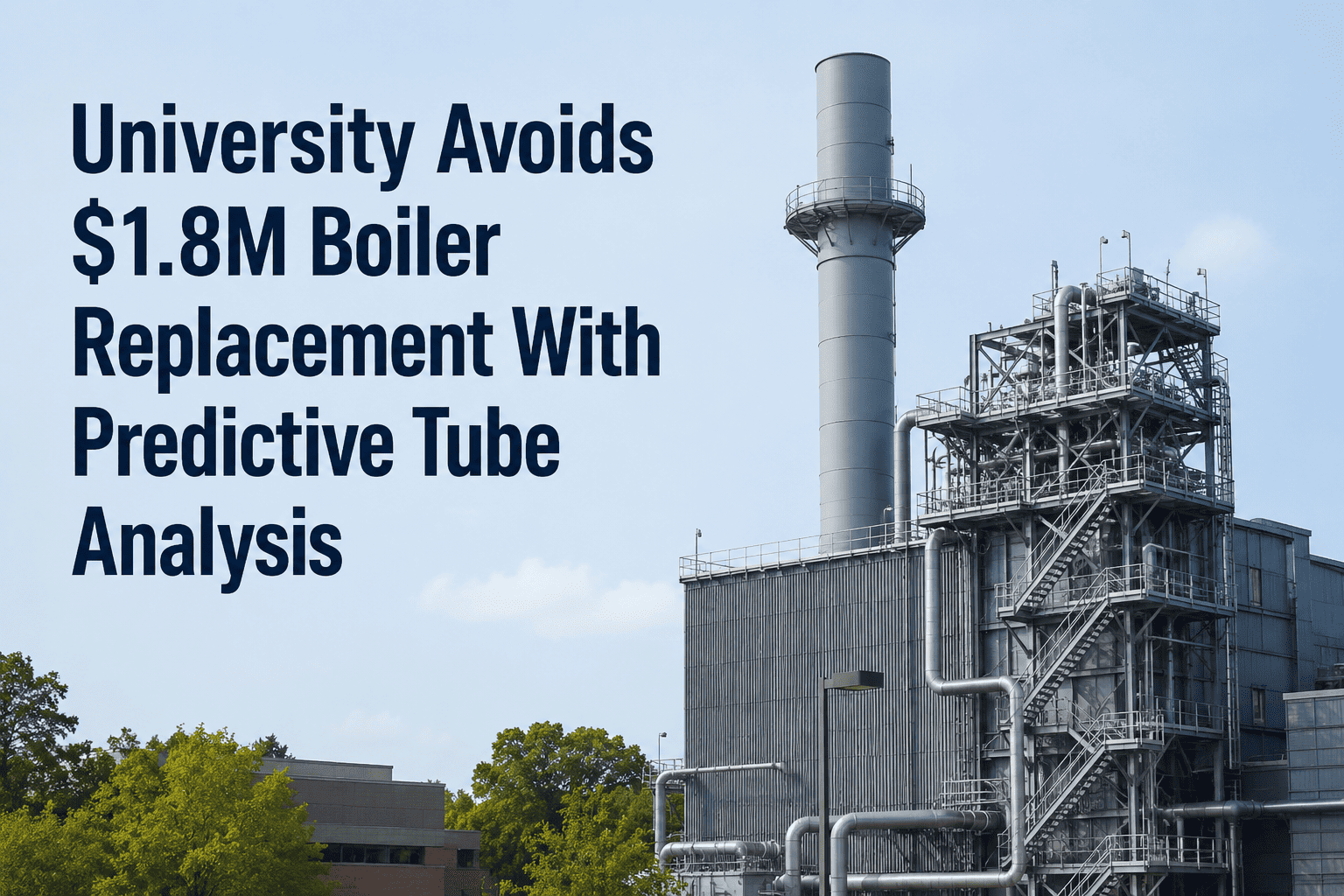
When a central plant engineer flagged unusual tube scaling patterns in three of the university's aging steam boilers, the conventional answer was capital replacement — a $1.8M line item that would have taken two years to procure and install. Instead, the facilities team deployed Oxmaint's predictive maintenance platform to run structured tube condition inspections, trend degradation data across maintenance cycles, and auto-schedule targeted interventions before failure thresholds were crossed. The result: a confirmed 7-year boiler life extension, zero unplanned shutdowns across four heating seasons, and $1.8M in deferred capital expenditure. If your institution is weighing boiler replacement costs against a predictive maintenance investment, Sign Up Free to see how Oxmaint maps inspection data to asset life decisions. Already managing a central plant with aging infrastructure? Book a Demo to walk through a live boiler PM compliance scenario.
See how Oxmaint turns boiler inspection data into capital avoidance — built for university central plants and multi-facility campuses.
The Challenge: Aging Boiler Infrastructure With No Predictive Visibility
3
Steam boilers flagged for potential early replacement
$1.8M
Capital replacement cost initially projected by procurement
0
Structured tube degradation records available at baseline
4 Seasons
Of heating reliability at stake with no intervention data
The university's central plant operated three high-pressure steam boilers — each over 18 years old — supplying heat and domestic hot water across a residential and academic campus. Tube scaling, pitting, and early-stage corrosion had been noted in annual inspections, but no structured condition trending existed. Maintenance records were paper-based and stored by season, not by asset. Without longitudinal tube condition data, facilities leadership could not determine whether the boilers were approaching end-of-life or had years of serviceable operation remaining under a proper PM regime. The institution faced a binary decision: spend $1.8M on replacement or continue running assets whose degradation trajectory was unknown. Oxmaint gave them a third option — measure, intervene, and extend.
The Solution: Oxmaint Predictive Maintenance and Tube Condition Tracking
01
Structured Tube Inspection Checklists With Digital Records
Oxmaint's inspection module deployed boiler-specific tube condition checklists — capturing scale thickness readings, corrosion zone mapping, water chemistry observations, and technician sign-off on every inspection cycle. For the first time, each boiler had a complete, timestamped inspection history in a single asset record rather than scattered paper logs.
02
Degradation Trending Across Maintenance Cycles
Condition data from each inspection populated Oxmaint's asset health timeline, allowing the facilities team to trend tube degradation rates across quarterly and annual cycles. The platform surfaced which boiler sections were deteriorating faster than expected and which remained within acceptable operating parameters — giving engineers the data to argue against blanket replacement.
03
Automated PM Scheduling for Chemical Treatment and Tube Cleaning
Oxmaint auto-scheduled water chemistry testing, chemical descaling treatments, and tube brushing intervals based on manufacturer guidance and observed scaling rates. Work orders were assigned to qualified technicians before intervals lapsed — eliminating the deferred maintenance that had accelerated prior degradation and caused the replacement recommendation in the first place.
04
Compliance Documentation for Insurance and Regulatory Audits
Every inspection, treatment, and repair was captured in Oxmaint with technician credentials, timestamps, and condition photos. The CMMS generated audit-ready compliance reports for the state boiler inspection board and the university's property insurer — replacing the manual binder assembly that previously consumed 3–4 days of administrative labor before each inspection cycle.
Implementation: From Replacement Decision to 7-Year Life Extension
| Phase |
Timeframe |
Action |
Outcome |
| Asset Setup |
Week 1–2 |
Boiler assets entered in Oxmaint; historical paper inspection data digitized; baseline tube condition photographed and recorded |
Complete asset record established; degradation baseline quantified per boiler section |
| Inspection Rollout |
Week 3–5 |
Tube inspection checklists deployed; technicians onboarded to mobile app; first structured inspection cycle completed across all three boilers |
Condition data collected; two boilers confirmed stable; one boiler identified for targeted descaling intervention |
| PM Schedule Activation |
Week 6–8 |
Automated work orders generated for chemical treatment, tube brushing, and water chemistry testing; compliance PM windows configured |
PM completion rate reached 96% in first semester; zero missed chemical treatment cycles |
| Year 1 Assessment |
Month 12 |
Annual boiler inspection completed with full Oxmaint-generated history; tube condition trended against baseline |
Degradation rate confirmed below replacement threshold; replacement decision formally deferred; insurer notified of structured PM program |
| Year 2–4 Optimization |
Ongoing |
Inspection intervals adjusted based on observed degradation data; targeted tube bundle replacement on one boiler section ($47K partial repair vs. $1.8M full replacement) |
All three boilers operational; 7-year life extension confirmed by independent boiler engineer; $1.8M capital avoidance documented |
The program required no outside contractors beyond the independent boiler engineer retained for the Year 1 assessment. Existing maintenance staff executed all inspection and treatment work orders through the Oxmaint mobile app — capturing condition data that directly supported the decision to extend rather than replace. Facilities leadership presented the Oxmaint asset history as evidence to both the CFO and the state inspection board. Book a Demo to see how Oxmaint structures boiler inspection and PM compliance documentation for capital decision support.
Results: Four Heating Seasons, Zero Unplanned Shutdowns, $1.8M Saved
$1.8M
Capital expenditure avoided
Full boiler replacement deferred through documented PM compliance and condition trending
7 Years
Confirmed boiler life extension
Verified by independent boiler engineer using Oxmaint inspection history as primary evidence
96%
PM completion rate on boiler work orders
Up from an estimated 40% under the prior paper-based schedule — no missed chemical treatment cycles
0
Unplanned boiler shutdowns across 4 heating seasons
Compared to 2–3 reactive shutdowns per season under the previous maintenance regime
$47K
Targeted partial repair cost
One tube bundle replaced on a single boiler section — replacing what would have been a $1.8M full capital project
3–4 Days
Eliminated per inspection cycle in admin labor
Compliance documentation generated automatically from Oxmaint — no manual binder assembly before audits
Key Business Impact for University Central Plant Operations
Capital Avoidance With Data Evidence
The $1.8M replacement recommendation was reversed by condition data, not by assumption. Oxmaint's inspection history gave the facilities team a documentable evidence base that satisfied the CFO, the board of trustees, and the state inspection authority. The decision to extend was a data-driven conclusion, not a budget-driven gamble.
Heating Reliability Across Campus
With zero unplanned boiler shutdowns across four consecutive heating seasons, residential and academic operations ran without interruption. The prior reactive shutdown pattern — averaging two to three events per year — had driven emergency contractor costs and student complaint volumes that now became non-issues.
Regulatory and Insurance Confidence
State boiler inspections passed without findings for the first time in six years. The property insurer acknowledged the structured PM program in the renewal assessment. Compliance PMs for high-pressure vessel regulations were documented with full technician credentials and condition photography — eliminating the risk of citation or coverage dispute.
Predictive Maintenance ROI at Platform Cost
The Oxmaint platform investment returned measurable ROI within the first fiscal year based on capital deferral alone — before accounting for avoided reactive maintenance costs, reduced emergency contractor spend, and recaptured administrative labor. For a public institution operating under fixed facilities budgets, the financial case required no projection modeling.
"We were days away from issuing an RFP for boiler replacement when we pulled the first six months of Oxmaint inspection data and put it in front of our boiler engineer. He told us two of the three units had years of life left with the right PM program in place. That data changed a $1.8 million decision. That's the whole story."
— Associate Vice President for Facilities, Public Research University
Boiler replacement decisions should be driven by inspection data, not deferred maintenance anxiety.
Sign Up Free and deploy Oxmaint's predictive maintenance platform across your central plant assets in under two weeks. Have a specific boiler or central plant challenge?
Book a Demo to scope a PM compliance program with a facilities CMMS specialist.
Frequently Asked Questions
Can Oxmaint track boiler tube condition data across multiple inspection cycles?
Yes. Oxmaint stores structured inspection records — including scale readings, corrosion zone notes, and condition photos — against each asset over time, enabling trend analysis across any number of maintenance cycles.
Does Oxmaint support compliance documentation for state boiler inspection requirements?
Yes. Inspection records, technician credentials, PM completion history, and condition documentation are stored in the CMMS and exportable as audit-ready compliance reports for state and insurance requirements.
How quickly can a university central plant deploy Oxmaint for boiler PM tracking?
Most central plant deployments complete asset setup, checklist configuration, and technician onboarding within two to three weeks using Oxmaint's bulk import tools and onboarding support team.
Can Oxmaint auto-schedule chemical treatment and descaling work orders based on observed conditions?
Yes. PM intervals for chemical treatment, tube brushing, and water chemistry testing are configured in Oxmaint and generate work orders automatically — ensuring no treatment cycle is missed regardless of shift changes or personnel turnover.
How does Oxmaint help justify deferred capital replacement to university leadership?
Oxmaint generates asset health timelines with inspection history, PM compliance rates, and condition trending data — giving facilities teams a structured evidence base for capital deferral recommendations that satisfies CFO, board, and regulatory review.
Book a Demo to see a sample capital avoidance report.
Is Oxmaint suitable for managing both boiler and broader central plant assets on one platform?
Yes. Oxmaint manages boilers, chillers, cooling towers, AHUs, pumps, and all central plant assets in a single CMMS with unified inspection, PM scheduling, and compliance tracking.
Sign Up Free to explore the full asset management capability.
This university avoided a $1.8M boiler replacement and extended asset life by 7 years — using the same maintenance team, no capital investment, and an Oxmaint deployment completed in three weeks. Predictive tube analysis, automated PM scheduling, and audit-ready compliance documentation give university central plant teams the data to make the right call before the wrong one gets made for them.