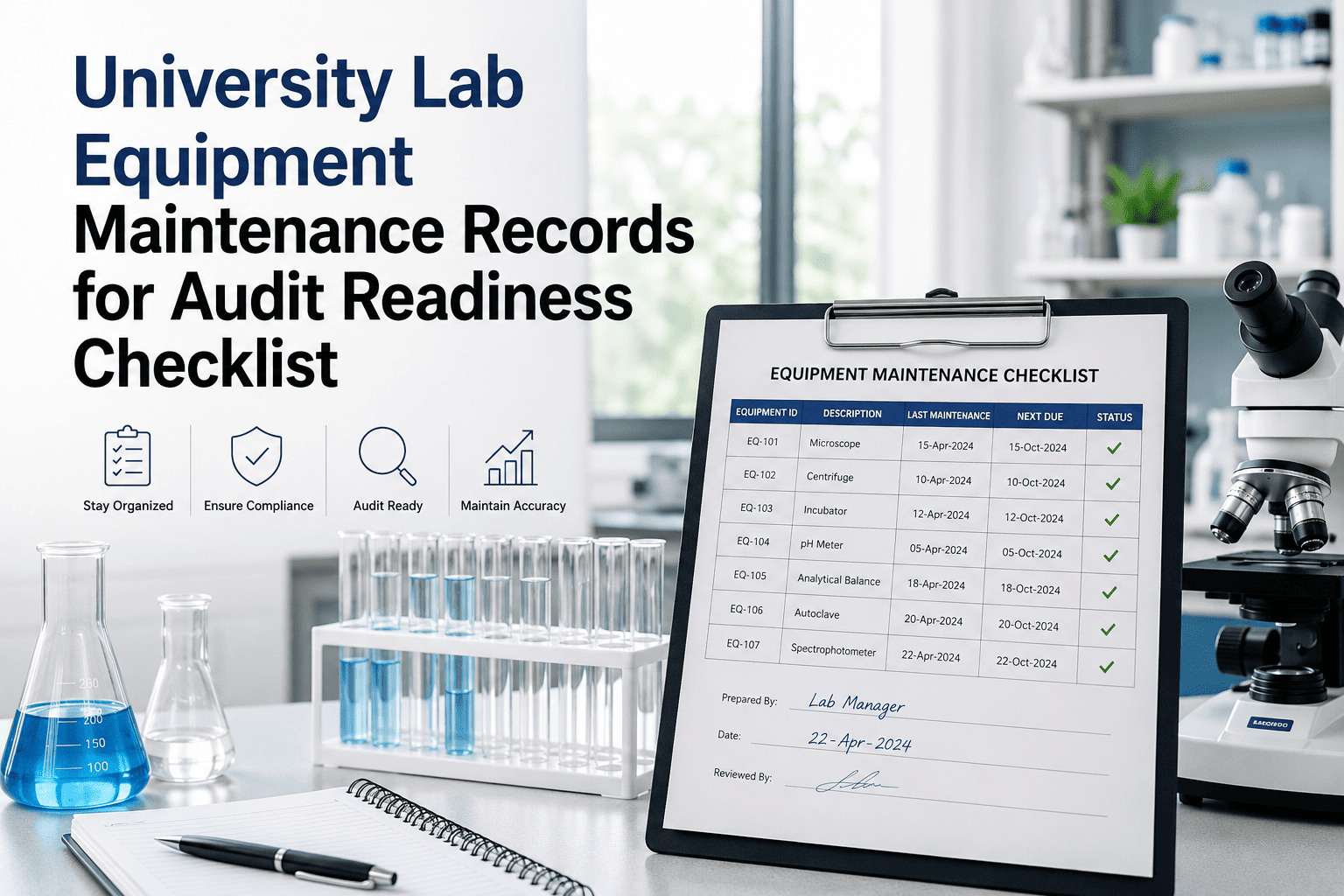
University Lab Equipment Maintenance Records for Audit Readiness Checklist

By Corin Hale on June 24, 2026

university-lab-equipment-maintenance-records-for-audit-readiness-checklist

An accreditation auditor or CLIA surveyor doesn't ask whether your lab equipment works — they ask for proof, in the form of a record, that it was calibrated, maintained, and verified on schedule. Universities running research, teaching, and clinical labs often manage thousands of instruments across multiple buildings, and a single missing calibration certificate can stall an accreditation review. This checklist lays out exactly what an auditor expects to find and what your records system needs to produce on demand. If your lab equipment records still live across spreadsheets, binders, and individual PI folders to centralize every calibration and maintenance record, or book a demo to see your audit readiness in one view.

Laboratory Maintenance

Lab Equipment Audit Readiness Checklist

What CLIA, ISO/IEC 17025, GMP, and CAP assessors expect to find when they ask for proof of equipment calibration and maintenance.

What an Auditor Actually Asks to See

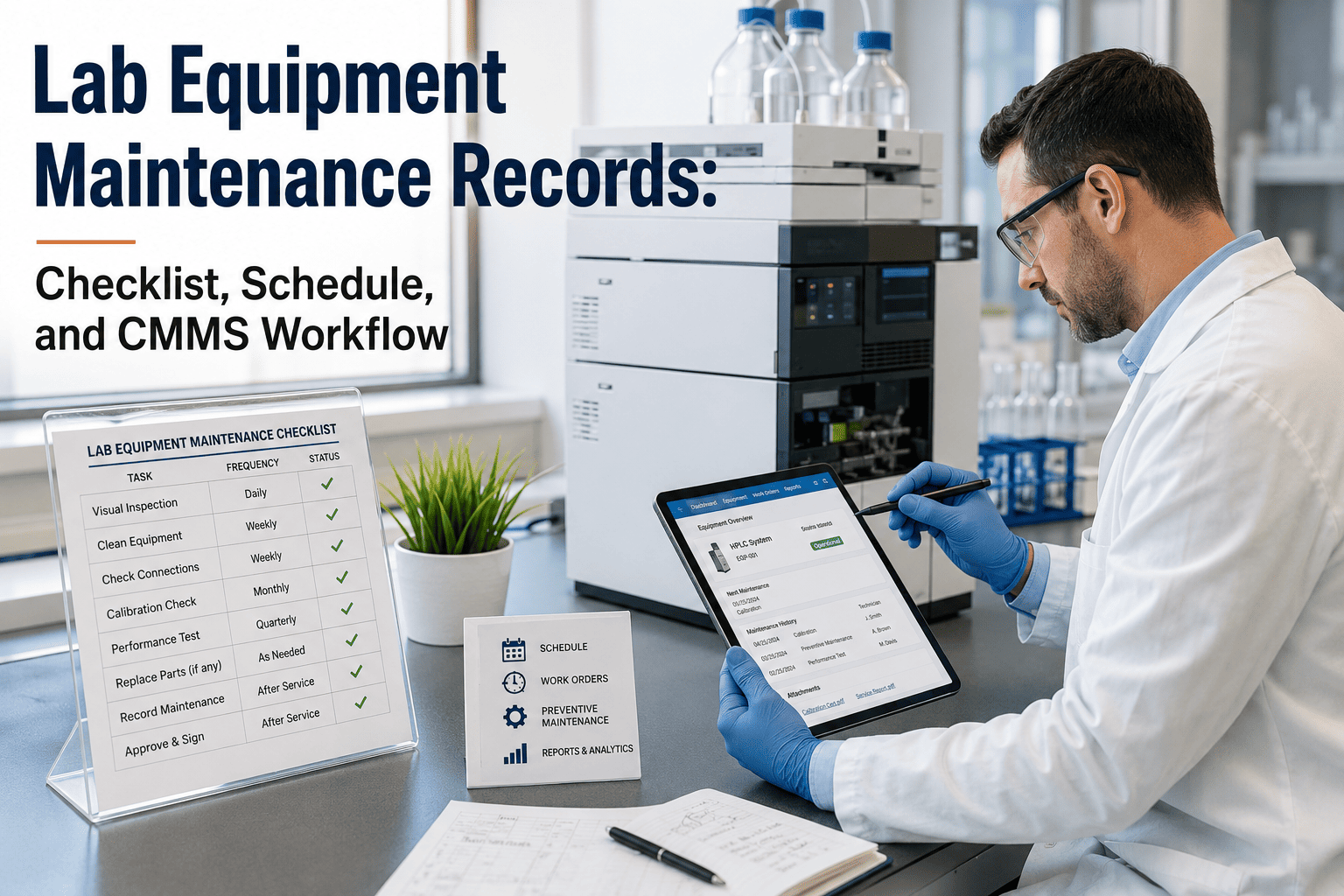
Across CLIA, ISO/IEC 17025, GMP, and CAP frameworks, the documents an assessor requests are remarkably consistent. The institutions that struggle during a review aren't usually the ones with broken equipment — they're the ones who can't locate the record proving the equipment was ever serviced. Run through the checklist below before your next review.

Document Group 1
Calibration Certificates
Every certificate is dated, signed, and linked to a specific instrument ID
Calibration is traceable against a recognized standard, not a generic equipment type
No certificate is missing, expired, or unverifiable for any in-service instrument
Document Group 2
Preventive Maintenance Logs
Every scheduled service is timestamped with a named technician
The work performed is described in enough detail to reconstruct what happened
Logs are retrievable per instrument, not buried in a general maintenance folder
Document Group 3
Corrective Action Records
Every failed calibration has a documented root cause
The affected test period is identified and reviewed
The resolution and repeat verification outcome are recorded in one linked chain
Document Group 4
Staff Training Records
Every technician who calibrated or serviced an instrument has a current competency record
Training records are easy to retrieve alongside the related maintenance log
Refresher training dates are tracked, not assumed current indefinitely
Pull Every Record an Auditor Will Ask For — In Seconds

OxMaint stores calibration certificates, maintenance logs, and corrective actions against each instrument's permanent record, searchable and exportable the moment a review begins.

Where Audit Findings Most Often Originate

The same handful of nonconformities appear again and again across laboratory inspections. Knowing where reviewers look first lets a lab operations team get ahead of the finding rather than explaining it after the fact.

Documentation
Incomplete records, missing revisions, or calibration history that can't be traced back to a specific instrument.
Equipment
Overdue calibration windows, missing maintenance logs, or performance checks never formally verified.
Personnel
Outdated or missing competency records for staff who performed calibration or maintenance work.
Data Integrity
Records that aren't attributable, contemporaneous, or accurate under ALCOA+ data integrity expectations.

Record-Keeping Standard by Framework

Framework Core Requirement Typical Review Frequency
CLIA 42 CFR Part 493 Documented calibration verification and corrective action Biennial survey cycle
ISO/IEC 17025 Traceable calibration linked to measurement uncertainty Annual surveillance, triennial reassessment
CAP Accreditation Instrument-specific maintenance and QC documentation Biennial inspection cycle
GMP / GLP Full audit trail with technician sign-off per task Ongoing self-inspection plus external audit

Frequently Asked Questions

What is the most common reason a university lab fails an audit?
Missing or unverifiable records, not broken equipment. An instrument calibrated on time but lacking a retrievable certificate creates the same finding as one never calibrated.
How long should calibration and maintenance records be retained?
Retention varies by framework and instrument type, so check your accreditation body's requirement, but most institutions retain records for the instrument's life plus several years.
Can a spreadsheet meet audit documentation requirements?
It can technically work, but spreadsheets lack version history and automatic linkage between an instrument, its certificate, and the technician who performed the work.
What does ALCOA+ require for calibration data integrity?
Records must be attributable, legible, contemporaneous, original, and accurate, meaning data should be entered in real time by an identifiable person.
Does OxMaint support multiple accreditation standards for one instrument?
Yes — a single instrument can be tracked under more than one standard simultaneously. Book a demo to see this set up for your lab portfolio.
Walk Into Your Next Audit With Every Record Already Organized

Stop reconstructing calibration history the week before a review. OxMaint keeps every certificate, log, and corrective action tied to its instrument from day one.
Share This Story, Choose Your Platform!