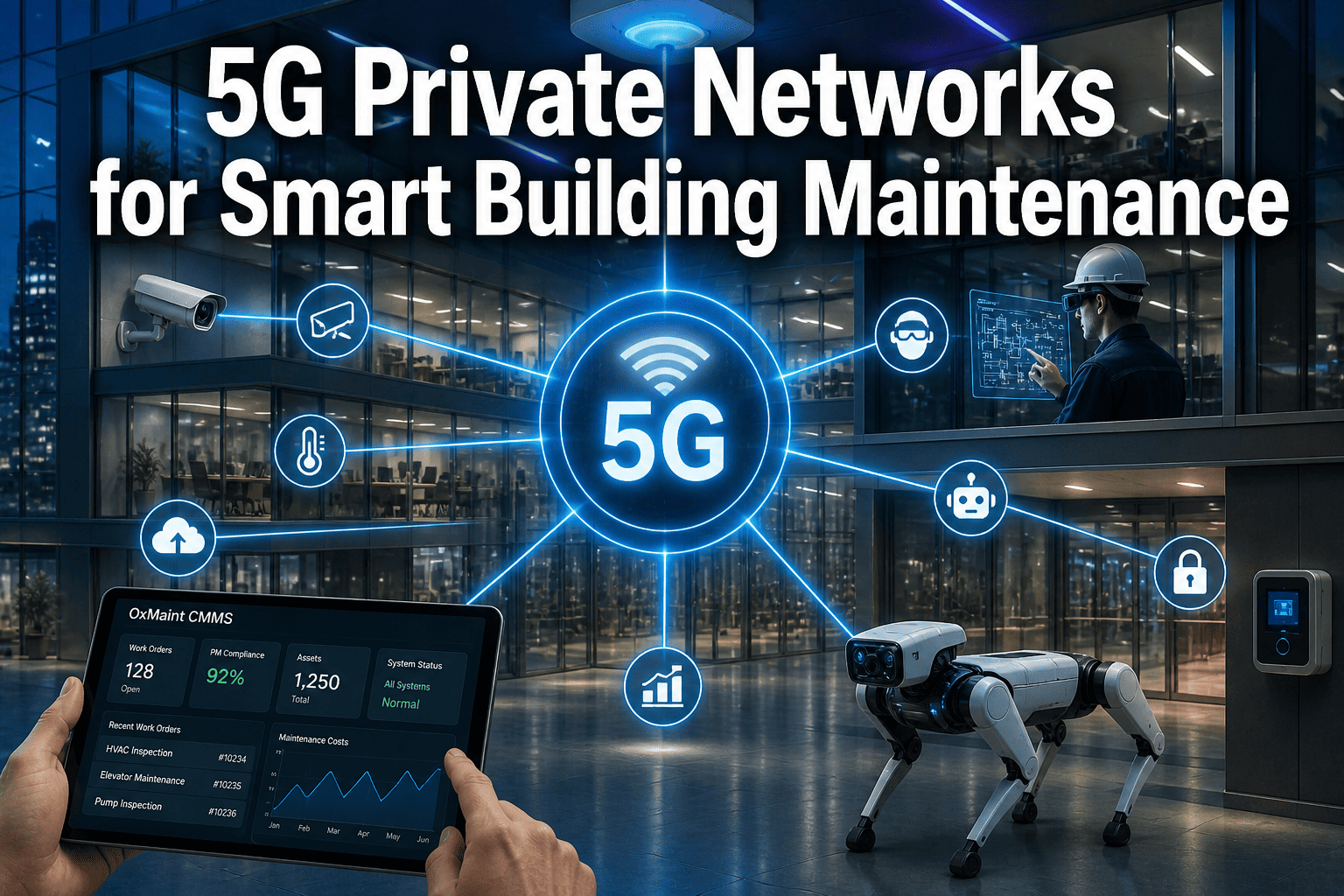
Wi-Fi works well for email. It does not work well for 200 IoT sensors streaming vibration data in real time, an AR-assisted technician inspecting a rooftop unit, and an autonomous inspection robot navigating a basement — all simultaneously. Private 5G networks solve the connectivity gap that has held smart building maintenance back from reaching its full potential. With the global private 5G market projected to grow from $4.5 billion in 2025 to over $195 billion by 2035, the infrastructure shift is already underway — and the facilities teams adopting it earliest are gaining a decisive operational edge.
5G Private Networks for Smart Building Maintenance
Private 5G gives facility teams real-time sensor coverage, AR-assisted maintenance, robot deployment, and CMMS integration — all over a secure, dedicated network that Wi-Fi cannot match.
5G vs. Wi-Fi: What Changes for Facility Maintenance
Most facility teams underestimate how much their network infrastructure limits what their maintenance technology can do. Private 5G is not just faster Wi-Fi — it is a fundamentally different architecture that enables use cases that Wi-Fi cannot reliably support.
| Capability | Wi-Fi 6 | Private 5G | Impact on Maintenance |
|---|---|---|---|
| Latency | 5–100ms (variable) | 1–5ms (consistent) | Real-time robot & AR control |
| Device Density | ~100 devices/AP | 1M+ devices/km² | Full IoT sensor coverage |
| Coverage | Indoor only, gaps | Campus-wide, basement to roof | No blind spots in monitoring |
| Security | Shared spectrum, SSID-based | SIM/eSIM auth, dedicated | OT/IT separation, zero intrusion |
| Reliability | Interference-prone | Mission-critical SLA | Continuous uptime for sensors |
| Mobility | Handoff drops common | Seamless handover | Mobile tech carts, AGVs |
5 Ways Private 5G Transforms Building Maintenance Operations
A large commercial building might need 500–2,000 sensors monitoring HVAC performance, vibration, temperature, water leak detection, and electrical load. Wi-Fi architecture was not designed for this density. Private 5G supports massive machine-type communications at scale — every sensor streams continuously without contention, network slicing, or dead zones. OxMaint ingests this data in real time, triggering condition-based work orders the moment a threshold is crossed rather than waiting for a scheduled inspection to find the problem.
Augmented reality maintenance — where a technician views live equipment data, repair instructions, and remote expert guidance overlaid on the physical asset — requires sub-5ms latency and high bandwidth simultaneously. Public Wi-Fi cannot sustain this reliably. Private 5G can. Lufthansa Technik's Hamburg facility deployed AR-assisted maintenance over a private 5G network from Ericsson and Vodafone, enabling real-time quality inspections that previously required specialist travel. The same model applies to commercial HVAC, electrical panels, and building automation systems — OxMaint surfaces the work order context directly into the AR interface.
Robotic inspection platforms — walking assets like Boston Dynamics SPOT — require continuous, low-latency connectivity to navigate autonomously and stream sensor data without interruption. Hitachi Rail deployed SPOT over a private 5G network at their Hagerstown facility to inspect train cars, replacing manual walkaround inspections with AI-powered continuous monitoring. In commercial buildings, the same approach covers roof inspections, mechanical room walkthroughs, and basement infrastructure checks — with OxMaint receiving inspection data automatically and creating work orders for any anomalies detected.
Edge computing — processing data locally before sending it to the cloud — is most valuable when it is paired with a network that can handle the volume and speed of raw sensor output. Private 5G enables edge computing architectures where vibration analysis, thermal imaging, and electrical monitoring are processed on-site in milliseconds. This means anomaly detection happens in real time, not minutes later. OxMaint's CMMS receives the processed alert and generates a prioritized work order before a technician would have otherwise noticed anything wrong — shifting from reactive repair to true predictive intervention.
Building automation systems — BMS, SCADA, HVAC controls — operate on operational technology (OT) networks that facility managers are rightly cautious about connecting to corporate IT networks or public Wi-Fi. Private 5G resolves this with network slicing: creating isolated, dedicated virtual networks for OT traffic that share physical infrastructure but remain logically separated from IT. CMMS data can flow securely from sensors through OT slices into OxMaint's cloud platform without exposing building control systems to corporate or external network threats.
Ready to Connect Your Building's Sensor Network to a CMMS?
OxMaint's cloud CMMS platform integrates with IoT sensor streams — regardless of whether they run over Wi-Fi, private 5G, or LoRaWAN — and converts real-time building data into actionable maintenance workflows automatically.
How to Evaluate Private 5G for Your Facility
Private 5G is not right for every building. The decision depends on footprint, device density, use case requirements, and budget. This framework helps facility managers assess whether the investment makes sense for their portfolio.
We piloted private 5G across two floors before committing to a full campus rollout. The difference in sensor reliability was immediate — we went from periodic data gaps that required manual inspection follow-up to a completely continuous stream across every monitored asset. Our CMMS work order accuracy improved because we stopped missing events that happened between Wi-Fi check-ins. The ROI case for the full deployment wrote itself.
Private 5G for Buildings — Common Questions
Does private 5G replace Wi-Fi in buildings entirely?
How does a private 5G network connect to a CMMS like OxMaint?
What spectrum options are available for private 5G in commercial buildings?
What maintenance use cases have the highest ROI on private 5G?
Your Sensors Are Generating Data. OxMaint Turns That Data Into Maintenance Action.
Whether your building runs on Wi-Fi, private 5G, or a hybrid IoT network — OxMaint connects sensor streams to work orders, technician workflows, and reporting dashboards automatically. Go live in under 60 minutes.


