Facility managers are making space planning decisions based on guesswork — booking logs, hallway observations, and anecdotal reports from department heads. Meanwhile, CBRE's 2024–2025 Global Workplace Report reveals that office utilization rates in the Americas averaged just 31% in 2023, against a 64% pre-pandemic global benchmark. You are paying for space that two-thirds of the time sits empty. Occupancy sensors, integrated with a CMMS like OxMaint, turn that invisible waste into data you can act on — optimizing cleaning schedules, HVAC setpoints, and maintenance workflows automatically.
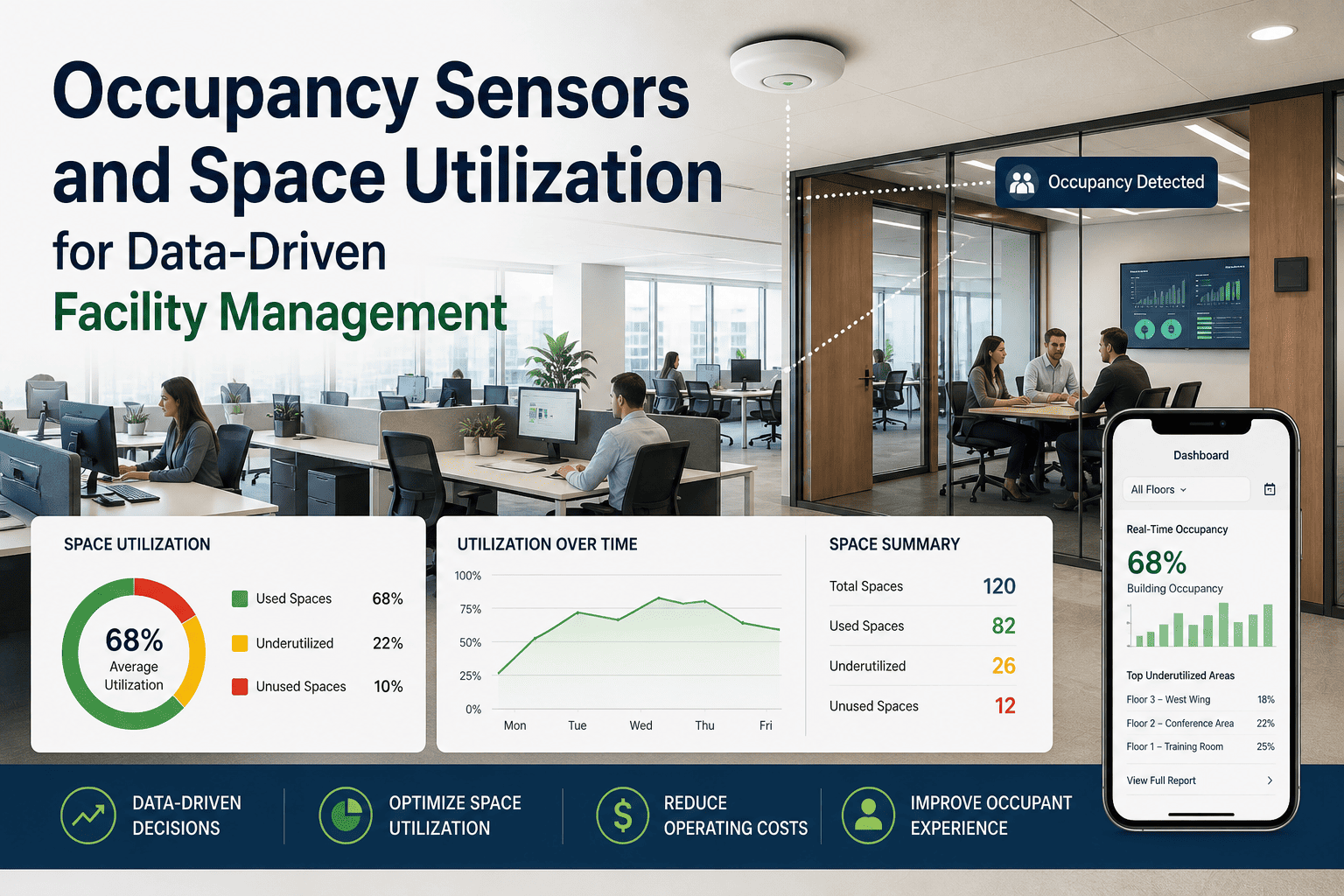
Occupancy Sensors & Space Utilization for Data-Driven Facility Management
Real-time occupancy data closes the gap between how you think your facility is used and how it actually performs — cutting energy waste, optimizing maintenance timing, and eliminating reactive decisions.
Why Booking Logs and Headcounts Are Not Enough
Room booking systems tell you when a space was reserved — not whether anyone showed up, how many people used it, or how long they stayed. This gap between scheduled and actual occupancy is where most facility cost waste originates, and it is completely invisible without sensor data.
Choosing the Right Sensor for Each Space
Sensor selection determines what data you can act on. Under-specifying produces gaps; over-specifying inflates cost without adding insight. Match sensor type to the decision you need to make.
| Sensor Type | What It Detects | Best Use Case | Accuracy | CMMS Integration |
|---|---|---|---|---|
| Passive Infrared (PIR) | Motion / heat presence | Small rooms, corridors, offices | Presence only | Lighting & HVAC trigger |
| Time-of-Flight (ToF) | People counting, direction | Entry points, lobbies, floors | High headcount | Zone load tracking |
| Thermal / Infrared Array | Headcount, position, dwell | Large open offices, labs | 95%+ headcount | Work order scheduling |
| Wi-Fi / BLE Analytics | Device presence, movement | Campus-wide, multi-floor | Zone-level | Portfolio dashboards |
| AI Optical (Camera-Free) | Active vs. passive occupancy | Desk utilization, restrooms | Highest granularity | Hot-desking ratios |
Where Occupancy Data Drives Real Facility Decisions
Traditional HVAC runs on fixed schedules regardless of who is actually in the building. Connecting occupancy sensors to HVAC controls via OxMaint's IoT module enables zone-level conditioning that responds to real occupancy — reducing energy consumption by 15–30% in the first year while improving occupant comfort during actual peak hours.
Cleaning rosters built on fixed schedules over-clean vacant areas and under-clean high-traffic zones. OxMaint generates cleaning work orders triggered by occupancy thresholds — a restroom receiving 300+ uses before 11 AM gets serviced mid-morning; a conference room unused all day does not. Janitorial labor is deployed where it creates value, not where the clock says so.
AI optical sensors reveal that nearly one-third of all desk time is passive occupancy — a bag or laptop, not a person. True desk utilization is typically 20–35% lower than standard reporting shows. This is the data that accurately justifies hot-desking ratios, desk reduction programs, and lease renegotiations to finance leadership — with sensor data as the evidence, not assumptions.
Disruptive maintenance — floor care, equipment calibration, electrical work — should happen when a space is genuinely empty, not when it appears empty. OxMaint identifies low-occupancy windows from sensor data and schedules maintenance work orders automatically for those periods, reducing disruption to occupants and eliminating the guesswork of "after-hours" scheduling that misses actual usage patterns in hybrid workplaces.
Connect Occupancy Sensors to Your CMMS — In Under 60 Minutes
OxMaint's IoT integration module connects sensor data streams to maintenance workflows, cleaning schedules, and space dashboards automatically — no custom development required.
How OxMaint Turns Sensor Data Into Maintenance Actions
OxMaint connects via API or IoT feeds to PIR, ToF, thermal, and Wi-Fi sensors across your facility portfolio — aggregating real-time occupancy signals into a unified dashboard.
Set occupancy thresholds per zone: cleaning triggers, HVAC setpoint changes, low-traffic maintenance windows, and overutilization alerts — configured once, enforced automatically.
When a threshold is crossed, OxMaint generates the relevant work order — cleaning, HVAC adjustment, or maintenance — assigned to the right technician with location, priority, and task details pre-populated.
Utilization trend reports, space efficiency scores, maintenance compliance rates, and HVAC optimization savings are available on demand — giving operations managers the data to justify portfolio decisions.
The integration between occupancy data and our CMMS was the missing link. Before, we were cleaning conference rooms on a Monday morning that hadn't been used since Thursday. After connecting sensor thresholds to work order triggers in OxMaint, we reduced cleaning labor by 22% in the first quarter while actually improving scores in our occupant satisfaction survey — because the spaces that were used heavily were serviced faster, not on a fixed schedule.
Space Utilization Benchmarks by Facility Type
Understanding where your facility sits relative to industry benchmarks is the first step to identifying optimization opportunity. Most buildings have more headroom than their managers realize.
| Facility Type | Avg. Utilization Rate | Optimal Target | Primary Waste Driver | CMMS Opportunity |
|---|---|---|---|---|
| Corporate Office | 31–38% | 55–65% | Ghost bookings, hybrid no-shows | Desk ratio optimization |
| University Campus | 40–55% | 65–75% | Semester schedule gaps | Seasonal maintenance scheduling |
| Healthcare Facility | 55–70% | 75–85% | Bed turnover inefficiency | Room readiness work orders |
| Commercial Building | 60–70% peak hours | 80%+ peak | Off-hours HVAC waste | Demand-driven HVAC triggers |
| Retail / Mixed-Use | Highly variable | Match staff to traffic | Fixed staffing vs. foot traffic | Traffic-based cleaning schedules |
Occupancy Sensors & CMMS Integration — Common Questions
How does OxMaint connect to occupancy sensor hardware?
What occupancy threshold should trigger a cleaning work order?
How accurate are occupancy sensors for desk utilization tracking?
Can occupancy sensor data reduce our facility operating costs measurably?
Stop Managing Space by Gut Feel — Let Sensor Data Drive Every Facility Decision
OxMaint connects real-time occupancy data to cleaning schedules, HVAC triggers, and maintenance work orders — automatically, without manual tracking or reactive firefighting.