This benchmarking guide is published by OxMaint as part of its Analytics & Reporting resource series. Most facility managers approve annual maintenance budgets without a reliable answer to one question: is what we are spending actually competitive? This article compiles 2025–2026 industry benchmark data from IFMA, BOMA, and Plant Engineering to give facility directors, operations heads, and asset managers a credible baseline — broken down by building type, building class, and region — to evaluate their own cost position and identify where optimisation is possible.
Analytics & KPIs · 2026 Benchmark Data
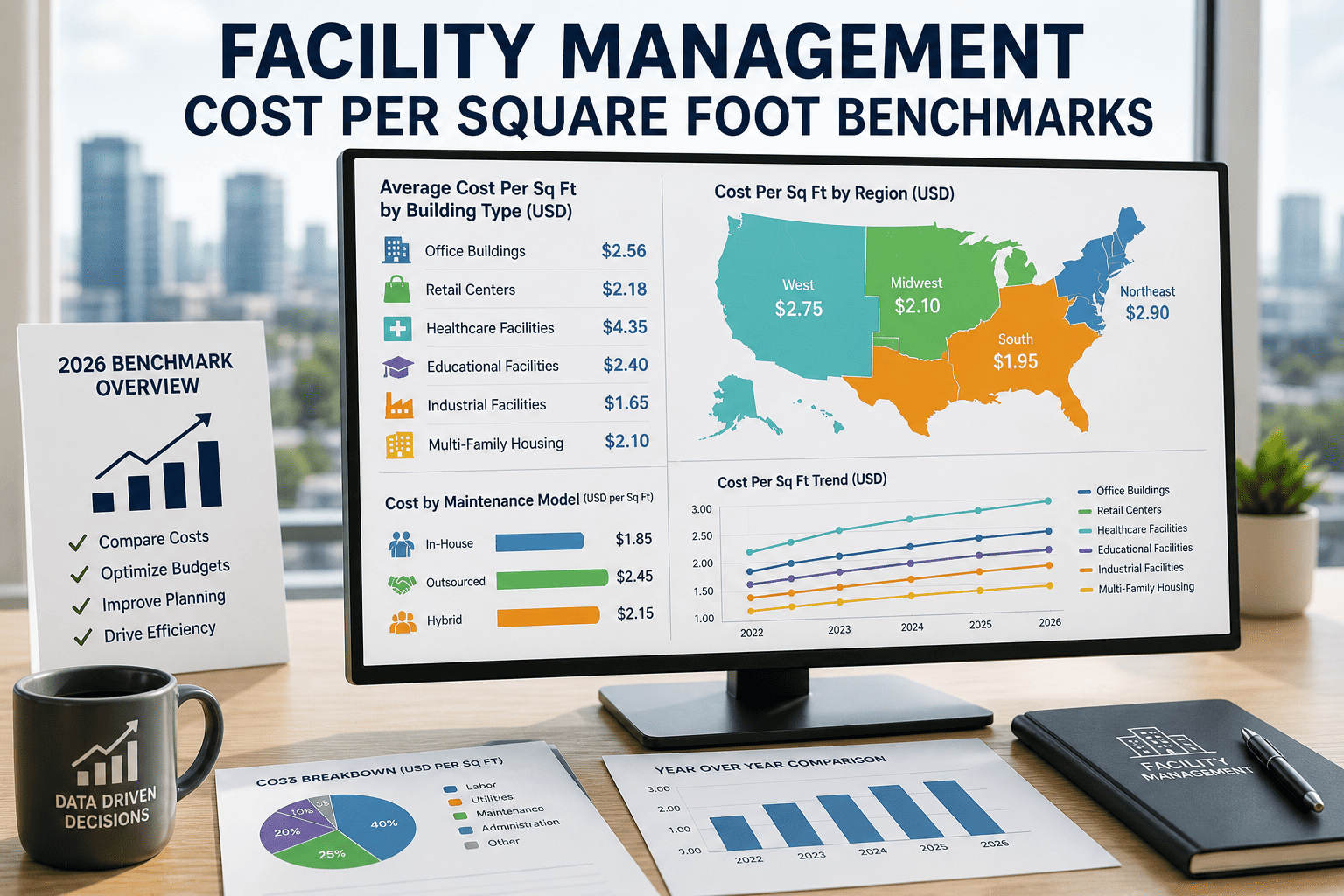
Facility Management Cost Per Square Foot Benchmarks 2026
Industry benchmarks for maintenance spend per square foot across office, industrial, healthcare, retail, and educational facilities — segmented by building class and region to help FM teams validate budgets and find savings.
IFMA 2025 Data
BOMA 2024 Standards
Plant Engineering KPIs
Updated May 2026
$2.50
– $5.59/sqft IFMA median maintenance cost range across facility types
18–25%
cost premium from reactive overspend vs. planned maintenance
22%
average cost-per-sqft reduction when planned maintenance exceeds 65%
2–5%
of building replacement value — the recommended annual maintenance budget
1 Maintenance Cost Per Sqft by Building Type
These figures reflect 2025–2026 benchmarks from IFMA, BOMA, and Plant Engineering research. They cover direct maintenance spend and do not include total operating expenses, which can run $10–$25/sqft when utilities, management fees, and janitorial costs are included.
| Building Type |
Low Quartile ($/sqft) |
Median ($/sqft) |
High Quartile ($/sqft) |
Key Cost Driver |
Planned PM % |
| Office |
$1.60 |
$2.15 |
$3.20+ |
HVAC, electrical |
65–70% target |
| Healthcare / Hospital |
$4.50 |
$6.80 |
$10.00+ |
Compliance & uptime-critical systems |
>68% top quartile |
| Industrial / Manufacturing |
$2.80 |
$4.50 |
$7.00+ |
Heavy equipment, process systems |
Best under $4.50 |
| Retail |
$1.00 |
$1.63 |
$2.80 |
Lighting, HVAC, customer areas |
>55% target |
| Educational |
$1.50 |
$2.20 |
$3.50 |
Building envelope, MEP systems |
60–65% target |
| Warehousing / Distribution |
$0.80 |
$1.30 |
$2.20 |
Dock equipment, fire systems |
Lower PM typical |
| Hospitality / Hotels |
$2.50 |
$4.00 |
$6.50 |
Guest experience systems, HVAC |
Varies by class |
Sources: IFMA 2025, BOMA 2024, Plant Engineering KPI study. Low quartile above $3.20 in office settings typically signals reactive overspend.
2 Maintenance Cost by Building Class
Building classification is one of the strongest predictors of maintenance spend. Class A properties carry higher tenant expectations and more complex systems — both increase cost per sqft significantly.
Class A
$2.50 – $8.40
per sqft / year
Premium finishes, advanced building systems, and high tenant expectations. HVAC, BMS, and life safety systems drive the top end of this range.
Class B
$1.80 – $5.40
per sqft / year
Mid-tier commercial buildings. Solid systems but often without the automation and redundancy of Class A. Reactive maintenance risk increases as assets age past 10–15 years.
Class C
$1.00 – $3.60
per sqft / year
Older buildings with aging systems. Spend appears lower but reactive maintenance percentage is typically highest in this class, masking true cost-of-delay.
3 Regional Maintenance Cost Benchmarks
Geography significantly affects FM cost. Labor rates, climate, regulatory requirements, and local market conditions all shift the baseline. These are median direct maintenance cost ranges for commercial facilities.
US (Northeast)
$2.20 – $3.80/sqft
Highest
US (West Coast)
$2.00 – $3.50/sqft
Very High
US (Midwest)
$1.60 – $2.80/sqft
Mid Range
US (South)
$1.50 – $2.60/sqft
Mid Range
Europe
$1.70 – $2.50/sqft
Mid Range
Know Exactly Where Your Spend Stands
OxMaint's Analytics & Reporting module tracks cost per sqft in real time across your portfolio — so you always know whether your maintenance spend is competitive or leaking value.
4 Supporting KPI Benchmarks for FM Budget Planning
Cost per sqft tells you what you spent. These supporting KPIs tell you whether that spend was efficient. Track them monthly alongside your sqft cost to get a complete picture of maintenance performance.
Planned Maintenance Percentage
Target: 65–80%
Scheduled vs emergency/break-fix work orders. Facilities above 65% planned maintenance reduce annual cost/sqft by 22% on average. Below 50% is a reactive overspend signal.
Utility Cost Per Sqft
$1.00 – $2.50/sqft
Typical range in temperate climates. Varies widely with HVAC load and energy prices. Pair with energy use intensity (kWh/sqft) for full picture.
Maintenance Cost as % of Asset Value
Target: 2–5% annually
Industry standard budget rule. Below 2% risks asset deterioration and costly reactive catch-up. Above 5% warrants capital replacement analysis rather than ongoing repair.
Critical Asset Uptime
Target: >99%
For HVAC and life-safety systems, 99% uptime means less than 87 unplanned hours of downtime per year. Below this threshold, reactive costs escalate rapidly and compliance risk increases.
Staffing Ratio (FTE per 100K sqft)
1.9 FTE per 10,000 m²
IFMA European benchmark. Teams above optimal ratios see labour cost per work order rise 18%+. Below optimal, planned maintenance completion suffers.
Janitorial & Cleaning Cost
$0.50 – $1.50/sqft
Often the most visible FM cost to occupants. Improvements in cleaning efficiency through route optimisation and digital task management reduce this line by 10–20%.
5 The Reactive vs. Planned Cost Gap
This is the single most impactful benchmark for most facility teams. Reactive maintenance costs 3–5x more per repair than the same work done preventively. The financial gap is large and measurable.
>55% Reactive
Danger Zone
Unplanned downtime rises 30%. Budget variance becomes unpredictable. Emergency contractor premiums inflate cost per repair by 3–5x. Tenant satisfaction and compliance records suffer.
>65% Planned
Best Practice
22% lower average cost per sqft. Equipment lives 30–40% longer. Compliance audit readiness improves. Technician productivity increases because work is scheduled, not scrambled.
CMMS platforms that track and schedule preventive maintenance typically cost $3–$15 per asset per month, but reduce total maintenance costs by 15–25% — delivering positive ROI within the first year for most portfolios.
MT
The most common mistake I see facility directors make is treating cost per square foot as the primary goal. It is a snapshot metric, not a strategy. A team that cuts spend to $1.40/sqft by deferring maintenance looks great on paper until three HVAC units fail in the same month. The teams that genuinely reduce cost over time do it by shifting their planned-to-reactive ratio above 65% and using asset data to make the case for capital investment before systems reach failure. That requires a CMMS that gives you visibility, not just work order management. When you can show leadership that a $12,000 compressor replacement today avoids a $47,000 emergency replacement plus two days of tenant downtime next winter, budget conversations change completely.
Marcus Thompson
Director of Facilities Operations, 22 years in commercial FM · IFMA Certified Facility Manager (CFM)
6 Frequently Asked Questions
What is a good facility management cost per square foot for a commercial office building?
For a commercial office building in 2025–2026, industry benchmarks from IFMA and BOMA indicate a median direct maintenance cost of approximately $2.15 per square foot annually. A reasonable budget target for most US office facilities is $1.60–$2.80/sqft for maintenance alone. Total operating costs — including utilities, janitorial, management fees, and security — typically run $10–$25/sqft annually depending on location, building class, and services included. If your maintenance-only spend is significantly above $3.20/sqft for an office building, it is worth investigating whether reactive repair premiums are inflating the number.
OxMaint's cost tracking dashboards can isolate maintenance spend from total operating costs to give you a clean comparison against these benchmarks.
Why does healthcare cost so much more per square foot to maintain than other building types?
Healthcare facilities carry significantly higher maintenance costs — typically $4.50–$10.00/sqft — due to three converging factors. First, the regulatory and compliance burden is far greater: HVAC systems must maintain precise pressure differentials and filtration standards, electrical systems require redundancy for life-safety, and water systems need legionella management programmes. Second, the consequences of downtime are severe — a failed HVAC system in an operating theatre is a life-safety event, not just an inconvenience. Third, healthcare buildings contain substantially more complex and expensive equipment per square foot than any other building type. Planned maintenance ratios above 68% are the minimum expectation for top-quartile healthcare FM teams, and the best facilities maintain asset registers and maintenance histories detailed enough to satisfy accreditation bodies on demand.
How do I calculate my facility's maintenance cost per square foot?
The formula is straightforward: divide total annual maintenance spend by total facility gross floor area in square feet. The critical decisions are what to include in "maintenance spend" — labour, contractors, parts, and materials are standard inclusions; utilities, cleaning, and management fees are typically tracked separately but included in total operating cost benchmarks. For multi-site portfolios, calculate the metric per site and then aggregate, rather than using total portfolio numbers, since this reveals which individual sites are outliers. If you are tracking this manually in spreadsheets, consider that CMMS platforms like
OxMaint automate this calculation in real time as work orders are completed, giving you an always-current benchmark that does not require month-end manual reconciliation. Segment by building type, age, and class for comparisons that are meaningful against IFMA and BOMA industry data.
What is the fastest way to reduce maintenance cost per square foot?
The highest-impact intervention is shifting your planned-to-reactive maintenance ratio above 65% — facilities that achieve this reduce cost per sqft by 22% on average. This requires a CMMS that schedules preventive maintenance automatically and tracks completion rates. The second fastest lever is energy and utility optimisation, since utilities represent $1.00–$2.50/sqft and a 20–30% reduction through HVAC scheduling and smart controls directly reduces total cost. Third is procurement consolidation — facilities that negotiate annual service contracts for HVAC, electrical, and fire systems typically pay 15–30% less per intervention than those using ad hoc contractors. Emergency repairs cost 3–5x more per repair than planned work, so every reactive job converted to a scheduled job compresses cost per sqft over time.
Book a demo with OxMaint for a benchmarking review against your specific portfolio.
Stop Guessing. Start Benchmarking in Real Time.
OxMaint tracks cost per sqft, planned maintenance percentage, and asset uptime automatically — giving facility teams the data to prove performance and cut costs.