Most buildings are not performing the way they were designed — they are performing the way time, occupancy change, and deferred maintenance have shaped them. Building commissioning for new construction and retro-commissioning for existing facilities are the two structured processes that bring building systems back into alignment with performance intent. For facility managers facing energy mandates like NYC Local Law 87, San Francisco's Existing Buildings Ordinance, or ASHRAE 90.1 requirements, understanding the difference between these two approaches — and when each applies — is essential for planning, budgeting, and compliance.
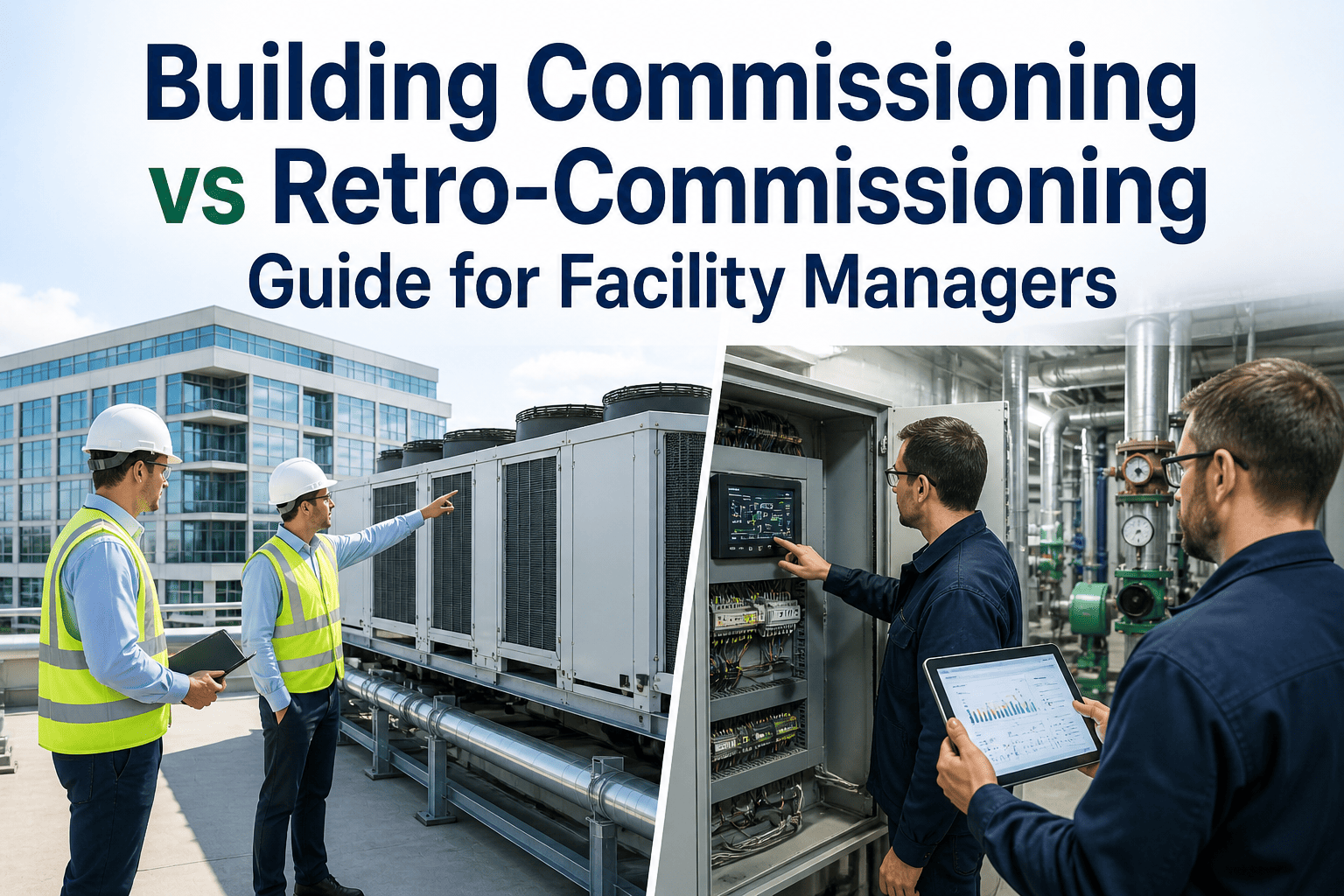
Building Commissioning vs. Retro-Commissioning: The Complete Guide for Facility Managers
Know when to commission, when to retro-commission, how much savings to expect, and how CMMS documentation turns commissioning from a one-time event into a continuous performance discipline.
Commissioning vs. Retro-Commissioning: What Each Actually Means
These two processes are often confused because they use similar methods — but they apply to fundamentally different situations and serve different objectives. Getting this distinction right determines which process your facility needs and how to plan for it.
Commissioning is a quality assurance process implemented during design, construction, and startup to verify that new building systems are installed and operating according to design intent. It runs through design review, equipment installation, functional testing, and operator training — ensuring systems meet performance specifications before occupancy. Buildings that skip commissioning typically consume 20–30% more energy than designed due to installation errors, control misconfigurations, and inadequate operator training.
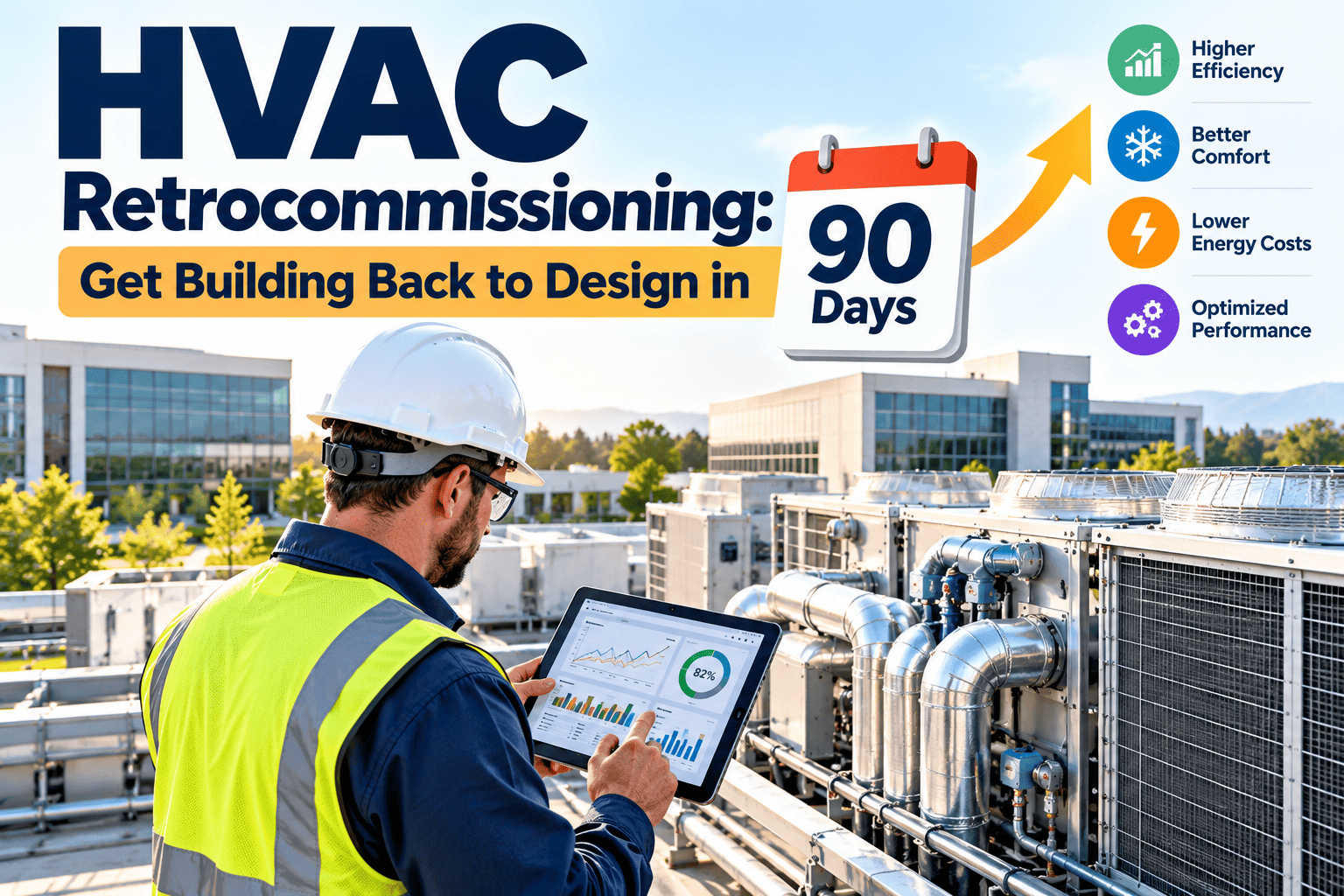
Retro-commissioning evaluates and optimizes the performance of existing building systems — HVAC, controls, electrical, plumbing — to ensure they are functioning as originally intended or better. Buildings drift over time due to sensor calibration errors, control sequence changes, occupancy shifts, equipment aging, and deferred maintenance. RCx identifies these drifts, corrects them, and documents the improved baseline — often delivering 10–20% energy savings with payback periods under two years, making it one of the highest-ROI actions a facility team can take without capital replacement.
Cx vs. RCx: Decision Matrix for Facility Managers
| Factor | Commissioning (Cx) | Retro-Commissioning (RCx) |
|---|---|---|
| When to use | New build or major renovation | Existing building, 5+ years old |
| Primary goal | Verify design intent at startup | Restore peak operational performance |
| Typical cost | 0.5–1.5% of construction cost | $0.10–$0.30 per sq ft |
| Energy savings | Prevents 20–30% energy waste at handoff | Delivers 5–20% savings on existing consumption |
| Payback period | Typically 1–3 years | Often under 2 years |
| Regulatory trigger | Required for LEED, ASHRAE 90.1 | NYC LL87, SF Existing Buildings Ord., Atlanta CBEEO |
| CMMS role | Baseline documentation, warranty tracking | Deficiency tracking, compliance documentation |
| Who performs it | Commissioning authority (CxA) | RCx provider or experienced facility team |
6 Reasons Building Systems Drift From Design Performance
Retro-commissioning exists because well-designed buildings degrade predictably. These are the six most common root causes that RCx consistently uncovers in commercial facilities — and each is addressable without capital replacement.
Temperature, humidity, and CO2 sensors drift from calibration over 2–4 years of operation. A thermostat reading 2°F high causes HVAC to overcool spaces indefinitely — wasting energy while generating occupant comfort complaints that maintenance treats symptomatically rather than at the root cause.
Building operators make point changes to BAS control sequences over time to resolve complaints — disabling economizer modes, overriding setback schedules, locking damper positions. Each individual change seems reasonable; the cumulative effect is a building that no longer operates by any coherent energy strategy.
Tenant changes, hybrid work adoption, or facility repurposing alter how spaces are actually used relative to original design assumptions. Systems sized and scheduled for full occupancy run the same way for spaces now at 30% utilization — a direct energy waste that only occupancy-aware recommissioning corrects.
One of the most common RCx findings: HVAC systems simultaneously heating and cooling adjacent zones due to control conflicts, broken economizers, or misaligned setpoints. This "fighting" condition generates energy waste without any benefit to occupant comfort and often goes undetected for years.
Broken dampers, fouled heat exchangers, failing variable frequency drives, and degraded insulation each reduce system efficiency incrementally. Without CMMS-tracked preventive maintenance connecting equipment condition to performance data, these losses accumulate invisibly until a major failure forces action.
BAS firmware updates and new control sequences become available but go unapplied. Buildings running control logic from 10 years ago miss energy-saving strategies like demand-controlled ventilation, optimal start, and fault detection diagnostics that modern systems deliver as standard features.
OxMaint Turns Commissioning Findings Into Ongoing Maintenance Discipline
Most RCx programs produce a deficiency report that sits in a folder. OxMaint converts commissioning findings into tracked work orders, preventive maintenance schedules, and performance dashboards — so the savings persist beyond the assessment.
Retro-Commissioning Process: Phase-by-Phase Checklist
A structured RCx program follows four phases. Each phase generates documentation that should live in your CMMS — not in a consultant's report that no one references between assessments.
The most common mistake I see is treating retro-commissioning as a report, not a program. Teams invest in the assessment, get a list of 40 deficiencies, fix the top 10, and file the rest. Three years later, the savings have eroded and nobody knows why. The buildings that maintain their RCx savings are the ones that loaded every finding into a CMMS and tracked completion and performance as ongoing maintenance work — not a one-time project.
Building Commissioning & RCx — Common Questions
How often should an existing building undergo retro-commissioning?
What is the difference between retro-commissioning and recommissioning?
How does a CMMS support the commissioning and retro-commissioning process?
What building types see the highest ROI from retro-commissioning?
Turn Commissioning Findings Into Lasting Performance — Not a Filed Report
OxMaint tracks every RCx deficiency as a work order, monitors energy KPIs against your post-commissioning baseline, and generates compliance documentation for NYC LL87, ASHRAE, and LEED audits — automatically.