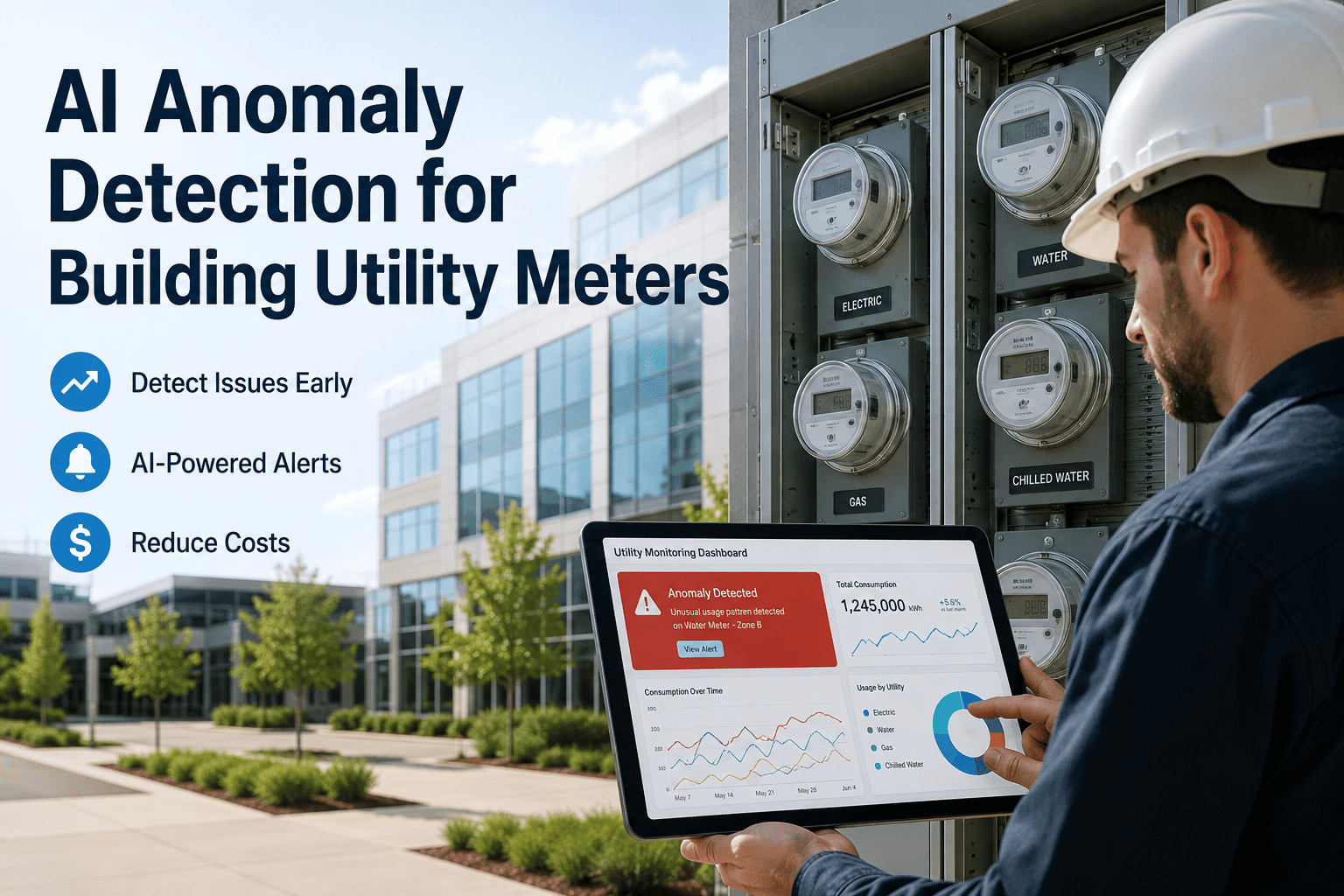
Buildings don't suddenly develop energy problems — they develop them slowly, invisibly, until a utility bill arrives that no one can explain. A leaking pipe, a malfunctioning chiller, or a circuit left energized overnight compounds over 30 days before it becomes visible on a statement. By then, the waste has already happened. Oxmaint's AI anomaly detection monitors electricity, water, and gas consumption in real time — flagging abnormal usage patterns the moment they emerge, not the month after. For facility teams managing utility costs across single or multiple buildings, book a 30-minute utility analytics session to see what your meters are telling you that your current tools are missing.
Utility Intelligence
Catch Abnormal Utility Usage Before It Becomes an Unexplained Bill
Electricity
22%
Avg. waste from undetected anomalies
Water
18%
Of consumption is non-revenue water loss
Gas
$4,200
Avg. annual loss from undetected gas anomalies per building
How Utility Anomalies Go Undetected for Weeks
The gap between when an anomaly starts and when a facility team discovers it is where utility waste compounds. Three structural problems keep facilities blind to real-time consumption problems.
Day 1
Anomaly begins — leaking valve, stuck actuator, overnight equipment left on
Undetected
Day 7–14
Usage drift becomes statistically significant but stays below alarm thresholds
Still invisible
Day 30+
Monthly utility bill arrives — variance investigated manually, cause unclear
Waste already incurred
With Oxmaint
AI detects statistical deviation within 24–48 hours of anomaly onset and alerts facility team
Contained immediately
Every day an anomaly runs undetected is money already spent. Oxmaint AI catches utility deviations in 24–48 hours — not 30 days.
What Oxmaint Detects Across Water, Gas, and Electricity
AI anomaly detection goes beyond simple threshold alerts. Oxmaint identifies contextual deviations — flagging consumption that is abnormal for the time of day, day of week, occupancy level, or weather conditions.
Overnight baseload spike above baseline
Demand charge events from equipment cycling
HVAC runtime deviation from occupancy schedule
Circuit-level consumption outlier vs. same-day prior week
Continuous low-flow indicating fixture leak
Zone-level consumption spike by meter
After-hours usage in unoccupied areas
Irrigation system running outside scheduled window
Heating consumption above weather-normalized baseline
Pilot light failure indicated by unusual low consumption
Boiler efficiency degradation pattern
After-hours gas draw in unoccupied building zones
Utility Anomaly Detection: Performance Comparison
| Capability |
Manual Monitoring |
Basic Threshold Alerts |
Oxmaint AI Detection |
| Detection time |
30+ days |
Hours to days |
24–48 hours |
| False alarm rate |
N/A (manual) |
High (no context) |
Low (context-aware) |
| Weather normalization |
Never applied |
Rarely applied |
Automatic |
| Multi-meter correlation |
Not possible |
Single-meter only |
Cross-meter analysis |
| Work order auto-creation |
Manual entry |
Manual entry |
Automatic on alert |
"
The buildings sector accounts for over 40% of global energy consumption, and a significant portion of that is attributable to undetected operational anomalies — not design flaws. AI anomaly detection that operates at the meter level, with contextual awareness of occupancy and weather, is the single most impactful tool available to facility managers for reducing operating costs without capital investment. Facilities implementing real-time utility AI consistently identify savings of 15–25% within the first year.
Dr. Yuki Tanaka, LEED Fellow
PhD in Building Energy Systems, ASHRAE Distinguished Lecturer — advisory board member for three national sustainable facility programs
Frequently Asked Questions
How does Oxmaint AI know what "normal" consumption looks like for my building?
Oxmaint builds a dynamic consumption baseline for each meter by analyzing your historical utility data across multiple variables: time of day, day of week, occupancy schedule, and local weather data. The AI model continuously updates this baseline, so it distinguishes a genuine anomaly from a planned high-consumption event — such as a weekend event or seasonal HVAC transition.
Start a free trial and connect your utility data to generate your building's baseline profile.
What meter and IoT integrations does Oxmaint support for utility monitoring?
Oxmaint integrates with BACnet, Modbus, and MQTT-based smart meter infrastructure, as well as direct API connections to major utility data platforms and BMS systems. For buildings without smart meters, Oxmaint can ingest manual meter reads and utility bill data to build baseline models and flag statistical outliers at a monthly and weekly level.
Book a demo to assess your current meter infrastructure and integration path.
Does Oxmaint automatically create work orders when a utility anomaly is detected?
Yes. When an anomaly is confirmed beyond the defined confidence threshold, Oxmaint automatically generates a work order categorized by utility type and probable cause — pre-routed to the appropriate technician or energy management team. The automatic work order creation eliminates the gap between detection and response that occurs when alerts require manual follow-through.
Sign up to configure alert thresholds and auto-work-order rules for your facility.
How quickly do facilities typically see utility cost savings after implementing Oxmaint AI detection?
Most facilities identify at least one actionable anomaly within the first two weeks of connecting meter data — typically an overnight baseload issue, a leaking fixture, or an HVAC scheduling deviation. Measurable utility cost reduction appears within 30–60 days for facilities with real-time meter infrastructure. Buildings using monthly bill data typically see savings reflected in the second billing cycle after deployment.
Book a session to calculate your estimated savings based on your building size and current utility spend.
Your Meters Are Sending Signals Your Team Isn't Seeing
Oxmaint AI detects abnormal water, gas, and electricity usage within 24–48 hours — and turns every alert into an automatic work order before the waste compounds.