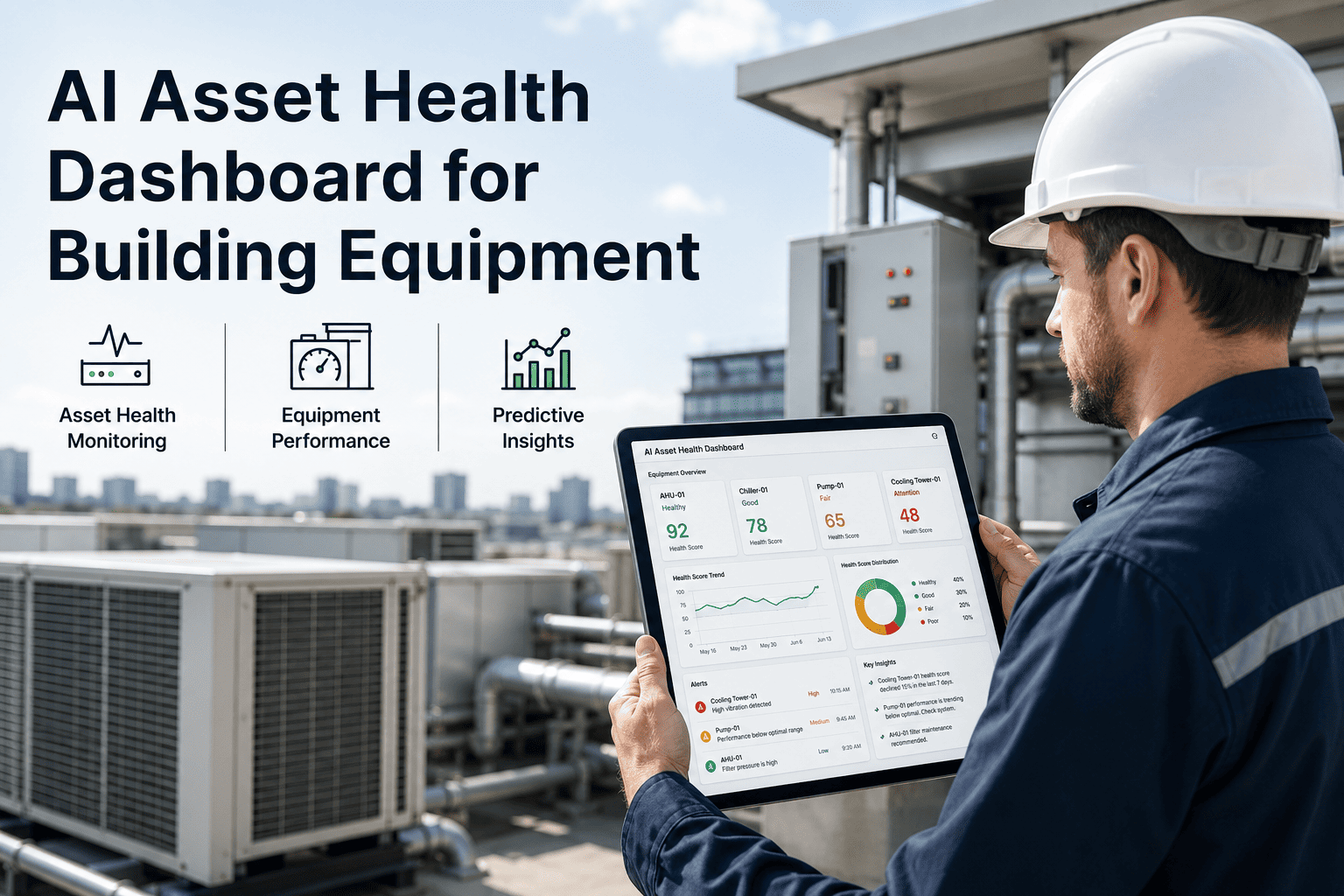
Facility managers responsible for buildings with dozens or hundreds of critical assets — HVAC units, pumps, UPS systems, generators, elevators, and electrical panels — have traditionally had no reliable way to know which assets were healthy, which were declining, and which were about to fail without physically inspecting each one. OxMaint's AI Asset Health Dashboard solves this by scoring every building asset on health, risk, and maintenance priority in real time — giving facility teams a single visual surface where the entire asset portfolio is ranked by condition, not just by scheduled date. Teams using OxMaint stop guessing which assets need attention and start making data-driven decisions about where to spend maintenance hours and budget. Book a demo to see the dashboard scoring your asset types live, or sign in to OxMaint to run your first asset health assessment.
Dashboard Preview — Asset Health Scoring
Chiller Unit B3 — Level 2 Plant Room
Chiller
22
Critical
Immediate WO
AHU-07 — North Wing Floor 4
AHU
48
At Risk
Schedule PM
Diesel Generator G1 — Basement
Generator
65
Watch
Advisory Alert
Elevator Bank A — Floors 1–12
Elevator
88
Healthy
No action
UPS System — Server Room 3
UPS
94
Healthy
No action
Scoring Methodology
How OxMaint Calculates Each Asset's Health Score
Five weighted inputs combine to produce a 0–100 composite health score per asset, updated after every work order, inspection, or alarm event.
30%
Fault & Alarm History
Number, frequency, and severity of fault events in the trailing 90 days. Recurring faults on the same asset reduce the health score faster than isolated events.
25%
PM Compliance Rate
Percentage of scheduled preventive maintenance tasks completed on time in the trailing 12 months. Missed PMs decay the health score proportional to the task's criticality.
20%
Asset Age vs. Expected Life
Installation date relative to manufacturer-defined expected service life. Assets in the final 20% of expected life are scored with a higher base risk modifier regardless of recent history.
15%
Inspection Condition Rating
Technician-assigned condition rating from the most recent inspection — factoring in visual wear indicators, fluid condition, physical damage, and operational performance observations.
10%
Criticality Classification
Facility-manager-assigned criticality level (life safety, operations-critical, comfort, non-critical) influences alert thresholds and escalation speed without changing the raw health score.
Asset Coverage
Six Building Asset Categories in the OxMaint Health Dashboard
HVAC & Chillers
Compressors
AHUs / FCUs
Cooling towers
Electrical Panels
Distribution boards
Switchgear
Transformers
UPS Systems
Battery health
Load capacity
Runtime test
Generators
Load test history
Fuel level
Runtime hours
Elevators & Lifts
Door cycle count
Service intervals
Fault code trend
Pumps & Motors
Discharge pressure
Flow rate trend
Bearing condition
OxMaint · AI Asset Health · Building Equipment
Know which assets in your building need attention today — not after they fail.
Measured Outcomes
What Facility Teams Achieve with AI Asset Health Scoring
| Metric |
Without Health Scoring |
With OxMaint AI Dashboard |
Improvement |
| Unplanned downtime events / year |
18–24 per 100 assets |
5–7 per 100 assets |
68% reduction |
| Reactive vs. planned maintenance ratio |
60% reactive |
Under 20% reactive |
3× more planned |
| PM compliance rate |
61% average |
91% average |
+30 percentage points |
| Mean time to detect asset degradation |
12–18 days (manual) |
Under 48 hours (automated) |
10× faster detection |
| Annual maintenance cost per asset |
$2,800 average |
$1,640 average |
41% cost reduction |
Expert Review
The asset health dashboard concept is one of the most practically valuable developments in facility management technology of the past decade. Not because scoring assets is a new idea — condition assessment has been standard practice in large infrastructure for years. What's new is that it's now accessible to building operations teams without a dedicated reliability engineer or expensive condition monitoring hardware. When a facility manager can open a dashboard and see, ranked by health score, exactly which assets need attention this week, maintenance budget allocation becomes a data-driven decision rather than a gut-feel conversation. That shift in decision quality is where the financial impact comes from.
James R. Okafor, FMP, SFP
Facility Management Professional · IFMA Certified · 21 years in commercial real estate operations and building systems management
Frequently Asked Questions
How quickly does the health dashboard become useful after we add our assets?
The dashboard generates initial health scores immediately after assets are added and populated with existing maintenance history. Teams that import 12+ months of work order history see accurate risk stratification within the first week. Even without historical data, the dashboard provides real-time scoring from the moment new work orders, inspections, and PM records begin accumulating in
OxMaint. Most facilities reach meaningful predictive accuracy within 60–90 days of active use.
Can the health scoring weights be adjusted for our specific asset types and criticality levels?
Yes. OxMaint allows facility managers to adjust the criticality classification and PM compliance weighting for each asset class based on the building's specific operational priorities. A data centre facility will weight UPS and electrical panel health very differently than a commercial office, and the dashboard accommodates those differences.
Book a demo to see how scoring weights are configured for a specific building type and asset portfolio.
Does the dashboard support multi-building or multi-site portfolios?
Yes. OxMaint's asset health dashboard supports portfolio-level views across unlimited buildings and sites — with the option to drill down to building level, floor level, or individual asset. Regional facility managers see their entire portfolio ranked by health score in a single view, while site technicians see only their local assets.
Sign in to OxMaint to configure your building hierarchy and asset structure for multi-site portfolio management.
What happens when an asset's health score drops into the Critical band?
A Critical health score triggers an immediate alert to the assigned facility manager and generates a high-priority work order automatically — without requiring manual intervention. The work order includes the contributing factors that caused the score to fall, relevant maintenance history, and a recommended response action. Teams can customise escalation recipients and response time expectations by asset class and criticality level in
OxMaint's settings.
Book a demo to see a Critical score alert and auto-generated work order in the dashboard.
OxMaint · AI Asset Health Dashboard · Building Equipment
Every asset in your building has a health score. OxMaint makes it visible — before the score hits zero.
Health scoring across HVAC, UPS, generators, elevators, electrical panels, and pumps. Risk stratification. Priority ranking. Automated alerts. All in one dashboard.


.jpeg)
