An EPA inspector does not need to find a leaking chiller to issue a violation. They need to find a refrigerant addition log that does not have a leak-rate calculation attached to it. They need to find a 30-day repair clock that expired without verification testing on file. They need to find a contractor invoice for refrigerant that cannot be matched to a specific appliance, charge size, or technician certification number. Refrigerant compliance is not a maintenance question — it is a documentation question with a $63,361-per-violation-per-day price tag attached. With the AIM Act lowering thresholds and EPA scrutiny intensifying across commercial facilities, the cost of getting it wrong has never been higher. OxMaint's AI-enabled compliance tracking automatically calculates leak rates after every refrigerant addition, opens repair work orders the moment a threshold is exceeded, and produces inspector-ready evidence packages in one click. This checklist walks through the complete compliance workflow facility teams must execute — and where AI changes the game from reactive paperwork to proactive risk control.
HVAC Compliance · EPA Section 608 + AIM Act · AI-Enabled Tracking
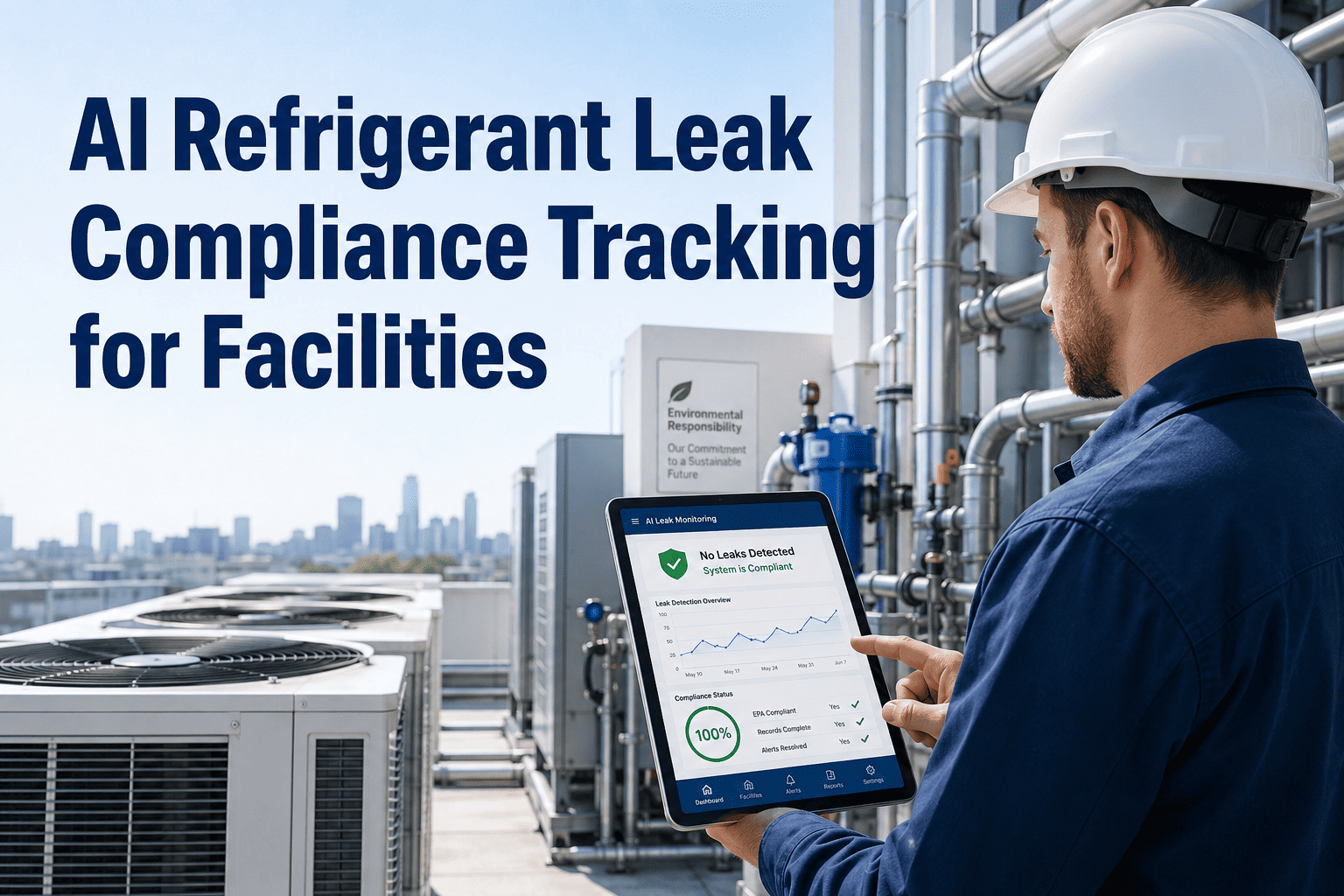
AI Refrigerant Leak Compliance Tracking for Facilities
Automated leak-rate calculation, 30-day repair clock enforcement, technician certification tracking, and EPA-ready audit packages — across every chiller, RTU, VRF, and refrigeration system in your portfolio.
EPA Leak Rate Thresholds Triggering 30-Day Repair Duty
20%
Commercial Refrigeration
30%
Industrial Process Refrigeration
$63,361
Maximum EPA civil penalty per violation, per day, under the Clean Air Act
30 days
Deadline to repair leak after exceeding the applicable threshold
3 years
Minimum retention period for refrigerant service records on-site
15 lbs
AIM Act lowered threshold for many HFC systems falling under federal tracking
The Two Compliance Clocks That Start at Every Refrigerant Addition
Every time a Section 608 certified technician adds refrigerant to a regulated appliance, two clocks start at the same moment. Most facilities track neither in real time. AI-enabled compliance tracking starts both clocks automatically the instant a charge log is created — and refuses to let either expire silently.
Clock 01
Leak Rate Calculation
Triggered the moment refrigerant is added. EPA approves two methods — annualising or rolling 365-day average. Must be calculated against the appliance's full charge size and compared to the applicable threshold for the equipment category. Manual calculation errors are the most common audit finding.
Annualising: (Lbs Added ÷ Full Charge) × (365 ÷ Days Since Last Addition) × 100%
Clock 02
30-Day Repair Deadline
Starts the moment the leak rate exceeds the threshold. Facility must locate the leak, repair it, and conduct an initial verification test within 30 days. A follow-up verification test is required within 10 days of the initial test. Missed deadlines are independent violations regardless of underlying repair work.
Threshold exceeded → Repair → Initial verification → Follow-up verification within 10 days
Five-Phase Compliance Checklist — From Inventory to Audit Defence
Refrigerant compliance is a closed-loop programme. Every regulated appliance must move through five phases continuously across its operational life. AI-enabled tracking automates the calculations and deadline enforcement that paper-based programmes consistently get wrong. EPA Section 608 management through CMMS reduces audit exposure by orders of magnitude when implemented across a portfolio.
Phase 01
Refrigerant Asset Inventory & Baseline
Every regulated appliance registered with unique asset ID, location, full charge size in pounds, refrigerant type, GWP value, and equipment category (comfort cooling, commercial, industrial process)
Owner Compliance Lead · Evidence Asset register export with EPA category mapping
Threshold leak rate (10%, 20%, or 30%) configured per appliance based on equipment category — incorrect category assignment is one of the most common audit findings
Owner Compliance Lead · Evidence Category-to-threshold mapping signed by qualified personnel
Nameplate documentation including OEM charge specification, refrigerant type, and any retrofit history attached to the asset record
Owner Facility Engineer · Evidence Photo + document upload per appliance
AIM Act review completed — appliances with 15 or more pounds of HFC evaluated for new tracking obligations under the 2025 expanded scope
Owner Compliance Lead · Evidence AIM Act scope review document
Phase 02
Leak Detection & Threshold Monitoring
Every refrigerant addition logged in real time with date, technician ID, certification number, refrigerant type, amount in pounds, and reason for addition
Owner Service Technician · Evidence Digital service log with electronic signature
Leak rate auto-calculated at every addition using both annualising and rolling 365-day methods — the higher result is applied for compliance decisions
Owner CMMS · Evidence Calculation audit trail per addition event
Threshold exceedance triggers immediate notification to facility manager and compliance lead — within minutes of the addition record being saved
Owner CMMS · Evidence Notification timestamp + receipt log
Automatic leak detection systems active on commercial and industrial refrigeration systems with charges of 1,500 pounds or more, per AIM Act requirement
Owner Facility Engineer · Evidence ALD system installation certificate and maintenance log
Quarterly leak inspections scheduled for appliances that exceeded the threshold in the past 12 months — required until full year clears below threshold
Owner Compliance Lead · Evidence Recurring PM work order in CMMS
AI Capability
What Changes When Compliance Tracking Goes AI-Native
OxMaint's AI engine reads charge addition patterns across the portfolio and flags refrigerant assets trending toward threshold breach 30–90 days before it happens. It detects abnormal consumption patterns across comparable equipment, identifies repeat-offender appliances, and surfaces hidden compliance risk that manual reporting misses entirely. Predictive flags become preventive work orders before the 30-day repair clock ever starts.
Phase 03
Repair Workflow & 30-Day Clock
Repair work order auto-generated within 24 hours of threshold exceedance, with 30-day deadline visible on the work order header and dashboard
Owner Maintenance Manager · Evidence Auto-created work order linked to exceedance event
Leak source identified and documented with location, type (e.g. fitting, valve stem, coil), and root cause assessment before repair execution
Owner Service Technician · Evidence Leak diagnosis report with photos
Repair completed by Section 608 certified technician with documentation of parts replaced, sealing methods used, and refrigerant recovered or added during the repair process
Owner Service Technician · Evidence Repair completion record with certification number
Escalation alerts triggered at 14, 7, and 2 days before deadline if repair work order remains open — visible to facility director and compliance officer
Owner CMMS · Evidence Escalation log with recipient acknowledgement
Phase 04
Verification Testing
Initial verification test conducted at completion of repair using EPA-approved methods (electronic leak detector, fluorescent dye, soap bubble, or pressure test)
Owner Service Technician · Evidence Test method and result per leak point
Follow-up verification test conducted within 10 days of initial test to confirm sustained repair under operating conditions
Owner Service Technician · Evidence Follow-up test record dated within window
Test instruments used during verification verified to be within calibration window with certificate of traceability to recognised standard
Owner Compliance Lead · Evidence Test instrument calibration certificate
Failed verification test reopens the repair work order — does not close out the original exceedance record until both verification tests pass
Owner CMMS · Evidence Workflow state transition log
Stop Calculating Leak Rates on Paper. Start Defending Compliance in Real Time.
OxMaint's AI engine calculates every leak rate the moment a charge is logged, opens the repair work order automatically, and tracks every verification test against the federal deadline. Inspector-ready evidence in one click.
Phase 05
Records, Reporting & Audit Defence
Service records retained at the place of business for minimum 3 years and producible to EPA on demand — owner liability, not contractor liability
Owner Facility Manager · Evidence Centralised CMMS with retention policy
Annual report submitted to EPA for any system containing 50 or more pounds of refrigerant that leaked 125% or more of full charge in a calendar year
Owner Compliance Lead · Evidence EPA submission receipt and supporting calculation
Technician certifications verified at every service event — Section 608 Type I, II, III, or Universal — with certificate copy on file and expiration tracked
Owner Compliance Lead · Evidence Certification register with expiry alerts
Disposal records retained for refrigerant recovered from retired equipment — recovery technician certification, destruction or reclamation certificate, weight tracked
Owner Compliance Lead · Evidence Recovery and disposal documentation chain
Audit package exportable in EPA-ready format — service logs, leak calculations, repair records, verification tests, and certifications consolidated per appliance
Owner Compliance Lead · Evidence One-click export from CMMS
Penalty Exposure by Violation Category
EPA enforcement under the Clean Air Act treats each day of non-compliance as a separate violation. A single chiller with an undocumented leak that ran 90 days past the 30-day deadline can generate over $5 million in theoretical maximum exposure. Actual settlement amounts vary, but consent decrees from the past five years show settlements regularly in the $200,000 to $5 million range for portfolio-wide failures.
| Violation Category |
Maximum Daily Penalty |
Typical Inspector Finding |
OxMaint Prevention |
| Failure to repair leak within 30 days of threshold exceedance |
$63,361 per day |
Service log shows addition above threshold with no repair record |
Auto-created repair WO with deadline enforcement |
| Missing or inadequate leak rate calculation |
$63,361 per day |
Addition logged but no calculation evidence on file |
Calculation runs automatically at every addition |
| Failure to conduct verification testing |
$63,361 per day |
Repair record exists but no follow-up verification within 10 days |
Verification WO auto-triggered with deadline |
| Service by uncertified technician |
$63,361 per event |
Service record shows technician without valid Section 608 certificate |
Certification validated at service log entry |
| Records not retained or producible on demand |
$63,361 per day |
Contractor holds records; owner cannot produce on inspection |
Owner-controlled retention in CMMS |
| Failure to report 125%+ annual leakage on 50+ lb systems |
$63,361 per day |
Annual calculation exceeded reporting threshold; no EPA filing made |
Annual threshold monitored, alert generated |
The Live AI Compliance Dashboard — What Facility Managers Actually See
A live compliance dashboard surfaces the appliances that need attention right now, not the appliances that needed attention three months ago when the leak was first detected. AI-enabled predictive maintenance for HVAC facilities identifies risk before a single threshold is breached.
Portfolio Compliance Status · 247 Regulated Assets · Live
AI tracking active · Last updated 47 seconds ago
CHILLER-04-B · West Tower Mechanical · R-134a · 280 lb charge
Annualised leak rate 24.6% (Threshold 10%) · Repair WO-2026-4471 · Deadline 21 days remaining · Section 608 Universal tech assigned
Threshold Exceeded
RTU-12 · East Pavilion Roof · R-410A · 84 lb charge
AI prediction: trending to 12% leak rate within 45 days based on 6-month addition pattern · Pre-emptive inspection recommended
AI Predictive Flag
REFRIG-LOOP-02 · Kitchen Walk-In · R-404A · 142 lb charge
Verification test follow-up due in 3 days · Initial verification passed on April 21 · Tech notified · Test instrument calibration verified
Verification Pending
VRF-SUITE-08 · North Building · R-32 · 64 lb charge
Annual leak rate 2.3% (within threshold) · Quarterly inspection complete · No action required · Records on file
In Compliance
Compliance KPIs Every Facility Director Should Track
Target 100%
Leak Calculation Currency
Percentage of refrigerant addition events with a documented leak-rate calculation attached within 24 hours of the addition. Below 100% indicates a documentation pipeline gap that will surface at EPA inspection.
Target Zero
Overdue 30-Day Repairs
Number of repair work orders past the federal 30-day deadline. Each overdue day on each appliance is a separate violation. A non-zero count is an active enforcement risk requiring immediate escalation to facility leadership.
Less than 10%
Portfolio Average Leak Rate
Average annual leak rate across all regulated appliances in the portfolio. Trending upward across multiple quarters indicates systemic equipment age or refrigerant transition issues that need capital planning attention.
Target 100%
Technician Certification Currency
Percentage of service events performed by technicians with valid, in-date Section 608 certification. Service by an uncertified technician is an independent violation regardless of repair quality.
Under 5 min
Evidence Retrieval Time
Time to produce complete service history, leak calculations, and verification records for any regulated appliance during EPA inspection. Paper-based programmes typically take hours; CMMS-based programmes take seconds.
Target 100%
Verification Test Compliance
Percentage of completed repairs with both initial and follow-up verification tests on file within the federal window. Missing verification is among the most common audit findings even when repair work was performed correctly.
Expert Review
"
After eighteen years inside the EPA's Stratospheric Protection Division and now advising facility operators on Section 608 and AIM Act compliance, the single biggest misconception I encounter is that refrigerant compliance is a service contractor problem. It is not. The appliance owner carries ultimate legal responsibility for record availability, leak rate calculation, and timely repair — regardless of who performed the work. When my colleagues at EPA inspect a facility, they ask the owner to produce the documentation. If the contractor has the records and the owner does not, the owner is in violation. AI-enabled compliance tracking solves this in a way no manual programme ever could: it captures every event into an owner-controlled system the moment it happens, calculates leak rates automatically, enforces the 30-day clock without depending on human follow-through, and produces inspector-ready evidence packages in seconds. For multi-site facility portfolios, this is no longer optional given the AIM Act expansion. It is the difference between a routine inspection and a multi-million-dollar consent decree.
Daniel Thornberry, PE, CEM
Professional Engineer · Certified Energy Manager · Former EPA Stratospheric Protection Division Inspector · 18 years federal HVAC compliance enforcement · Senior advisor on Section 608 and AIM Act implementation for Fortune 500 facility portfolios · Co-author of two industry guidance documents on refrigerant transition planning
Frequently Asked Questions
FAQ 01
Who is legally responsible for refrigerant compliance records — the owner or the service contractor?
Both parties have obligations, but the owner or operator of the appliance carries ultimate legal responsibility for record availability. Technicians must provide an invoice to the appliance owner at the time of service noting the type and quantity of refrigerant added. The owner must maintain those service records, leak inspection logs, and repair verification records at the place of business for a minimum of three years — and produce them to EPA on demand.
OxMaint stores all service records against your appliances regardless of which contractor performed the work.
FAQ 02
How does AI improve refrigerant leak detection over traditional methods?
AI analyses charge addition patterns, run hours, and ambient conditions across the entire portfolio to identify appliances trending toward threshold breach 30–90 days before it occurs. Traditional methods rely on reactive inspections after a leak is suspected. AI surfaces the appliance that has had three small charges in five months as a higher risk than the appliance with one large charge — a pattern human reviewers routinely miss.
FAQ 03
What changed under the AIM Act that facility managers must respond to?
The AIM Act expanded refrigerant management requirements to cover many HFC systems with as little as 15 pounds of refrigerant — significantly lower than the previous 50-pound threshold. Automatic leak detection systems are now required for commercial and industrial refrigeration with charges of 1,500 pounds or more. Sector-based GWP limits also affect new equipment installation and the long-term refrigerant transition plan. Facility managers operating R-410A systems should be documenting current charge status and planning transition timelines.
Book a demo to scope your AIM Act response plan.
FAQ 04
How is the annual leak rate actually calculated and when must it be recalculated?
EPA approves two calculation methods. The annualising method divides pounds added by the full system charge, multiplies by 365 divided by days since the last addition, then multiplies by 100% — giving an annualised leak rate from a single addition event. The rolling-average method divides total pounds added in the past 365 days by the full charge, then multiplies by 100%. Leak rate must be recalculated every time refrigerant is added to a regulated appliance — not just at scheduled inspections. The method used must be documented consistently.
OxMaint runs both calculations automatically at every addition.
FAQ 05
Can OxMaint integrate with our existing service contractor workflow and BMS?
Yes. OxMaint supports mobile work order completion by contractor technicians with electronic signature, Section 608 certification verification, and refrigerant addition logging in the field. BMS integration via BACnet or REST API streams real-time refrigerant pressure, temperature, and run hours into the same record. The contractor performs the work — OxMaint captures the documentation into your owner-controlled system in real time.
Refrigerant Compliance That Defends Itself — Every Asset, Every Site, Every Audit
OxMaint's AI compliance tracking calculates every leak rate, enforces every 30-day clock, verifies every technician certification, and produces every EPA-ready evidence package automatically. Across your entire portfolio. Without spreadsheets, paper logs, or contractor file requests.