Benchmarking Facility Maintenance Costs: Industry Standards and Metrics

By James smith on April 8, 2026

benchmarking-facility-maintenance-costs-industry-standards

Most facility managers approve budgets without knowing if their maintenance spend is efficient — until they benchmark against real industry data. Without standards, reactive repairs inflate costs by 18–25% and planned maintenance lags below 50%."Benchmarking Facility Maintenance Costs: Industry Standards and Metrics" helps facility managers compare their maintenance costs against industry standards. It covers key metrics such as cost per square foot, planned maintenance percentages, and staffing ratios across different building types. This guide offers valuable insights into optimizing maintenance budgets and improving cost efficiency. By benchmarking against industry data, facilities can identify areas for improvement and ensure they are aligned with best practices in cost management. Compare your facility metrics with Oxmaint’s analytics or book a 30‑min benchmarking review to uncover hidden savings.

Data‑Driven Benchmarking

Facility Maintenance Costs: Industry Standards & Metrics That Matter

Stop guessing if your spending is competitive. Compare cost per square foot, planned vs. reactive ratio, and staffing benchmarks across office, industrial, healthcare, and retail facilities.

$2.85

Median cost / sq ft (all sectors)
62%

Top quartile planned maintenance %
1.2

FTE staff per 100k sq ft (best‑in‑class)

Industry Benchmarks at a Glance

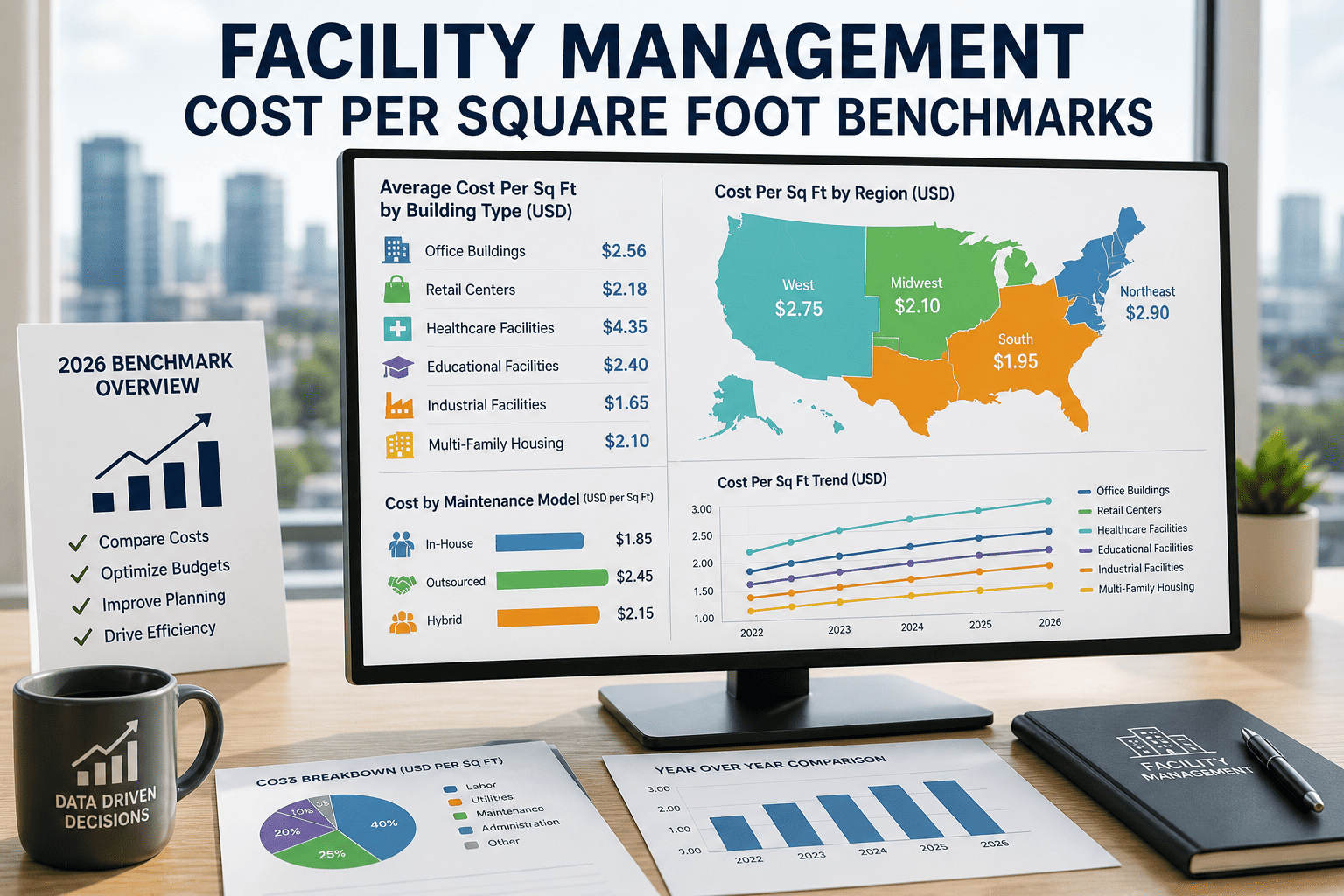
Benchmarking transforms maintenance from a cost center into a strategic asset. The data below reflects 2025 IFMA, BOMA, and Plant Engineering standards — use these KPIs to locate your facility’s performance gap.

$1.90 – $3.70
Office / Corporate
Annual maintenance cost per sq ft. Lower quartile > $3.20 suggests reactive overspend.
$3.50 – $6.20
Industrial / Manufacturing
Heavy asset intensity. Best performers stay below $4.50 with predictive maintenance.
$5.10 – $8.80
Healthcare / Hospitals
Compliance & uptime drive costs; top quartile still hits >68% planned maintenance.
$1.60 – $2.90
Retail / Big Box
Lowest per‑sq‑ft but high reactive risk; leaderboards achieve >55% planned.

Detailed Benchmarking by Facility Type

← swipe table →
Facility Type Cost per Sq Ft (annual) Planned Maintenance % Reactive Maintenance % Staff per 100k Sq Ft
Office (Class A) $2.10 – $3.50 55% – 68% 32% – 45% 0.9 – 1.5
Light Industrial $3.40 – $5.20 58% – 72% 28% – 42% 1.2 – 2.0
Heavy Manufacturing $4.20 – $6.80 62% – 78% 22% – 38% 1.8 – 2.8
Healthcare (acute care) $5.50 – $8.50 65% – 80% 20% – 35% 2.0 – 3.5
Retail / Grocery $1.80 – $3.00 45% – 60% 40% – 55% 0.7 – 1.3
Warehouse / DC $2.20 – $4.10 50% – 68% 32% – 50% 0.8 – 1.6

Benchmark sources: IFMA 2025, BOMA 2024, Plant Engineering KPI study. Planned maintenance % = scheduled vs. total work orders.

Your facility not hitting the benchmarks? Oxmaint’s real‑time analytics compare your actual spend, planned maintenance ratio, and OEE against industry‑specific standards — instantly.

Hidden Cost Drivers: Where Your Budget Leaks

Beyond benchmarks, specific operational gaps drain maintenance budgets. Targeting these three areas yields the fastest ROI improvement.

Emergency premium
+35‑55%
Reactive repairs cost 3x more than planned work. Each emergency call adds overtime, expedited parts, and production loss.
Inventory obsolescence
12‑18%
Facilities with disconnected CMMS/ERP carry 12‑18% excess stock. Real‑time sync reduces dead inventory.
Manual reconciliation
$28k‑$75k/year
Spreadsheet matching of work orders and POs wastes finance & maintenance hours. Automated integration eliminates it.
Ready to plug the leaks? Start with a free benchmarking assessment. Oxmaint shows exactly where your facility ranks against peers.

How to Conduct a Benchmarking Audit in 5 Steps

A structured audit helps you gather the right data and compare apples-to-apples. Follow this process before you implement changes.

1
Collect 12 months of work order data Pull total maintenance spend, labor hours, parts consumed, and contractor costs from your CMMS or ERP.
2
Calculate your cost per square foot Total annual maintenance spend ÷ total facility square footage. Segment by building type.
3
Determine planned vs. reactive ratio Count scheduled work orders vs. emergency/break-fix. Industry target: >65% planned.
4
Measure staffing efficiency FTE maintenance staff per 100,000 sq ft. Compare to your sector’s optimal range.
5
Benchmark against industry tables Use the detailed table above. Identify gaps and prioritize quick wins.

Sign up for Oxmaint to automate this audit — real-time dashboards replace manual spreadsheets.

Deep Dive: Key Maintenance KPIs You Must Track

Beyond cost per square foot, these four metrics separate top performers from the rest. Monitor them monthly.

Overall Equipment Effectiveness (OEE)
Industry avg: 65% | Top quartile: >85%
Measures availability, performance, and quality. Low OEE often correlates with reactive maintenance.
Mean Time Between Failures (MTBF)
Varies by asset; benchmark against manufacturer spec
Longer MTBF indicates effective preventive and predictive programs.
Mean Time to Repair (MTTR)
Target: <2 hours for critical assets
Short MTTR requires good spare parts availability and trained technicians.
Backlog (hours of work)
Ideal: 2–4 weeks of planned work
Too low → underutilized crew; too high → deferred maintenance risk.
“After implementing Oxmaint, we reduced our cost per square foot from $5.10 to $3.85 within nine months. The benchmarking dashboards showed exactly where we were overspending on emergency repairs. Now our planned maintenance sits at 73% — above industry top quartile.”
— Ellen Voss, Director of Facility Operations, Fortune 500 Industrial Portfolio
Expert in maintenance benchmarking & CMMS transformation (25+ years)

Case Study: How a 2M sq ft Warehouse Cut Costs by 27%

A Midwest distribution center with 2 million square feet and 18 technicians was spending $5.20 per sq ft — well above the $3.80 industry median. After a benchmarking audit, they implemented three changes:

  • Shifted 40% of reactive work to planned PMs using asset condition data.
  • Integrated CMMS with ERP to eliminate double data entry and reduce inventory by 14%.
  • Introduced mobile work orders to improve technician compliance from 62% to 91%.

Within 8 months, cost per sq ft dropped to $3.80, planned maintenance rose from 48% to 69%, and month-end close time fell from 5 days to 1 day. Book a demo to see the full case study and apply similar tactics to your facility.

Staffing & Cost Efficiency: Where Do You Stand?

Maintenance staffing ratios directly impact both cost per square foot and equipment uptime. Use these breakpoints to optimize your team structure.

Under‑staffed
<0.8 FTE / 100k sq ft
Reactive maintenance >55% → unplanned downtime rises 30%.
Optimal Range
1.0 – 1.8 FTE / 100k sq ft
Planned maintenance reaches 60‑70% with lower emergency spend.
Over‑staffed
>2.2 FTE / 100k sq ft
Diminishing returns; labor cost per work order increases 18%+.

Book a demo to benchmark your actual crew productivity and get tailored staffing recommendations based on your asset portfolio.

How to Improve Your Benchmark Scores

Move from reactive to planned

Facilities with planned maintenance >65% reduce annual cost per sq ft by 22% on average. Schedule preventive work using asset condition data.

Implement CMMS + ERP visibility

Closing the cost loop cuts reconciliation errors and provides real budget vs. actuals. See how Oxmaint integrates with your ERP to automate cost tracking.

Train on mobile-first work orders

Technicians logging parts/labor on mobile improves data accuracy by 40% and boosts planned maintenance completion rates.

Optimize spare parts inventory

Run ABC analysis: 80% of stock value comes from 20% of SKUs. Reduce slow-moving items and set min/max levels based on usage data.

Frequently Asked Questions

What is a good maintenance cost per square foot for industrial facilities?
For heavy manufacturing, the 50th percentile is $4.80–$5.50/sq ft. Best‑in‑class (top 25%) achieve below $4.20/sq ft through predictive maintenance. Use Oxmaint to benchmark your exact facility type.
How is planned maintenance percentage calculated?
Planned maintenance % = (scheduled work orders) / (total work orders) ×100. Industry best practice targets >65%. Lower than 50% indicates excessive firefighting.
What staffing ratio should a 300,000 sq ft warehouse target?
A distribution center typically needs 2.5 to 4.5 FTEs (0.8–1.5 per 100k sq ft). High automation can lower to 2 FTEs. Book a demo for a customized staffing analysis.
How often should we update our benchmarking data?
Refresh benchmarks quarterly using actual cost, labor, and work order data. Oxmaint automatically tracks variances against industry standards and alerts you to drift.
Does Oxmaint support integration with SAP or Oracle for cost benchmarking?
Yes. Oxmaint’s bidirectional connectors sync work order costs, parts consumption, and labor directly to your ERP. Real‑time data ensures your benchmarks reflect actual spend. Sign up to explore integration options.
What is the average ROI after improving benchmark scores?
Companies that move from bottom quartile to top quartile see 15–25% reduction in total maintenance cost within 12 months, plus 10–15% improvement in asset uptime. Oxmaint users report average payback period of 6‑8 months.

Turn Benchmarks Into Actionable Savings

Stop guessing if your maintenance budget is efficient. Oxmaint gives you live dashboards comparing your cost per sq ft, planned maintenance ratio, and staffing against your industry peers. See exactly where to cut waste and improve reliability.
Share This Story, Choose Your Platform!