A benchmark without context is just a number. A benchmark compared to your actual performance, tracked over time, and tied to the specific maintenance decisions that caused it to move — that is a management tool. Facility managers who benchmark their operations against sector-specific standards consistently outperform peers: McKinsey's 2024 operations data shows facilities using standardized maintenance metrics achieve up to 25% better asset uptime and 20% better cost efficiency than those without. The challenge is knowing which benchmarks to use — because an office building maintenance cost of $3.50 per square foot is excellent for a suburban suburban facility and alarming for a hospital. A PM compliance rate of 75% is adequate for a retail strip center and dangerously low for a data center. Sector matters as much as the metric itself. Book a demo to see how OxMaint's analytics and reporting module compares your facility's actual KPIs against sector-specific benchmarks in real time.
Article · Analytics & KPIs · Facility Management · Benchmarking
Building Performance Quality Benchmarks by Sector
MTBF targets, energy intensity standards, maintenance cost per square foot, and PM compliance rates — mapped by sector so your KPIs are compared against the right reference point, not a generic industry average.
25%
Better asset uptime at facilities using standardized maintenance metrics (McKinsey 2024)
4.8×
Higher cost of reactive repairs vs planned maintenance — closing this gap is where benchmarking ROI lives
92%+
PM compliance rate at best-in-class FM operations — below 80% means reactive failures are accumulating
20%
Better cost efficiency at organizations using standardized maintenance metrics vs peers
Core KPI Definitions
The 5 Metrics That Drive Every Sector Benchmark
Before applying sector benchmarks, teams need aligned definitions. The same metric named differently across two facilities creates comparisons that mislead rather than inform. These are the five metrics used throughout this guide, with their precise definitions and the direction of improvement for each.
MTBF
Mean Time Between Failures
Average hours of operation between unplanned failure events on a specific asset. Rising MTBF indicates effective PM. Falling MTBF signals deferred maintenance accumulating into failure clusters.
Higher is better
MTTR
Mean Time To Repair
Average hours from failure report to full restoration. Rising MTTR indicates parts availability gaps, skill gaps, or work order bottlenecks. Target: under 4 hours for critical systems.
Lower is better
PM%
PM Compliance Rate
Percentage of scheduled preventive maintenance tasks completed on time. Below 80% means reactive failures are accumulating. Best-in-class FM operations sustain 92% or above.
Higher is better
$/sqft
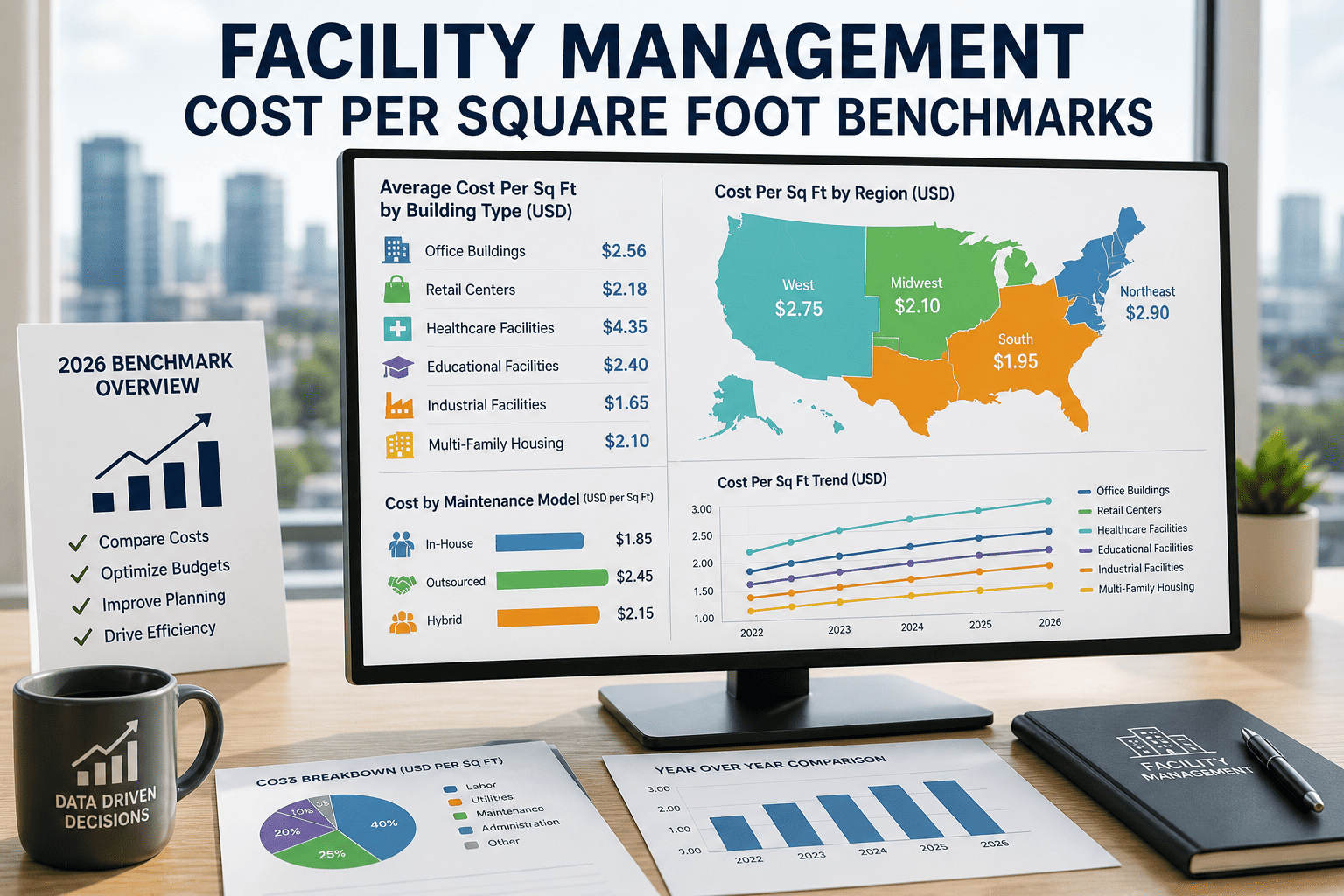
Maintenance Cost per Square Foot
Total maintenance spend (labor, parts, contractors) divided by gross floor area. Highly sector-dependent — compare only within sector for meaningful benchmarking.
Lower is better within sector
EUI
Energy Use Intensity
Annual energy consumption in kBtu per square foot per year. ASHRAE Standard 100-2024 sets EUI benchmarks for existing buildings. ENERGY STAR requires top quartile performance (score 75+).
Lower is better
Sector Benchmark Tables
Performance Benchmarks by Building Type — 2025 Data
These benchmarks draw from IFMA 2025 data, BOMA 2024 benchmarking reports, ASHRAE Standard 100-2024 energy intensity standards, and the Uptime Institute tier performance data. Use these as the reference point for your facility's KPI comparison — and identify the gaps that represent your largest improvement opportunities.
Commercial Office Buildings
| KPI | Bottom Quartile | Industry Median | Top Quartile (Best-in-Class) |
| Maintenance cost per sq ft / yr |
>$4.50 |
$2.80–$3.50 |
<$2.50 |
| PM compliance rate |
<65% |
72–80% |
>92% |
| MTBF — HVAC chillers |
<1,400 hrs |
1,800–2,000 hrs |
>2,200 hrs |
| MTTR — critical systems |
>12 hrs |
4–8 hrs |
<4 hrs |
| Energy Use Intensity (EUI) |
>90 kBtu/sqft/yr |
50–80 kBtu/sqft/yr |
<45 kBtu/sqft/yr |
| Planned vs reactive ratio |
<50% planned |
65–75% planned |
>80% planned |
Healthcare / Hospital Facilities
| KPI | Bottom Quartile | Industry Median | Top Quartile (Best-in-Class) |
| Maintenance cost per sq ft / yr |
>$9.00 |
$6.50–$8.00 |
<$5.50 |
| PM compliance rate |
<75% |
82–88% |
>95% |
| MTBF — critical HVAC |
<1,800 hrs |
2,400–3,000 hrs |
>3,500 hrs |
| MTTR — critical systems |
>6 hrs |
2–4 hrs |
<2 hrs |
| Energy Use Intensity (EUI) |
>350 kBtu/sqft/yr |
250–300 kBtu/sqft/yr |
<220 kBtu/sqft/yr |
| Regulatory compliance rate |
<88% |
93–96% |
100% (non-negotiable) |
Industrial / Manufacturing Facilities
| KPI | Bottom Quartile | Industry Median | Top Quartile (Best-in-Class) |
| Maintenance cost per sq ft / yr |
>$5.50 |
$3.50–$4.80 |
<$3.20 |
| PM compliance rate |
<60% |
68–75% |
>85% |
| OEE (Overall Equipment Effectiveness) |
<55% |
65–75% |
>85% |
| Planned vs reactive ratio |
<45% planned |
60–70% planned |
>80% planned |
| Maintenance cost as % of RAV |
>4.5% |
2.5–3.5% |
<2.0% |
| Energy Use Intensity (EUI) |
>250 kBtu/sqft/yr |
150–200 kBtu/sqft/yr |
<120 kBtu/sqft/yr |
MTBF Targets by Asset Type
Asset-Level MTBF Benchmarks Across Building Systems
MTBF tracked at the building level masks the asset-level failures driving the number. HVAC chillers, elevators, generators, and fire suppression systems have very different failure rates and very different acceptable MTBF floors. Facilities that track MTBF by asset type — not just portfolio-wide — can identify which specific systems are falling below benchmark and allocate PM resources accordingly.
HVAC Chillers
Target: >2,200 hours
Below 1,400 hrs: PM program failure or deferred maintenance — investigate before next failure
Elevators
Target: >4,500 hours
High traffic buildings: track separately by elevator — one outlier drags the average
Emergency Generators
Target: >1,800 hours
Monthly load testing is the primary PM — test under actual load, not at idle
UPS Systems
Target: >5,000 hours
Battery replacement at 4–5 years regardless of apparent condition is the key PM
Fire Suppression
Target: Zero unplanned activations
NFPA 25 inspection compliance is the primary benchmark — not MTBF
BMS / Controls
Target: >8,000 hours
Software update schedules and communication pathway testing are the dominant PM tasks
Compare Your Facility's KPIs Against Sector Benchmarks — Live, Not Quarterly
OxMaint's analytics and reporting module calculates MTBF, MTTR, PM compliance, and cost per square foot from your actual work order data — and compares them against sector-specific benchmarks in real time. Book a demo to see where your facility stands against best-in-class performance today.
Expert Perspective
What Facility Directors Say About Benchmarking
★★★★★
We were spending $5.10 per square foot on maintenance and thought it was normal — our team was busy, we were handling requests, things seemed fine. OxMaint's benchmarking dashboards showed we were 45% above the industry median for our sector. The problem was our planned-to-reactive ratio was 48% — we were firefighting, not maintaining. Within nine months of improving PM compliance, our cost per square foot dropped to $3.85. The benchmark told us where to look. The CMMS gave us the lever.
EV
Ellen V.
Director of Facility Operations, Fortune 500 Industrial Portfolio, USA
★★★★★
Hospital facilities benchmarking is different from every other sector. MTTR targets, regulatory compliance rates, and PM compliance thresholds are all substantially higher than commercial office benchmarks — because the consequence of failure is not inconvenience, it is patient safety. Once we started benchmarking against healthcare-specific standards rather than generic FM data, our PM program priorities completely reordered. We had been gold-plating low-consequence assets and under-maintaining critical HVAC. The sector comparison made the reallocation obvious.
PG
Patricia G.
VP of Facilities, Regional Hospital Network, USA
★★★★☆
Energy Use Intensity benchmarking is now mandatory for our portfolio under building performance standards legislation. What changed when we started tracking EUI in OxMaint per building was that we could see exactly which assets were driving excess consumption — not just a building-level score. Two aging AHUs were responsible for 60% of our EUI gap vs benchmark. Replacing them moved our whole building from the bottom quartile to top quartile performance. EUI without asset-level root cause is just a compliance number. With it, it is a capital decision tool.
LT
Lucas T.
Head of Sustainability, Commercial Real Estate Portfolio, UK
Frequently Asked Questions
Facility Performance Benchmarking — Common Questions
What is a good maintenance cost per square foot benchmark for office buildings?
Based on IFMA 2025 and BOMA 2024 benchmarking data, the industry median for commercial office building maintenance cost sits between $2.80 and $3.50 per square foot per year. Top quartile performers achieve below $2.50 through high PM compliance rates (above 80% planned maintenance ratio) and predictive maintenance programs that prevent the costly reactive repairs that inflate bottom-quartile costs to above $4.50 per square foot. The single largest driver of above-median cost in commercial office buildings is a low planned-to-reactive ratio — reactive repairs consistently cost 3 to 5 times more than the equivalent planned work.
Book a demo to benchmark your portfolio's cost per square foot against sector data in OxMaint.
What is the MTBF target for HVAC chillers in commercial buildings?
The target MTBF benchmark for HVAC chillers in commercial buildings is above 2,200 hours, with top-performing facilities achieving 3,000 or more hours between unplanned failures through a combination of vibration monitoring, oil analysis, and condition-based maintenance. An MTBF below 1,400 hours typically indicates a PM program failure — either missed service intervals, incorrect lubricant, or deferred maintenance accumulating into recurring failures. MTBF tracking per asset in a CMMS is what makes this benchmark actionable — a portfolio-average MTBF masks the specific chillers that are below target and driving the overall failure rate.
Start a free trial to track MTBF per asset in OxMaint and compare against benchmark targets.
What PM compliance rate should a facility management team target?
Best-in-class facility management operations sustain PM compliance rates above 92% — meaning over 92% of scheduled preventive maintenance tasks are completed on time. Below 80% is an early warning indicator that reactive failures are accumulating, because missed PM tasks create the deferred maintenance backlog that eventually produces unplanned equipment failures at 3 to 5 times the cost of the planned work they replaced. Healthcare facilities require PM compliance above 95% due to regulatory and patient safety requirements. Industrial facilities typically benchmark at above 85%. The measurement itself requires a CMMS — PM compliance cannot be accurately tracked without digital work order management that records both scheduled and actual completion dates.
Book a demo to see how OxMaint calculates PM compliance rate from your actual work order data.
How does Energy Use Intensity (EUI) benchmarking work and what are the targets by building type?
Energy Use Intensity measures annual energy consumption in kBtu per square foot per year, normalized for building type and climate. ASHRAE Standard 100-2024 establishes EUI benchmarks for existing commercial and residential buildings. For office buildings, the national median EUI is roughly 50 to 80 kBtu per square foot per year — ENERGY STAR certification requires a score of 75 or above on EPA's 1 to 100 percentile scale, meaning the building performs in the top 25%. Hospitals have significantly higher EUI benchmarks due to continuous operation requirements, with medians around 250 to 300 kBtu per square foot. Tracking EUI per building in OxMaint and linking consumption anomalies to specific assets makes the benchmark actionable rather than just a compliance score.
Book a demo to see OxMaint's energy intensity tracking and benchmarking features.