Every escalator and moving walkway operating in a commercial facility is governed by ASME A17.1 — the Safety Code for Elevators and Escalators — which mandates specific inspection intervals, safety device tests, and documented maintenance records. A missed monthly check or an unlogged safety brake test is not just a compliance gap; it is a direct liability exposure when an incident occurs. OxMaint's Asset Lifecycle Management automates every checklist in this guide — scheduling tasks, capturing technician sign-offs, and maintaining the audit trail your authority having jurisdiction (AHJ) will require. Book a free demo to see escalator compliance management in action.
Checklist · Equipment & Asset Management
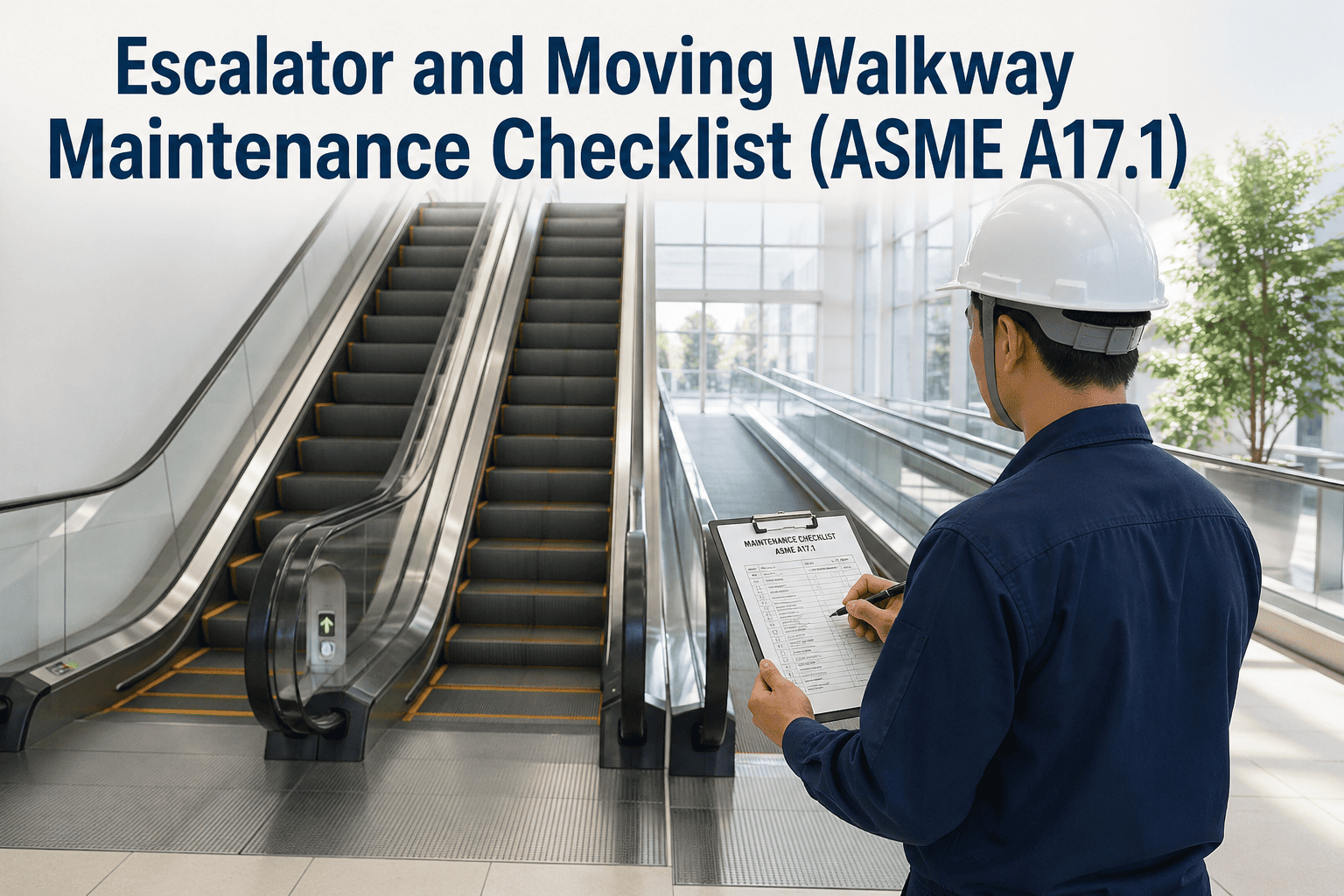
Escalator and Moving Walkway Maintenance Checklist (ASME A17.1)
ASME A17.1
Governing Standard
Monthly
Minimum PM Frequency
Annual
AHJ Inspection Cycle
100%
Safety Device Test Completion Required
$2.3M
Avg. Liability Cost of Escalator Incident
How to Use This Checklist
Checklist Structure and Compliance Requirements
This checklist is organized by inspection frequency — daily, weekly, monthly, quarterly, and annual — in alignment with ASME A17.1 Section 8.6 requirements. Each task includes the relevant code reference, the responsible party, and the acceptance criterion. All completed tasks must be documented with technician name, date, findings, and corrective actions taken. OxMaint captures all of this automatically at point of inspection on mobile.
Daily
Weekly
Monthly
Quarterly
Annual
Section 1 — Daily Checks
Daily Operational Inspection
Daily checks are typically performed by facility staff before the first public operating period. These are visual and functional verifications — not full maintenance tasks — but must be logged and any deficiency reported immediately to the qualified elevator/escalator mechanic.
Start-up functional test — run escalator through full operating cycle in both directions
8.6.1.1
Smooth start, no unusual noise, correct direction indication
Daily
Handrail surface condition and speed synchronization with step speed
8.6.4.1
No cuts, cracks, or missing sections; handrail speed within ±2% of step speed
Daily
Step or pallet surface condition — visible cleanliness, no missing demarcation lines
8.6.3.1
Yellow demarcation strips intact, no cracked or chipped step surfaces
Daily
Combplate finger condition at both landings — no missing, bent, or broken teeth
8.6.3.3
All comb teeth present, engaged in step grooves, no visible damage
Daily
Emergency stop button test at both landings
8.6.9.1
Escalator stops within 1.5 seconds of button actuation
Daily
Skirt panel clearance — no objects wedged between step and skirt
8.6.3.2
Clear, uniform 4 mm maximum gap between step edge and skirt panel
Daily
Section 2 — Weekly Checks
Weekly Mechanical and Safety Verification
Handrail inlet guard (newel guard) condition and finger protection device test
8.6.4.3
Guard present, undamaged; device stops escalator when triggered
Weekly
Lubrication check — step chain lubrication and handrail drive chain oil level
8.6.6.1
Adequate lubricant on chain pins; no dry or corroded links visible
Weekly
Machine room or drive area inspection — temperature, cleanliness, no water ingress
8.6.7.1
Temperature below 40°C; no combustibles stored; drain clear
Weekly
Decking and balustrade panel integrity — no loose, cracked, or missing panels
8.6.5.1
All panels secure, no gaps, grilles undamaged
Weekly
Operating speed verification with calibrated tachometer
8.6.1.3
Rated speed ±5% under no-load condition
Weekly
Section 3 — Monthly Checks
Monthly ASME A17.1 Preventive Maintenance Tasks
Monthly tasks must be performed by a licensed elevator/escalator mechanic and documented in the maintenance record log retained on-site. These records are a primary document requested during AHJ inspections and insurance audits.
Step chain tension measurement and adjustment — both sides
8.6.6.2
Chain tension within manufacturer specification; no elongation beyond 2% of pitch
Monthly
Step chain safety device (broken step chain switch) functional test
8.6.9.4
Escalator stops within required distance when switch is manually actuated
Monthly
Drive motor current and voltage measurement under load
8.6.7.2
Within ±10% of nameplate rated current; no phase imbalance above 2%
Monthly
Brake holding force test — static load test at rated capacity
8.6.8.1
Brake holds escalator stationary with rated load applied; no drift detected
Monthly
Skirt deflector (skirt obstruction device) functional test
8.6.9.5
Device triggers escalator stop when 85 N lateral force applied to skirt
Monthly
Step or pallet axle and roller inspection — wear measurement
8.6.3.4
Roller diameter within 1 mm of nominal; no flat spots or cracked tires
Monthly
Combplate impact device functional test at both landings
8.6.9.3
Escalator stops when 135 N upward or 67 N downward force applied to comb
Monthly
Handrail speed monitoring device test
8.6.4.2
Device stops escalator if handrail speed deviates more than 15% from step speed
Monthly
Never Miss a Monthly ASME A17.1 Inspection Again
OxMaint auto-schedules every task in this checklist, assigns it to the right technician, captures digital sign-off with timestamp, and generates the on-site maintenance record log — automatically.
Section 4 — Quarterly Checks
Quarterly Mechanical Condition Assessment
Main drive chain elongation measurement and lubrication
8.6.6.3
Chain elongation less than 3% of original pitch length; lubricated per spec
Quarterly
Gear reducer oil level and condition check; oil sample analysis
8.6.7.3
Oil at correct level; no metal particles above 50 ppm in sample; no emulsification
Quarterly
Drive motor bearing temperature and vibration measurement
8.6.7.4
Bearing temperature below 80°C; vibration below 4.5 mm/s RMS
Quarterly
Step upthrust device (anti-reversal) functional test
8.6.9.6
Device prevents step reversal under upward thrust load; escalator stops
Quarterly
Truss and supporting structure visual inspection for cracks or corrosion
8.6.2.1
No visible cracking, deformation, or active corrosion on structural members
Quarterly
Section 5 — Annual Tests
Annual Safety Tests Required by ASME A17.1
Annual tests must be performed by a licensed mechanic and witnessed or reviewed by the AHJ inspector. All test results — load values, stopping distances, device actuation forces — must be recorded on the official inspection form and retained for a minimum of five years under most jurisdictions.
ASME 8.6.9.1
Overspeed Governor Test
Governor must actuate and stop the escalator when speed exceeds rated speed by more than 20%. Stopping distance must not exceed values in ASME A17.1 Table 8.6.9.1.
Record: Actuation speed (m/s) · Stopping distance (m) · Pass/Fail
ASME 8.6.8.2
Brake Stopping Distance Test
With rated load descending, brake must stop the escalator within the maximum stopping distances defined by the code for the unit's rated speed and angle of inclination.
Record: Load applied (kg) · Stopping distance (m) · Brake adjustment made
ASME 8.6.4.4
Handrail Continuity Test
Handrail must complete a full operating cycle without interruption. Handrail speed must remain within ±2% of step speed throughout the test under simulated passenger load.
Record: Speed differential (%) · Any handrail slippage events noted
ASME 8.6.10.1
Step Level Device Test
Device must detect a step or pallet that is out of level (exceeding 4 mm deflection) and stop the escalator before the affected step reaches the combplate engagement zone.
Record: Deflection threshold used · Stopping point on strand · Pass/Fail
ASME 8.6.2.2
Rated Load Test
Escalator must operate at rated speed with full rated load (typically 75 kg per step, all steps simultaneously loaded) for a minimum of 1 hour without thermal trip, current overload, or abnormal noise.
Record: Load used · Duration · Motor current at peak load · Pass/Fail
ASME 8.6.9.2
Broken Drive Chain Device Test
Simulate drive chain failure by disconnecting or bypassing chain; device must detect loss of drive within one step pitch of movement and initiate a controlled stop.
Record: Detection distance · Stop initiated · Chain reconnected and verified
Moving Walkway Differences
Additional Checklist Items Specific to Moving Walkways
| Component |
Difference from Escalator |
Inspection Criterion |
Frequency |
| Pallet or Belt Surface |
Flat surface — no step rise to contain foot placement |
No pallet separation > 4 mm; belt surface smooth with no tears |
Daily |
| Inclination Angle |
0–12° max vs escalator 30° |
Angle within ±1° of design; no visible structural deflection |
Quarterly |
| Pallet-to-Comb Engagement |
Wider comb span required for flat pallet |
All comb fingers seated minimum 6 mm into pallet grooves |
Monthly |
| Rated Speed |
Max 0.9 m/s (horizontal) vs 0.75 m/s (escalator) |
Speed within ±5% of rating; speed monitoring device calibrated |
Weekly |
| Belt Tension (belt-type walkways) |
Continuous belt rather than linked pallets |
Belt sag not exceeding 25 mm between support rollers |
Monthly |
Expert Review
Industry Guidance and Expert Perspectives
"Analysis of escalator incident data consistently identifies three primary failure points: step chain fatigue failure, brake degradation below minimum stopping force, and combplate damage that creates entrapment hazards. All three are preventable through the monthly inspection tasks mandated by ASME A17.1 — yet our audit data shows that 38% of commercial facility escalators have no documented evidence of monthly safety device testing. The maintenance record gap is as dangerous as the mechanical gap."
— National Elevator Industry Inc. (NEII), Escalator Safety and Maintenance Benchmarking Report, 2024
"Digital maintenance management platforms that automate escalator inspection scheduling and capture technician findings at the point of inspection have demonstrated a 60–70% reduction in missed task rates compared to paper-based systems. More importantly, the digital audit trail they create has become the primary defense document in escalator liability litigation — facilities with complete digital records resolve claims at significantly lower settlement values than those with paper logs or no records at all."
— Elevator World Magazine, Technology in Vertical Transportation Maintenance, 2024
FAQs
Frequently Asked Questions
Who is legally required to perform ASME A17.1 escalator maintenance inspections?
ASME A17.1 requires that all maintenance and testing tasks be performed by a qualified elevator/escalator mechanic — defined as an individual who holds a current certification from a recognized body such as the National Elevator Industry Educational Program (NEIEP) or has equivalent documented training and experience. Daily operational checks may be performed by trained facility staff, but all monthly and periodic safety device tests must be carried out by a licensed mechanic. Jurisdictions adopting A17.1 also require periodic inspection and witnessing by an AHJ-approved inspection agency.
Start free to assign tasks to credentialed mechanics in OxMaint.
How long must escalator maintenance records be retained under ASME A17.1?
ASME A17.1 requires that the complete maintenance record log — including all inspection dates, task descriptions, findings, and corrective actions — be retained on-site and available for AHJ review. Most jurisdictions that have adopted A17.1 mandate a minimum retention period of five years. In practice, OxMaint retains all records indefinitely in the cloud, making them immediately accessible during unannounced inspections, insurance audits, or incident investigations without physical file retrieval.
Book a demo to see the compliance record dashboard.
What happens if an escalator fails the annual brake stopping distance test?
A brake stopping distance failure is a mandatory out-of-service condition under ASME A17.1. The escalator must be immediately removed from service, tagged, and locked out. A qualified mechanic must adjust, replace, or overhaul the brake system until the unit passes a repeat test with witnessed results meeting the code table values for the unit's speed and angle. The failed test result, corrective action taken, and successful repeat test must all be documented in the maintenance record. OxMaint creates a corrective work order automatically when a test failure is recorded during inspection.
How does OxMaint help manage escalator inspections across a multi-site facility portfolio?
OxMaint maintains a separate asset record for each escalator and moving walkway across all sites, each with its own PM schedule aligned to ASME A17.1 frequencies. A portfolio-level compliance dashboard shows every unit's inspection status, upcoming tasks, overdue items, and expiring certifications in a single view. When an AHJ inspection is approaching at a specific site, the facility manager can pull a complete inspection-ready report covering all units at that location — covering the last five years of maintenance history — in under two minutes.
Asset Lifecycle Management
Run Every Escalator Inspection on Schedule — Zero Gaps, Full Documentation
OxMaint automates the complete ASME A17.1 maintenance program for every escalator and moving walkway in your portfolio — scheduling, assigning, capturing, and reporting every inspection so your facility is always audit-ready.


.jpeg)
