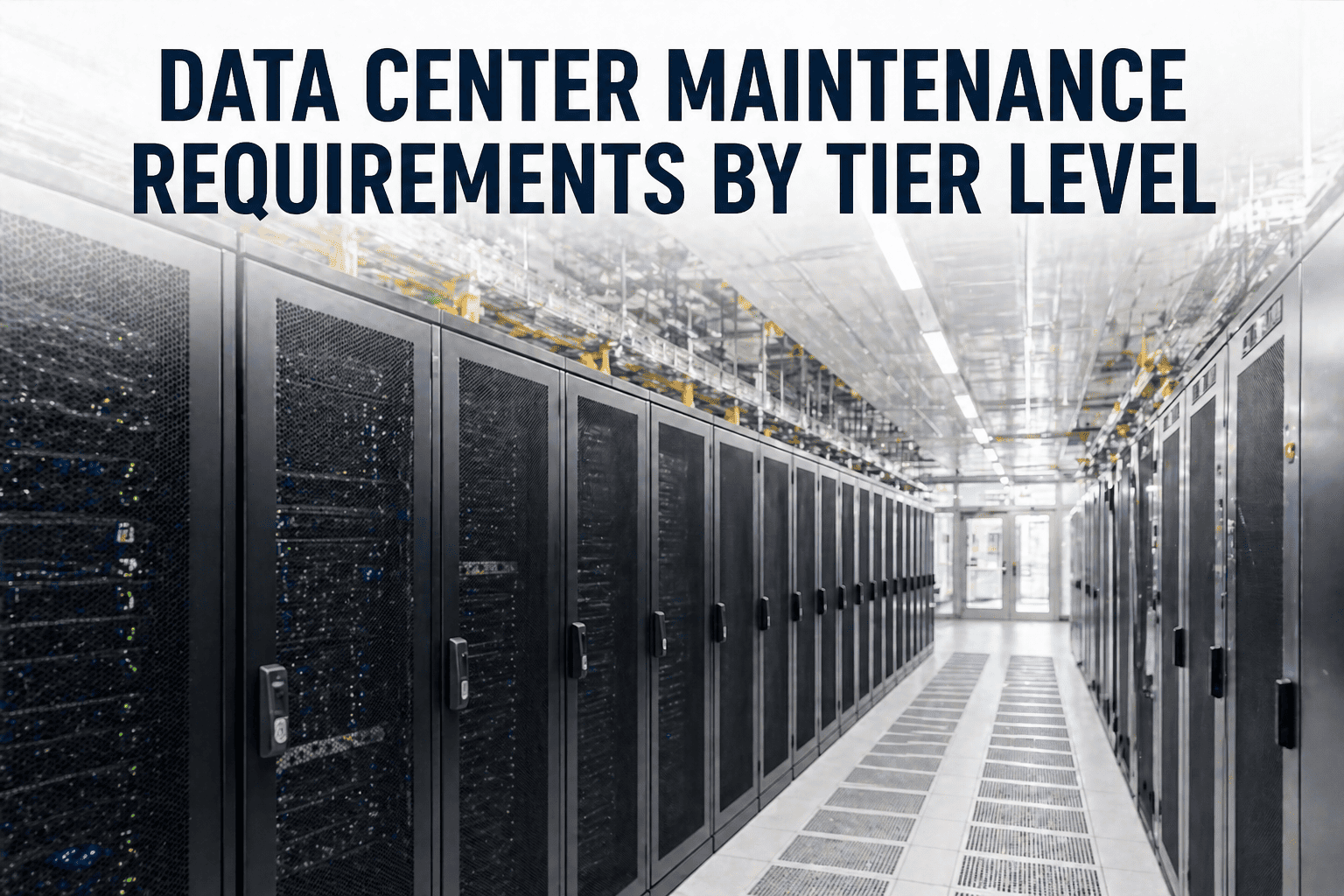
Data Center Maintenance Requirements by Tier Level

By james smith on April 30, 2026

data-center-tier-maintenance-requirements-dcim

The Uptime Institute's tier classification system does not just define how much redundancy a data center has — it defines how that data center must be maintained. A Tier IV facility with Tier II maintenance practices will fail to deliver Tier IV uptime. The hardware redundancy is only half the equation. The other half is a maintenance program structured precisely around your tier's concurrent maintainability obligations, failover testing cadence, and CMMS documentation requirements that satisfy Uptime Institute's operational sustainability criteria. This article maps every tier to its specific maintenance obligations — and shows how DCIM and CMMS systems work together to enforce them. Start managing data center maintenance by tier on Oxmaint — free trial, no credit card.

Article · Industry Verticals · Predictive Maintenance AI

Data Center Maintenance Requirements by Tier Level

From 28.8 hours of allowable annual downtime at Tier I to just 26 minutes at Tier IV — each tier demands a fundamentally different maintenance strategy, not just better hardware.

I
99.671%
28.8 hrs/yr
II
99.741%
22 hrs/yr
III
99.982%
1.6 hrs/yr
IV
99.995%
26 min/yr
TierUptimeAllowable Downtime
Tier-by-Tier Breakdown

What Each Tier Actually Requires From Your Maintenance Program

Uptime Institute evaluates four factors when assigning and maintaining tier certification: uptime guarantee, redundancy levels, concurrent maintainability, and staff expertise with maintenance protocols. The last two are entirely determined by how your maintenance program operates — not by infrastructure spend.

Tier I
99.671% Uptime
28.8 hours downtime/year
Infrastructure
Single path for power and cooling with no backup components. Non-redundant design means any maintenance requiring shutdown stops operations.
Maintenance Obligations
Monthly PM on UPS, cooling, and generators. Annual load testing. Scheduled maintenance windows require full site downtime — must be coordinated with clients in advance.
CMMS Requirement
Basic work order scheduling and completion records. Documentation of planned downtime windows communicated to stakeholders.
Best for: Dev/test environments, internal non-critical workloads
Tier II
99.741% Uptime
22 hours downtime/year
Infrastructure
Single distribution path with N+1 redundant components for power and cooling. Some maintenance can occur with reduced risk, but not full concurrent maintainability.
Maintenance Obligations
Monthly PM with standby component testing. Quarterly UPS battery condition assessments. Generator load bank testing semi-annually. Redundant component inventory maintained on-site.
CMMS Requirement
Scheduled PM records with completion evidence. Standby component condition tracking linked to primary asset records. Maintenance window communication log.
Best for: SMB production workloads with moderate downtime tolerance
Tier IV
99.995% Uptime
26 minutes downtime/year
Infrastructure
2N fully fault-tolerant design. Every component has a complete active backup. Any single failure — including during maintenance — cannot affect IT load. Highest cost; used by financial, healthcare, and national infrastructure operators.
Maintenance Obligations
Daily condition monitoring with automated alerts. Weekly PM on all active and standby systems. Monthly full-system failover tests under real load. Quarterly Uptime Institute operational sustainability compliance review.
CMMS Requirement
Predictive AI maintenance with real-time sensor integration. Every maintenance action documented with pre/post condition data. DCIM-CMMS bidirectional integration for capacity and maintenance coordination. Complete audit trail for Tier IV operational sustainability certification.
Best for: Financial services, healthcare, national critical infrastructure
Maintenance Comparison Table

Tier Maintenance Requirements at a Glance

Requirement Tier I Tier II Tier III Tier IV
Annual Downtime Budget 28.8 hours 22 hours 1.6 hours 26 minutes
Power Redundancy None (N) N+1 partial N+1 all paths 2N fully active
Concurrent Maintainability No Partial only Yes — required Yes + fault tolerant
PM Frequency (Minimum) Monthly Monthly + standby Weekly + dual path Daily monitoring
Generator Test Cadence Annual Semi-annual Quarterly under load Monthly full failover
CMMS Documentation Basic WOs PM records + standby log Full PM + DCIM integration AI predictive + audit trail
Uptime Institute Operational Review Not required Not required Recommended Required for certification
DCIM + CMMS Integration
Your Tier Certification Is Only as Strong as Your Maintenance Documentation.
Oxmaint integrates with DCIM systems to connect real-time capacity monitoring to automated PM scheduling — giving Tier III and Tier IV operators the documented concurrent maintainability records and audit trails that Uptime Institute operational sustainability reviews require.
DCIM + CMMS Integration

How DCIM and CMMS Work Together Across Tier Levels

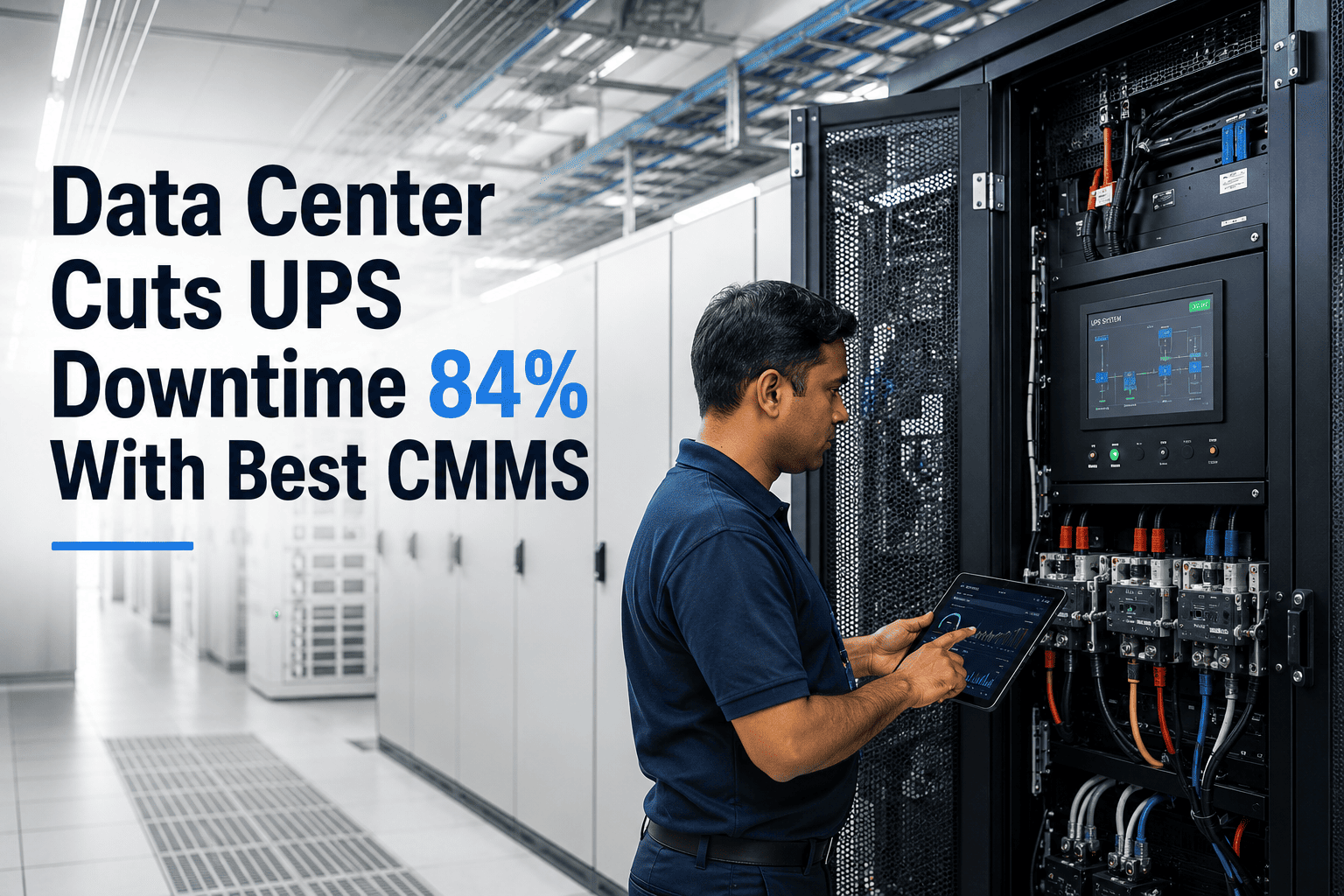
DCIM (Data Center Infrastructure Management) monitors real-time capacity — power, cooling, and space utilization. CMMS manages the maintenance workflows that keep those systems performing to specification. At Tier III and Tier IV, these two systems must be integrated. A DCIM alert that stays in the DCIM system is not an action — it is just data.
01
DCIM Detects Anomaly
PDU load imbalance, cooling unit delta-T reduction, or UPS discharge depth trend detected in real time by DCIM sensors and monitoring software.
02
CMMS Receives Alert
DCIM alert automatically triggers a CMMS work order via API integration — tagged to the specific asset, cabinet, or power path with the anomaly data attached.
03
Technician Dispatched
Work order assigned to the qualified technician on-shift with access to asset history, concurrent maintainability procedure, and required permit-to-work approval workflow.
04
Maintenance Documented
Pre- and post-maintenance condition data captured in CMMS. Concurrent maintainability test result recorded. Uptime Institute audit trail updated automatically with each closed work order.
Tier IV Requirement
At Tier IV, this integration is not optional — it is an operational sustainability obligation. Uptime Institute operational sustainability reviews examine whether your maintenance execution matches your tier's concurrent maintainability design intent. Without DCIM-CMMS integration, your documentation will not withstand scrutiny.
Expert Review

What Data Center Facility Managers Say About Tier-Aligned Maintenance

JB
James B.
Critical Facilities Director, Tier III Colocation — 12MW, 2,800+ Tier Certifications industry context
★★★★★
Our Uptime Institute operational sustainability review flagged one finding in our last cycle: we lacked documented evidence that concurrent maintainability tests had been performed under actual load conditions. We had performed the tests — we just hadn't logged them in a way that created an audit trail. After connecting Oxmaint to our DCIM, every concurrent maintainability test is automatically timestamped, linked to the active load data at test time, and filed against the relevant asset record. The next review was clean.
NK
Nadia K.
Data Center Operations Manager, Tier IV Financial Services Facility — 40MW
★★★★★
At Tier IV, the maintenance documentation burden is significant. Every generator test, every UPS maintenance event, every cooling system PM has to create an audit-ready record before, during, and after the work. Oxmaint's mobile work order system with pre and post-task checklists has eliminated the documentation backlog we used to face after major maintenance windows. Auditors now get a complete maintenance history exportable from one platform in minutes, not days.
FAQs

Data Center Tier Maintenance — Frequently Asked Questions

What is concurrent maintainability and which tiers require it?
Concurrent maintainability is the ability to perform planned maintenance on any component of the data center's infrastructure without requiring any IT load to be taken offline. Tier III requires concurrent maintainability — meaning multiple active power and cooling distribution paths exist so that maintenance on one path does not affect the other. Tier IV goes further, requiring fault tolerance, meaning even an unplanned failure during maintenance cannot impact IT operations. Tiers I and II do not require concurrent maintainability; their maintenance windows require planned downtime. Book a demo to see how Oxmaint schedules concurrent maintainability tests.
What documentation does a Tier III or Tier IV facility need for Uptime Institute operational sustainability?
Uptime Institute Operational Sustainability reviews examine whether a facility's actual maintenance operations match its certified design intent. Auditors review PM completion records, concurrent maintainability test results with load data, generator and UPS test logs, incident records with root cause documentation, and staff training evidence. The most common finding is that PM tasks were performed but not documented in a way that creates a traceable audit trail. CMMS records with timestamped technician sign-offs and pre/post condition data resolve this gap. Start building your operational sustainability documentation on Oxmaint.
How does DCIM differ from CMMS and why do Tier III/IV facilities need both?
DCIM monitors real-time infrastructure capacity — power utilization, cooling efficiency, space availability, and environmental conditions. CMMS manages the maintenance workflows, work orders, PM schedules, and compliance documentation that keep infrastructure healthy. DCIM tells you what is happening; CMMS manages what to do about it. At Tier III and IV, the link between the two is critical: a DCIM alert that does not automatically trigger a CMMS work order relies on manual transcription, which creates delays, missed actions, and documentation gaps. Integration eliminates that gap. Book a demo to review DCIM-CMMS integration options for your facility.
Can a Tier I or Tier II data center upgrade its maintenance program to improve effective uptime beyond its tier rating?
Yes — and this is a common strategy for operators who cannot justify the capital cost of Tier III infrastructure but need better effective uptime than Tier I/II hardware alone delivers. By deploying predictive maintenance on critical power and cooling assets (UPS systems, CRAC units, generators), Tier I and II operators routinely achieve effective uptime significantly above their tier's theoretical maximum. Predictive maintenance converts unplanned failures into planned interventions scheduled during low-demand windows, dramatically reducing the frequency and duration of actual downtime events relative to the tier's formal allowance. Start a free trial and deploy predictive maintenance on your critical DC assets.
Data Center · Tier I–IV · Predictive Maintenance AI
Your Tier Certification Demands a Maintenance Program Built to Match It.
Oxmaint gives data center operators tier-aware PM scheduling, DCIM integration for real-time alert-to-work-order automation, AI predictive monitoring on critical power and cooling assets, and complete audit trail documentation for Uptime Institute operational sustainability reviews.

Share This Story, Choose Your Platform!