More than 1 million organizations across 189 countries hold ISO 9001 certification — yet for facility management companies specifically, closing the gap between the standard's abstract clauses and daily maintenance operations remains the leading implementation challenge. Clients increasingly require ISO 9001 certification as a contractual precondition, not just a differentiator. This guide maps every clause of ISO 9001:2015 directly to FM workflows, shows which CMMS features satisfy each requirement, and gives your team a clear path from gap analysis to certification audit. Start building your ISO 9001 QMS on Oxmaint — free trial, no credit card.
Article · Quality & Compliance · Compliance Tracking
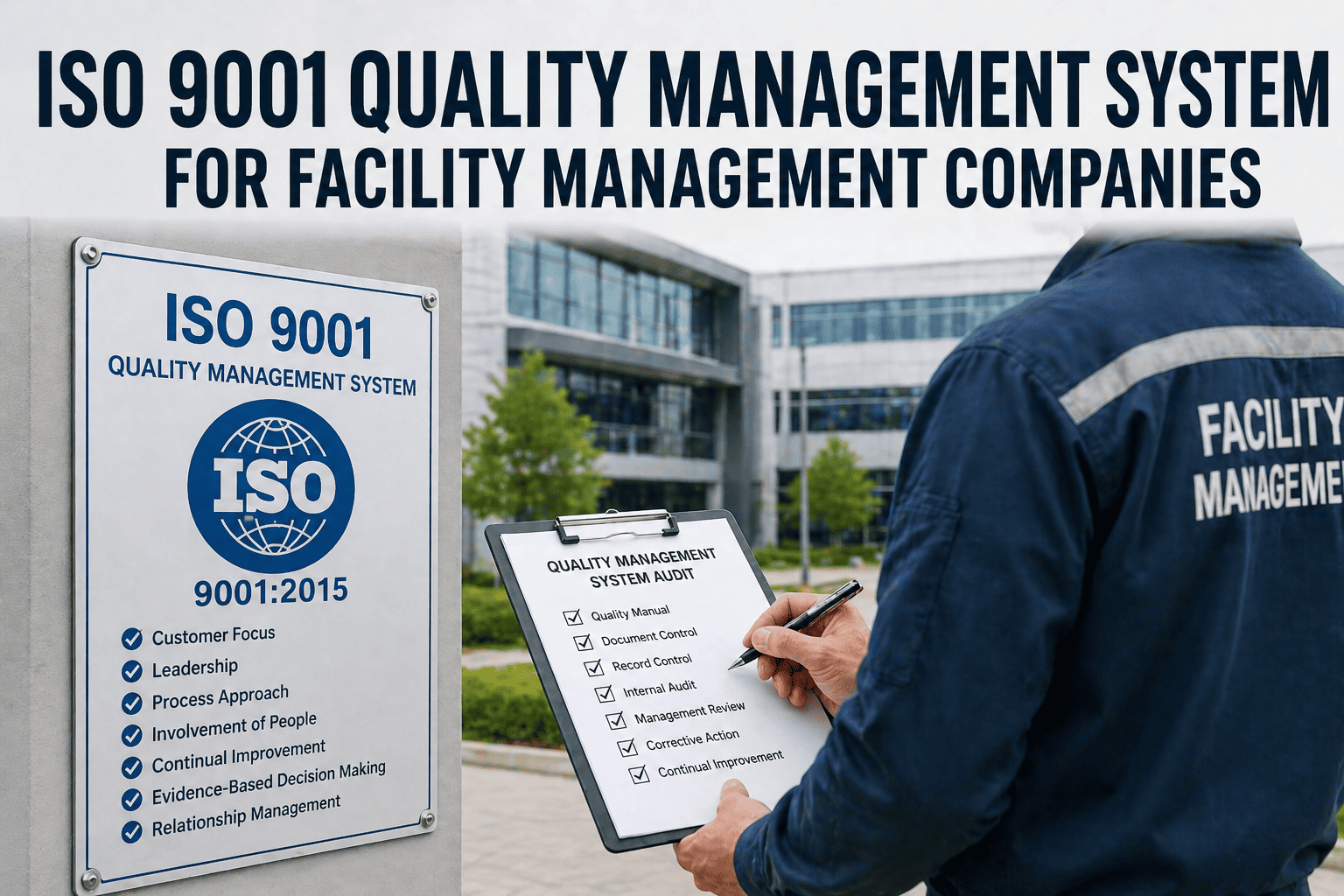
ISO 9001 Quality Management System for Facility Management Companies
Implement structured workflows, quality manuals, and compliance audit documentation that satisfy ISO 9001:2015 clauses — built around FM operations, not generic manufacturing processes.
1M+
ISO 9001 certificates issued in 189 countries
3–6
months typical FM certification timeline with structured CMMS support
Clause 7–9
most directly satisfied by CMMS documentation and performance data
Why ISO 9001 Matters for FM
What ISO 9001 Certification Actually Delivers for a Facility Management Business
FM companies pursuing ISO 9001 are rarely doing it voluntarily — they are doing it because a major client, a government tender, or a regional procurement requirement demands it. Understanding the concrete operational and commercial value changes how you approach implementation: less bureaucracy, more results.
01
Contract Eligibility
Major corporate occupiers, NHS trusts, government frameworks, and international accounts increasingly require ISO 9001 as a pass/fail precondition. Certification opens contracts that are structurally inaccessible without it.
02
Reduced Client Audit Burden
ISO-certified FM companies face fewer client-side quality audits and shortened due diligence processes. The certificate signals structured process control — reducing the time and cost of winning and retaining enterprise accounts.
03
Operational Process Discipline
The ISO 9001 implementation process forces FM companies to document, standardize, and measure service delivery for the first time. Most companies discover 3–5 significant process gaps during gap analysis that were reducing service quality invisibly.
04
Continuous Improvement Structure
The Plan-Do-Check-Act cycle embedded in ISO 9001 gives FM management teams a repeatable framework for identifying recurring failures, root-cause analysis, and corrective action — turning ad hoc problem-solving into a structured discipline.
Clause-by-Clause FM Mapping
ISO 9001 Clauses 4–10 Mapped to Facility Management Operations
ISO 9001:2015 is structured around ten clauses, with Clauses 4–10 defining the implementation requirements. Each clause has a direct FM operational equivalent — and a corresponding CMMS feature that satisfies documentation and evidence requirements.
| ISO 9001 Clause |
Requirement Summary |
FM Operational Equivalent |
CMMS Satisfaction Method |
| Clause 4 — Context |
Define internal/external factors affecting QMS |
Client SLA environment, regulatory landscape, site risk profile |
Asset register with site context documentation |
| Clause 5 — Leadership |
Top management commitment, quality policy deployment |
Quality policy signed and visible across service delivery teams |
Policy document linked to onboarding workflows |
| Clause 6 — Planning |
Risk-based thinking, quality objectives with measures |
Risk register, SLA KPI targets per contract |
KPI dashboards with risk-flagged asset records |
| Clause 7 — Support |
Competence, awareness, controlled documentation |
Technician certification tracking, SOP version control |
CMMS competence matrix + document control module |
| Clause 8 — Operation |
Plan and control processes to meet requirements |
Work order management, PM scheduling, subcontractor control |
CMMS work orders, PM schedules, vendor compliance records |
| Clause 9 — Performance |
Monitor, measure, analyse, evaluate QMS effectiveness |
SLA compliance reporting, MTTR, planned vs. unplanned ratio |
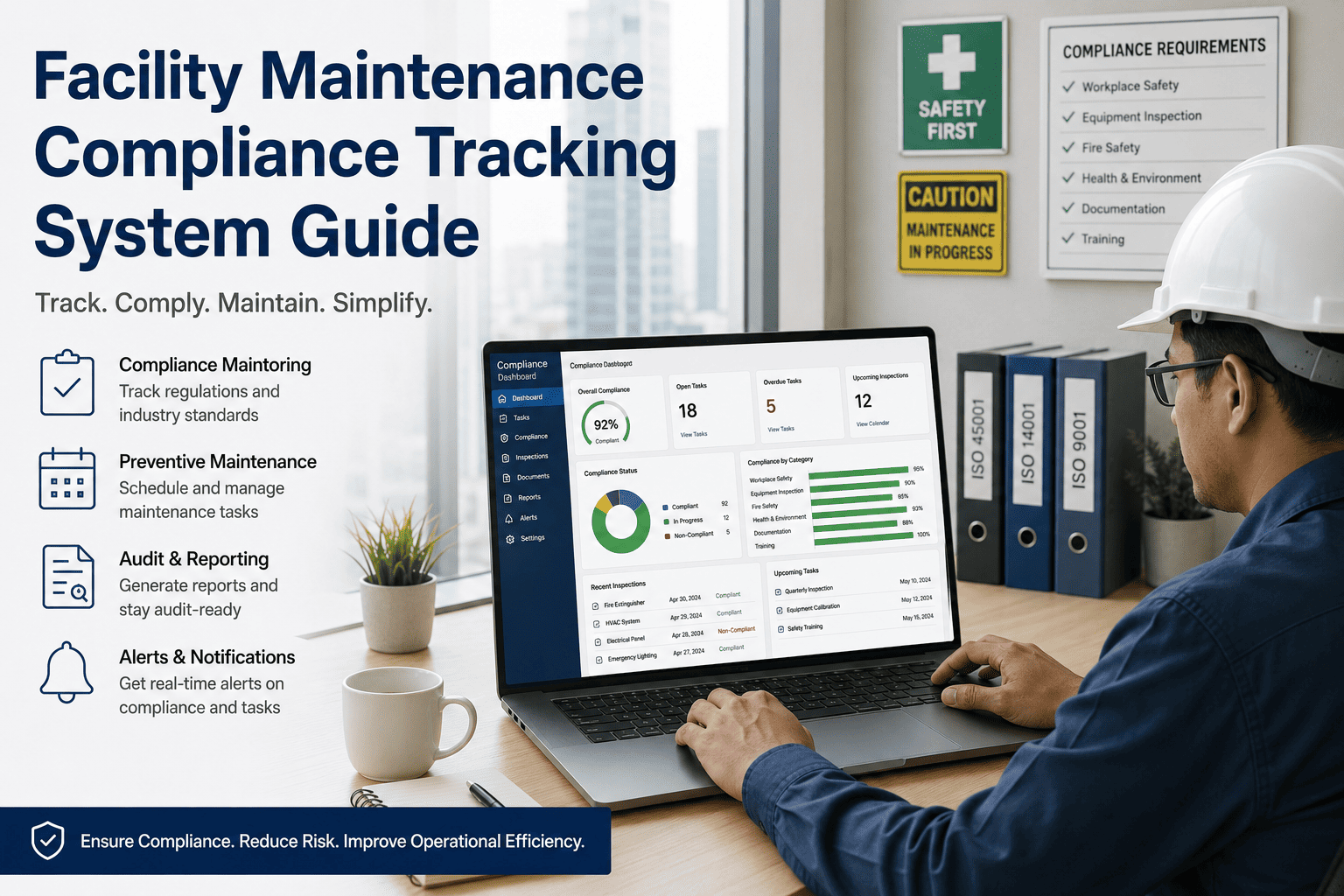
Analytics dashboards with automated monthly reports |
| Clause 10 — Improvement |
Nonconformity, corrective action, continual improvement |
Defect reporting, repeat failure analysis, corrective action tracking |
CAPA workflows linked to work order failure codes |
Clauses 7, 8, and 9 are the three most directly satisfied by a mature CMMS implementation. These are also the three clauses where FM certification audits most commonly identify evidence gaps.
Implementation Roadmap
FM ISO 9001 Implementation: 4-Phase Roadmap to Certification
Phase 1
Gap Analysis & Scoping
Weeks 1–3
Map current FM processes against all Clauses 4–10 requirements. Identify undocumented procedures, missing records, and untested workflows. Define QMS scope — which service lines, sites, and contract types will be covered by the certification. Most FM companies discover 8–15 significant gaps during this phase.
Phase 2
Documentation & System Build
Weeks 4–10
Write or formalize the Quality Manual, quality policy, process maps for core FM services (PPM, reactive maintenance, compliance inspections), and SOPs for each service stream. Configure CMMS to generate documented evidence automatically: work orders, PM completion records, technician sign-offs, and SLA performance data.
Phase 3
Internal Audit & Management Review
Weeks 11–16
Conduct internal audits against all 10 clauses. Record findings, nonconformities, and corrective actions. Hold a formal management review meeting with documented outputs — a mandatory ISO 9001 requirement that many FM companies skip, creating a certification blocker. Close all major nonconformities before Stage 2 audit.
Phase 4
Certification Audit
Weeks 17–24
Stage 1 audit: Desk review of your QMS documentation by accredited certification body. Stage 2 audit: On-site assessment of live operations, evidence sampling, and witness of processes. Certificate issued valid for 3 years with annual surveillance audits. CMMS records are typically the primary evidence source for Clauses 7–9 during Stage 2.
CMMS-Backed ISO 9001
Let Your CMMS Build the Evidence Your ISO Auditor Requires.
Oxmaint automatically generates the Clause 7, 8, and 9 evidence records that FM certification auditors sample — work orders, PM completions, SLA KPIs, technician competence logs, and corrective action histories — without any additional documentation effort from your team.
Key Documentation Requirements
The 7 Documents ISO 9001 Auditors Expect from FM Companies
ISO 9001:2015 does not specify a fixed document list — but accredited certification bodies consistently expect to see these seven during FM company audits. Missing or incomplete versions of any of these are the most common Stage 2 audit findings.
1
Quality Manual
Scope of the QMS, exclusions from Clause 8, and the overall quality policy. Must reference or embed all core process maps for FM service delivery.
2
Competence and Training Matrix
Evidence that every technician and FM operative is qualified for the tasks they perform. Certification expiry dates, renewal records, and skill gap tracking — directly satisfied by CMMS competence module.
3
Controlled Procedures and SOPs
Documented processes for PPM execution, reactive job handling, subcontractor management, and compliance inspection. Versioned, approved, and accessible to operations teams at point of work.
4
Internal Audit Records
Schedule, findings, nonconformities, and corrective action records from at least one complete internal audit cycle covering all ten clauses before Stage 2 certification audit.
5
Management Review Minutes
Documented outputs from a formal top-management review covering QMS performance data, customer feedback, and improvement decisions. The most commonly missing document in FM certification attempts.
6
Nonconformity and CAPA Register
Log of all quality failures, their root causes, corrective actions taken, and verification of effectiveness. Must demonstrate that recurring failures trigger systemic corrective action — not just reactive repair.
7
Customer Satisfaction and KPI Records
Evidence of how customer satisfaction is measured, monitored, and acted upon — SLA compliance rates, customer feedback records, complaint resolutions, and trend analysis over the preceding 12 months.
Expert Review
What FM Quality Managers Say After ISO 9001 Certification With CMMS Support
SL
Sarah L.
Quality Manager, Hard Services FM Company — 340 technicians, 180 sites
★★★★★
Our Stage 2 auditor spent 80% of the time in our CMMS. Work order records, PM completion rates, SLA performance data, and technician competency logs satisfied Clauses 7, 8, and 9 without us needing to produce any separate documentation. Oxmaint essentially became our quality evidence system automatically — we didn't build a separate quality system on top of our operations.
AP
Amit P.
Operations Director, Integrated FM Provider — TFM contracts, GCC region
★★★★★
We failed our first ISO 9001 attempt because our management review minutes were informal and our CAPA process had no evidence of corrective action follow-through. The second attempt, with Oxmaint tracking every corrective action to closure and generating monthly management review data automatically, resulted in a clean Stage 2 pass with zero major nonconformities.
FAQs
ISO 9001 for Facility Management — Common Questions
How long does ISO 9001 certification take for a facility management company?
Most FM companies complete certification within 3–6 months from gap analysis to certificate issue, assuming a structured implementation approach and an existing CMMS generating documented evidence. The timeline extends to 9–12 months when a company needs to build documentation from scratch, formalize undocumented processes, or implement a CMMS concurrently with ISO preparation. The single largest timeline risk is failure to close major nonconformities before the Stage 2 audit.
Book a demo to map your ISO 9001 readiness with Oxmaint.
Which ISO 9001 clauses are hardest for FM companies to satisfy in a Stage 2 audit?
Clause 9 (Performance Evaluation) and Clause 10 (Improvement) generate the most audit findings for FM companies. Clause 9 requires documented evidence of monitoring customer satisfaction and measuring QMS performance against defined objectives — many FM companies measure this informally or inconsistently. Clause 10 requires that nonconformities trigger verified corrective actions, not just reactive repairs. A CMMS with CAPA tracking and KPI dashboards resolves both of these gaps systematically.
Start building your compliance evidence on Oxmaint today.
Does a CMMS count as the documented information system required by ISO 9001?
Yes — ISO 9001:2015 does not prescribe a specific form or format for documented information. It requires that documents be available, suitable for use, and adequately protected. A CMMS that generates controlled work orders, maintains versioned PM procedures, tracks technician competence, and produces performance reports fully satisfies the documented information requirements of Clause 7.5. Certification auditors regularly accept CMMS records as primary evidence across Clauses 7, 8, and 9.
Book a demo to see how Oxmaint satisfies ISO 9001 documentation requirements.
Do all sites in our FM portfolio need to be included in the ISO 9001 certification scope?
No — ISO 9001 allows organizations to define their QMS scope and exclude sites, service lines, or contract types that are not within the defined boundary. FM companies commonly start with their largest or most commercially critical contract portfolio and expand scope at annual surveillance or recertification. The scope statement must be documented and the exclusions justified. Attempting to certify your entire operation simultaneously on a first attempt significantly increases both cost and timeline risk.
Start your free Oxmaint trial and scope your first site cluster today.
ISO 9001 · Facility Management · Compliance Tracking
Your CMMS Can Build the ISO 9001 Evidence Trail Automatically.
Oxmaint gives FM quality teams work order documentation, PM completion records, SLA performance dashboards, technician competence tracking, and CAPA workflows — the exact evidence set ISO 9001 auditors sample across Clauses 7, 8, and 9. Certification becomes a documentation exercise, not a documentation crisis.