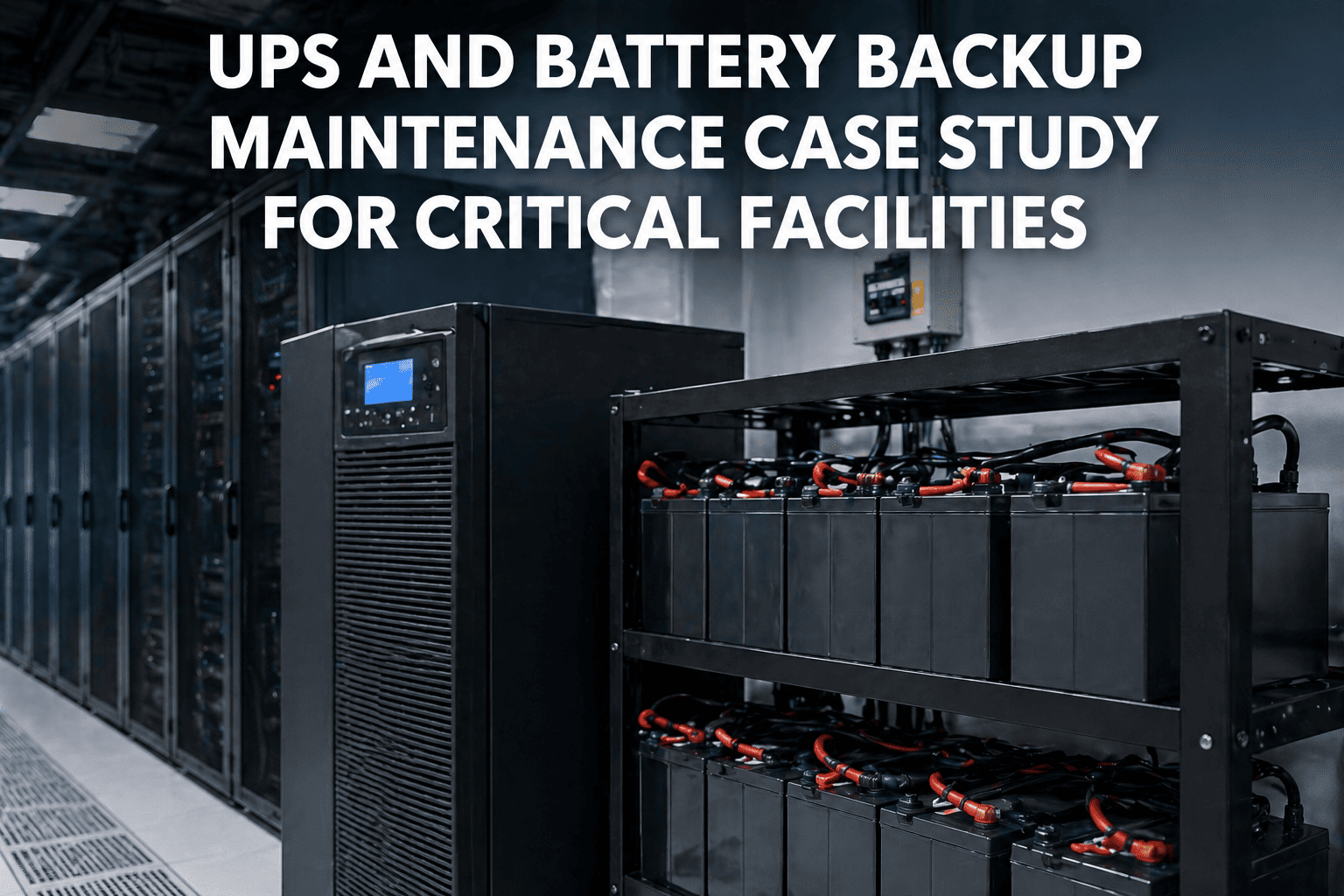
UPS and Battery Backup Maintenance Case Study for Critical Facilities
By Lewis Abbott on April 27, 2026
A data centre operator managing 47 UPS units across three facilities discovered — after a $2.3M unplanned outage — that their battery replacement programme was based entirely on calendar age, not battery condition. Seventeen of the failed batteries had been installed within the previous 24 months. The problem was not the batteries. It was the absence of a predictive monitoring programme that would have flagged the internal resistance trending in those units 60–90 days before failure. UPS and battery backup systems are the last line of protection between a power disturbance and a critical load — and they are among the most under-maintained assets in critical facilities because they are designed to be invisible until the moment they are needed. Book a demo to see how OxMaint's Predictive Maintenance AI monitors UPS health, tracks battery state of health against discharge history, and prevents the silent degradation that calendar-based programmes miss entirely.
Case Study · Equipment & Asset Management · Predictive Maintenance AI
UPS & Battery Backup Maintenance: From Calendar-Based to Predictive Monitoring
How three critical facilities eliminated unplanned UPS failures, extended battery lifecycle by 34%, and reduced annual maintenance cost by $410,000 using OxMaint Predictive Maintenance AI.
The post-outage root cause analysis identified four compounding failures — none of which required new equipment to prevent. All four were programme design failures, not equipment failures.
01
No Battery State-of-Health Tracking
VRLA battery capacity degrades non-linearly. A battery that tests at 95% capacity at month 24 can drop below the 80% critical threshold at month 28 due to thermal cycling, partial discharge events, or manufacturing variation. Calendar replacement at 36 or 48 months has no relationship to actual capacity. The only reliable metric is measured internal resistance trending against the battery's baseline impedance reading.
02
Discharge History Not Recorded
Every discharge event — whether a full runtime during a utility outage or a partial discharge during a voltage sag — accelerates battery aging at a rate that varies by depth of discharge, temperature at discharge, and recharge characteristics. None of the 47 UPS units had discharge event logs that were systematically reviewed. Batteries with 12 deep discharges in 24 months were being treated identically to batteries with zero events.
03
Thermal Management Not Monitored
VRLA battery life halves for every 10°C rise above the rated 25°C operating temperature. The data centre's UPS room had been operating at 32°C for 14 months following an HVAC upgrade that changed airflow patterns. No alert existed for UPS battery room temperature deviation. The thermal acceleration had reduced effective battery life by approximately 40% for the units in that room.
04
Annual Vendor Visit Created False Confidence
The annual PM visit from the UPS vendor produced a report showing each unit as "passed" or "failed" based on a snapshot test at a single point in time. A battery with declining internal resistance that passed on test day — because ambient conditions were favourable — received no flag. The 11-month gap between annual visits was the failure window. Condition is not a point-in-time measurement; it is a trend.
Implementation
OxMaint Deployment: Four Phases Across 90 Days
Phase 1
Asset Registry & Baseline — Weeks 1–3
All 47 UPS units registered in OxMaint with complete asset data: manufacturer, model, rated capacity, battery technology, string configuration, installation date, and room temperature log from available BMS data. Baseline impedance readings taken per string and entered as the reference against which future readings are trended. Each battery string assigned a unique OxMaint asset ID linked to its UPS parent asset.
Phase 2
Predictive Monitoring Configuration — Weeks 4–6
OxMaint Predictive Maintenance AI configured with alert thresholds specific to each battery technology and UPS criticality tier. VRLA strings: alert at 20% internal resistance rise from baseline; critical alert at 30% rise. Temperature sensors integrated via BMS API — alert when battery room exceeds 27°C. Discharge event logging workflow configured so every UPS runtime event generates an automatic work order documenting discharge depth and duration.
Phase 3
PM Schedule Restructure — Weeks 7–9
Annual vendor visit replaced with a tiered PM cadence: quarterly impedance measurement on all strings (technician-performed with OxMaint mobile app); semi-annual full PM on Tier 1 critical UPS units; annual full PM on Tier 2 and 3 units. Each PM task generates a structured work order with step-by-step instructions, pass/fail fields per measurement, and automatic escalation if any measurement exceeds alert threshold.
Phase 4
Lifecycle Analytics Activation — Weeks 10–12
OxMaint asset lifecycle module configured to project battery end-of-life based on current impedance trend rate, cumulative discharge history, and thermal exposure. Each battery string shows projected replacement date on a rolling 18-month horizon — enabling procurement planning instead of reactive replacement. Capital budget for battery replacement shifted from a fixed 3-year cycle to a condition-based rolling forecast.
Calendar-based UPS maintenance misses the batteries that fail early and replaces the batteries that still have years of life. OxMaint's Predictive Maintenance AI replaces both problems with condition-based data.
What the Critical Facilities Director Sees Every Morning
Fleet Health
Battery State-of-Health by Unit
All 47 UPS units displayed with current impedance vs. baseline percentage, colour-coded by health status. Units trending toward alert threshold flagged with projected days-to-alert so procurement and scheduling can begin before the critical window.
Predictive AI
Failure Probability Scoring
OxMaint AI assigns a failure probability score to each battery string based on impedance trend rate, discharge history, thermal exposure, and age-adjusted degradation model. Strings above 65% probability generate automatic work orders for inspection — no manual review required.
Capital Planning
18-Month Battery Replacement Forecast
Rolling replacement forecast per string with projected cost and procurement lead time. Finance team receives quarterly forecast report directly from OxMaint — battery budget moved from a fixed annual allocation to a condition-driven rolling model that reduced total battery spend by 22%.
Compliance
PM Completion & Discharge Log
Every PM event, discharge event, and battery measurement captured in a timestamped, technician-attributed record. Audit-ready compliance report generated on-demand for insurance assessors, data centre certification audits (Uptime Institute, ISO 22301), and facility management reviews.
"
The data centre industry has a well-documented blind spot on UPS battery maintenance. Everyone understands that a UPS is critical — and then they put it in a room and visit it once a year. Internal resistance trending is the only reliable early-warning indicator for VRLA battery failure, and it requires quarterly measurement to be actionable. The facilities in this case study were measuring impedance annually, which meant the trending data covered 12-month intervals — far too coarse to catch accelerating degradation before it reached the failure threshold. Quarterly measurement with automated trend analysis is the minimum programme for any facility where a UPS failure carries significant business or safety consequences. OxMaint made quarterly measurement operationally feasible for the in-house team rather than requiring a specialist contractor visit — which is what turned the programme from a recommendation into a practice.
Marcus Eidenschink, B.Eng, CRL · Critical Power Systems Engineer, voestalpine · 21 Years UPS and Battery System Management · Specialist in VRLA battery lifecycle analytics and mission-critical power continuity programmes
FAQs
Frequently Asked Questions
What metrics does OxMaint track to predict VRLA battery failure?
OxMaint tracks four primary predictive indicators for VRLA batteries: internal impedance (measured quarterly against individual string baseline), temperature deviation from rated 25°C operating range, cumulative discharge event count and depth, and float voltage drift from manufacturer specification. The Predictive Maintenance AI weights these inputs against the battery's age-adjusted degradation model to produce a failure probability score and projected end-of-life date per string — replacing the calendar-based replacement schedule with a condition-based one. Book a demo to see the predictive battery monitoring dashboard.
How does OxMaint integrate with existing UPS monitoring systems like Eaton Intelligent Power Manager or Vertiv Liebert?
OxMaint connects to UPS monitoring platforms via API where available, and via direct SNMP or Modbus integration for units with network management cards. For facilities without network-connected UPS units, OxMaint provides a structured mobile data entry workflow for technician-recorded impedance measurements, ambient temperature, and discharge event documentation — which is how the three facilities in this case study began their programme before adding sensor integrations in Phase 2. The platform is designed to work with the data you have, not require new hardware investment before delivering value. See OxMaint's integration capabilities.
What is the recommended PM frequency for UPS batteries in a Tier III or IV data centre?
For Tier III and IV data centres, the Uptime Institute and IEEE 1188 both recommend quarterly impedance testing and a minimum semi-annual full PM on UPS units supporting critical loads. Annual-only programmes are insufficient for high-criticality applications because the 12-month gap between measurements is too wide to catch accelerating degradation before it reaches the failure threshold. This case study's facilities moved from annual to quarterly impedance testing — the change that enabled early detection of the three pre-failure conditions that prevented unplanned outages in Year 1.
Predictive Maintenance AI · OxMaint · UPS & Battery Systems
Your Next UPS Battery Failure Is Already Showing Its Signal. OxMaint Reads It.
OxMaint's Predictive Maintenance AI tracks impedance trends, discharge history, and thermal exposure per battery string — generating replacement forecasts and pre-failure work orders 60–90 days before the failure event that a calendar-based programme would miss entirely.