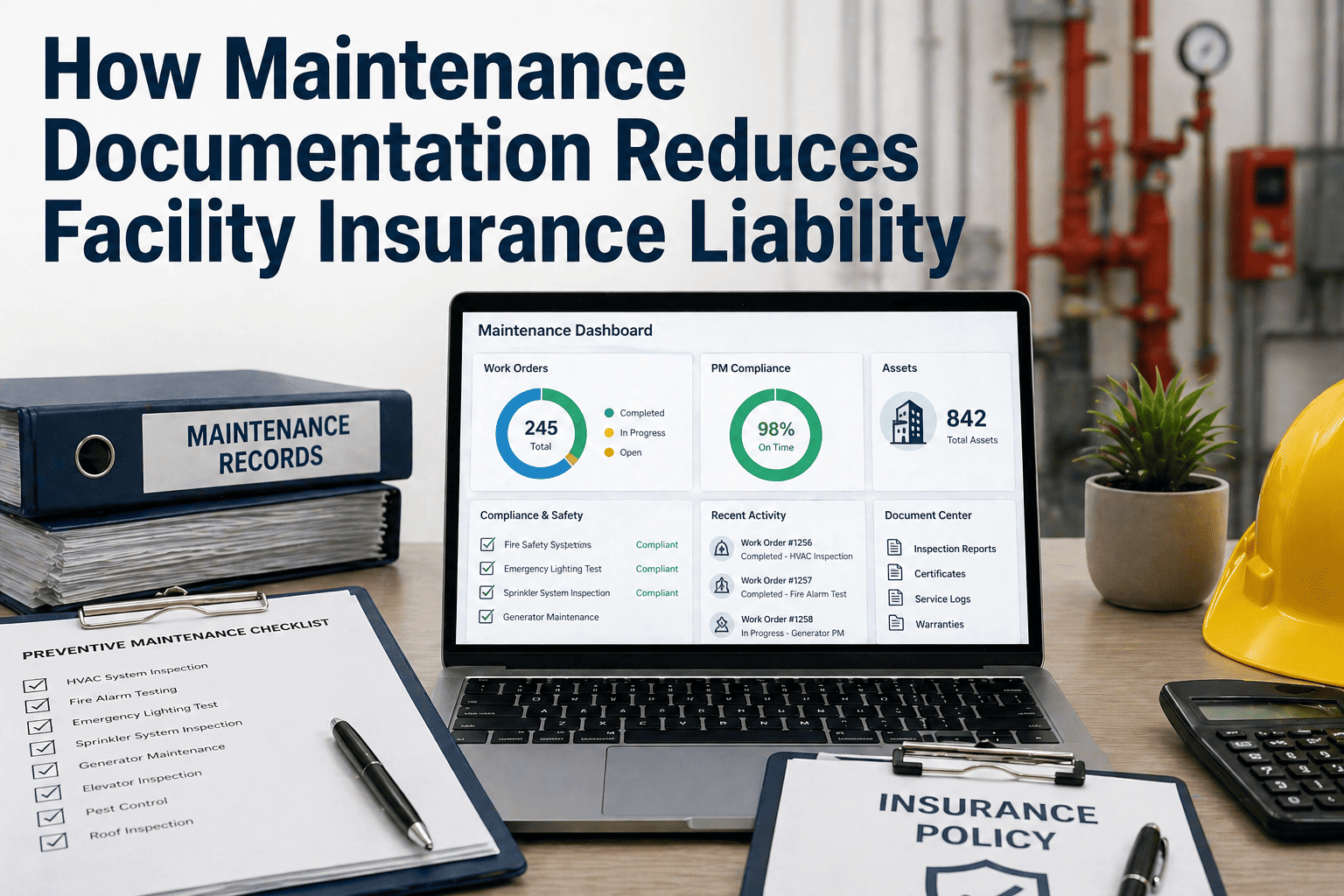
A commercial property manager receives a slip-and-fall claim six weeks after an incident in the lobby. The plaintiff's attorney requests all maintenance inspection records for that area for the prior 12 months. In the building managed with paper logbooks and spreadsheets, this request triggers a three-week scramble through filing cabinets, an uncomfortable admission that two months of records cannot be located, and a settlement negotiation that begins from a position of documented negligence. In the building managed with a CMMS, the same request is answered in four minutes: a timestamped digital report showing 52 completed weekly inspections, 3 corrective work orders raised and closed during the period, and photo evidence confirming the hazard in question did not exist at the last inspection before the incident. The difference between those two responses is not the standard of maintenance performed — it is the standard of maintenance documented. Book a 30-minute demo to see how Oxmaint's Compliance Tracking platform builds the maintenance documentation that becomes your strongest liability defence — or start a free trial and run your first documented inspection today.
Compliance Tracking · Safety & Compliance · Insurance Risk
How Maintenance Documentation Reduces Facility Insurance Liability
The legal principle, the documentation gaps that void insurance coverage, the evidence types courts trust, and the CMMS practices that transform maintenance records from operational data into liability protection.
30%
Insurance premium reduction documented with CMMS-based maintenance records
60%
Higher claim defence success rate with digital maintenance audit trails
14.7×
Average citations in audits without CMMS vs 1.2 with comprehensive digital records
$150K+
Per-day OSHA fine for wilful violations — documentation is the primary defence
The Legal Principle That Makes Documentation Your First Line of Defence
Courts and insurance carriers operate under a principle that facility managers must internalise before the first claim arrives: "If it isn't written down, it didn't happen." This is not hyperbole — it is the legal standard applied in premises liability cases, OSHA enforcement actions, and insurance coverage disputes alike. The duty of care standard requires facility owners to prove not just that maintenance was performed, but that it was performed systematically, on schedule, and with documented corrective action for every identified hazard. A facility that cannot produce those records is treated, for legal and insurance purposes, as a facility that did not perform the maintenance at all — regardless of what was physically done.
Duty of Care
Property owners owe a duty of care to lawful visitors — to maintain premises in a reasonably safe condition and to inspect for hazards regularly. Documentation proves the inspection happened. Without records, the inspection may as well not have occurred in the eyes of a court.
Prior Notice Laws
Many jurisdictions protect property owners from liability for defects they did not know about. A CMMS tracks exactly when a hazard was reported, when a work order was raised, and what action was taken — satisfying the "prior notice" protection where it applies and demonstrating due diligence where it does not.
Digital Evidence Standard
Courts increasingly view digital, timestamped, geo-tagged records as superior evidence compared to handwritten logs — which can be backdated, altered, or simply lost. A CMMS work order closed at 14:37 on a named technician's account with a photo attachment is evidence of a different quality than a paper sign-off sheet.
Insurer's Documentation Requirement
Commercial property insurers increasingly require proof of systematic preventive maintenance as a condition of coverage or as a factor in premium calculation. A facility that cannot produce PM completion records during a claim investigation risks coverage denial on the grounds that the loss resulted from deferred maintenance.
Three Scenarios Where Documentation Determined the Insurance Outcome
The scenarios below illustrate how the presence or absence of maintenance documentation changes the legal and insurance outcome of identical physical events. These are composite examples drawn from documented claim patterns in commercial property, industrial, and institutional facility management.
Without CMMS Documentation
Facility performed weekly lobby inspections but recorded them on a paper sign-off sheet stored in a binder. Two months of sheets are missing. Attorney requests 12 months of records. Facility produces 10 months of incomplete records with no photos and no specificity about what was checked. Settlement pressure increases. Claim settled for $185,000.
→
With CMMS Documentation
Same weekly inspections completed but recorded in CMMS with mobile app. 52 inspections in 12 months, each timestamped, technician-attributed, with photo attachments. Work orders showing three corrective actions completed during the period. Clear documentation that the hazard location was inspected and clear 4 days before the incident. Claim dismissed at pre-trial.
Without CMMS Documentation
Fire suppression system had not been inspected for 22 months — inspection was outsourced to a contractor who reported verbally. When fire damage claim was filed, insurer requested inspection records. Contractor's invoice was found but no signed inspection report existed. Insurer denied coverage citing "failure to maintain in accordance with policy conditions." $340,000 loss uninsured.
→
With CMMS Documentation
Contractor inspection logged in CMMS with signed inspection report attached to the work order record. Semi-annual inspection schedule automated with alert 30 days before due date. Insurer receives inspection certificate with timestamped service record at first request. Full policy coverage applied. $340,000 loss covered in full.
Without CMMS Documentation
Residential tenant files habitability claim after HVAC failure in summer heat. Landlord claims HVAC was "regularly maintained" but cannot produce service records. Tenant's attorney argues deferred maintenance — the system had not been serviced in 18 months. Local authority issues notice. Tenant awarded rent abatement and legal fees of $22,000.
→
With CMMS Documentation
HVAC PM records showing coil cleaning 4 months prior, filter change 6 weeks prior, and contractor service report 5 months prior all accessible in 3 minutes. Work order raised within 2 hours of failure notification, emergency contractor dispatched, repair completed same day with timestamped completion record. Habitability claim dismissed. No award.
Build the documentation that wins the claim before the claim is filed. Oxmaint creates timestamped, photo-backed, technician-attributed maintenance records automatically — as a byproduct of your daily operations.
The Five Documentation Qualities That Determine Whether Records Hold Up
Not all maintenance records are equal in an insurance dispute or legal proceeding. The five qualities below determine whether a maintenance record functions as evidence or as a liability. Paper-based systems typically satisfy none of them reliably. CMMS-based records built on proper workflows satisfy all five by default.
Q1
Timestamped and Immutable
Records must show the exact date and time the work was performed — not when it was recorded, not when it was filed. CMMS work orders closed on a mobile device carry server-generated timestamps that cannot be backdated. Courts treating digital timestamps as superior to paper sign-off dates are applying this standard.
CMMS: Auto-generated at work order closure — immutable
Paper: Date filled in by technician — backdating possible and provable in court
Q2
Attributable to a Named Individual
Insurance carriers and courts need to know who performed the inspection or maintenance — and that the person was qualified to perform it. A CMMS work order attributed to a named, credentialed technician carries more evidentiary weight than a paper sheet signed "MAINT DEPT."
CMMS: Named technician with certification linked to user account
Paper: Illegible signature or department-level attribution — insufficient attribution
Q3
Specific About What Was Observed and Done
"Checked OK" does not satisfy a court's evidentiary standard. A record that states "Checked lobby floor surface for loose tiles, spills, or slip hazards. No defects found. Photo attached." provides the specificity that demonstrates systematic, competent inspection — not a drive-by check-in.
CMMS: Structured checklist fields force specific observation recording per task
Paper: Open-text fields produce generic entries that defeat their own purpose
Q4
Complete — No Gaps in the Record
A plaintiff's attorney will look for gaps in the inspection schedule first. Three months of records followed by a gap followed by more records is more damaging than no records at all — it demonstrates that the facility knew an inspection programme was required, failed to maintain it, and the hazard that caused the claim occurred during the undocumented period.
CMMS: Overdue PM alerts prevent gaps; missed tasks visible on dashboard in real time
Paper: Gaps only discovered retrospectively when records are assembled for litigation
Q5
Corrective Actions Documented and Closed
Finding a hazard and documenting it without closing the corrective action is often worse than not finding it at all. A work order that identifies a trip hazard and remains open is documented evidence that the facility knew about the hazard. A closed work order with repair date and technician signature is documented evidence of due diligence.
CMMS: Open work orders visible and escalated; every correction timestamped at closure
Paper: Open findings often lost in backlog; no escalation mechanism for unresolved hazards
Expert Review — What Insurance Adjusters and Attorneys Actually Look For
"I have reviewed maintenance documentation for insurance defence purposes for seventeen years, and the pattern is consistent. The claims that settle cheaply are the ones where the facility can produce complete, specific, timestamped records showing systematic inspection with corrective action follow-through. The claims that settle expensively — or go to verdict — are the ones where the records are incomplete, vague, undated, or missing entirely for the critical period. What changes the outcome is never the quality of the maintenance performed. It is always the quality of the documentation. A paper sign-off sheet filled in after the fact by a well-meaning technician is worse evidence than no record at all, because it demonstrates the facility was aware of its documentation obligation and failed to satisfy it properly. A CMMS work order closed at 11:22 AM on a named technician's device with a photograph attached is a different category of evidence entirely — one that I have seen terminate claims at the first demand letter stage."
Jonathan Reyes, Esq., CPCU
Property & Casualty Insurance Attorney · Chartered Property Casualty Underwriter · 17 years insurance defence and premises liability specialisation · Former claims consultant to three top-10 US commercial property insurers
Frequently Asked Questions
How long should facility maintenance records be retained for insurance and legal purposes?
Most jurisdictions require
3 to 7 years of maintenance records for commercial properties, with longer retention recommended for life-safety systems — fire suppression, emergency power, lifts — where records are often retained for the life of the asset. The practical standard for insurance defence is to retain records for the entire applicable statute of limitations for premises liability claims in your jurisdiction, plus two years. CMMS records stored in the cloud satisfy this requirement automatically without physical storage management.
Book a demo to see Oxmaint's retention and archive capabilities.
Can paper maintenance records be used to defend a liability claim?
Yes, but they carry significantly lower evidentiary weight than digital records. Courts consistently apply a scepticism standard to paper logs because they can be backdated, altered, or fabricated after the fact. Insurance adjusters share this scepticism. Paper records that are incomplete, contain gaps, or lack specificity about what was actually observed typically fail to provide the standard of proof needed to establish systematic maintenance and duty-of-care compliance. Gaps in paper records are especially damaging — they are often interpreted as an admission that inspections during the gap period were not performed.
Does maintaining CMMS records actually reduce insurance premiums?
Yes, in documented cases. Commercial property insurers base premiums partly on demonstrated maintenance discipline — a facility with 3 years of complete PM records, rapid corrective action closure, and documented compliance with statutory inspection requirements presents a materially lower risk profile than one that cannot produce maintenance history. Reported reductions of
15–30% in liability premiums have been documented by facilities transitioning from paper-based to CMMS-based maintenance documentation, as part of broader risk management improvements.
Start a free trial to begin building your maintenance documentation record.
What maintenance records do insurance carriers typically request after a claim?
The standard first request typically covers: all inspection records for the affected area in the 12 months preceding the incident; all work orders raised and closed for the affected asset or area; any open or unresolved corrective actions at the time of the incident; contractor service records for relevant systems; and any documented notices of hazards received during the relevant period. A CMMS with proper work order management produces all of these as a standard report in minutes — compared to weeks of manual record assembly from paper-based systems.
What is the biggest documentation mistake that voids insurance coverage?
The single most common documentation failure that leads to coverage denial is an undocumented or incomplete inspection schedule for a statutory requirement — fire suppression inspections not on record, lift inspection certificates expired or missing, annual fire extinguisher inspections with no signed certificate. When a loss occurs and the facility cannot prove that the required inspection was performed within the required window, the insurer treats the loss as resulting from deferred maintenance — which most commercial property policies exclude from coverage.
The Claim That Costs $340,000 Without Records Costs Nothing With Them
Oxmaint Compliance Tracking builds the timestamped, photo-backed, technician-attributed maintenance documentation that protects your facility in insurance disputes, regulatory audits, and premises liability claims — as a natural byproduct of your daily maintenance programme, not as an extra administrative burden.