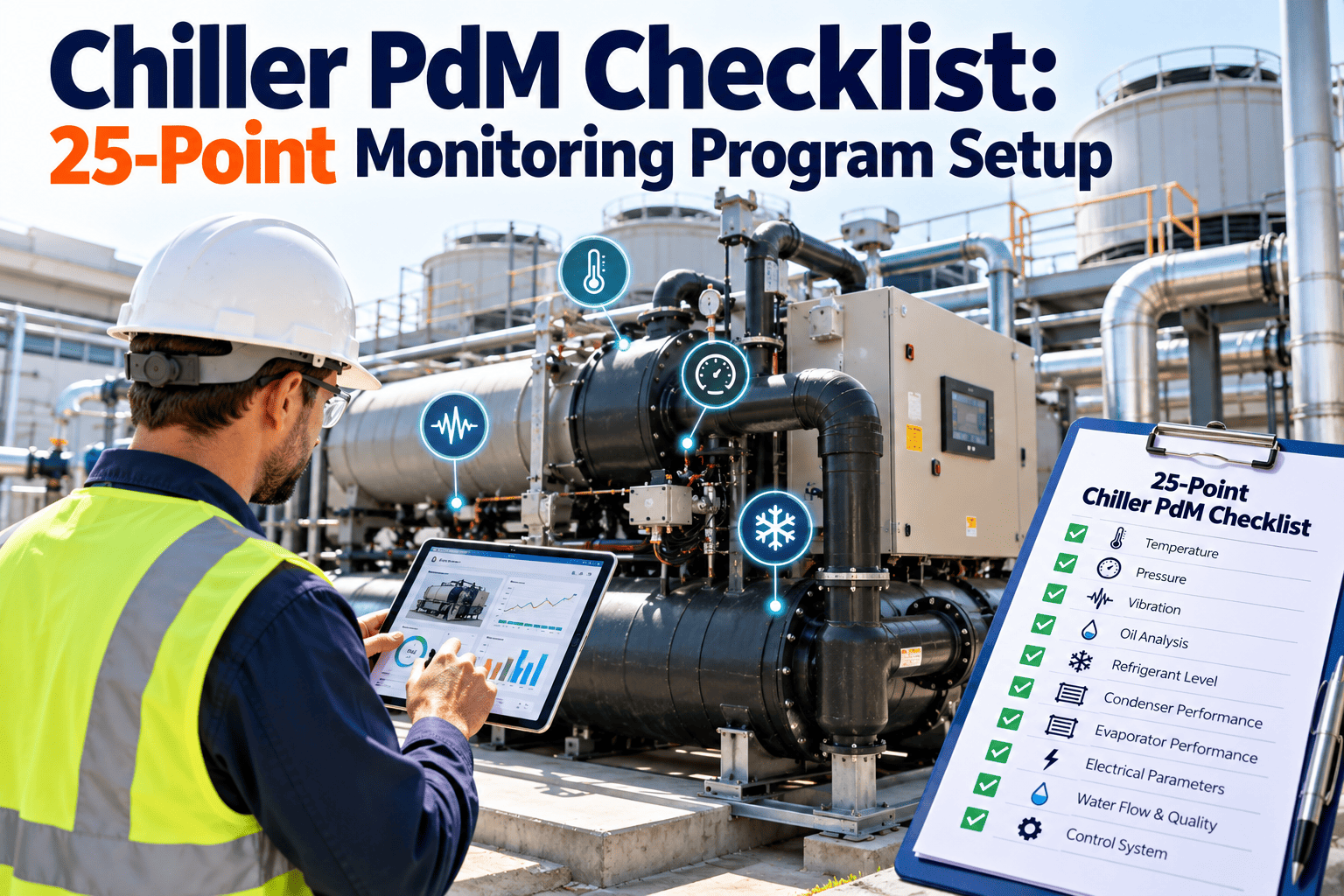
A chiller rarely fails without warning. Condenser tubes foul, refrigerant charge drifts, oil degrades, and bearings wear, and each change shows up in the data weeks before a trip or a shutdown. A predictive maintenance programme catches those signals, but most rollouts stall because sensors are bought before goals, thresholds, and response paths are defined. This 25-point checklist sequences the setup into five phases so monitoring is live in about 30 days, with alerts that feed straight into work orders in Oxmaint maintenance management software.
Chiller PdM Checklist: 25-Point Monitoring Program Setup
A phased setup plan for commercial chiller plants covering sensors, thresholds, water treatment, oil sampling, refrigerant monitoring, and CMMS integration.
What a Chiller Plant Tells You Before It Fails
Every common chiller fault leaves a measurable trail. The matrix below links symptoms to likely causes, and it explains why the checklist starts with the right measurements rather than the most expensive hardware.
| Early signal | Likely cause | Measure with |
|---|---|---|
| Condenser approach rising | Tube fouling, scale, or non-condensables | Condenser water and saturation temperatures |
| Evaporator approach rising | Evaporator fouling, low charge, or oil in the evaporator | Chilled water and suction saturation temperatures |
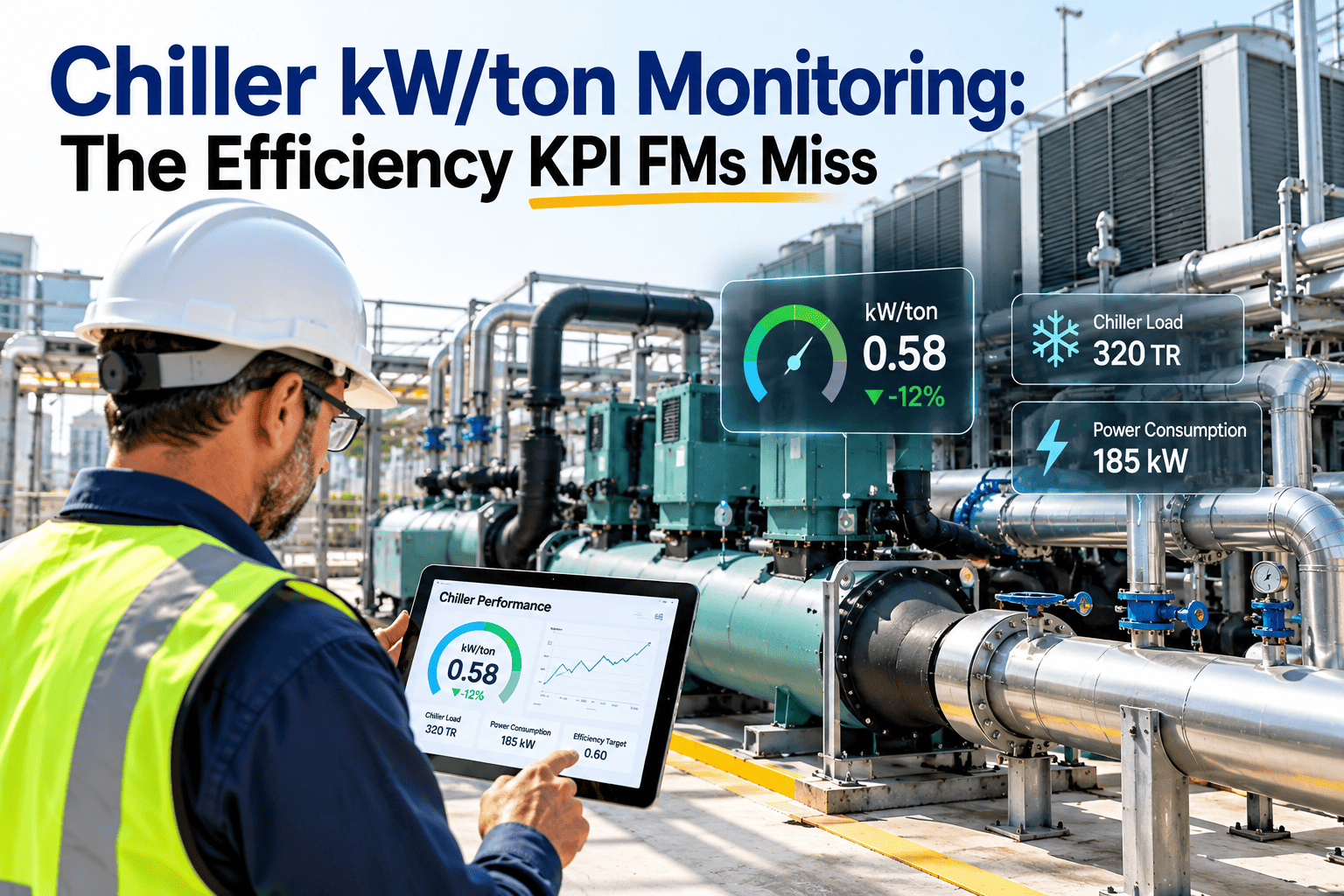
| kW per ton worsening at similar load | Efficiency loss from fouling, charge, or controls drift | Power, flow, and delta-T |
| Vibration trend climbing | Bearing wear, misalignment, or imbalance | Accelerometers on compressor and motor |
| Oil contamination or acid number rising | Moisture ingress, overheating, or wear | Laboratory oil sample |
| Purge run-time or make-up refrigerant increasing | Air ingress or refrigerant leak | Purge counters and refrigerant log |
Phase 1: Foundation (Days 1 to 5)
Define what you are protecting and why before choosing instruments. Skipped foundations are the main reason pilots produce data nobody uses.
Phase 2: Sensors and Data Capture (Days 6 to 15)
Many plants already hold much of this data in the building management system. Audit what exists, then add only what closes gaps.
Turn Chiller Data Into Scheduled Work
Oxmaint links asset records, inspection readings, and work orders so a rising trend becomes an assigned task with a due date.
Phase 3: Thresholds and Alarm Logic (Days 12 to 20)
Fixed limits copied from a brochure create false alarms. Build thresholds from each machine's own baseline at comparable load.
Alarm Response Ladder
Use this ladder as a starting design and adjust response times to your plant's redundancy.
Phase 4: Water Treatment, Oil, and Refrigerant (Days 15 to 25)
These measurements catch slow-developing faults that electrical and temperature data alone can miss.
Phase 5: CMMS Integration and Review (Days 22 to 30)
Monitoring only pays when an alert reliably becomes a job that somebody completes and closes.
Monitoring Priorities by Chiller Type
The checklist applies to all machines, but the emphasis changes with compressor design. Adjust points 9, 10, and 21 accordingly.
| Chiller type | Watch closely | Typical extra check |
|---|---|---|
| Centrifugal | Bearing vibration, oil system, approach temperatures, and surge behaviour | Purge run-time on low-pressure machines |
| Screw | Oil separation and filtration, slide valve position, and compressor vibration | Oil analysis at shorter intervals |
| Scroll and reciprocating | Motor current, discharge temperature, and short-cycling | Start counts and run-hours per circuit |
| Air-cooled | Condenser coil condition, fan operation, and ambient temperature | Coil cleaning trigger from discharge pressure |
Permanent Sensors or Handheld Rounds?
You do not need full online monitoring on day one. Match the method to the criticality ranking from point 2.
Who Does What During the 30 Days
Clear ownership keeps the rollout moving. Assign named people rather than departments.
- Programme lead: owns the plan, the timeline, and the weekly progress check.
- Controls technician: verifies BMS points, calibrates sensors, and builds trends.
- Chiller technician: confirms baselines, takes oil samples, and responds to alarms.
- Water treatment provider: supplies test results and recommendations in a usable format.
- Maintenance planner: sets up work order triggers, schedules, and spare parts levels.
- Facility manager: approves alarm response times and reviews KPIs.
Timing the Rollout Around the Cooling Season
Start before the main cooling season if you can, because baselines are most useful under real load.
- Capture baselines at several load levels, not only at full load.
- Complete tube cleaning and water treatment checks before peak demand begins.
- Test alarms and standby changeover while the plant has spare capacity.
- Review the first heat-wave data to retune thresholds quickly.
Data Quality Checks Before You Trust a Trend
A bad sensor produces a convincing but false trend. Run these checks during phase 2 and repeat them at each review.
- Compare chilled water temperature sensors against a calibrated reference at stable load.
- Confirm the heat balance across the evaporator is plausible given flow and delta-T.
- Look for flat-lined values, sudden steps, or missing intervals that suggest a failed point.
- Check that engineering units and scaling in the BMS match the instrument range.
- Confirm that trend data is stored long enough to compare year over year.
From Finding to Maintenance Action
Each finding should lead to a defined job type. Agree these mappings once so technicians do not improvise under pressure.
| Finding | Typical work order | Follow-up record |
|---|---|---|
| Condenser approach trending up | Inspect and clean condenser tubes, and verify water treatment | Approach after cleaning compared with baseline |
| Vibration above alert level | Confirm reading, inspect alignment and bearings, plan repair | Spectrum before and after the work |
| Oil moisture or acid number high | Investigate leak path, change oil and filters per OEM | Repeat oil sample result |
| Refrigerant top-ups increasing | Leak search and repair by a certified technician | Refrigerant log and leak test result |
| Alarm repeats with no fault found | Review threshold and sensor health | Updated alarm settings |
Common Rollout Mistakes and Fixes
Most failed programmes share the same few weaknesses, and nearly all can be avoided with planning in the first week. Check your own rollout against each row before go-live, and revisit the table at the 30-day review to confirm none of these problems has crept in.
| Mistake | Consequence | Fix |
|---|---|---|
| Buying sensors before defining goals | Data collected with no decision attached | Complete points 1 to 5 first |
| Using generic thresholds | False alarms and ignored alerts | Baseline each machine at comparable load |
| No owner for alarms | Alerts sit unread | Assign responders per tier |
| Uncalibrated sensors | Wrong approach and efficiency figures | Verify against a reference instrument |
| Monitoring separate from work orders | Findings never turn into repairs | Integrate alerts with the CMMS |
Oxmaint in a Chiller PdM Workflow
KPIs for the First 90 Days
| KPI | Purpose | Review |
|---|---|---|
| Monitored chillers as share of fleet | Programme coverage | Monthly |
| Alarm to work-order time | Speed of response | Weekly |
| False alarm rate | Quality of thresholds | Monthly |
| Unplanned chiller downtime | Reliability outcome | Quarterly |
| Normalised kW per ton | Efficiency trend | Monthly |
| Oil and water result compliance | Condition of consumables | Per sample |
Frequently Asked Questions
How quickly can a chiller PdM programme go live?
Do we need new sensors on every chiller?
How often should chiller oil be sampled?
Can PdM replace preventive maintenance?
What standards should the programme reference?
Get Your Chiller Programme Live in 30 Days
Bring the checklist, your chiller list, and your BMS points. Oxmaint helps you connect monitoring to work orders and records.