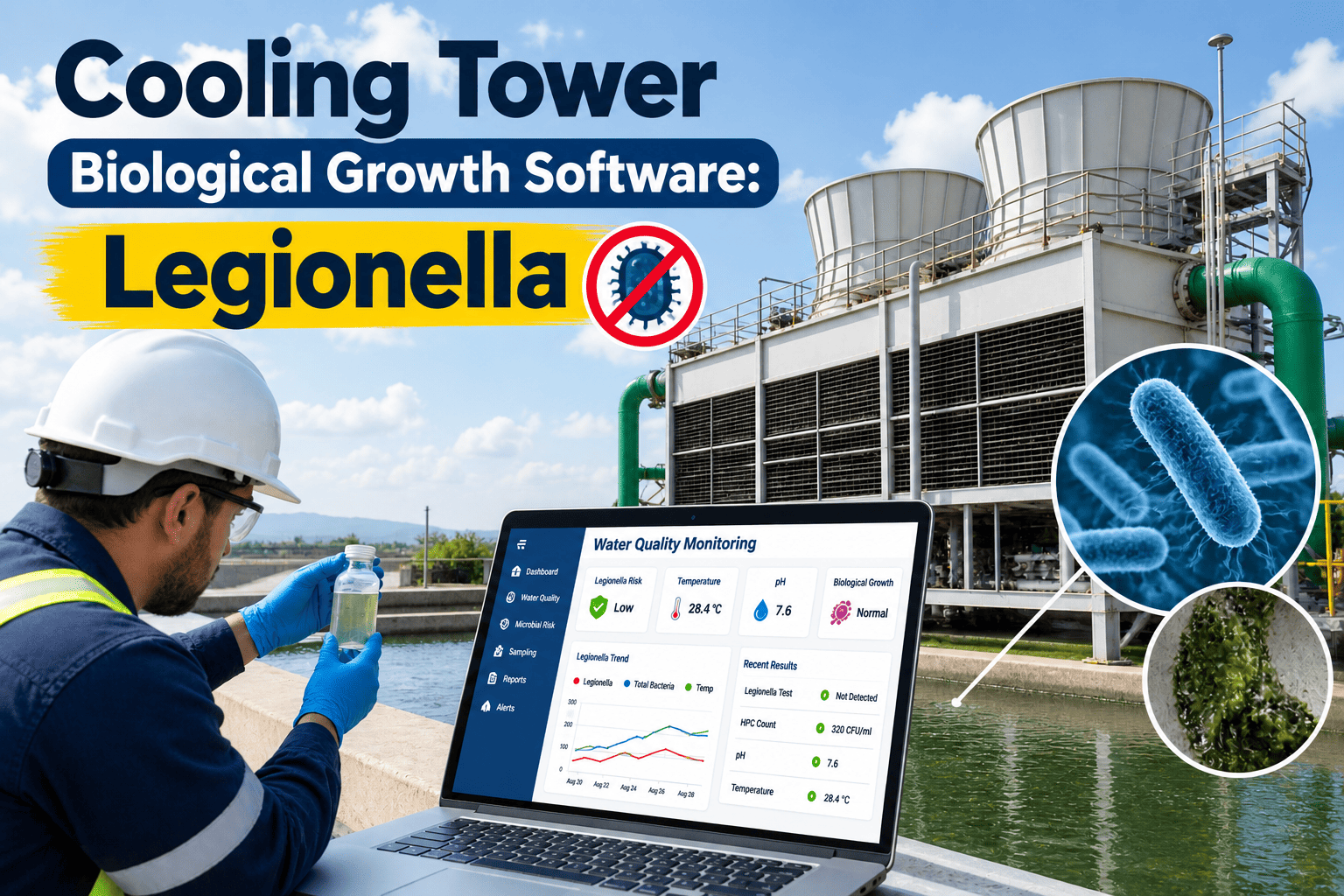
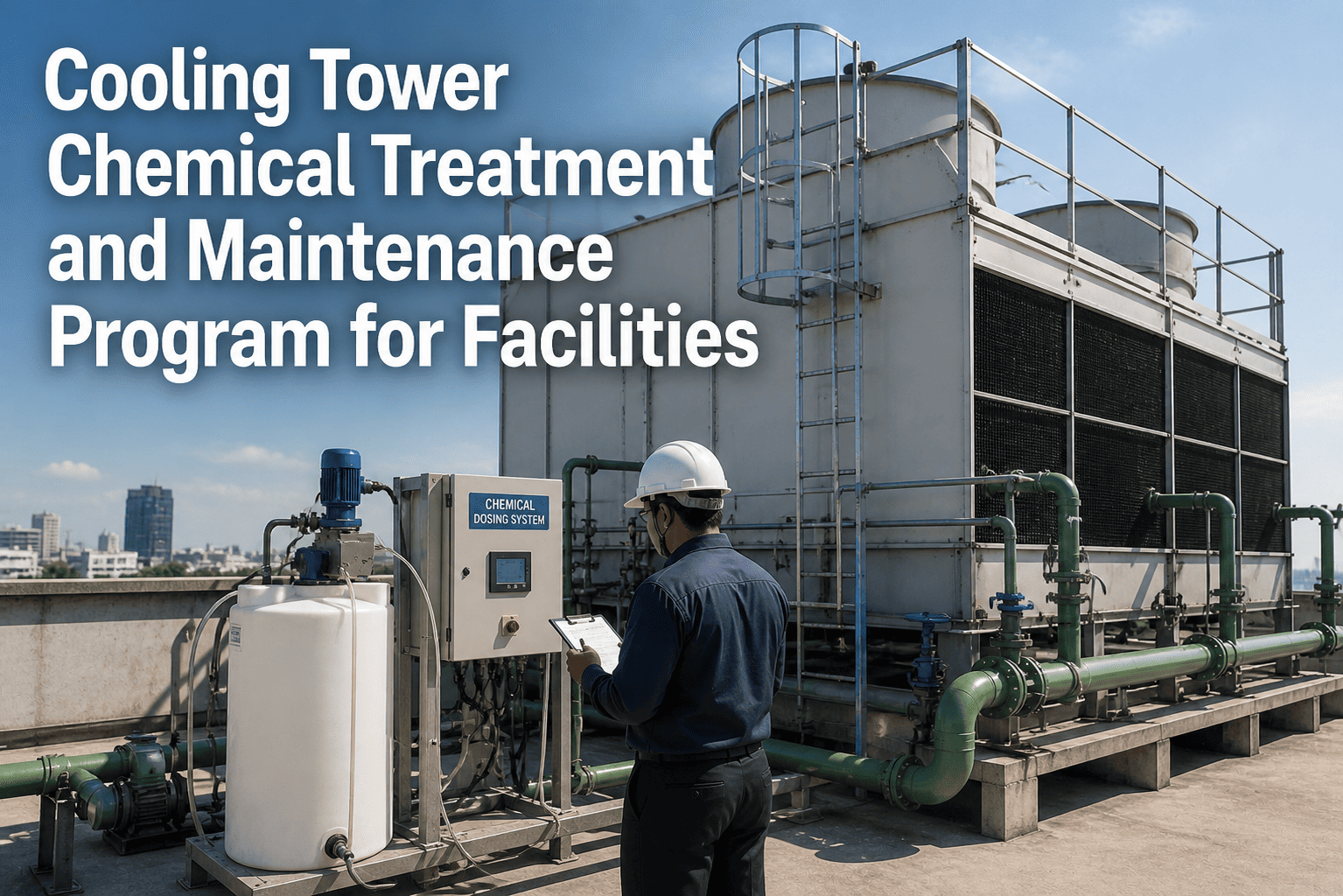
Cooling towers are the single highest-risk water system in any commercial or industrial facility for Legionella pneumophila — the bacterium responsible for Legionnaires' disease outbreaks that have resulted in facility shutdowns, multi-million dollar lawsuits, and fatalities. ASHRAE Standard 188 and CDC guidelines require every facility with a cooling tower to maintain a written Water Management Plan (WMP) backed by documented inspection and treatment records. This checklist gives facilities managers, water treatment contractors, and compliance teams a complete framework covering water chemistry, basin cleaning, drift eliminator inspection, biocide dosing, and microbiological testing — structured for use with OxMaint's compliance tracking to generate audit-ready documentation at every step.
Cooling Tower Maintenance & Legionella Prevention Checklist
A systematic, regulation-aligned checklist covering water treatment, basin cleaning, microbiological testing, and ASHRAE 188 compliance documentation — built for facilities that cannot afford a Legionella outbreak.
ASHRAE 188 & Regulatory Framework
Before executing any checklist, facilities must understand the regulatory baseline. ASHRAE Standard 188-2018 is the primary compliance framework in the United States, requiring a formal Water Management Plan, defined control limits, and ongoing documentation. Several states — including New York, California, and Maryland — have enacted mandatory Legionella regulations that exceed ASHRAE minimums, requiring quarterly or annual tower registrations and third-party inspection sign-offs.
| Regulation / Standard | Applies To | Key Requirement | Documentation Required |
|---|---|---|---|
| ASHRAE 188-2018 | All commercial buildings with cooling towers | Written Water Management Plan (WMP) | WMP document + control limit logs |
| NYC Local Law 77 | NYC facilities with cooling towers | Annual registration + 30-day inspection | Registered inspection reports, quarterly culture tests |
| CDC MMWR Guidelines | Healthcare, hospitality, large commercial | Risk assessment + WMP implementation | Risk assessment records + corrective action logs |
| OSHA General Duty Clause | All employers with cooling towers | Eliminate recognized hazards (Legionella) | Inspection records + training logs |
Daily & Weekly Inspection Checklist
Consistent daily monitoring is the first line of defense against Legionella amplification. Biological growth accelerates rapidly when water temperature, pH, and biocide residuals drift outside control limits — making daily data entry non-negotiable for high-risk systems.
- Record system operating temperature (supply and return)
- Measure and log biocide residual (oxidizing + non-oxidizing)
- Check conductivity / TDS and compare to bleed-off setpoint
- Inspect makeup water flow meter — verify normal refill rate
- Confirm blowdown valve cycling correctly
- Visual inspection — no visible scale, foam, or discoloration
- Measure pH — target range 7.0 – 8.5 (per WMP)
- Test inhibitor levels (phosphate, molybdate, or azole)
- Inspect drift eliminators — check for fouling or displacement
- Inspect fill media for scale, biofilm, or physical damage
- Check distribution basin — clear debris and inspect nozzles
- Inspect fan blades and motor for unusual vibration or noise
Water Chemistry Control Limits
Cooling water chemistry must stay within tight control limits to suppress Legionella growth, prevent scale and corrosion, and protect heat exchanger efficiency. All readings should be logged with date, time, technician name, and corrective action taken if out of range.
| Parameter | Control Limit | Test Frequency | Out-of-Range Action |
|---|---|---|---|
| pH | 7.0 – 8.5 | Daily | Dose acid or alkali — retest in 2 hours |
| Conductivity (TDS) | Per WMP cycles-of-concentration | Daily | Increase blowdown rate — check makeup valve |
| Oxidizing Biocide (chlorine) | 0.5 – 1.0 ppm free chlorine | Daily | Dose biocide — retest after 30 min contact time |
| Non-Oxidizing Biocide | Per product SDS and WMP | Per dosing schedule | Verify chemical pump operation — redose |
| Corrosion Inhibitor | Per product spec (ppm target) | Weekly | Check dosing pump calibration — redose |
| Total Hardness | 100 – 400 ppm (as CaCO₃) | Weekly | Adjust blowdown / softener |
| Iron | < 0.5 ppm | Monthly | Investigate corrosion source — check inhibitor |
| Suspended Solids | < 100 ppm | Weekly (visual) | Check filtration — clean basin sump |
Every parameter above needs to be logged, signed, and retrievable on demand. OxMaint digitizes the entire process — timestamped entries, automatic alerts when readings go out of range, and one-click compliance reports for regulators and insurance auditors.
Microbiological Testing Schedule
Culture testing for Legionella and heterotrophic plate count (HPC) bacteria is the only way to confirm your water treatment program is actually working. Testing frequency must be defined in your WMP — the schedule below reflects ASHRAE 188 minimum expectations for a medium-to-high risk facility.
Basin Cleaning & Disinfection Checklist
Physical cleaning of the cooling tower basin and fill media removes biofilm and sediment that biocides cannot penetrate. Most WMPs require a minimum annual cleaning — twice yearly for high-risk or high-load systems. Document every cleaning event as a formal work order with before/after photos and technician certification.
Dose system to 5–10 ppm free chlorine, circulate for minimum 1 hour. This kills planktonic bacteria and loosens biofilm before mechanical cleaning begins. Log chlorine residual at start and end of contact period.
Drain tower completely. Inspect basin walls, sump, and structural components for corrosion, scale deposits, biofilm (slime), and physical damage. Photograph all findings and create corrective work orders before refilling.
Pressure-wash all basin surfaces, fill media, distribution decks, and drift eliminators. Remove all scale, biological growth, and sediment. Vacuum sump to remove accumulated solids. Document cleaning crew, date, and method used.
Refill system and dose to 5 ppm free chlorine. Circulate for 2 hours minimum. Verify chlorine residual is maintained throughout. Neutralize residual chlorine to < 1 ppm before returning to service to protect heat exchangers.
Verify all chemical parameters are within WMP control limits before returning to full service. Sample for HPC and Legionella. File the complete cleaning record — including before/after readings, crew sign-off, and test results — in the WMP documentation file.
"The most dangerous cooling towers I inspect are not the ones with poor chemistry — they are the ones with no records. A facility can have a solid water treatment program but no documentation trail, and when a Legionella case is investigated, the absence of logs is treated the same as absence of control. Regulators and plaintiffs' attorneys draw the same conclusion: if it wasn't recorded, it wasn't done. Digital compliance tracking is not optional anymore — it is your legal protection."
— Certified Water Technologist (CWT), ASHRAE 188 WMP Specialist with 18 years in industrial water treatment
This aligns with findings from a 2023 CDC report on Legionellosis investigations: 91% of outbreak-linked facilities had either no Water Management Plan or incomplete documentation records — even when physical water treatment was present.
Annual Maintenance & Inspection Summary
Beyond routine tasks, cooling towers require a comprehensive annual review covering mechanical integrity, fill media condition, and Water Management Plan accuracy. Use this table to track annual completion status across your tower fleet.
| Annual Task | Responsible Party | Documentation Required | Frequency |
|---|---|---|---|
| Full basin clean & disinfection | Certified contractor or in-house CPO | Cleaning record + post-clean test results | 1–2x per year |
| Fill media inspection & replacement | Tower technician | Before/after photos + work order | Annually (replace if fouled) |
| Fan motor & gearbox inspection | Mechanical technician | Vibration readings + lubrication log | Annually |
| Drift eliminator replacement | Tower technician | Product spec + installation record | Per manufacturer (typically 3–5 yr) |
| WMP review & update | Facility manager + water treatment contractor | Signed WMP revision document | Annually or after system changes |
| Third-party compliance audit | Certified water treatment specialist | Audit report + corrective action plan | Annually (required in some states) |
Turn This Checklist Into an Automated Compliance System
OxMaint converts every item in this checklist into a digital work order with automatic scheduling, technician sign-off, and timestamped log entries. Your Water Management Plan documentation is always complete, always current, and always ready for an inspector or auditor — with zero manual report generation.