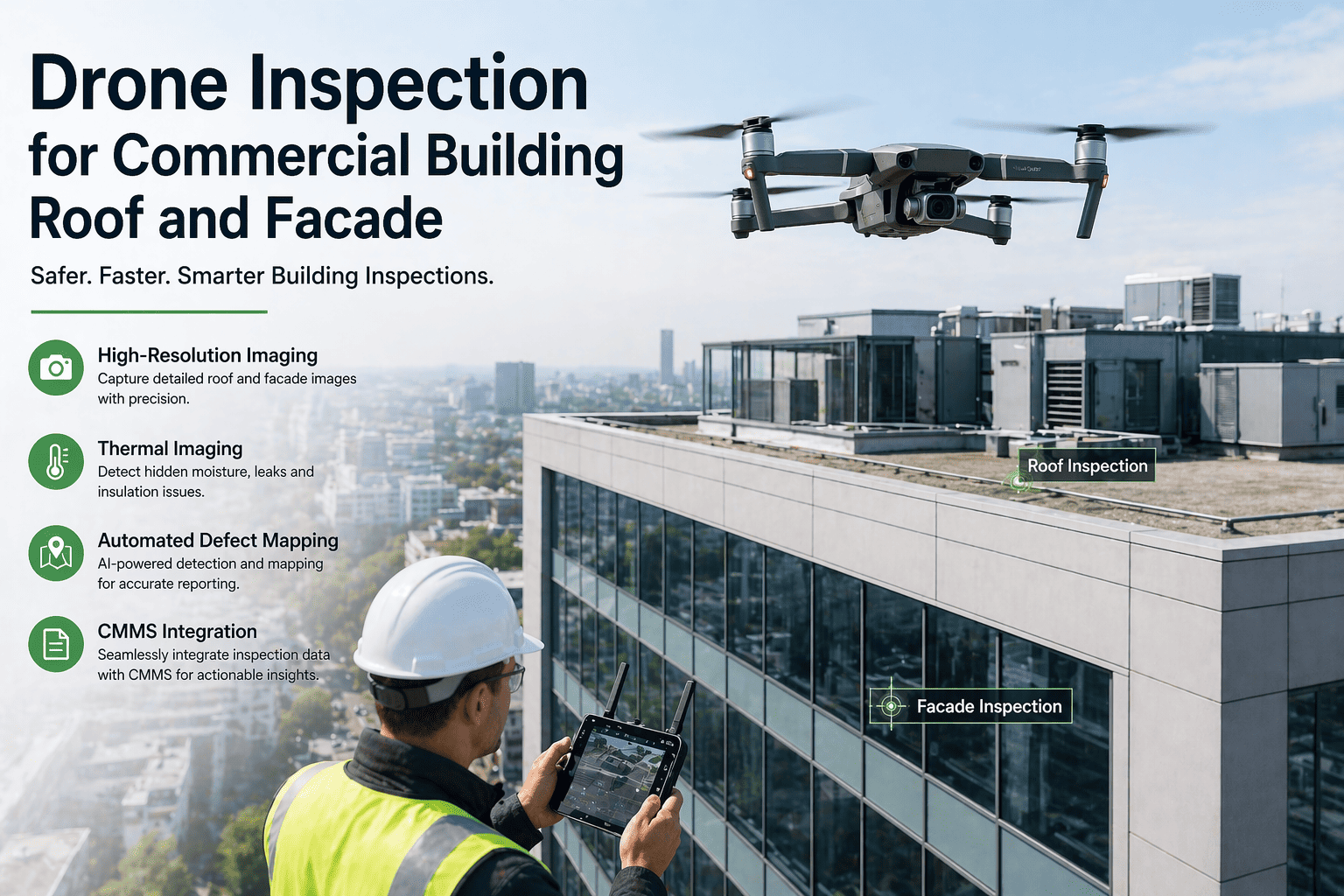
Commercial building roofs and facades are failing earlier than their designed lifespan — often because the first sign of trouble is an interior leak or a falling piece of masonry. Traditional hands-on inspection methods are expensive, dangerous, and incomplete. A drone inspection covers 100% of a building envelope in hours, not days, detecting micro-cracks, membrane breaches, and thermal anomalies that ground crews would miss entirely. An undetected parapet crack can lead to water infiltration that damages ten floors of interior finishes before it surfaces. A thermal drone flight identifies failing insulation with ±1°F accuracy, long before it shows up on an energy bill. OxMaint's asset lifecycle management platform integrates drone inspection data — orthomosaic maps, thermal images, and defect annotations — directly into your CMMS, auto-generating work orders for every flagged anomaly. Book a demo to see how drone-to-CMMS workflows transform building envelope maintenance.
Drone Inspection · Roof & Facade · Thermal Imaging
Drone Inspection for Commercial Building Roof and Facade
Thermal imaging, automated defect mapping, and CMMS integration — the complete guide to drone-based building envelope inspection.
80%Faster than traditional hands-on inspection methods
40%Lower cost than scaffold or rope access inspections
100%Envelope coverage — no blind spots or inaccessible areas
Stop discovering roof leaks through interior damage. OxMaint integrates drone inspection data — thermal images, defect maps, and annotations — directly into your CMMS, auto‑generating work orders for every flagged anomaly.
Inspection Types
What Drone Inspections Detect — Roof and Facade
01
Roof Membrane Integrity
Thermal imaging identifies wet insulation, membrane breaches, and ponding water invisible to visual inspection. A 1% increase in roof moisture can reduce insulation R-value by 50%.
02
Parapet & Coping Condition
Drone close-up inspection captures cracked coping stones, failed sealants, and leaning parapet walls — the most common source of water infiltration at roof perimeters.
03
Facade Cracks & Spalling
High-resolution imagery identifies hairline cracks, masonry spalling, and efflorescence before they become falling debris hazards. Flagged anomalies map directly to maintenance work orders.
04
Flashing & Penetration Seals
Thermal and visual inspection of roof flashing around penetrations (pipes, curbs, HVAC) — the highest-probability leak points on any commercial roof.
05
Window & Curtain Wall Seals
Thermal bridging detection around window perimeters indicates failed seals or missing insulation — a primary source of energy waste and condensation damage.
06
Drainage & Gutter Systems
Aerial inspection identifies blocked drains, sagging gutters, and downspout separation that cause ponding water and ice dam formation in winter.
Technology Comparison
Drone Inspection vs Traditional Methods
← Swipe to see full table →
| Inspection Method |
Coverage |
Time (100k sq ft roof) |
Safety Risk |
Documentation Quality |
Typical Cost |
| Hands-on / Walkthrough | Accessible areas only | 2-3 days | Fall hazard | Photos + notes | $5,000-$12,000 |
| Scaffold / Rope Access | 100% | 3-7 days | Moderate-high | Inspection report | $15,000-$40,000 |
| Drone (Visual) | 100% | 4-6 hours | None (ground-based pilot) | 4K video + high-res photos | $3,000-$8,000 |
| Drone (Thermal + Visual) | 100% | 6-8 hours | None | Orthomosaic + thermal map + annotated defects | $5,000-$12,000 |
"The building owners who still rely on annual walkthrough roof inspections are operating with 80% less data than drone-enabled competitors. A ground-based inspector sees what they can reach from the roof edge. A drone sees every square inch — including the membrane under HVAC units, the back side of parapets, and the slope where ponding water is forming. When you overlay thermal data, you see wet insulation that hasn't yet leaked into the building. That is not just better inspection. That is deferred maintenance dollars still in your pocket."
Captain (ret.) Michael Torres, sUAS Certified
Commercial Drone Inspection Specialist · 8 years building envelope inspections · Part 107 certified · 2,500+ commercial building inspections completed
Frequently Asked Questions
How does drone inspection data integrate with OxMaint CMMS?
OxMaint accepts drone inspection outputs in standard formats: orthomosaic maps (GeoTIFF), thermal image sets (JPG/PNG with embedded temperature data), and defect annotation files (GeoJSON, CSV). The platform geo-locates each defect on the building model, creates an asset record for the defect location (e.g., "Roof Zone 4 - East Parapet"), and generates a work order with the annotated image attached. The work order includes the defect type, severity rating, and recommended repair.
Book a demo to see drone-to-work-order automation.How often should commercial roofs be inspected by drone?
Industry best practice calls for annual drone roof inspections, plus post-storm inspections after major hail, high-wind, or heavy rain events. For buildings over 10 years old, or those with known membrane issues, semi-annual inspections are recommended. Drone inspections between formal engineering assessments catch developing issues early — the leak that would have required interior demolition to find is detected as a small thermal anomaly.
Start a free trial to schedule drone inspection work orders.Can thermal drones detect moisture inside a roof membrane?
Yes. Thermal drone inspections detect temperature differentials as small as 0.5°F. Wet insulation retains heat differently than dry insulation, creating a detectable thermal lag pattern. The drone identifies wet zones, even when the roof surface shows no visible damage. This is particularly valuable for built-up roofs and single-ply membranes where moisture can migrate far from the entry point, making visual leak detection nearly impossible.
Book a demo to see thermal image analysis for roof moisture.What are the regulatory requirements for commercial drone inspections?
Commercial drone operators must hold a Part 107 Remote Pilot Certificate from the FAA. For building inspections, flights must maintain visual line of sight (VLOS) unless a waiver is obtained. No-fly zones (airports, heliports, restricted airspace) require FAA authorization through LAANC or DroneZone. Privacy considerations require notification to building occupants and neighboring properties. A professional inspection provider handles all regulatory compliance.
Start a free trial to track inspection provider compliance records.
From Drone Data to Maintenance Action
OxMaint's asset lifecycle platform integrates drone inspection data — thermal images, defect maps, and annotations — directly into your CMMS, auto-generating work orders for every flagged anomaly before leaks or failures occur.