Loading dock equipment failures are not gradual — they are sudden. A dock leveler that drops unexpectedly during pallet transfer, a vehicle restraint that releases while a trailer is being loaded, or an overhead door that de-rails mid-cycle each create injury events and OSHA recordables that a structured preventive maintenance program would have prevented. The US Bureau of Labor Statistics reports that loading dock incidents account for a disproportionate share of warehouse fatalities and serious injuries relative to floor area — and the OSHA 1910.30 standard explicitly requires that powered industrial truck operations at docks include safe means of access and egress. OxMaint’s Preventive Maintenance platform schedules, assigns, and tracks every dock equipment inspection on a configurable interval — daily visual checks, weekly functional tests, and monthly hydraulic and mechanical PM — with mobile completion, photo capture, and automatic work order generation for every deficiency found.
Equipment & Asset Management · Warehouse Safety · OSHA 1910.30
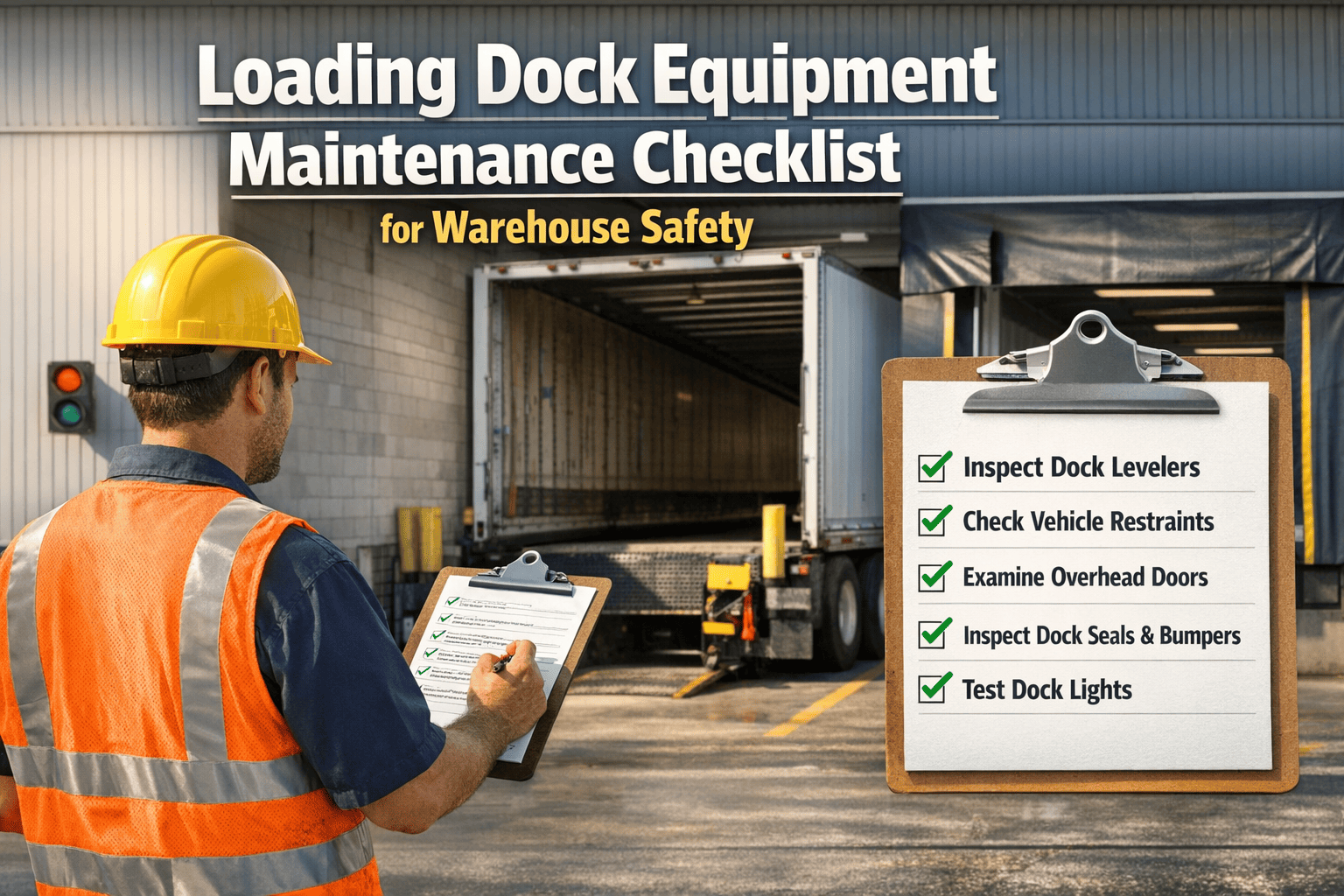
Loading Dock Equipment Maintenance Checklist for Warehouse Safety
Dock levelers, vehicle restraints, overhead doors, seals, bumpers, and lighting — complete inspection coverage structured for daily, weekly, and monthly PM cycles. OSHA-referenced, mobile-ready, and built for high-traffic warehouse operations.
25K+
Dock-related injuries reported annually in the US — the majority preventable with structured PM
$30K–$75K
Average cost per dock-related injury claim including lost time, workers’ comp, and incident investigation
Daily
Minimum visual inspection frequency for vehicle restraints and levelers under active dock operations
OSHA 1910.30
Federal standard requiring safe dock access — non-compliance triggers citations up to $16,131 per violation
Zone 01 · Dock Levelers
Dock Leveler Inspection & PM Checklist
Dock levelers bridge the height difference between the dock floor and trailer bed and support live pallet jack and forklift loads during loading operations. Hydraulic, mechanical, and air-powered levelers each have different failure modes but share the same consequence: unexpected movement under load. A leveler that creeps, drops, or fails to hold position is an immediate forklift tip-off hazard.
Daily — Visual + Operational
Weekly — Functional Test
Monthly — Hydraulic / Mechanical PM
Daily Checks
Inspect leveler deck surface — no visible cracks, holes, bent deck sections, or missing anti-skid grating that could catch forklift tines or pallet jack wheelsRecord: Deck condition · Role: Dock Supervisor / Lead Operator
Operate leveler through one full cycle (raise, extend lip, lower to stored position) — confirm smooth movement, no jerking, hesitation, or unusual noise during operationRecord: Cycle test result · Cycle: Pass / Fail / Irregular
Confirm lip extends fully and seats positively on trailer floor — an improperly extended lip creates a fall hazard for pallet loads bridging the gap between dock and trailerRecord: Lip seating confirmed · Role: Dock Operator
Verify leveler returns to stored (raised maintenance) position when dock is unoccupied — a leveler left in the lowered cross-traffic position is a pedestrian fall hazard at the dock pitRecord: Stored position confirmed · Ref: OSHA 1910.30
Weekly Checks
Inspect hydraulic unit (hydraulic levelers) — check fluid level, inspect all visible hoses and fittings for leaks, staining, or cracking. Any hydraulic fluid on the dock floor is a slip hazard and leak indicator requiring immediate attentionRecord: Hydraulic inspection log · Fluid level: OK / Low / Leak found
Test leveler hold-down function: lower to working position under load simulation and confirm the leveler maintains position without drifting. Downward creep under load indicates hydraulic seal wear requiring PMRecord: Hold-down test · Result: Pass / Drift observed (mm/min)
Inspect lip hinge and lip keeper condition — verify lip moves freely without binding, lip keeper engages positively, and all pivot pins and hinge hardware are present and not cracked or deformedRecord: Lip mechanism condition · Role: Maintenance Technician
Monthly PM
Lubricate all pivot points, hinge pins, and roller bearings per manufacturer specification — dry pivots are the leading cause of hydraulic leveler noise and premature structural wear. Document lubricant type and quantity usedRecord: Lubrication log · Lubricant type and quantity recorded
Check hydraulic fluid condition and level — cloudy fluid indicates water contamination; dark fluid indicates oxidation. Change fluid per manufacturer interval or immediately on contamination indicationRecord: Fluid condition + change date · Next change due logged
Inspect and test cross-traffic legs (where present) — confirm legs extend and support load, pins and brackets intact, no bending or cracking from impact damageRecord: Cross-traffic leg condition · Role: Maintenance Technician
Inspect dock pit for debris, water pooling, or structural damage — clear pit, verify drain functional, and inspect pit walls and floor for cracking that could compromise leveler anchoringRecord: Pit inspection · Drain: Clear / Blocked
Zone 02 · Vehicle Restraints
Vehicle Restraint Inspection Checklist
Vehicle restraints prevent trailer creep and pull-away during loading — the leading cause of dock walk-away incidents where a trailer moves away from the dock while a forklift is in or on it. A restraint that fails to engage, releases early, or is bypassed because it appears malfunctioning eliminates the primary safety barrier at the dock face. Restraints must be tested before every trailer engagement, not on a calendar-only basis.
Before Every Trailer Engagement
Confirm vehicle restraint engages positively with trailer ICC bar (rear impact guard) — engagement indicator (light/horn/visual) shows green / active. Do not begin loading until engagement is confirmedRecord: Pre-engagement check · Ref: OSHA 1910.178(m) · Engaged: Yes / No
Verify interlock communication with dock leveler — if interlock is present, confirm leveler cannot be operated until restraint shows engaged status. Bypassed interlocks must be reported as a safety non-conformance immediatelyRecord: Interlock status · Interlock: Active / Bypassed / Not present
Confirm dock communication lights are functioning — red/green light system visible to truck driver from cab position; confirm driver has acknowledged restraint engaged before forklift entry to trailerRecord: Light system status · Both interior and exterior lights confirmed
Weekly Functional Tests
Test restraint hook engagement and release cycle without trailer present — confirm smooth mechanical movement, hook returns to full engagement position, no binding or incomplete retractionRecord: Cycle test result · Role: Maintenance Technician
Inspect restraint housing, mounting hardware, and guide rail for impact damage, corrosion, or deformation — dock bumper strikes, snow plows, and low trailer clearances are the primary causes of restraint frame damageRecord: Housing and mounting condition · Damage: None / Minor / Major (report)
Test control panel indicator lights, audible alarm (where present), and power supply — confirm all indicators function correctly; a non-functional indicator must be treated as a restraint failure until repairedRecord: Control panel function · All indicators: Pass / One or more failed
Schedule every dock inspection automatically — daily, weekly, and monthly PM work orders assigned to your team before the shift starts.
Zone 03 · Overhead Doors
Overhead Door & Industrial Door Inspection Checklist
High-cycle industrial overhead doors at active warehouse docks complete 50–100 cycles per day. At that frequency, spring fatigue, cable wear, and bottom bar seal damage accumulate faster than most PM calendars account for. An overhead door that de-rails, drops, or fails to reverse on obstacle contact is both a crush hazard for personnel and a $10,000–$40,000 unplanned replacement event.
Daily Checks
Test door operation through one full open/close cycle — confirm smooth movement, no jerking, cable tracking correctly in drums, and no unusual mechanical noise from springs or counterbalance systemRecord: Cycle test · Smooth: Yes / No · Noise: None / Present
Test auto-reverse / safety edge function — trigger safety edge contact during closing cycle and confirm door reverses immediately. A door that does not reverse on contact is a crush hazard and must be taken out of service until repairedRecord: Auto-reverse test · Result: Reverses immediately / Delayed / Failed
Inspect bottom seal and bottom bar — confirm rubber seal contacts floor evenly across full door width, no torn sections, and bottom bar is straight with no impact deformation that would prevent even seal contactRecord: Bottom seal condition · Seal: Intact / Torn / Missing section
Weekly Checks
Inspect door panels for dents, cracks, damaged sections, or panel joint separation — forklift strikes on door panels from inside are the most common door damage source; any panel showing structural deformation must be replaced before failure in trackRecord: Panel condition per door · Damage: None / Minor / Structural (remove from service)
Inspect door tracks and rollers — confirm tracks are straight, bracket fasteners are tight, and rollers move freely without wobble. Bent tracks cause de-railing; loose brackets cause track misalignment under cycle loadsRecord: Track and roller condition · Track straight: Yes / No · Brackets tight: Yes / No
Inspect spring system (torsion or extension) — DO NOT attempt to adjust or replace springs without proper training and equipment. Broken torsion springs under high tension are a serious injury hazard. Flag any spring with visible cracks, separation, or uneven coil spacing for immediate serviceRecord: Spring visual inspection · Springs: No defects / Defect flagged (no adjustment by operator)
Monthly PM
Lubricate hinges, rollers, tracks, and torsion spring shaft bearings per manufacturer specification — use silicone or manufacturer-approved lubricant only; petroleum-based lubricants attract debris and accelerate wear in high-cycle applicationsRecord: Lubrication log · Lubricant type, date, technician
Verify and adjust door open and close travel limits — door must fully open to clear forklifts and trailers without striking the header; close limit must seat the bottom bar firmly without motor strain at the fully closed positionRecord: Travel limit adjustment · Role: Qualified Technician
Test photo eye / safety loop alignment (where present) — clean optical sensors, confirm beam alignment, and verify that an obstruction in the door opening prevents closing cycle from initiatingRecord: Safety sensor test · Beam aligned: Yes / No · Obstruction test: Pass / Fail
Zone 04 · Dock Seals & Shelters
Dock Seal & Shelter Inspection Checklist
Dock seals and shelters maintain thermal separation between dock and exterior, prevent pest ingress, and protect cargo from weather exposure during loading operations. Deteriorated seals that allow cold air infiltration in winter or allow water ingress during rain events are both an energy cost and a product damage liability. Compressed foam seals wear from trailer contact; inflation-style shelters are vulnerable to puncture and valve failure.
Weekly Visual Inspection
Inspect foam pad face and head pad surface (compression seals) — compression wear exposing backing material indicates seal replacement required; torn or missing foam sections allow air, water, and pest infiltration at dock faceRecord: Seal face condition · Condition: Good / Worn / Replacement required
Inspect shelter fabric and frame (inflatable and curtain shelters) — check fabric for tears, holes, or frame contact abrasion; inspect frame for bending or bracket loosening from trailer contact loadingRecord: Shelter fabric and frame condition · Role: Maintenance Technician
Test inflation system (inflatable shelters) — inflate and confirm uniform pressure across all chambers; note any chamber that fails to inflate fully or deflates faster than normal, indicating a valve or fabric leakRecord: Inflation test per chamber · Pressure: Normal / Low / Leak detected
Inspect seal mounting hardware and backing board — confirm mounting brackets are tight, backing boards are not delaminating or water-damaged, and the seal assembly is square to the dock opening with no gaps at the header or sidesRecord: Mounting hardware condition · Gaps: None / Present (location noted)
Zone 05 · Bumpers & Approach
Dock Bumpers, Approach Apron & Safety Markings
Dock bumpers absorb the impact energy of trailer backing and protect both the dock face and trailer from damage. Deteriorated or missing bumpers allow trailers to contact the dock structure directly, causing progressive concrete and steel damage. The approach apron condition directly affects trailer angle and restraint engagement reliability.
Weekly Checks
Inspect dock bumpers for compression set, cracking, missing sections, or loose mounting hardware — rubber bumpers flattened to <50% of original thickness have lost their energy absorption capacity and require replacementRecord: Bumper condition per dock · Compression set: <50% original thickness = replace
Confirm bumper mounting bolts are present, tight, and not pulling through the dock face — missing mounting hardware shifts impact load directly to the dock structure and creates trailer damage liabilityRecord: Mounting bolt condition · All bolts present and tight: Yes / No
Inspect dock approach apron and surface for potholes, surface heave, edge cracking, or drainage issues — apron surface defects affect trailer backing angle and restraint engagement reliability; report pavement defects for work orderRecord: Apron surface condition · Defects: None / Present (work order generated)
Confirm dock approach safety markings are legible: trailer staging lines, pedestrian caution zones, forklift crossing points, and dock assignment numbers — faded markings are a leading cause of trailer/forklift proximity incidents at busy docksRecord: Markings condition · Legibility: Good / Faded (refresh required)
Zone 06 · Lighting & Signage
Dock Lighting, Safety Signage & Communication Systems
Daily Checks
Confirm all dock-area overhead lighting is operational — failed lighting in the dock pit area, inside trailers during loading, and approach apron lighting are safety-critical failures requiring same-day work ordersRecord: Lighting status per dock · Role: Dock Supervisor
Confirm dock communication light systems (red/green interior and exterior) are operational at every active dock position — a non-functional communication light must be treated as a dock out-of-service conditionRecord: Communication lights per dock · Status: Operational / Failed (dock out of service)
Weekly Checks
Inspect all safety signs: dock edge warnings, forklift clearance height signs, pedestrian crossing signs, and capacity/load limit postings — missing or faded OSHA-required safety signs are citation items during inspectionsRecord: Safety sign audit · Missing signs: Work order generated · Ref: OSHA 1910.145
Test emergency stop buttons at dock control stations — confirm each E-stop is accessible, unobstructed, and triggers the correct lockout of dock equipment in its zone. Red mushroom head buttons must not be taped over or disabledRecord: E-stop test per station · Result: Pass / Fail
Test dock intercom or communication systems connecting interior dock operators to trailer drivers — confirm audio clarity and confirm protocols for driver communication are posted and followedRecord: Communication system test · Role: Dock Supervisor
PM KPIs
Dock Equipment PM Metrics That Matter
| Metric |
How to Measure |
Target |
OxMaint Tracking |
| PM Completion Rate |
Completed PM work orders / Scheduled PM work orders |
>95% |
Auto-scheduled by asset and interval; overdue escalations |
| Vehicle Restraint Test Compliance |
Pre-engagement checks completed / Trailer arrivals |
100% |
Checklist required before work order can be closed per dock |
| Defect-to-Work-Order Rate |
Defects generating work orders / Total defects found |
>95% |
One-tap work order creation from inspection defect item |
| Dock Equipment MTBF |
Total operating time / Number of unplanned failures per asset |
Trending upward quarter-over-quarter |
Asset-level failure history and PM adherence correlation |
| Safety Event Rate (Dock) |
OSHA recordable dock incidents / 100,000 trailer movements |
Zero — target zero, review on any event |
Incident log linked to asset PM history for root cause |
| Reactive vs Planned Work Ratio |
Unplanned repairs / Total dock equipment work orders |
<20% |
Ratio trending per dock zone and equipment type |
Expert Review
What Warehouse Safety and Maintenance Professionals Say
01
The most dangerous moment at a loading dock is the five seconds when a forklift is entering a trailer and nobody has verified that the vehicle restraint is actually engaged — not just that it looks engaged. A visual indicator light that shows green when the restraint hook has not fully seated the ICC bar is the most common equipment failure mode I encounter in dock safety audits. Test the restraint mechanically, not just visually, every day.
Senior EHS Manager, 3PL Distribution Center — 48 Active Dock Positions, OSHA VPP Star Site
02
Overhead door spring failures are a recurring serious injury event at high-cycle warehouse docks. A torsion spring under 150–200 lbs of tension stores enormous energy — when it breaks, it does not break quietly. The operators who have been told “do a visual check on the springs” but have never been trained on what a cracked spring looks like or told not to operate the door if they see one are the operators who get hurt. Put spring inspection on a formal PM work order with a trained technician, not a daily operator checklist.
Certified Maintenance & Reliability Professional (CMRP), Industrial Door Service Contractor — 22 Years High-Cycle Door Maintenance
03
We moved dock leveler and restraint PM into OxMaint and within the first quarter we caught three hydraulic levelers with measured downward creep under load. All three would have progressed to leveler drop events within weeks. The catch came from the weekly hold-down test being a mandatory checklist item that auto-generated a work order for any measured drift — something that was never captured consistently on the previous paper-based system because the test was optional and nobody knew what the acceptable drift threshold was.
Facilities Manager, Food Distribution Warehouse — 36 Dock Positions, 400+ Trailer Movements Per Day
FAQs
Frequently Asked Questions
What OSHA standards apply to loading dock equipment maintenance?
The primary federal OSHA standards applicable to loading dock operations include 1910.30 (walking-working surfaces, dock safety), 1910.178(m) (powered industrial truck operations on docks), and 1910.147 (lockout/tagout for dock equipment servicing). OSHA 1910.22 also applies for dock area floor conditions, lighting, and marking requirements. Many states have OSHA-approved plans that may impose additional requirements. OSHA 1910.30 specifically requires employers to ensure that powered industrial trucks can operate safely at dock plates and bridge plates — including maintaining the equipment in good repair.
OxMaint tags each inspection item against the applicable OSHA standard for audit documentation.
How often should dock leveler hydraulic fluid be changed?
Most manufacturers recommend hydraulic fluid changes every 2–3 years under normal operating conditions, but high-cycle docks (50+ movements per day) and operations in extreme temperatures (cold storage, outdoor docks) require annual changes. More importantly, change fluid immediately on any indication of contamination — cloudy appearance signals water ingress, dark colouration signals oxidation, and either condition accelerates seal wear and pump cavitation. Always use the manufacturer-specified fluid type — substituting with generic hydraulic oil can damage seals and void the equipment warranty.
Book a demo to see how OxMaint tracks fluid change dates and generates PM work orders automatically.
Who is qualified to perform dock equipment maintenance and PM?
Daily visual and operational checks are suitable for trained dock operators who have received documented equipment-specific training. Weekly functional tests should be completed by a maintenance technician with training on the specific equipment brand and model. Monthly and annual PM — including hydraulic system service, spring adjustment, and electrical work — should be performed by a qualified industrial door and dock equipment technician or the OEM service team. Spring system work should never be performed by untrained personnel due to stored energy hazards. Document technician qualifications in the work order record for audit purposes.
How does OxMaint manage dock PM schedules across multiple dock positions?
OxMaint registers each dock position as an individual asset with its own PM schedule, inspection interval, and service history. Daily, weekly, and monthly checklists auto-generate as work orders assigned to the relevant role (dock operator, maintenance tech) before each shift or PM cycle. Defects found during inspection generate child work orders linked to the inspection record — maintenance knows what needs to be done before they reach the dock position. Fleet-level reporting shows PM completion rates, defect trends, and reactive vs planned work ratios across all dock positions in one dashboard.
Preventive Maintenance · OxMaint · Warehouse Safety
Dock Equipment Failures Are Preventable. Start Preventing Them on a Schedule.
OxMaint’s Preventive Maintenance platform registers every dock position as an asset, auto-schedules daily, weekly, and monthly PM work orders to the right team member, captures inspection results and photos on mobile, generates repair work orders from defects before they become failures, and delivers the OSHA-ready maintenance documentation your dock operations require.



.jpeg)