Indoor air quality is the environmental factor most directly connected to occupant health, productivity, and regulatory compliance in commercial buildings — and it is the one most commonly managed reactively, after complaints, rather than proactively, on a documented schedule. ASHRAE 62.1 sets the minimum ventilation requirements for acceptable IAQ in commercial buildings; OSHA 1910.94 and 1910.1000 establish permissible exposure limits for airborne contaminants; WELL Building Standard and LEED require documented monitoring programs. Poor IAQ — CO² above 1,000 ppm, PM2.5 exposure from blocked filters, or RH below 30% during winter operation — reduces cognitive performance by 15–50% in office environments according to Harvard Chan School of Public Health research. OxMaint’s Preventive Maintenance platform schedules every IAQ inspection, filter change, and sensor calibration on configurable intervals — generating timestamped digital records that satisfy ASHRAE, OSHA, LEED, and WELL documentation requirements automatically.
Sustainability & ESG · Facility Management · ASHRAE 62.1 · WELL & LEED
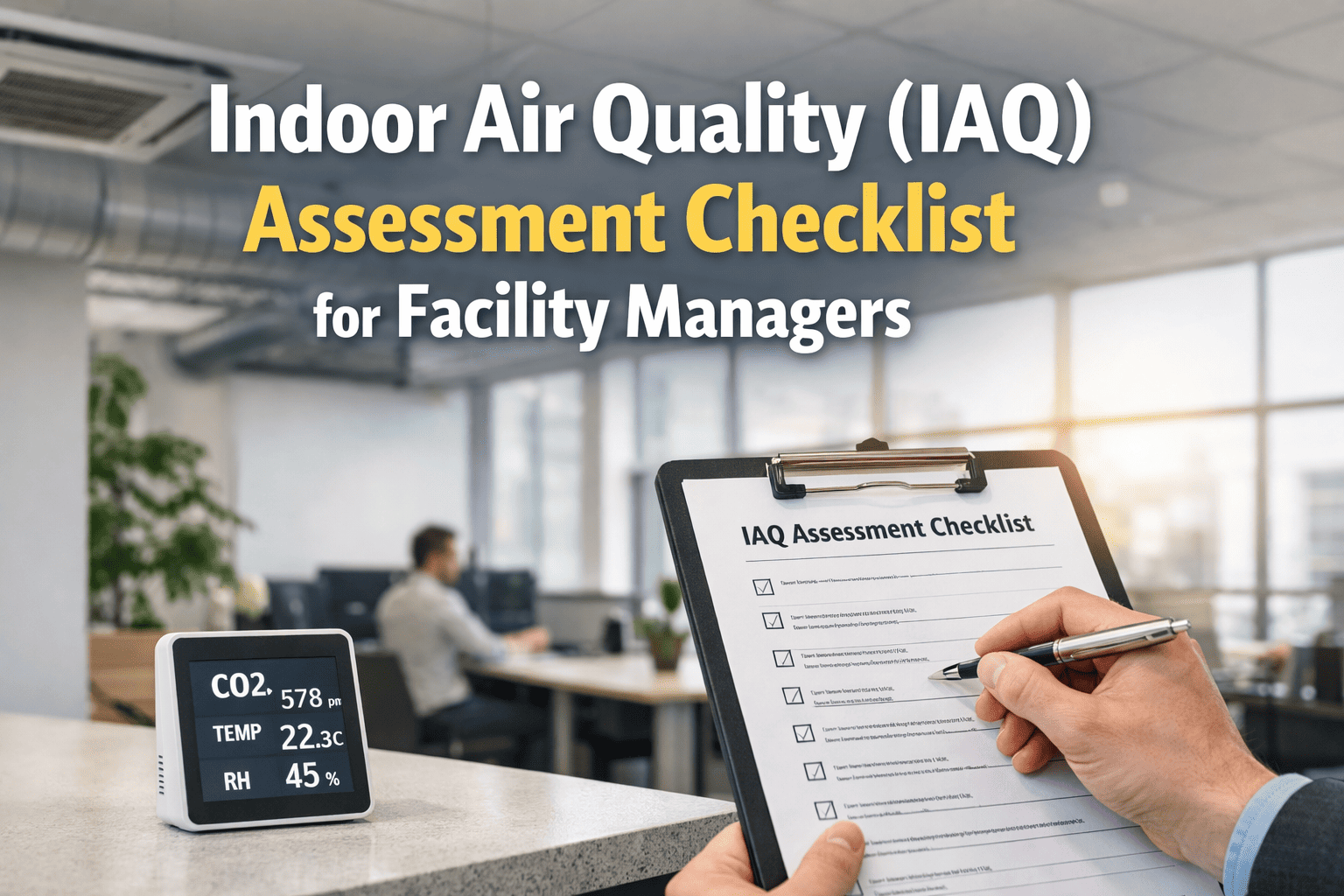
Indoor Air Quality (IAQ) Assessment Checklist for Facility Managers
Ventilation, CO², PM2.5, humidity, HVAC filters, IAQ sensors, and chemical source control — complete assessment coverage for commercial, office, healthcare, and educational facilities. Referenced to ASHRAE 62.1, EPA IAQ guidance, WELL Building Standard, and OSHA 1910.1000.
15–50%
Cognitive performance reduction in poor IAQ environments — Harvard Chan / Syracuse University research
90%
of time the average person spends indoors — making IAQ a primary health exposure category
1,000 ppm
CO² threshold above which ASHRAE 62.1 ventilation adequacy should be investigated in occupied spaces
ASHRAE 62.1
Primary commercial building ventilation standard — minimum outdoor air rates, filtration, and monitoring requirements
Zone 01 · Pre-Assessment Setup
Pre-Assessment: Documentation & Baseline Review
IAQ assessments without a documented baseline produce data without context. Before any measurement is taken, establish what the building design targets are, what the last assessment found, and whether any building changes — occupancy increases, renovations, new equipment — have altered the IAQ exposure conditions since the previous assessment.
Assessment Context
Record assessment date, building address, zones covered, occupancy type (office, healthcare, education, industrial), and current occupancy load — IAQ standards vary by occupancy type and occupant densityRecord: Assessment header · Ref: ASHRAE 62.1 Table 6-1 (occupancy categories)
Retrieve prior IAQ assessment report — review previous parameter readings, outstanding recommendations, and any complaints received since last assessment. IAQ trending requires consistent zone-by-zone comparison, not point-in-time snapshotsRecord: Prior report retrieved and compared · Role: Facility Manager
Document any building changes since last assessment: renovation work (new finishes, carpet, paint), changes in occupancy density, new equipment with emission potential (printers, lab equipment), or HVAC system modificationsRecord: Change log reviewed · Changes: None / Present (describe)
Confirm outdoor air quality conditions at assessment time — high AQI days, wildfire smoke events, or nearby construction activity create transient IAQ impacts. Note outdoor AQI (EPA AirNow) and any site-specific outdoor sourcesRecord: Outdoor AQI at assessment time · Source: EPA AirNow or local monitoring
Confirm HVAC system is operating in normal occupied mode during assessment — assessments conducted during unoccupied operation or during scheduled night setback do not represent occupied IAQ conditions and are not comparable to baseline readingsRecord: HVAC mode at assessment time · Mode: Normal occupied / Other (note)
Zone 02 · Ventilation Systems
Ventilation System Inspection Checklist
Ventilation is the primary engineering control for diluting indoor-generated pollutants and maintaining acceptable CO² concentration. ASHRAE 62.1 specifies minimum outdoor air ventilation rates by occupancy and area. A building that meets its design ventilation rate on paper but has blocked dampers, failed actuators, or recirculating air without outdoor air intake is operating below its IAQ design intent regardless of what the mechanical drawings show.
Outdoor Air Intake & Dampers
Inspect outdoor air intake(s) for obstruction, debris accumulation, bird nesting, or vegetation growth within 10 feet of the intake — confirm intake screen is intact and clean. A blocked intake reduces outdoor air delivery to zero regardless of damper positionRecord: Intake condition per AHU · Obstruction: None / Present (work order)
Verify outdoor air damper position during occupied hours — confirm damper opens to minimum design position per control sequence; log damper position percentage and compare to design minimum outdoor air fractionRecord: OA damper position · Ref: ASHRAE 62.1 Section 6 · Design min OA: ___% · Actual: ___%
Test economiser damper function (where present) — confirm damper modulates correctly in response to outdoor temperature and enthalpy; a stuck economiser in closed position on cool days denies free cooling and IAQ improvement opportunityRecord: Economiser test · Function: Correct / Stuck / Absent
Supply, Return & Exhaust Airflow
Verify supply air is reaching all zones — check that all supply diffusers are open and unobstructed by furniture, partitions, or storage. Confirm no zone terminals (VAV boxes) are stuck in closed position for occupied spacesRecord: Supply diffuser survey per zone · Blocked: None / Present (location noted)
Inspect return air grilles — confirm all return grilles are open, unobstructed, and free of accumulated dust. Blocked returns create pressure imbalances that reduce outdoor air fraction and pull infiltration air from uncontrolled pathsRecord: Return grille condition per zone · Condition: Clear / Dust-loaded / Blocked
Verify exhaust fans are operational in all high-contaminant zones: restrooms, kitchens, copy rooms, janitor closets, and chemical storage areas. Exhaust fan failure in these zones allows locally generated pollutants to migrate to occupied spaces via return airRecord: Exhaust fan function per zone · Ref: ASHRAE 62.1 Table 6-1 exhaust rates
Confirm positive pressure in occupied spaces relative to service corridors, garages, and mechanical rooms — negative pressure in occupied zones draws in contaminants from adjacent spaces. This is critical in healthcare and laboratory facilitiesRecord: Pressure relationship confirmed · Healthcare: Negative pressure isolation rooms verified separately
Zone 03 · Air Quality Parameters
IAQ Parameter Measurement Checklist
Direct measurement of IAQ parameters provides the objective evidence base that a visual inspection of HVAC systems cannot. Measurements must be taken during normal occupied operation, at representative locations in each zone, and compared against established reference values. A single point measurement is a data point; a series of measurements at the same location over multiple assessments is a trend that enables early detection of deteriorating conditions.
Carbon Dioxide (CO²)
Measure CO² concentration in each occupied zone during peak occupancy — record results in ppm. Target: <800 ppm (excellent); 800–1,000 ppm (acceptable); >1,000 ppm (investigate ventilation adequacy); >1,500 ppm (inadequate, immediate action)Record: CO² reading per zone · Time: Peak occupancy · Ref: ASHRAE 62.1 / WELL Air Feature 03
If CO² exceeds 1,000 ppm: verify outdoor air damper position, check for VAV box closures in the affected zone, confirm supply air is reaching occupant breathing zone, and investigate occupancy load vs design capacityRecord: Remediation steps taken when >1,000 ppm · Role: Facility Manager
Particulate Matter (PM2.5 & PM10)
Measure PM2.5 concentration in representative occupied zones — target: <12 µg/m³ (EPA annual NAAQS); WELL Building Standard Platinum requires <12 µg/m³ and Gold requires <35 µg/m³ for 98th percentile of readingsRecord: PM2.5 reading per zone · Ref: EPA NAAQS / WELL Air Feature 01
If PM2.5 elevated: correlate with filter condition and MERV rating, check for indoor particle sources (printers, laser devices, renovation activity), and assess outdoor PM contribution via OA intake. Consider upgrade to MERV-13 or higher filtrationRecord: PM2.5 source investigation when elevated · MERV upgrade consideration noted
Relative Humidity (RH)
Measure relative humidity in each zone — target: 30–60% RH. Below 30%: increased respiratory irritation, static electricity, and accelerated viral transmission. Above 60%: mould growth risk, dust mite proliferation, structural moisture damageRecord: RH per zone · Ref: ASHRAE 55 / WELL Air Feature 05 · Target: 30–60% RH
If RH <30%: inspect humidification system for function, scale blockage, or sensor calibration issues. If RH >60%: inspect cooling coil drainage, condensate drain pan for standing water, and building envelope for moisture infiltration pathsRecord: Remediation steps taken for out-of-range RH · Role: HVAC Technician
Temperature & VOC (where applicable)
Measure operative temperature in occupied zones — target: 68–76°F (20–24°C) in winter, 73–79°F (23–26°C) in summer per ASHRAE 55. Thermal discomfort is the most reported IAQ-adjacent occupant complaint even when air quality parameters are within limitsRecord: Temperature per zone · Ref: ASHRAE 55 Thermal Comfort Standard
If TVOC (Total Volatile Organic Compounds) monitoring is in place or complaints indicate chemical odour: measure TVOC concentration — target <500 µg/m³ (WELL Platinum). Identify source: new furnishings, cleaning products, adhesives, sealants, or adjacent chemical useRecord: TVOC reading where monitored · Ref: WELL Air Feature 04 (VOC limits)
Schedule IAQ assessments, filter changes, and sensor calibrations automatically — every building zone on its own PM interval.
Zone 04 · HVAC Filtration
HVAC Air Filtration Inspection & PM Checklist
Air filters are the primary physical barrier against particulate contamination of recirculated air and supply air to occupied spaces. A filter that is overloaded, bypassed, or installed at the wrong MERV rating provides far less protection than its specification suggests. Filter condition must be inspected on a documented schedule and changed before loading reaches the point where bypass or filter collapse becomes possible.
Filter Inspection (Monthly or Per PM Interval)
Inspect all pre-filters (MERV 4–8) and final filters (MERV 13+ for office and healthcare) — check loading condition visually and via pressure differential. Replace when pressure drop across filter exceeds manufacturer maximum or at scheduled interval, whichever comes firstRecord: Filter ΔP per AHU · Replace when ΔP > manufacturer limit · MERV rating confirmed
Inspect filter installation for bypass gaps — confirm filters seat squarely in tracks with no gaps between filter edge and housing frame. Bypass gaps allow unfiltered air to enter the supply air stream regardless of how clean the filter itself isRecord: Bypass gap inspection · Bypass: None / Present (location noted, seal or replace)
Confirm MERV rating of installed filters matches specification — filter substitutions during shortages often result in lower MERV filters being installed and not updated in maintenance records. Record actual installed MERV rating per AHURecord: Installed MERV per AHU · Design spec MERV: ___ · Installed MERV: ___
For HEPA filter stages (healthcare, cleanroom, laboratory): confirm HEPA integrity — visual inspection for tears, frame seal condition, and pressure differential within manufacturer limits. HEPA filter integrity testing (DOP/PAO scan) required per facility standard at defined intervalsRecord: HEPA condition · Last DOP/PAO test date · Next test due
Inspect AHU interior downstream of filter — if visible particulate accumulation is present on coils, drain pans, or duct surfaces, this indicates historical filter bypass or inadequate filtration and requires cleaning work order plus investigation of filter installation historyRecord: AHU interior condition · Accumulation: None / Present (cleaning work order generated)
Zone 05 · Source Control
IAQ Source Control Inspection Checklist
Source control — eliminating or isolating the sources of indoor contaminants — is always more effective than diluting or filtering contaminants after they enter occupied air. This zone covers the physical and operational sources most commonly responsible for IAQ complaints and measurable pollutant elevations in commercial facilities.
Moisture & Mould Risk
Inspect all condensate drain pans and drain lines in AHUs and FCUs — confirm drain pans are clear of standing water and biological growth. Standing water in drain pans is the most common source of mould and bacteria in recirculated HVAC airRecord: Drain pan condition per AHU · Standing water: None / Present · Biological growth: None / Present
Inspect building envelope for moisture intrusion: window seals, roof penetrations, facade joints, and any area with visible water staining or efflorescence. Moisture intrusion points create localised mould growth that volatile mycotoxins and spores distribute through the HVAC return systemRecord: Moisture intrusion survey · Intrusion points: None / Present (work order)
Inspect all plumbing leak points, including under-sink cabinets, building chases, and ceiling areas above wet spaces — concealed plumbing leaks create chronic moisture conditions that are invisible until mould development is advancedRecord: Concealed moisture inspection · Moisture meter readings where access permits
Chemical & Particulate Sources
Review cleaning product inventory against Green Seal or EPA Safer Choice certification — petroleum-based solvents, aerosol sprays, and ammonia-containing products are major VOC sources. Confirm cleaning is scheduled outside occupied hours where high-emission products are in useRecord: Cleaning product audit · VOC-emitting products: Identified / Substituted
Inspect printer and copier rooms — confirm exhaust ventilation is active and directed outdoors; laser printers and photocopiers emit ozone, ultrafine particles, and VOCs. Copy room IAQ should be assessed separately from general office IAQRecord: Printer room exhaust active · Ozone smell noted: Yes / No
Document any new furnishings, carpet, flooring, paint, or adhesives installed within the past 12 months — new building materials are primary VOC emission sources for 3–12 months post-installation. Increased ventilation flush-out (ASHRAE 62.1 Appendix A) may be required before occupancy or after renovationRecord: New materials log · Flush-out completed: Yes / No / N/A
Zone 06 · Sensors & Monitoring
IAQ Sensor & Continuous Monitoring System Checklist
Continuous IAQ monitoring sensors provide the real-time data that periodic assessments cannot — detecting transient pollution events, occupancy-driven CO² spikes, and equipment malfunctions as they occur rather than at the next scheduled inspection. Sensors that have not been calibrated within their manufacturer interval produce data that cannot be trusted for compliance or occupant health purposes.
Sensor Inventory & Location
Confirm IAQ sensor inventory is current — every CO², PM2.5, TVOC, temperature, and RH sensor registered as an asset with location, installation date, and calibration schedule in the CMMS. Unregistered sensors are unmanaged sensorsRecord: Sensor asset register complete · Role: Facility Manager
Verify sensor placement is in the occupant breathing zone (3–6 feet above floor, away from supply diffusers and exterior walls) — sensors mounted at ceiling height or within 3 feet of supply air diffusers do not measure representative occupant exposure concentrationsRecord: Sensor location verified · Height: ___ ft · Distance from diffuser: ___ ft
Calibration & Function Testing
Verify calibration date for every CO² sensor — NDIR CO² sensors require calibration every 1–2 years; electrochemical sensors (CO, O&sub3;) require calibration every 6–12 months. Flag any sensor past its calibration due date as non-compliant for monitoring purposesRecord: Calibration date per sensor · Next calibration due · Ref: WELL Air Feature 03
Test sensor against a reference measurement — compare fixed sensor reading to a calibrated portable meter at the same location and time. A deviation >10% between reference and fixed sensor reading indicates calibration drift requiring serviceRecord: Reference comparison reading · Deviation: ___% · Action required: Yes / No
Confirm sensor data is transmitting correctly to monitoring platform — check for data gaps, flat-line readings (sensor failure indicator), or readings fixed at an implausible value (sensor saturation or dead sensor). Any gap >4 hours in a monitored zone is a monitoring failureRecord: Data continuity check · Last 30 days reviewed for gaps · Gaps: None / Present
Confirm alert thresholds are correctly configured in the monitoring platform — CO² alert at 1,000 ppm (ASHRAE), PM2.5 alert at 35 µg/m³, RH alert at <30% or >60%. Alerts must route to a responsible person who takes documented action within a defined SLARecord: Alert thresholds and routing confirmed · Response SLA: ___ hours
IAQ KPIs
Building IAQ Performance Metrics
| Metric |
Measurement Method |
Target / Reference |
OxMaint Tracking |
| CO² Compliance Rate |
% of occupied zone-hours with CO² <1,000 ppm |
>98% of occupied hours · WELL Air 03 |
Sensor data threshold exceedance count per zone |
| PM2.5 Compliance Rate |
% of readings <12 µg/m³ (WELL Platinum) |
>98% of readings · EPA NAAQS |
Continuous sensor exceedance log per zone |
| Filter Change Compliance |
Filters changed on schedule / Total scheduled changes |
100% · ASHRAE 62.1 maintenance |
PM work orders auto-scheduled per AHU interval |
| Sensor Calibration Compliance |
Sensors calibrated on schedule / Total sensors |
100% · WELL monitoring requirements |
Calibration due dates tracked per sensor asset |
| RH Compliance Rate |
% of occupied hours with RH 30–60% |
>95% of occupied hours · ASHRAE 55 |
RH sensor exceedance tracking per zone |
| IAQ Complaint Rate |
Occupant IAQ complaints per 100 occupants per year |
Target <1 per 100 occupants; review on any event |
Complaint log linked to zone and assessment history |
Expert Review
What Facility IAQ Professionals Say
01
The most actionable IAQ metric for a facility manager who does not have a continuous monitoring system is the CO² reading at peak occupancy. It tells you, in one number, whether your ventilation system is delivering adequate outdoor air to your occupants right now. A reading above 1,000 ppm is not a target — it is an indicator that something is wrong with your ventilation design, operation, or occupancy load, and it needs to be investigated before the next assessment, not at the next assessment.
Certified Industrial Hygienist (CIH), ASHRAE 62.1 Committee Member — 26 Years Commercial Building IAQ Assessment
02
In my experience auditing LEED and WELL buildings for IAQ performance, the most common gap between design intent and actual performance is filter bypass. Buildings that specify MERV-13 filtration but have gaps between the filter media and housing frame are delivering MERV-4 performance regardless of what the specification says. Physical inspection of filter installation — not just checking the filter change log — is non-negotiable for any building claiming enhanced IAQ performance.
LEED Fellow, WELL AP — Senior Sustainability Consultant, Commercial Real Estate Portfolio · 400+ LEED Certifications
03
Condensate drain pan condition is the most under-inspected IAQ source in commercial HVAC systems. I have walked into buildings with documented PM programs showing all filters changed on schedule and all sensors in calibration, and then found AHU drain pans with visible biological growth that had been there for months. The PM program covered filters. It did not cover drain pans. The occupant-facing result was a musty odour complaint that was incorrectly blamed on the building envelope for six months before anyone opened the AHU access door.
Senior Facilities Manager, Class A Commercial Office Portfolio — 2.4M sq ft Under Management, ASHRAE Member
FAQs
Frequently Asked Questions
What IAQ standards apply to commercial office buildings in the US?
ASHRAE 62.1 (Ventilation and Acceptable Indoor Air Quality in Commercial Buildings) is the primary reference standard, setting minimum outdoor air ventilation rates, filtration requirements, and maintenance obligations. OSHA 1910.94 covers ventilation for specific contaminants; OSHA 1910.1000 sets permissible exposure limits for airborne chemicals. For buildings pursuing WELL Building Certification, WELL Air features set specific quantitative limits for CO², PM2.5, TVOC, and humidity with documented monitoring requirements. LEED v4.1 Indoor Environmental Quality credits require IAQ management plans, low-emitting materials, and enhanced ventilation.
OxMaint tags each assessment item against the applicable standard for one-click audit reporting.
How frequently should a commercial building conduct a formal IAQ assessment?
ASHRAE 62.1 does not specify a fixed IAQ assessment interval, but recommends periodic evaluation as part of the operations and maintenance programme. WELL Building Standard requires quarterly CO² verification and annual comprehensive assessments for WELL certification maintenance. Industry best practice for occupied commercial buildings is quarterly assessments for high-occupancy or healthcare facilities and biannual assessments for standard office buildings, supplemented by continuous sensor monitoring. Any significant building change — renovation, occupancy increase, HVAC modification — should trigger an unscheduled assessment regardless of the routine interval.
Book a demo to configure your building’s IAQ assessment schedule in OxMaint.
What MERV rating filter should a commercial office building use?
ASHRAE 62.1–2022 recommends MERV-8 as a minimum for outdoor air filtration in most commercial applications. ASHRAE 241 (Control of Infectious Aerosols, published 2023) recommends MERV-13 equivalent filtration for occupied spaces as a baseline for infection risk mitigation. WELL Building Standard Platinum requires filtration equivalent to MERV-13 or better. Healthcare facilities typically require MERV-14 or HEPA in certain zones. Higher MERV ratings increase pressure drop, which increases fan energy consumption — confirm your AHU fan can deliver design airflow at the higher filter pressure drop before upgrading filtration class.
How does OxMaint manage IAQ monitoring across a multi-building portfolio?
OxMaint registers each IAQ sensor, AHU, and inspection zone as individual assets with their own PM schedule, calibration interval, and assessment history. Filter change work orders auto-generate based on calendar interval or pressure differential triggers. Sensor calibration due dates generate PM work orders before the calibration window expires. Assessment results are stored per building and zone, enabling trend comparison across assessment cycles. Facilities teams managing multiple buildings see IAQ compliance status across the entire portfolio in one dashboard — identifying which buildings need immediate attention and which are performing within targets.
Preventive Maintenance · OxMaint · Indoor Air Quality
IAQ Compliance Is Not a One-Time Assessment. It’s a Continuous Programme.
OxMaint’s Preventive Maintenance platform schedules every IAQ inspection, filter change, sensor calibration, and drainage check on configurable intervals — across every AHU, every zone, and every building in your portfolio. Inspection results are timestamped, photo-backed, and standard-referenced, producing the ASHRAE, WELL, and LEED documentation your building programme requires automatically.