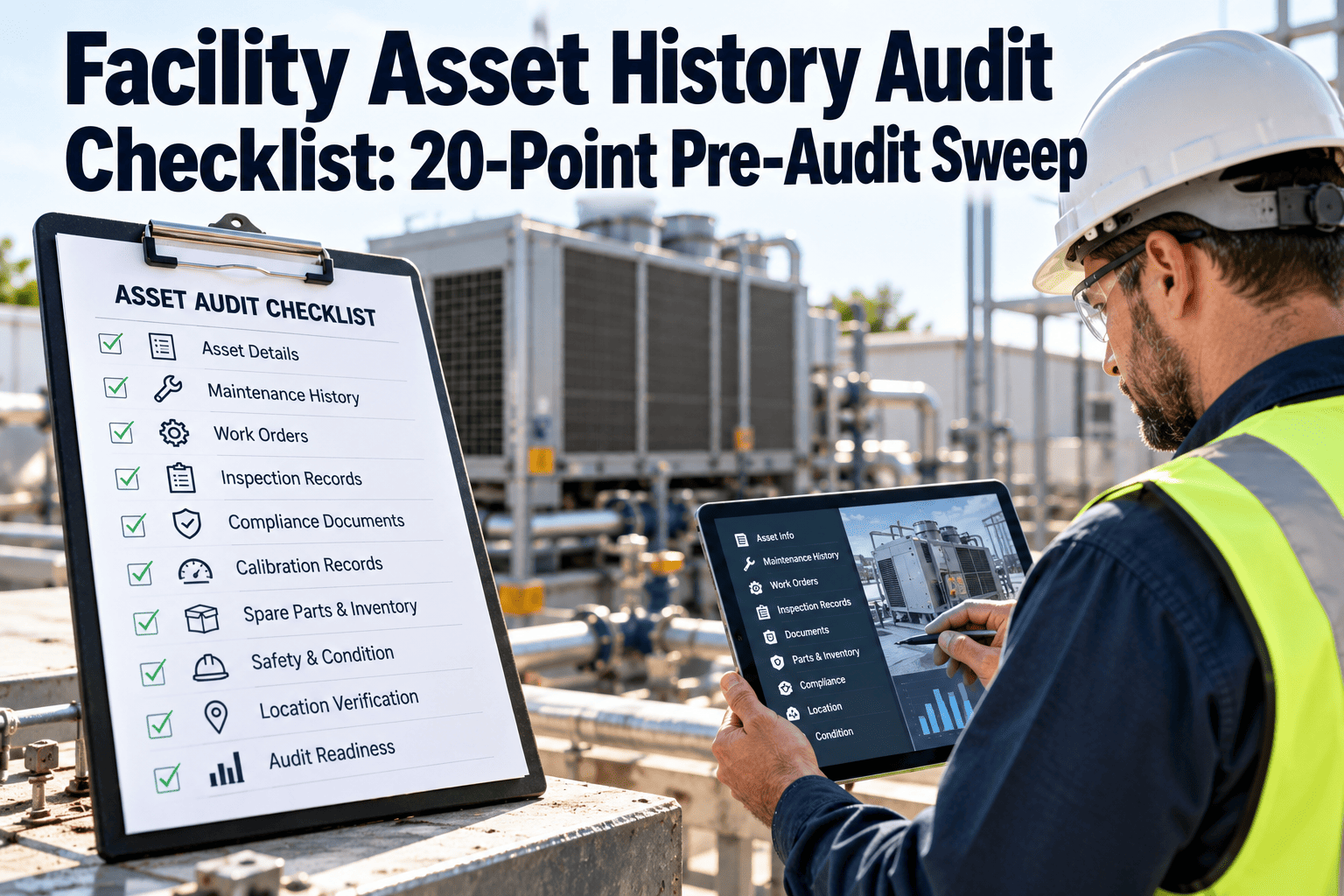
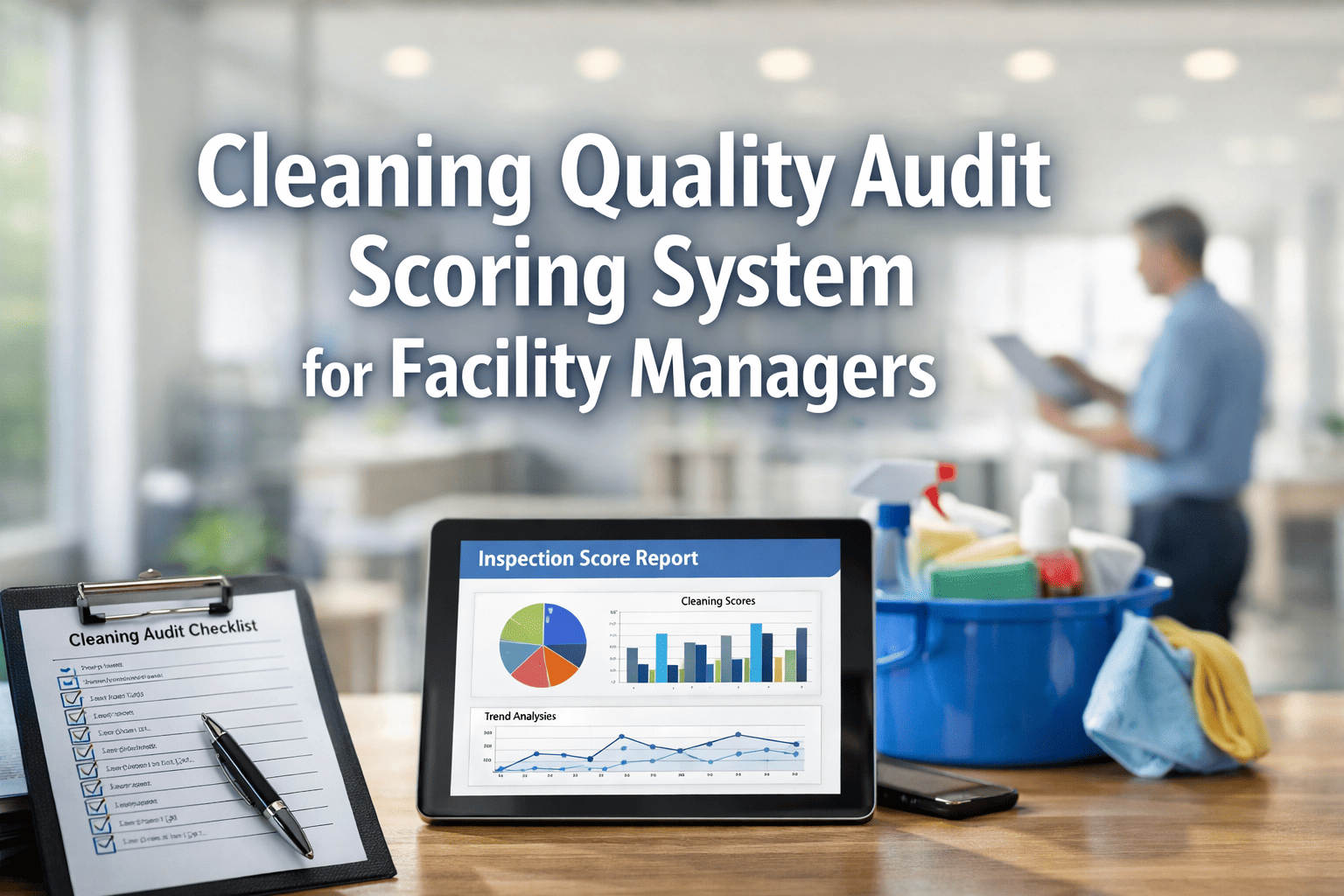
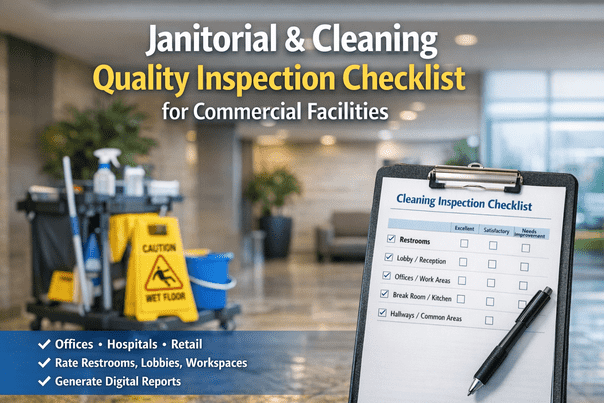
A cleaning schedule tells you when the restroom was cleaned. A scoring checklist tells you whether the cleaning met the standard. These are not the same thing — and the gap between them is where tenant complaints, health code citations, and janitorial vendor disputes all originate. Facilities that run structured inspection scoring programmes catch hygiene failures 3x earlier than those that rely on schedule completion alone, and digital inspection tools improve APPA cleanliness scores by up to 25% compared to paper-based verification. The OSHA sanitation standard (1910.141) requires workplaces to maintain toilets and washing facilities in a sanitary condition, floors clean and dry, and waste removed promptly — but compliance is meaningless without the documentation to prove it. This checklist covers five inspection zones — restrooms, offices and workspaces, break rooms and kitchens, common areas, and janitorial operations — with each item tied to an APPA scoring level, a corrective action trigger, and the regulatory basis that makes documentation non-negotiable. Book a demo to see how Oxmaint's Work Order Management platform converts inspection findings into timestamped corrective work orders, contractor scoring records, and compliance-ready audit reports.
Operations & Workflow · Facility Management · Work Order Management
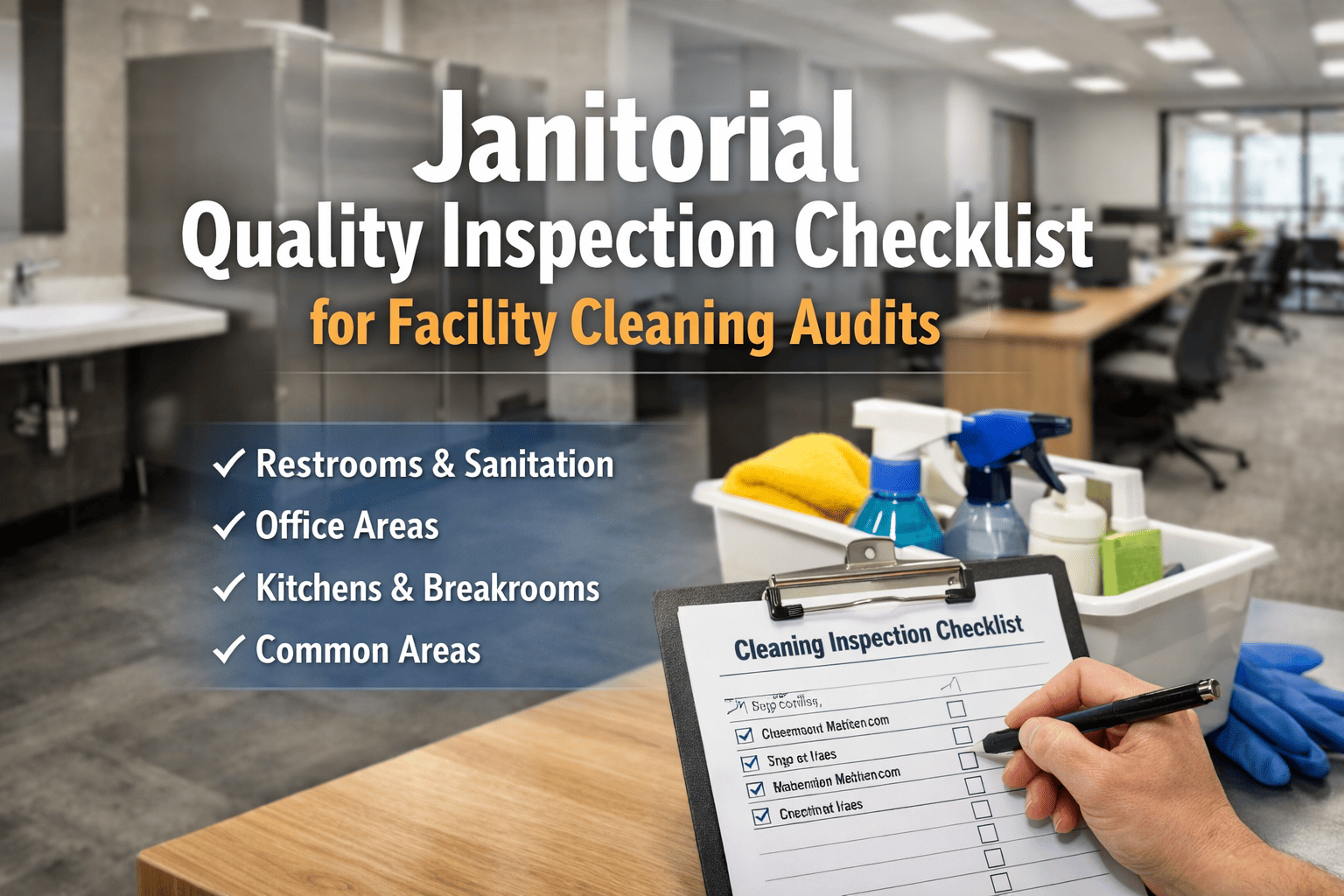
Janitorial Quality Inspection Checklist for Facility Cleaning Audits
Five inspection zones, APPA-aligned scoring criteria, corrective work order triggers, and OSHA compliance reference — structured for facility managers, operations leads, and janitorial vendor QA programmes.
3xEarlier hazard detection with structured scoring vs schedule-only cleaning verification
+25%APPA cleanliness score improvement with digital inspection validation vs paper checklists
18 minAverage digital inspection time for a full floor plate — vs 35-45 minutes on paper
OSHA1910.141 requires sanitary toilets, clean floors, and prompt waste removal — documented
APPA Cleaning Levels — Inspection Scoring Reference
Level 1
Orderly Spotlessness
Floors shine with no buildup in corners; all surfaces freshly polished, no dust or fingerprints; restroom fixtures gleam and are odour-free; trash holds daily waste only
Surgical / Executive
Level 2
Ordinary Tidiness
Floors clean with minimal dust; surfaces free of marks and streaks; restrooms fully stocked and sanitary; target standard for most commercial facilities
Target Standard
Level 3
Casual Inattention
Floors swept but not polished; dust on ledges and furniture; restrooms stocked but surfaces show soil or water marks — acceptable only in low-traffic secondary areas
Corrective Action
Level 4
Moderate Dinginess
Noticeable soil and stain accumulation; fixtures stained or malodorous; surfaces show evidence of deferred cleaning — contractor notification required same day
Same-Day Notice
Level 5
Unkempt Neglect
Heavily soiled, damaged, or neglected surfaces; health and safety risk present — immediate contractor intervention and documented corrective action mandatory
Immediate Action
Zone 1 — Restrooms
Zone 2 — Offices
Zone 3 — Break Rooms
Zone 4 — Common Areas
Zone 5 — Operations
Zone 01
Restrooms — Highest Complaint Density Zone
Restrooms represent the single highest complaint density zone in any commercial facility. A single substandard restroom condition generates more occupant dissatisfaction than a month of excellent performance elsewhere. Any zone average below 2.5 on a 4-point scale requires same-day contractor notification. Inspect after cleaning but before occupancy resumes for an accurate post-clean score.
Fixtures & Sanitary Equipment
OSHA 1910.141 / APPA Level 2 Target
Toilets and urinals — no staining inside bowl, under rim, or on exterior surfaces; flush mechanism functional; no odour from fixture
Score 1-4 · Corrective trigger: score below 3 · Role: Inspection Lead
Sinks — faucets clean, drain clear, basin free of soap residue and water staining; faucet handles and surrounds wiped and streak-free
Score 1-4 · Role: Inspection Lead
Mirrors — streak-free across full surface; no toothpaste, soap, or water marks; inspect at eye level and at angle to catch streaks invisible head-on
Score 1-4 · Role: Inspection Lead
Supplies & Dispensers
OSHA 1910.141(d) / APPA Level 2
Soap dispensers filled and functional — OSHA 1910.141(d)(1) requires adequate handwashing facilities supplied with hand soap; empty dispenser is a citable violation
Pass/Fail (non-negotiable) · Role: Inspection Lead
Paper towel dispensers and/or hand dryers operational — minimum 50% supply remaining; dispenser exterior clean and free of drips or residue
Pass/Fail · Score 1-4 for condition · Role: Inspection Lead
Toilet paper stocked in all stalls — minimum one roll present and mounted; spare roll available; no empty holder left unaddressed
Pass/Fail · Role: Inspection Lead
Floors, Walls & Stalls
OSHA 1910.141(a)(3) / APPA
Floors mopped and dry — no standing water, slip hazard, or visible soil; grout lines free of mould or dark staining; check under urinals and behind toilets
Score 1-4 · OSHA requires dry condition to extent feasible · Role: Inspection Lead
Stall walls, doors, and hardware wiped down — look high (top of partitions) and low (base of stall walls) for dust accumulation not visible at eye level
Score 1-4 · Role: Inspection Lead
Sanitary disposal units re-bagged and exterior wiped — check that unit lid closes fully and that bag is dated or labelled per facility policy
Score 1-4 · Role: Inspection Lead
Zone 02
Offices, Workspaces & High-Touch Surfaces
Office areas carry the highest virus transmission risk through high-touch surfaces — door handles, light switches, keyboards, and shared equipment. Dr. Gerba's research found cold viruses on surfaces in a third of offices during cold season. The inspection items below prioritise contact surfaces before general surface appearance.
High-Touch Surfaces — Priority Inspection
CDC Guidance / APPA Level 2
Door handles, push plates, and light switches wiped with disinfectant — these are the primary fomite transmission surfaces and the first items CDC cleaning guidance identifies for attention
Pass/Fail (no partial credit) · Role: Inspection Lead
Lift buttons, shared keyboard surfaces, printer controls, and reception desk touch surfaces disinfected and documented
Pass/Fail · Role: Inspection Lead
Desks, Surfaces & Floors
APPA Level 2 Target
Horizontal surfaces — desks, windowsills, shelving tops, and ledges — dusted and free of visible accumulation; check surfaces above eye level (monitor tops, filing cabinet tops)
Score 1-4 · Downgrade from Level 2 if dust visible at normal viewing distance · Role: Inspection Lead
Hard floors swept and mopped — no visible grit, debris, or liquid; floor finish shows no scuff marks or dull traffic paths; corners and wall edges checked
Score 1-4 · Role: Inspection Lead
Carpets vacuumed — no visible debris, paper, or food crumbs; traffic paths show vacuum lines confirming pass; spot-clean any visible staining during inspection
Score 1-4 · Role: Inspection Lead
Waste bins emptied and re-lined — no bin more than three-quarters full; bin exterior clean; recycling and general waste correctly segregated
Pass/Fail for emptied · Score 1-4 for condition · Role: Inspection Lead
Glass partitions and interior glass surfaces streak-free — inspect at oblique angle in natural light; smear or haze visible at angle constitutes a score deduction
Score 1-4 · Role: Inspection Lead
Zone 03
Break Rooms & Kitchen Areas
Break room and kitchen areas carry dual risk — cross-contamination from food contact surfaces and slip hazard from floor spills. Any food residue on a food contact surface is an unacceptable finding regardless of scoring level. These areas should be inspected at every shift where food preparation occurs.
Food Contact Surfaces — Zero-Tolerance Items
FDA Food Code 4-501.11 / OSHA 1910.141
Countertops and food preparation surfaces wiped and sanitised — no food residue, grease, or beverage spills on any food contact surface; unacceptable condition triggers immediate re-clean before next use
Pass/Fail (zero tolerance on food contact) · Role: Inspection Lead
Sink — clean, drain clear, no standing water or food residue; tap handles wiped; underside of rim inspected for mould or mineral deposit
Score 1-4 · Role: Inspection Lead
Appliance Exteriors & Storage Areas
APPA Level 2
Microwave interior and exterior cleaned — no food splatter inside; turntable removed and wiped; door handle and exterior surface free of fingerprints and grease
Score 1-4 · Role: Inspection Lead
Refrigerator exterior and door handles wiped; visible interior surfaces free of spills; door seal and gasket clean and free of mould growth
Score 1-4 · Role: Inspection Lead
Floor swept and mopped — grease-free, dry, and slip-hazard free; mat at sink area clean and lying flat; no mop water residue or streaking near appliances
Score 1-4 · OSHA 1910.141 requires clean and dry floors · Role: Inspection Lead
Waste bins emptied and sanitised — no food waste overflow; bin exterior clean; compostable and general waste correctly separated; no organic odour
Pass/Fail for emptied · Score 1-4 for odour and condition · Role: Inspection Lead
Convert every inspection score into a timestamped corrective work order — automatically assigned, tracked, and closed with photo evidence.
Zone 04
Common Areas, Lobbies & Entrances
Lobbies and entrances are the first impression of facility condition for every visitor, tenant, and inspector. These areas receive the most foot traffic and the most visual scrutiny. They are also the first areas a health or safety inspector sees — and the zone that most directly determines initial regulatory perception.
Entry, Reception & Lobby Surfaces
APPA Level 2 / OSHA 1910.22
Glass entry doors and sidelites streak-free — inspect from both interior and exterior; fingerprints and smear marks visible from one side only are not visible to occupants entering from the other
Score 1-4 · Role: Inspection Lead
Entry mats clean, lying flat, and free of debris accumulation — mat corners not curling; no visible soil piled at mat edges or tracking onto hard floor surface
Score 1-4 · Curled mats are a slip hazard under OSHA 1910.22 · Role: Inspection Lead
Reception desk, waiting area furniture, and hard surfaces dusted and wiped — no visible dust on horizontal surfaces, armrests, or table tops; coffee table surfaces clear of debris
Score 1-4 · Role: Inspection Lead
Corridors, Lifts & Staircases
OSHA 1910.22 / APPA Level 2
Corridor floors swept, mopped, and dry — OSHA 1910.22 requires aisles kept clean and in good repair; check 28-inch minimum width is not narrowed by cleaning equipment left in corridor
Pass/Fail for clear aisle · Score 1-4 for floor condition · Role: Inspection Lead
Lift interior floors, walls, and panel wiped — lift buttons and panel disinfected; no debris in lift track; inspection certificate visible and current
Score 1-4 · Role: Inspection Lead
Stairway treads clean, handrails wiped — no debris on steps; handrail surfaces free of sticky residue; stairwell walls free of cobwebs at corners and high ledges
Score 1-4 · Role: Inspection Lead
Zone 05
Janitorial Operations & Compliance Records
Cleaning programme quality is not only a function of what is cleaned — it is a function of whether the correct equipment, dilution ratios, dwell times, and trained personnel were used. The items below audit the operational inputs behind the cleaning outcomes visible in Zones 1 through 4.
Equipment & Chemical Compliance
OSHA HazCom 29 CFR 1910.1200 / ISSA CIMS
SDS (Safety Data Sheets) present and accessible for all cleaning chemicals in use — OSHA 29 CFR 1910.1200 (HazCom) requires SDS available to all workers at point of use
Pass/Fail (regulatory non-negotiable) · Role: Compliance Officer / Facility Manager
Chemical dilution ratios confirmed with test strips or dispenser calibration check — wrong dilution is a leading cause of both ineffective cleaning and surface damage
Pass/Fail · Role: Maintenance Lead / QA Inspector
Mops, cloths, and microfibre tools colour-coded and used in correct zones — restroom mops must never enter kitchen or office zones; cross-contamination protocol enforced
Pass/Fail · Role: Janitorial Supervisor
Documentation & Accountability
OSHA 1910.141 / ISSA CIMS 1101
Cleaning completion logs signed and timestamped for all zones — paper logs must include date, time, technician name, and supervisor sign-off; digital records capture GPS and timestamp automatically
Pass/Fail · Role: Janitorial Supervisor / Facility Manager
Corrective work orders from previous inspection closed and documented — all open deficiencies from the prior inspection reviewed; unresolved items escalated to contractor management
Pass/Fail · Role: Facility Manager
Janitorial closet clean, organised, and locked — chemicals stored in secondary containment; no chemical containers stored near HVAC returns; PPE (gloves, eye protection) accessible and stocked
Score 1-4 · OSHA HazCom compliance · Role: Janitorial Supervisor
Frequency Reference
Inspection Frequency by Zone and Facility Type
| Inspection Zone | Office / Commercial | Healthcare / Food Service | High-Traffic Retail / Transport |
| Restrooms |
Daily post-clean + weekly scored audit |
Every 2 hours during service |
Hourly during peak hours |
| High-Touch Surfaces |
Daily disinfection verification |
Between each patient / customer |
Every 2-4 hours |
| Break Room / Kitchen |
Daily + after every service period |
After every food prep period |
Each shift |
| Common Areas / Lobby |
Daily + quarterly deep inspection |
Daily + spot checks every 2 hours |
Continuous monitoring + daily audit |
| Janitorial Operations |
Monthly compliance audit |
Weekly compliance audit |
Weekly compliance audit |
| Full Facility Scored Audit |
Weekly (vendor contract) / Monthly (internal) |
Weekly minimum |
Weekly minimum |
Expert Review
What Facility Operations Professionals Say
01
A signed paper cleaning log means someone was in the building. A digital inspection record with GPS, timestamp, and scored checklist means the cleaning met the standard. These are fundamentally different things to a health inspector, a facilities auditor, or a tenant filing a complaint. The log proves presence. The inspection proves performance.
Facilities Director, Multi-Site Commercial Property Management Group
02
We moved from quarterly scoring audits to weekly digital inspections, and the restroom complaint rate dropped 70% in 90 days. Not because the cleaning improved overnight — but because the contractor now knew every single service was being scored, not just the one the auditor happened to show up for. Measurement changes behaviour.
Operations Manager, Class A Office Tower, CBD Portfolio
03
The most frequently missed item on any janitorial inspection is the top of high surfaces — partition tops, monitor backs, filing cabinet tops. They accumulate dust at 3x the rate of desk surfaces and are almost never in the cleaner's natural sightline. If it is not explicitly on the checklist, it does not get cleaned. Put it on the checklist.
Senior Custodial Programme Manager, University Facilities Division
FAQs
Frequently Asked Questions
How does Oxmaint link inspection scores to corrective work orders automatically?
When any scored item falls below the threshold set in the inspection template — for example, a restroom fixture below 3 on a 4-point scale — the system auto-generates a corrective work order assigned to the responsible contractor. Due times are set by zone criticality.
Book a demo to see the workflow.
What is the APPA Level 2 standard and why is it the default target for commercial facilities?
APPA Level 2 (Ordinary Tidiness) is the standard at which surfaces are consistently clean, fixtures are sanitary, and no visible deficiencies are present to an occupant under normal viewing conditions. It represents the minimum performance threshold most janitorial service contracts specify and the level health inspectors expect to find during unannounced audits.
Can this checklist be used to audit an external janitorial contractor, not just an in-house team?
Yes. The scoring structure is designed for third-party auditing — each zone generates a numerical score that can be reported against contractor SLA thresholds. Oxmaint includes contractor performance tracking that aggregates inspection scores over time, providing documented performance history for contract renewal and dispute resolution.
What OSHA standards are most commonly cited in commercial facility cleaning operations?
The most frequently cited standards are 1910.141 (sanitation — restroom maintenance and handwashing facilities), 1910.22 (walking-working surfaces — floor cleanliness and aisle clearance), and 1910.1200 (HazCom — chemical labelling, SDS access, and employee training on cleaning chemicals).
From Inspection Score to Corrective Work Order in Seconds.
Oxmaint's Work Order Management platform turns janitorial inspection scores into automatic, timestamped corrective actions — assigned, tracked, and closed with photo evidence. Digital inspection records replace paper logs with audit-ready documentation your health inspector, fire marshal, and tenant can all trust.