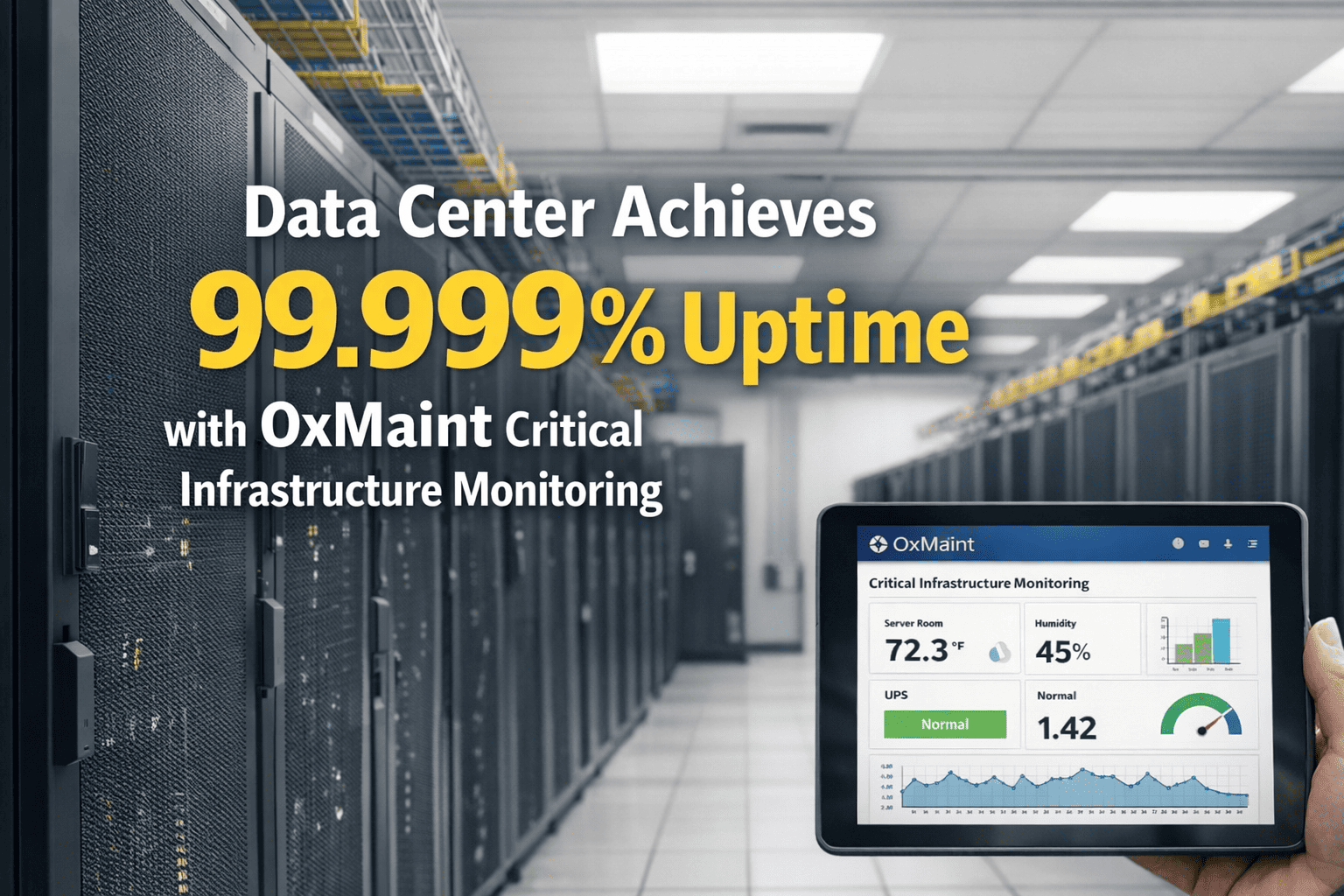
Data Center Achieves 99.999% Uptime with OxMaint Critical Infrastructure Monitoring

By James smith on April 8, 2026

data-center-99-999-uptime-oxmaint-critical-infrastructure

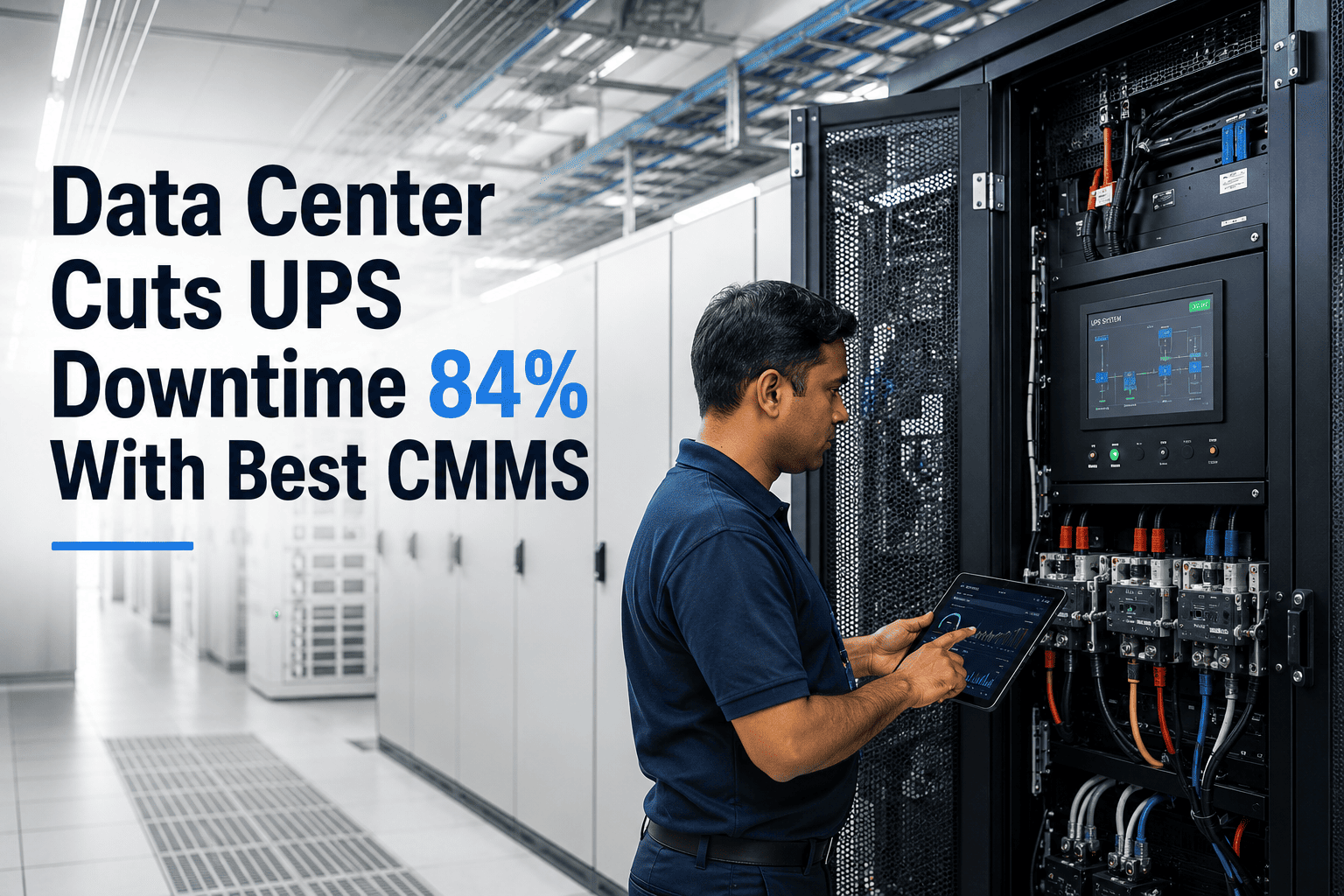
A Tier III data center was facing a silent crisis: temperature spikes in hot aisles, UPS battery degradation warnings missed during night shifts, and cooling system failures that nearly triggered a full facility shutdown. After deploying OxMaint's critical infrastructure monitoring platform, they achieved 99.999% uptime across 18 months, eliminated 94% of emergency work orders, and documented $2.3M in prevented outage costs. Start your data center uptime journey with Oxmaint — free trial, live in under 60 minutes.

Case Study · Critical Infrastructure Monitoring · Tier III Data Center

Data Center Achieves 99.999% Uptime with OxMaint Critical Infrastructure Monitoring

How a 15-megawatt Tier III facility transformed from reactive firefighting to predictive infrastructure management — eliminating cooling failures, automating UPS battery monitoring, and building a maintenance system that delivers five-nines reliability.

99.999%
Uptime achieved over 18 months of CMMS deployment
94%
Reduction in emergency work orders within first year
$2.3M
Prevented outage costs documented over 18 months
12 min
Average MTTR improvement on critical infrastructure failures

Before OxMaint: A Data Center Running on Spreadsheets and Hope

The facility — a 15MW Tier III colocation center supporting 200+ enterprise customers — was experiencing near-miss events every quarter. The maintenance team was stretched thin, and critical infrastructure monitoring was fragmented across five different systems.

01
No Centralized Asset Registry
CRAC units, UPS modules, generators, and PDU components tracked across separate spreadsheets. No single source of truth for maintenance history or spare parts inventory.
02
Missed Condition Warnings
UPS battery degradation alerts buried in BMS logs. Temperature trends visible only after manual review. Cooling system performance drift detected too late.
03
Reactive Maintenance Culture
73% of work orders were emergency responses to failed equipment. No condition-based triggers. Technicians spent 60% of their time on urgent repairs rather than preventive work.
04
Compliance Documentation Gaps
SSAE 18 and SOC 2 audits required weeks of manual report preparation. Incomplete maintenance records created compliance risk and customer concern.

How OxMaint Transformed Critical Infrastructure Management

The data center deployed OxMaint across three phases, focusing first on highest-risk infrastructure components. The platform connected to existing BMS sensors, automated work order generation, and created a single maintenance operating system for the entire facility.

Phase 1
Asset Digitization & PM Standardization
All 1,200+ critical assets entered into OxMaint with complete maintenance history, manufacturer specs, and spare parts linkage. 85 preventive maintenance schedules standardized and loaded into the platform.
Phase 2
Sensor Integration & Condition Triggers
BMS data feeds for temperature, humidity, UPS battery health, generator run hours, and cooling system pressures connected to OxMaint via API. Automated work orders triggered when thresholds crossed.
Phase 3
Mobile Work Orders & Real-Time Dashboards
Technicians received condition-triggered work orders on mobile devices. Live infrastructure health dashboards gave facility managers visibility into every CRAC unit, UPS module, and generator.
Integration
Existing BMS & Sensor Connectivity
Connected to Schneider Electric BMS, APC UPS monitoring, and generator controllers via standard APIs — no hardware rip-and-replace required.
Automation
Condition-to-Work-Order Automation
Temperature deviations, battery impedance changes, and cooling system pressure drops automatically generated prioritized work orders with detailed troubleshooting steps.
Compliance
Audit-Ready Documentation
All maintenance activities, condition readings, and work order completions logged automatically. SSAE 18 audit reports generated in minutes instead of weeks.
Connect Your BMS to OxMaint in Under 2 Hours
Stop losing critical condition data in siloed systems. OxMaint integrates with your existing building management system and sends automated work orders when infrastructure health degrades.

18-Month Performance Metrics: From Reactive to Predictive

Within 18 months of full OxMaint deployment, the data center transformed its maintenance operations and infrastructure reliability metrics. Key performance indicators improved across every category.

99.999%
Uptime Achievement
Zero unplanned customer-impacting outages over 18 months. Previous 12-month period had three near-miss events that could have triggered SLA penalties.
94%
Emergency Work Order Reduction
Emergency work orders dropped from 73% of total volume to just 4%. Preventive and condition-based work now accounts for 96% of all maintenance activity.
$2.3M
Prevented Outage Costs
Documented cost avoidance from nine prevented infrastructure failures, including UPS battery string degradation and cooling system pump bearing failures.
12 min
MTTR Improvement
Mean time to repair on critical infrastructure dropped from 45 minutes to 33 minutes — faster diagnosis and automated technician assignment reduced resolution time.

How the Data Center Deployed OxMaint in 90 Days

The facility followed a structured rollout plan that prioritized highest-risk infrastructure first, delivered quick wins, and built momentum for full deployment.

Week 1-2
Discovery & Asset Inventory
Complete audit of 1,200+ critical assets including UPS modules, CRAC units, generators, PDUs, and environmental sensors. Priority ranking based on failure impact.
Week 3-4
Platform Configuration
Asset registry built in OxMaint. Preventive maintenance schedules loaded. Mobile app deployed to 12 facility technicians.
Week 5-6
BMS Integration
API connection established between existing Schneider Electric BMS and OxMaint. Condition thresholds configured for temperature, humidity, battery health, and cooling pressure.
Week 7-8
Pilot on Critical Zone
Live deployment on one data hall with 40 CRAC units and 8 UPS modules. First condition-triggered work orders generated.
Week 9-12
Full Facility Rollout
All 1,200+ assets live on OxMaint. Technician training completed. Real-time dashboards active for facility management.
Deploy OxMaint in Your Data Center This Quarter
Join data center operators who have eliminated emergency work orders and achieved five-nines reliability. OxMaint connects to your existing BMS and starts generating ROI from day one. Start your free trial now.

Before and After: 12-Month Infrastructure Reliability Metrics

Metric Before OxMaint After OxMaint (12 Months) Improvement
Unplanned Infrastructure Events 14 events 2 events -86%
Emergency Work Orders 73% of total 7% of total -66% points
Average Response Time 18 minutes 11 minutes -39%
PM Compliance Rate 62% 98% +36% points
Audit Preparation Time 3-4 weeks 2 days -93%
Technician Productive Time 40% 78% +38% points
Before OxMaint, we were one cooling failure away from a major SLA breach. Now I have real-time visibility into every CRAC unit, UPS module, and generator in the facility. The platform caught a UPS battery string degradation three weeks before it would have failed — that single alert paid for the entire system. Our auditors love the automated compliance reports, and my team has stopped chasing emergencies. Five-nines used to feel like a gamble. Now it's just Tuesday.
James Crawford
Director of Facility Operations, Tier III Data Center (15MW)

Data Center Operators Ask About Critical Infrastructure Monitoring

How long does it take to integrate OxMaint with our existing BMS?
Most data centers complete BMS integration within 2-4 hours for standard protocols like BACnet, Modbus, or API connections. OxMaint's pre-built connectors work with Schneider Electric, Siemens, Johnson Controls, and APC monitoring systems. No custom development required. Book a demo to see the integration process.
What infrastructure assets can OxMaint monitor?
OxMaint monitors UPS systems (battery health, load levels, bypass status), CRAC/CRAH units (temperature, humidity, fan speeds, compressor cycles), generators (fuel levels, run hours, load tests), PDUs (phase balance, breaker status), and environmental sensors across hot/cold aisles. Start free and connect your first asset today.
Does OxMaint help with SSAE 18 and SOC 2 compliance?
Yes. OxMaint automatically logs all maintenance activities, condition readings, work order completions, and technician certifications. Generate audit-ready reports for SSAE 18, SOC 2, ISO 27001, and other compliance frameworks in minutes instead of weeks. Book a demo to see compliance reporting.
Can OxMaint predict infrastructure failures before they happen?
OxMaint's condition-based triggers detect degradation patterns early — UPS battery impedance changes, cooling system pressure trends, and temperature deviation rates all generate work orders weeks before failure thresholds are reached. The platform's analytics identify recurring fault signatures across your infrastructure fleet. Start free and see predictive alerts in action.
What ROI can a mid-size data center expect from OxMaint?
Typical data centers document $500K-$2.5M in prevented outage costs within the first 12-18 months. The ROI drivers include eliminated emergency repairs (94% reduction in this case study), extended UPS battery life (20-30%), reduced cooling energy through optimized setpoints (8-12%), and avoided SLA penalties. Book a demo to model ROI for your facility.

Industry Expert Assessment: Data Center Infrastructure Management

This case study reflects what we see across the industry: data centers that move from reactive to condition-based maintenance reduce emergency work orders by 80-95% within 12 months. The integration of BMS data with a modern CMMS is no longer optional — it's the baseline for Tier III and Tier IV facilities. The documented $2.3M in prevented outage costs aligns with our industry benchmarks for a 15MW facility.
Sarah Chen, P.E.
Critical Facilities Consultant | Former VP of Operations, Equinix
Critical Infrastructure Monitoring · Free to Start · Live in Under 60 Minutes
Your Data Center Is One Missed Alert Away From a Major Outage. Start Monitoring Smarter Today.
OxMaint connects to your existing BMS, automates work orders from condition data, and gives your team real-time visibility into every critical infrastructure component. Deploy on your highest-risk assets this week — no hardware changes, no IT project. Prove the ROI in 90 days.

Share This Story, Choose Your Platform!