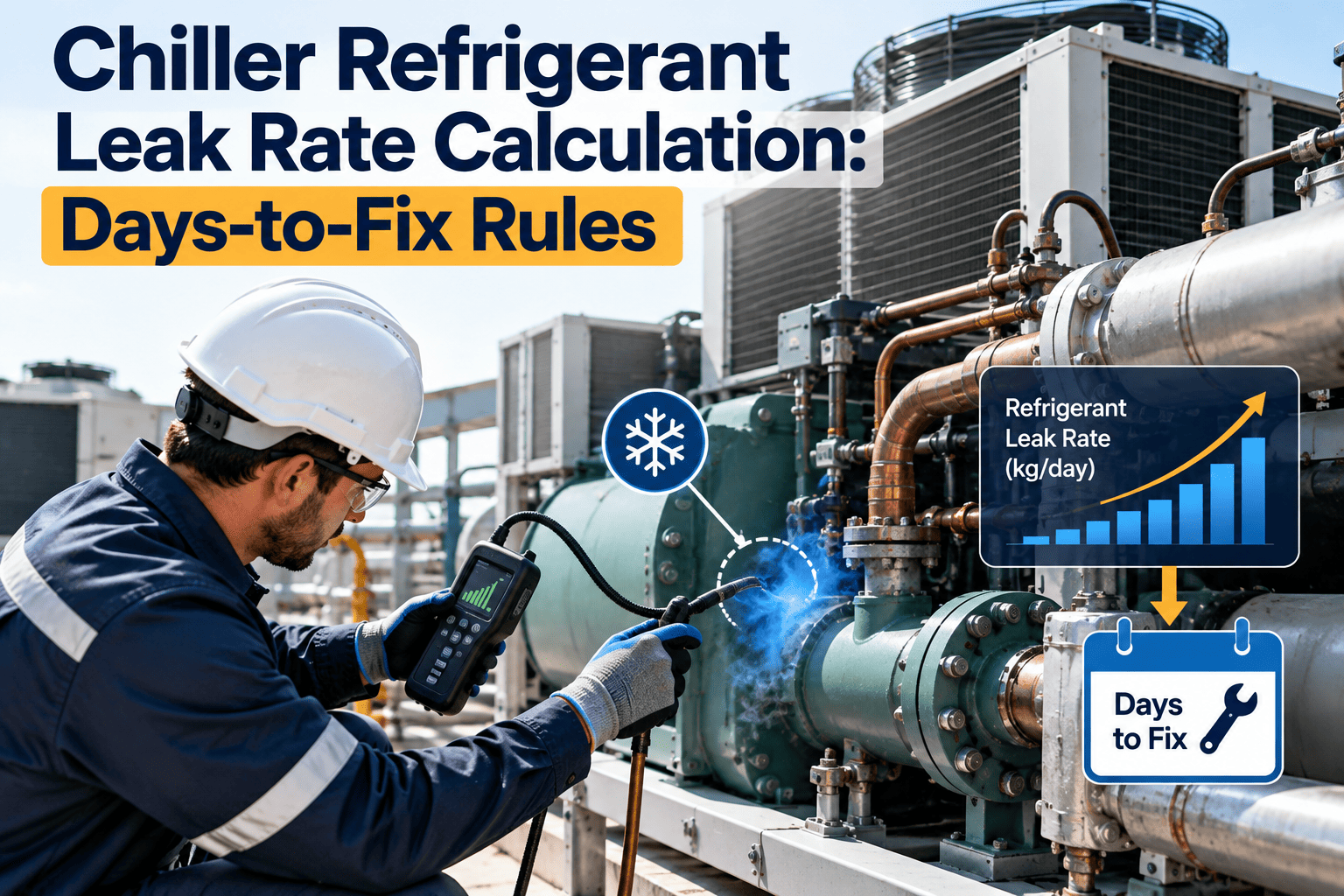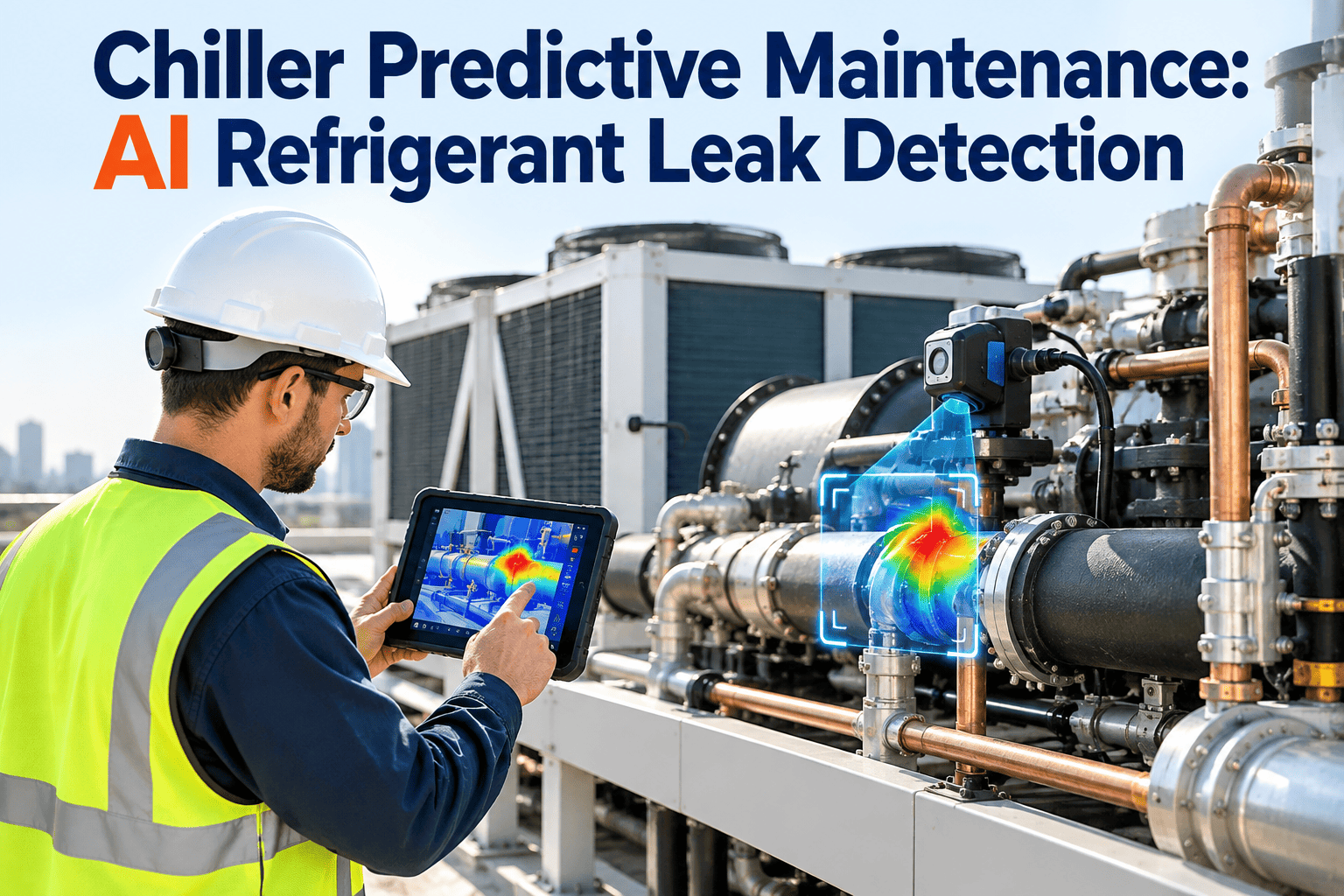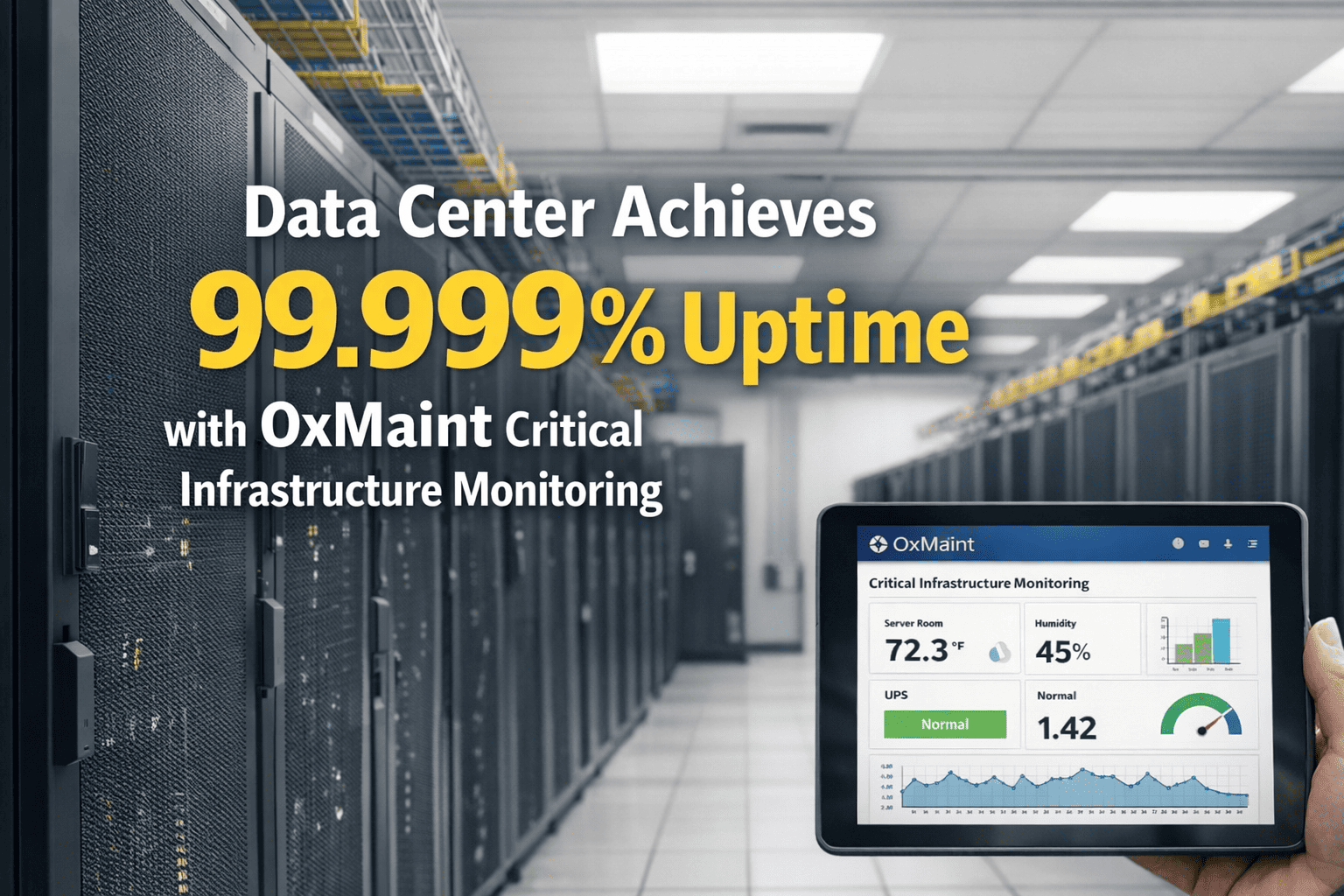
A slow refrigerant leak on a data center chiller rarely announces itself. Subcooling drifts down a fraction of a degree a week, suction pressure creeps, and the building automation system keeps reporting "normal" because no single reading crosses an alarm threshold on its own. This composite scenario, built from patterns documented across commercial and hyperscale chiller predictive maintenance programs, walks through how an AI-based condition monitoring layer caught a developing leak eight weeks before it would have forced an emergency compressor rebuild, and what that timing was actually worth in avoided cost. The numbers below reflect typical outcomes reported across chiller PdM deployments rather than a single audited disclosure, and Oxmaint's own trial environment lets a facilities team model the same math against its own chiller fleet.
How an 8-Week Early Warning Saved a Data Center $210,000
A 2.5MW chiller plant, a compressor headed for a rebuild, and the AI-driven condition trend that changed the outcome.
The Outcome in Four Numbers
A Chiller Plant That Had No Reason to Look Risky
The facility ran a pair of 2.5MW water-cooled centrifugal chillers supporting roughly 380 server racks, configured N+1 with a shared condenser water loop. Both units were mid-life, seven years into a twenty-year expected service life, with a clean maintenance history and no open work orders on either compressor.
Compressor discharge service valve fittings are a known weak point on centrifugal chillers of this vintage, since they see repeated thermal cycling every time the unit stages up and down under variable IT load. A fitting can seep refrigerant at a rate too small to register on a monthly gauge check yet large enough to show up as a steady weekly drift once the readings are trended against a baseline rather than compared to a fixed pass or fail limit.
Chiller Reliability Carries More Weight in a Data Center
Cooling failure in a data center is not just a maintenance event; it is a direct threat to uptime commitments. Most colocation and enterprise data centers operate under Power Usage Effectiveness targets and Service Level Agreements that assume mechanical cooling stays within design tolerance around the clock, with financial penalties written into the contract for every minute a rack runs above its allowed inlet temperature.
What the AI Model Saw, Week by Week
Oxmaint's condition monitoring layer ingested pressure, temperature, amperage, and flow readings from the chiller's existing sensors every fifteen seconds, then calculated derived thermodynamic values — superheat, subcooling, and approach temperature — instead of relying on raw setpoint alarms that only fire once a threshold is already crossed.
Every step in that timeline happened without a single unplanned rack outage, an emergency after-hours callout, or the compressor running outside its safe operating envelope. The repair itself took under four hours once the source was located, a sharp contrast to the multi-day emergency rebuild a full charge-loss event would have required.
What the Same Leak Costs Without Early Detection
Industry PdM data on comparable chiller refrigerant leaks consistently shows the same pattern: manual pressure checks and periodic inspections tend to catch a slow leak only after charge loss reaches 30 to 40 percent, close to the point where a low-pressure safety trip becomes likely. That is the scenario this facility avoided.
| Cost Category | With AI Early Detection | Without Early Detection |
|---|---|---|
| Repair scope | Single fitting replacement, planned window | Emergency compressor rebuild after low-pressure trip damage |
| Refrigerant loss | Under 5% of charge | 30–40% of charge lost before shutdown |
| N+1 redundancy status | Maintained throughout repair | Lost during emergency outage, exposing single point of failure |
| Energy penalty | Negligible, corrected within days | Weeks of degraded compressor efficiency prior to failure |
| Estimated total cost | Under $9,000 | $210,000+ including rebuild, emergency labor, and SLA exposure |
Most Chiller Failures Give Weeks of Warning — If Something Is Listening
See how Oxmaint's condition monitoring layer turns raw chiller telemetry into a prioritized work order before a leak becomes an outage.
Inside the Detection and Response Loop
The savings in this scenario did not come from a single clever alarm. They came from a closed loop connecting sensor data, asset history, and work order execution inside one system, so a subtle trend did not have to wait for a human to notice it on a spreadsheet.
Turning a Single Save Into a Standing Reliability Program
Catching one leak early is a good outcome. The larger value shows up once the same monitoring logic runs continuously across an entire chiller fleet, feeding a maintenance program that gets more targeted with every cycle instead of resetting to zero after each repair.
Reporting dashboards then roll every flagged anomaly, work order, and avoided-cost estimate up to a fleet view, giving facilities and finance teams the same evidence base used in this case whenever budget for expanded monitoring needs to be justified.
What This Case Confirms About Chiller Reliability Programs
A clean maintenance log is not the same thing as a healthy chiller. The gap between the two is exactly where AI-assisted condition monitoring earns its budget line, and this scenario reflects four lessons that show up consistently across chiller PdM programs.
Questions to Ask About Your Own Chiller Plant Today
This scenario is realistic precisely because none of its warning signs required exotic instrumentation. Most facilities already have the sensor data; what is usually missing is a system trending it against a baseline and turning a deviation into an assigned task. Before assuming a fleet is protected, it is worth checking a few basics.
| Question | Why It Matters |
|---|---|
| Is subcooling trended over time, or only checked at each inspection? | A single point-in-time reading cannot show a slow weekly drift the way a trend line can |
| Are BAS alarms the only detection layer in place? | Fixed thresholds only fire after a problem is already advanced, not while it is still developing |
| Does a flagged anomaly automatically generate a work order? | A dashboard alert nobody acts on provides no protection against the failure it detected |
| Is refrigerant charge history reconciled against nameplate values? | Gradual, sub-alarm charge loss is easiest to catch through reconciliation over time |
| Are redundant units monitored independently or assumed healthy? | N+1 redundancy fails silently if both units degrade on a similar schedule |
A facility that can answer yes to all five of these already has most of what this case study relied on. Most facilities cannot, which is usually a data and workflow gap rather than a sensor gap, and it is the gap Oxmaint's condition monitoring and work order automation are built to close.
Frequently Asked Questions
Is this a documented, audited case study or an illustrative scenario?
It is a composite scenario built from patterns seen across chiller PdM deployments and published AHR Expo data, used to illustrate realistic timing and cost dynamics rather than cite one disclosed customer.
How early can AI monitoring typically catch a chiller refrigerant leak?
Across reported deployments, early detection commonly runs four to eight weeks ahead of the point manual inspection would catch the same leak, depending on sensor density and leak rate. Start a free trial to see it on your fleet.
Do we need new sensors to get this kind of monitoring?
Most chillers already have the pressure, temperature, and amperage sensors needed; Oxmaint typically connects to existing BAS or chiller controller data rather than requiring a new sensor retrofit.
What does the work order routing actually automate?
Once a trend crosses a confidence threshold, Oxmaint creates a prioritized inspection work order with the supporting trend data attached, assigns it to the right technician, and tracks it through to a documented close-out, instead of leaving detection as a dashboard alert someone has to notice on their own.
Does this replace scheduled preventive maintenance on chillers?
No, condition monitoring supplements scheduled PM by catching the failures that occur between inspection intervals; book a demo to see how the two work together in one plan.
Model This Same Math Against Your Own Chiller Plant
Oxmaint tracks superheat, subcooling, and every other chiller trend against its own baseline, then turns the first real deviation into a work order automatically.