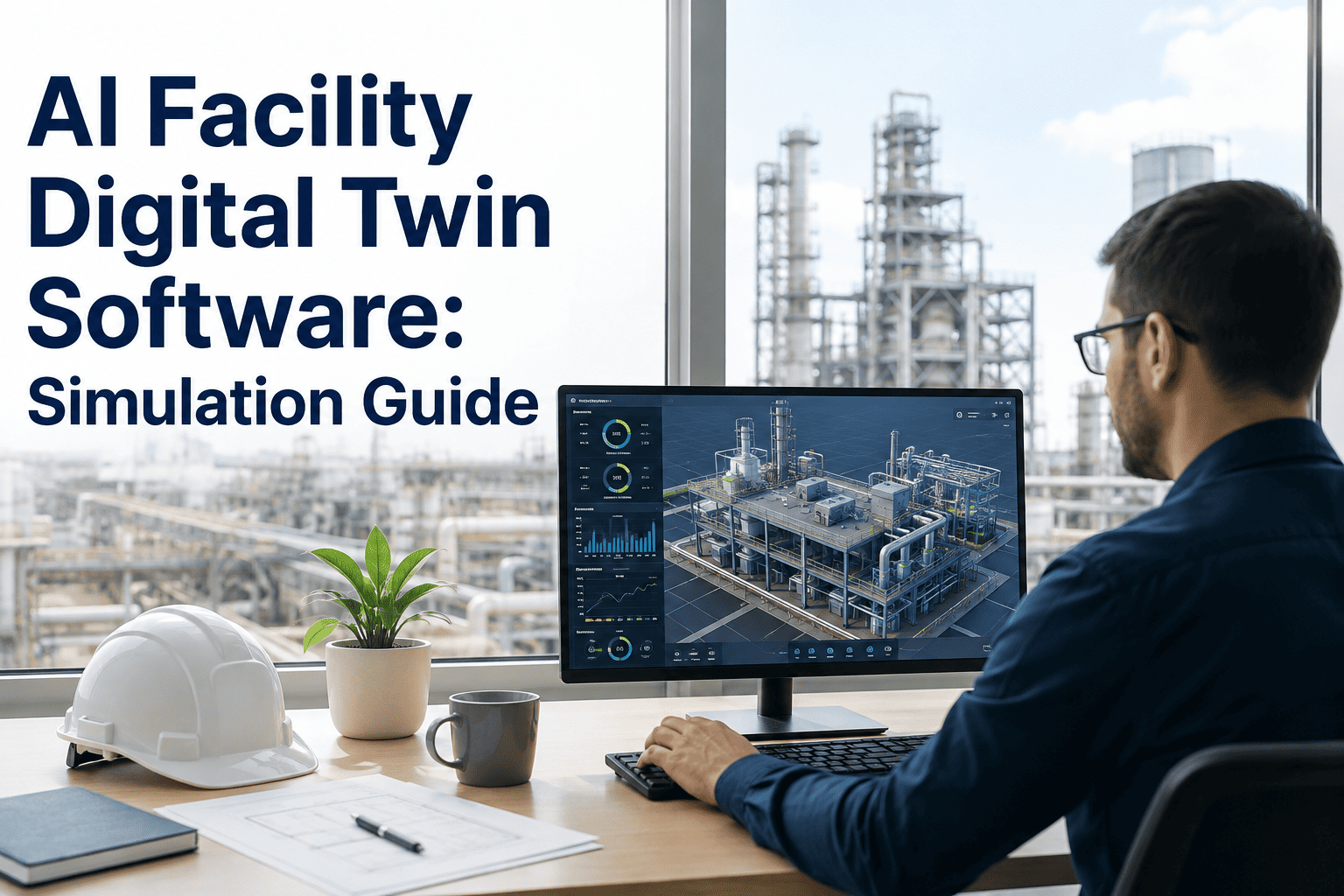
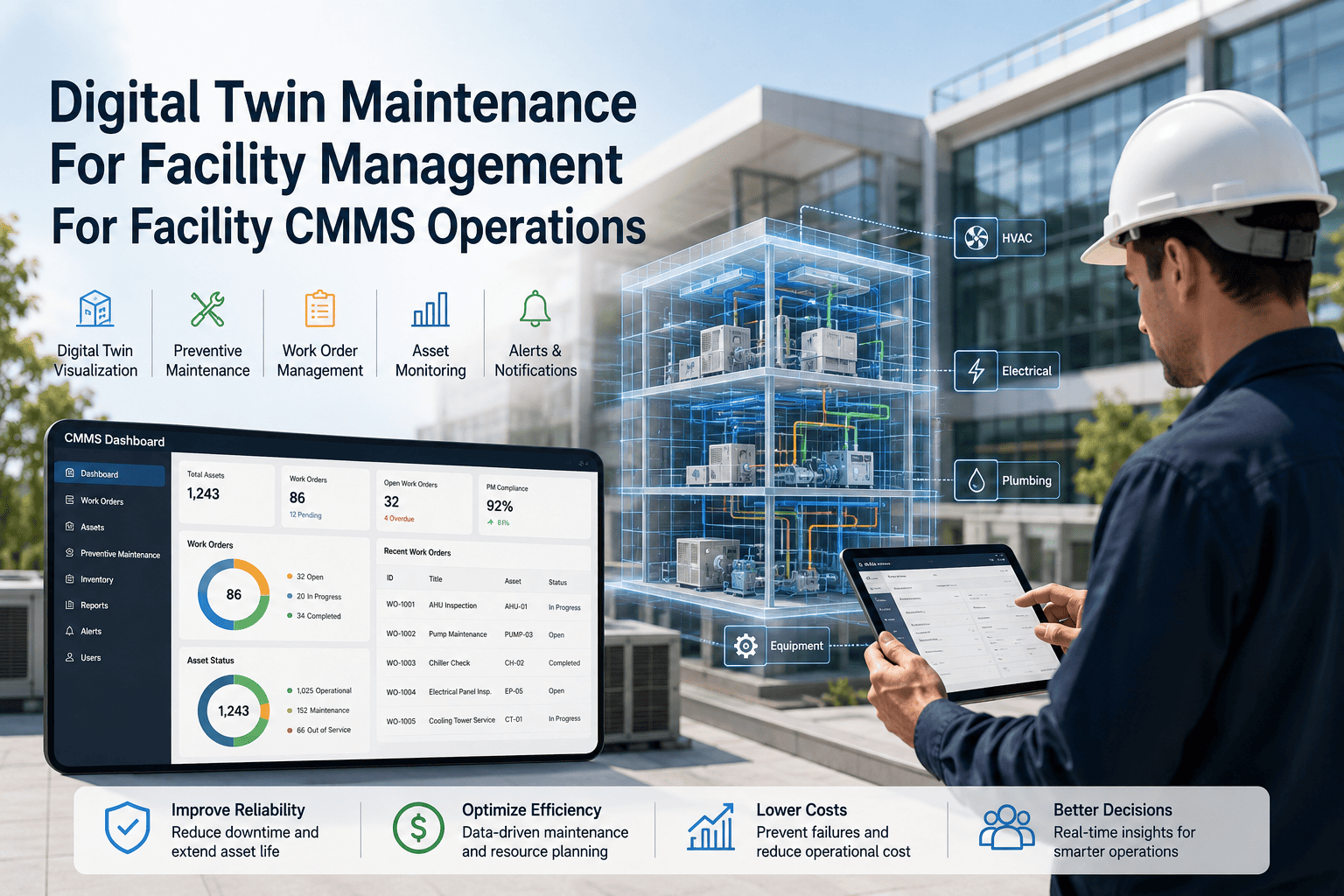
Facility managers have always made decisions based on incomplete information — a snapshot of asset condition taken during a scheduled inspection, a work order closed last month, a maintenance log that hasn't been updated since the last shift change. Digital twin maintenance changes this by creating a live virtual replica of every physical asset in your facility: continuously updated with sensor data, inspection records, maintenance history, and operational readings, so the model you look at reflects the building as it exists right now, not as it existed the last time someone wrote something down. OxMaint's digital twin-connected CMMS links your facility's physical assets to a live maintenance intelligence layer — tracking repairs, preventive schedules, inspection evidence, and condition data in one synchronized operational view. For ports, terminals, and asset-intensive facilities where downtime carries serious financial and operational consequences, digital twin maintenance is no longer an emerging technology — it is the operational standard that separates reactive teams from reliable ones. Book a demo to see a live digital twin maintenance workflow configured for your facility type, or start your free trial and connect your first asset today.
Digital Twin Maintenance for Facility Management
How live virtual asset models connected to CMMS workflows eliminate the gap between physical asset condition and maintenance action — for ports, terminals, and complex facility operations.
The Maintenance Intelligence Gap That Digital Twins Close
The Four Data Layers of a Facility Digital Twin
OxMaint translates digital twin alerts and condition thresholds into CMMS work orders, PM schedule adjustments, and inspection triggers — automatically, without operator intervention.
AI models analyse the live data stream from each asset twin — detecting anomaly patterns, calculating degradation rates, and predicting remaining useful life based on current operational trajectory.
The digital twin model aggregates all data streams for each physical asset into a unified virtual representation — including geometry, component hierarchy, maintenance history, and live condition scores.
Physical assets feed real-time data into the twin via IoT sensors, building management systems, OEM telemetry, historian platforms, and field inspection inputs from the OxMaint mobile app.
Facility Asset Classes with Highest Digital Twin Value
| Asset Class | Key Failure Mode | Twin Data Source | CMMS Output | Downtime Risk Reduction |
|---|---|---|---|---|
| Port Cranes and Gantries | Structural fatigue, hoist motor degradation | Load sensors, vibration, runtime counters | Condition-triggered PM, structural inspection | Up to 58% |
| Pumping Stations | Bearing wear, seal failure, cavitation | Vibration, flow, pressure, temperature | Predictive bearing replacement order | Up to 64% |
| HVAC and Cooling Systems | Refrigerant leak, coil fouling, compressor wear | BMS feeds, energy consumption, delta-T | Performance degradation alert, service order | Up to 47% |
| Conveyor and Materials Handling | Belt tracking, drive motor failure, idler wear | Motor current, belt tension, speed sensors | Idler replacement work order before failure | Up to 71% |
| Electrical Distribution | Switchgear overheating, cable insulation degradation | Thermal sensors, power quality meters | Thermal inspection trigger, panel servicing | Up to 53% |
| Fire and Safety Systems | Detector drift, suppression system pressure loss | Test results, pressure transducers, BMS | Compliance inspection work order | Compliance maintained |
Connect Your Facility's Physical Assets to a Live Maintenance Intelligence Layer
OxMaint links digital twin asset models to automated work order generation, PM scheduling, and inspection workflows — so your maintenance team acts on real asset condition, not scheduled guesswork.
What Facilities Achieve with Digital Twin Maintenance Integration
Digital Twin Maintenance for Ports and Terminal Operations
Port crane failures are among the highest-consequence unplanned downtime events in terminal operations — a single crane outage can delay vessel turnaround by 6–18 hours. Digital twin models tracking hoist cycles, load history, structural sensor data, and maintenance records give reliability engineers a continuous health score per crane, with PM triggers aligned to actual operational wear rather than fixed calendar intervals.
Mooring systems, fender panels, bollards, and quay wall drainage all carry inspection compliance requirements that generate significant paper trails. Digital twin-connected inspection workflows in OxMaint replace paper rounds with mobile QR-triggered inspections — every finding immediately creating a digital evidence record with AI classification and auto-generated work order if corrective action is required.
Bulk terminal conveyor systems run at high throughput rates where bearing failures and belt tracking faults translate directly into cargo handling delays and contractual penalties. Digital twin models fed by motor current sensors, belt tension readings, and vibration data detect early-stage bearing wear patterns that manual inspection rounds miss until failure has already progressed.
Industry Perspective on Digital Twin Maintenance Integration
Is Your Facility Ready for Digital Twin Maintenance?
Digital Twin Maintenance — Operations Questions
Not necessarily. OxMaint can build an initial digital twin layer using your existing data sources — BMS readings, historian time-series, manual inspection inputs from the mobile app, and any existing IoT sensors already on your assets. Many facilities begin their twin deployment using only existing data infrastructure and add targeted sensor coverage to high-priority assets in subsequent phases. Book a demo and share your current sensor and BMS coverage — we will show you what twin capability is achievable today with your existing infrastructure before any new hardware investment.
OxMaint operates as both the digital twin intelligence layer and the CMMS — work orders, PM schedules, inspection records, and asset data are all native to the platform. For organisations running an existing CMMS such as SAP PM, Maximo, or Infor EAM, OxMaint integrates via REST API to push condition-triggered work orders and twin alerts into the existing system without requiring a platform migration. Sign up to begin the integration scoping process and confirm API compatibility with your current CMMS version.
A focused single-asset-class deployment — for example, a crane fleet or a pumping station cluster — can reach operational status within two to four weeks with OxMaint's guided onboarding. This includes data connection configuration, baseline calibration of AI condition models, work order template setup, and PM schedule migration. Full facility-wide twin coverage for complex multi-asset operations typically takes eight to sixteen weeks depending on the number of data sources and asset classes being connected. Book a demo to get a deployment timeline estimate specific to your facility size and asset portfolio.
When a physical asset is replaced or modified, the OxMaint asset record and its connected twin model are updated to reflect the new configuration — preserving the historical data for the previous asset version as a separate archived record. The new asset begins building its own baseline from commissioning. For partial modifications such as component replacements, the affected component's history is updated within the existing twin model. Sign up to explore the asset lifecycle management workflow and see how digital twin records handle equipment changes across the full asset lifespan.
Your Facility's Next Unplanned Failure Is Already Visible in Your Asset Data — If You Have the Right System Looking at It
OxMaint connects your physical assets to a live digital twin maintenance layer — auto-generating work orders, adjusting PM schedules, and alerting your team to degradation before it becomes downtime. Start with your highest-risk asset class and expand from there.