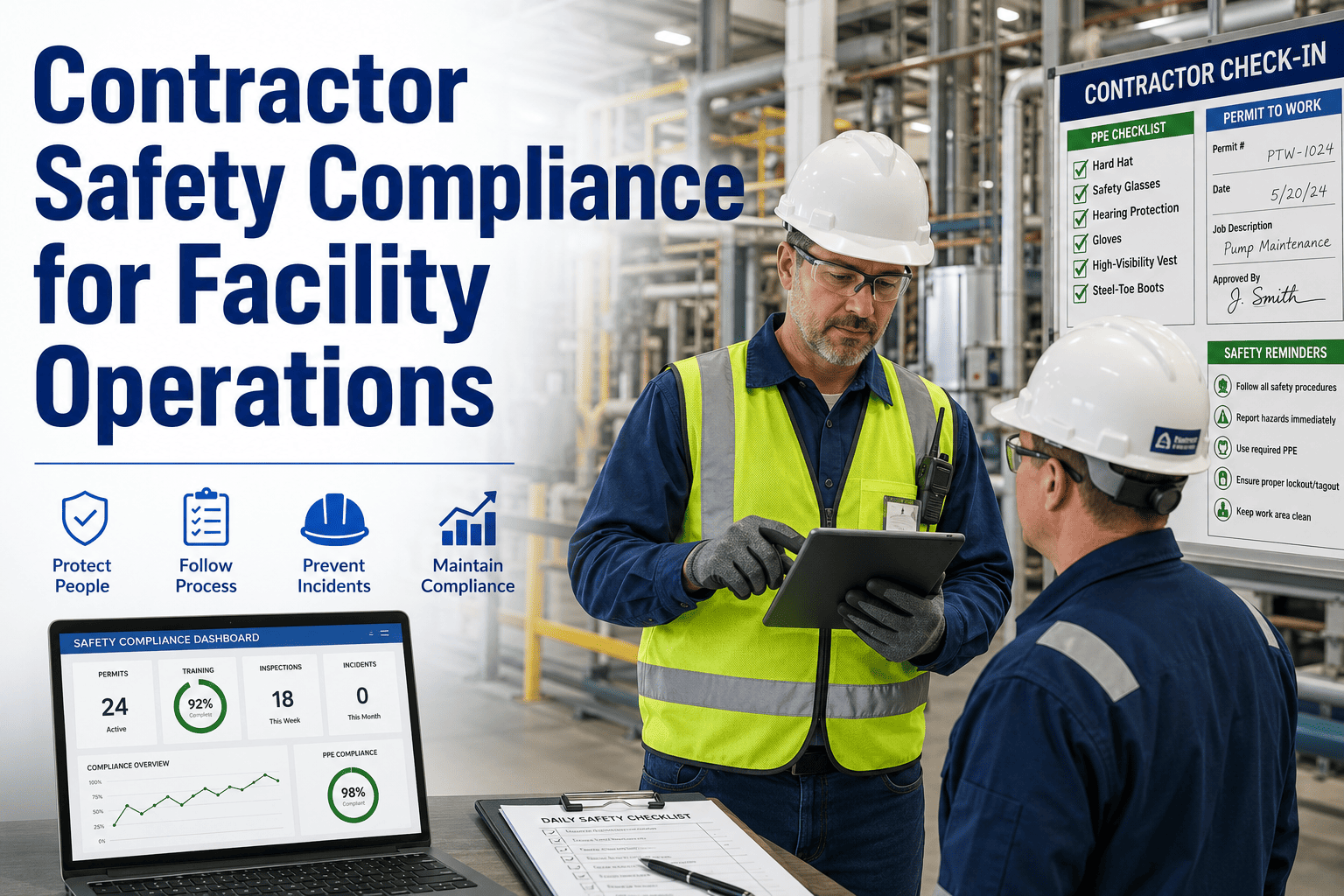
Managing Environment, Health, and Safety (EHS) compliance across facilities has never been more challenging. With OSHA penalties reaching $161,323 per willful violation in 2024 and EPA fines accumulating daily for non-compliance, facilities managers face mounting pressure to maintain rigorous standards while juggling limited resources. The reality is that 68% of facilities still rely on paper-based systems that leave critical gaps in compliance documentation, creating vulnerabilities that only surface during audits , or incidents.
A proactive, technology-driven approach to EHS compliance transforms regulatory obligations from reactive firefighting into strategic advantage. Organizations with mature EHS programs consistently outperform competitors in operational efficiency, employee retention, and risk mitigation. This guide explores proven best practices that leading facilities use to achieve seamless compliance while reducing administrative burden by up to 70%.
Ready to streamline your EHS compliance? Sign up for Oxmaint and automate inspections, track corrective actions, and generate audit-ready reports in real time.
Understanding EHS Compliance Framework
EHS compliance management encompasses the systematic processes and controls organizations implement to meet environmental, health, and safety regulations. At its core, effective EHS management requires identifying applicable legal requirements, developing policies and procedures, implementing training programs, and continuously monitoring performance. The framework spans three interconnected pillars: environmental compliance covering air emissions, water discharges, and waste management; occupational health and safety addressing workplace hazards, ergonomic risks, and employee training; and regulatory compliance ensuring adherence to federal, state, and local standards including OSHA, EPA, and industry-specific requirements.
Top OSHA Violations Facilities Must Address
OSHA's annual Top 10 Most Frequently Cited Standards provides a roadmap for compliance priorities. For 14 consecutive years, fall protection has topped the list, with over 6,300 citations in FY 2024 alone. General industry facilities face particular exposure in hazard communication, respiratory protection, and lockout/tagout standards. Understanding these high-citation areas allows facilities managers to proactively assess vulnerabilities and implement preventive controls before inspectors arrive.
| Rank | Standard | Industry | Citations | Max Penalty |
|---|---|---|---|---|
| 1 | Fall Protection (1926.501) | Construction | 6,307 | $161,323 |
| 2 | Hazard Communication (1910.1200) | General Industry | 2,888 | $16,131 |
| 3 | Respiratory Protection (1910.134) | General Industry | 2,649 | $16,131 |
| 4 | Ladders (1926.1053) | Construction | 2,573 | $16,131 |
| 5 | Lockout/Tagout (1910.147) | General Industry | 2,443 | $161,323 |
Avoid becoming a violation statistic.
Oxmaint helps you schedule inspections, track corrective actions, and maintain audit-ready documentation for every OSHA standard.
Best Practices for EHS Compliance Management
Transforming EHS compliance from a reactive burden to a proactive advantage requires systematic implementation of proven strategies. Leading facilities managers focus on five core areas: establishing comprehensive management systems aligned with ISO standards, conducting regular audits and inspections, maintaining accurate documentation, providing ongoing training, and leveraging technology for automation and visibility. The organizations that excel treat compliance not as a checkbox exercise but as an operational discipline integrated into daily workflows.
Identify all federal, state, and local requirements applicable to your facility operations
Compare current practices against requirements to identify compliance vulnerabilities
Develop prioritized corrective actions with deadlines and accountability assignments
Deploy controls, update procedures, and train employees on new requirements
Conduct audits and inspections to confirm controls are effective and documented
Monitor KPIs, analyze trends, and refine programs based on performance data
Regular Audits & Inspections
Documentation Management
Employee Training Programs
Technology Integration
Looking to implement these best practices? Book a demo to see how Oxmaint streamlines every aspect of EHS compliance management.
The Role of CMMS in EHS Compliance
Computerized Maintenance Management Systems (CMMS) have become essential infrastructure for EHS compliance. By centralizing maintenance data, automating inspection schedules, and generating audit-ready reports, CMMS platforms eliminate the manual processes that create compliance gaps. Modern systems integrate work order management, asset tracking, and compliance documentation into unified workflows accessible from any device. For facilities in regulated industries, CMMS provides the documentation trail and automated controls that satisfy requirements from OSHA, EPA, and industry-specific standards.
Automate Your EHS Compliance
Oxmaint's CMMS platform delivers real-time tracking, automated scheduling, and instant audit reports to keep your facility compliant.
ROI of Proactive EHS Compliance
The financial case for proactive EHS compliance extends far beyond avoided penalties. Organizations with mature EHS programs experience reduced workers' compensation costs, lower insurance premiums, fewer production disruptions, and improved employee retention. When a single willful OSHA violation can cost $161,323 and EPA fines accumulate daily, the ROI calculation becomes straightforward. Studies indicate that every dollar invested in EHS programs returns $4-6 in reduced incident costs, improved productivity, and avoided regulatory penalties.
Calculate your potential savings. Sign up for a free assessment of how Oxmaint can reduce your EHS compliance costs.
Implementation Roadmap
Successful EHS compliance transformation requires phased implementation that balances quick wins with sustainable system changes. Most organizations achieve full digital transformation within 12 weeks, with measurable improvements appearing within the first month. The key is starting with pilot programs that demonstrate value before full rollout, ensuring buy-in from frontline workers through leadership.
Assessment & Setup
Pilot & Validation
Full Deployment
Optimization & Scaling
Start Your EHS Compliance Transformation Today
Join facilities that have eliminated compliance gaps and reduced documentation time by 70%.
Key Performance Indicators
Measuring EHS compliance performance requires tracking both leading and lagging indicators. Leading indicators such as inspection completion rates and training currency predict future compliance status, while lagging indicators like incident rates and citation counts measure outcomes. Effective programs track both to enable proactive intervention before problems become violations.
Expert Perspective
"The shift from paper-based compliance tracking to a digital CMMS transformed our EHS program from reactive firefighting to proactive management. When OSHA arrived for an unannounced inspection, we generated three years of inspection records, training documentation, and corrective action logs in under five minutes. The inspector commented that our documentation was the most organized he had seen. Beyond avoiding citations, we reduced our compliance administrative time by 65% and reallocated those resources to actual hazard prevention work. The ROI was clear within the first quarter."
The Bottom Line
EHS compliance is no longer optional, and the costs of non-compliance continue rising with annual penalty adjustments. Facilities that treat compliance as an operational discipline rather than a burden consistently outperform those with reactive approaches. The technology exists today to automate inspections, centralize documentation, and ensure 100% compliance with every applicable regulation. The question is not whether to modernize your EHS management, but how quickly you can implement systems that protect your people, your operations, and your bottom line.
Transform Your EHS Compliance Today
Join facilities managers who have eliminated compliance gaps and passed every audit with Oxmaint.
Frequently Asked Questions
What are the most common EHS compliance violations in facilities?
The most frequently cited violations include fall protection (6,307 citations in 2024), hazard communication, respiratory protection, ladder safety, and lockout/tagout. General industry facilities also face significant exposure in machine guarding, electrical safety, and personal protective equipment compliance. Regular inspections and automated tracking systems help identify and address these vulnerabilities before they result in citations.
How much can OSHA fines cost my facility?
As of 2024, OSHA penalties reach $16,131 per serious violation and $161,323 per willful or repeat violation. Penalties accumulate per instance, meaning a single inspection could result in multiple six-figure fines. EPA violations can cost up to $70,117 per day per violation for hazardous waste management infractions. These amounts increase annually with inflation adjustments.
How does a CMMS improve EHS compliance?
A CMMS automates inspection scheduling, tracks corrective actions to completion, maintains audit-ready documentation, and provides real-time visibility into compliance status. Digital systems eliminate the paper-based processes that create compliance gaps, reducing documentation time by 70% while ensuring 100% inspection completion. Automated alerts prevent missed deadlines for permits, training renewals, and required inspections.
What records must be retained for EHS compliance?
Retention requirements vary by regulation: OSHA injury logs require 5-year retention, training records must be kept for duration of employment plus 3 years, and environmental permits often require indefinite retention. Best practice is digital retention with 6+ year minimum for all EHS documentation, with the ability to produce complete records within minutes for regulatory inspections.
How long does it take to implement an EHS compliance system?
Most organizations achieve full implementation within 12 weeks using a phased approach. Initial assessment and setup takes 2-3 weeks, pilot validation 3 weeks, full deployment 3 weeks, and optimization 3 weeks. Quick wins such as automated inspection scheduling typically appear within the first month, with full ROI realization within the first quarter.