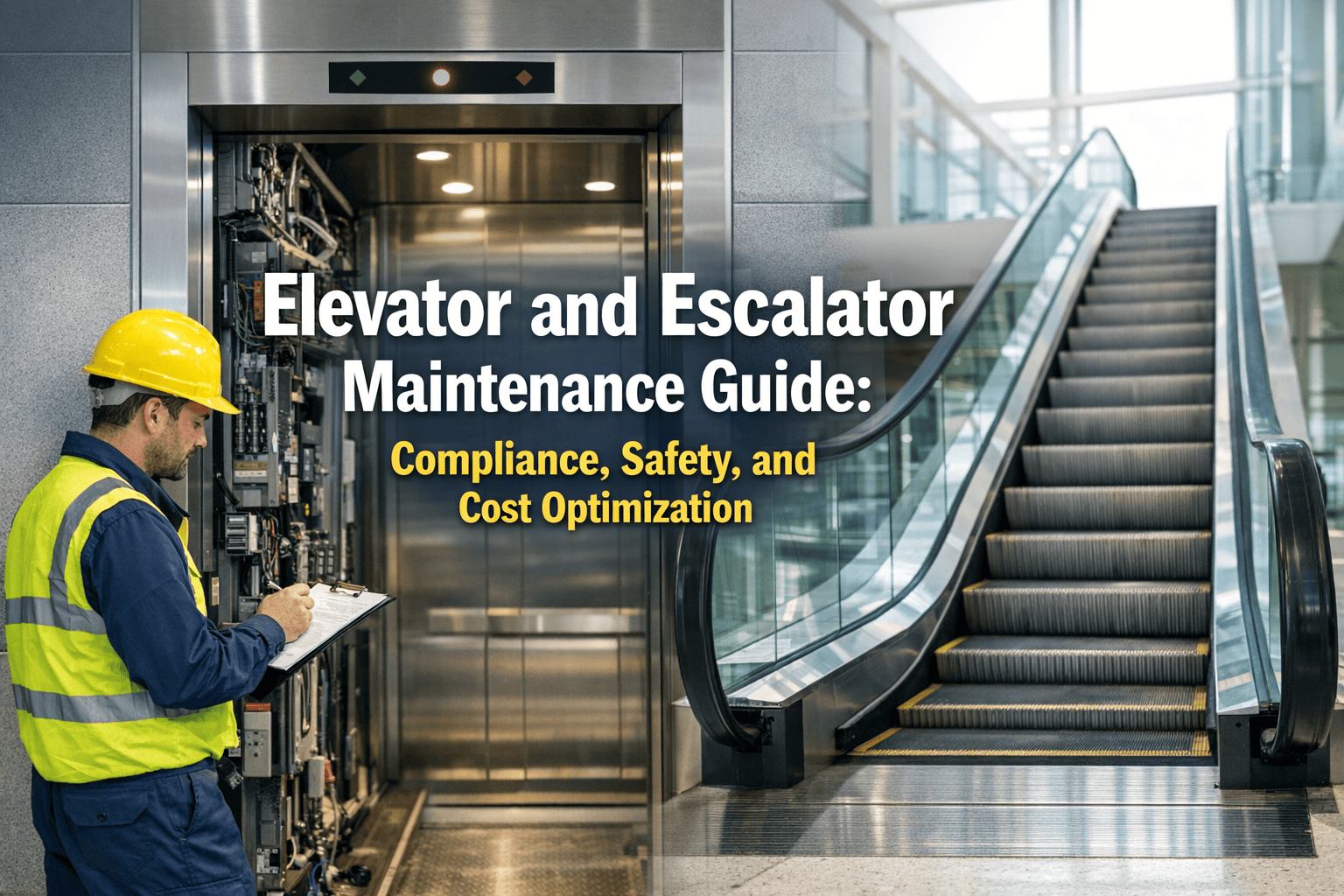
Elevator and escalator failures don't announce themselves — they build silently through missed inspections, skipped service records, and compliance gaps that only surface during audits or incidents. Oxmaint's compliance tracking platform gives facility managers, building owners, and inspection teams a single digital system to run structured inspection checklists, auto-assign corrective work orders, and maintain audit-ready records aligned with ASME A17.1/CSA B44 — the North American safety code for elevators and escalators. This page gives you the complete inspection framework, broken down by system area, frequency, and code reference, so every inspection captures what matters before an AHJ shows up at your door.
ASME A17.1 / CSA B44 Aligned
Elevator & Escalator Inspection Checklist
A complete, code-referenced inspection framework for facility managers, building engineers, and compliance teams — covering cab condition, door operation, safety devices, emergency communication, motor room, and escalator systems.
900K+
Elevators worldwide requiring periodic inspection
Annual
Minimum inspection frequency under ASME A17.1
5-Year
Full-load test cycle for traction elevators
AHJ
Records must be available to Authority Having Jurisdiction at any time
ASME A17.1-2025
Primary safety code — design, installation, operation & maintenance
ASME A17.2-2023
Inspection guide — procedures for electric, hydraulic & escalator systems
ASME A17.3-2020
Retroactive code — safety standards for existing installations
ADA / ICC A117.1
Accessibility requirements for cab dimensions & controls
Inspection Areas — 6 Critical Zones
Complete Elevator Inspection Checklist
Each zone below maps to a specific ASME A17.1 requirement. Use this as your field reference or digitize it in Oxmaint to auto-generate corrective work orders on every failed item.
01
Cab Condition & Interior
Floor covering — no buckling, gaps, or trip hazards
Walls and ceiling — no cracks, missing panels, or loose fixtures
Lighting — minimum 5 foot-candles at floor level, emergency light functional
Car capacity placard — posted, legible, matches rated load
Certificate of inspection — current, posted in cab
Handrail — secure, continuous, correct height (ADA compliance)
Emergency stop switch — accessible, functional, labeled
02
Door Operation & Protection
Door reopening device — activates on obstruction within 1 second
Door closing force — does not exceed 30 lbf (ASME A17.1 requirement)
Door open dwell time — minimum 3 seconds before initiating close
Door interlock — car will not move unless doors are fully closed and locked
Hoistway door panels — no visible damage, warping, or gaps exceeding 3/8 inch
Sill condition — clean, level, no raised edges at landing
Door position monitoring — functional as required by 2022 code update
03
Safety Devices & Mechanical
Governor and safety — last test date within required cycle (Category 5 test)
Buffer — condition, oil level (hydraulic), elastomeric integrity (2025 code adds elastomeric buffer requirements)
Wire rope / suspension system — no broken wires, corrosion, or wear exceeding ASME A17.6 limits
Brake system — clean, no oil contamination, releases fully on movement
Guide rails and guides — lubricated, no excessive wear or misalignment
Pit conditions — dry, clean, properly lit, stop switch accessible
Seismic requirements — verify compliance per ASME A17.1-2025 updates
04
Emergency Communication
Two-way communication — operational, connects to a staffed location
Hearing-impaired communication — visual/tactile alert capability (2025 ASME update requirement)
Emergency alarm bell — audible from outside hoistway, battery-backed
Emergency lighting — activates within 10 seconds of power failure, lasts minimum 4 hours
Emergency responder radio coverage — verified per 2022 code addition
Firefighter service Phase I and Phase II — tested, operational
05
Machine Room Inspection
Access — restricted to authorized personnel only, proper signage posted
Fire-resistive construction — walls and door meet required rating
Smoke detectors — present, connected, no obstructions
Temperature — maintained within equipment manufacturer specifications
Motor controller — no overheating, fault codes cleared, verification of remote interaction requirements (2022 update)
Hydraulic unit (if applicable) — oil level correct, no leaks, pressure relief tested
Maintenance log — present, entries current, available for AHJ review
06
Escalator & Moving Walk Systems
Steps and pallets — remove 6–8 steps for visual inspection of chains, trusses, drip pans (ASME A17.2.3 procedure)
Handrail — speed matches step speed, no slippage, no surface cracks
Skirt panels — no gaps exceeding code limits, brush/deflector guards present
Comb plates — intact, no missing teeth, properly aligned with step grooves
Emergency stop buttons — accessible at top and bottom landings, functional
Step chain lubrication — free of excess dirt and grease buildup
Skirt performance test — annual test per ASME A17.1 requirement
Digital Checklist Platform
Run This Checklist in Oxmaint — Auto-Generate Work Orders on Every Failure
When a technician marks any item as failed in Oxmaint, a prioritized corrective work order is automatically created and assigned — linked to the asset, the inspection record, and the ASME code reference. No paperwork, no gaps.
Inspection Frequency Reference
How Often Must Each System Be Inspected?
ASME A17.1 sets minimum inspection and testing cycles by equipment type. Missing a cycle is a compliance violation — and building owners are responsible for maintaining records available for AHJ review at any time.
| Equipment Type |
Inspection Cycle |
Load Test Cycle |
ASME Code Reference |
Compliance Risk if Missed |
| Traction Elevator (Electric) |
Annual |
Category 1: Annual / Category 5: 5-Year |
ASME A17.1 Section 8.6 |
High — permit suspension, liability exposure |
| Hydraulic Elevator |
Annual |
Category 1: Annual / Category 3: 5-Year |
ASME A17.1 Section 8.6 |
High — oil leak risk, jack seal testing required |
| Escalator |
Annual |
Skirt Performance: Annual |
ASME A17.1 / A17.2.3 |
High — entrapment hazard, public safety risk |
| Moving Walk |
Annual |
Skirt Performance: Annual |
ASME A17.1 |
Medium — AHJ citation, operational shutdown |
| Emergency Communication |
Monthly functional test |
N/A |
ASME A17.1 (2025 updated requirements) |
High — trapped passenger risk, ADA liability |
| Firefighter Service (Phase I & II) |
Annual |
Functional test required |
ASME A17.1 Section 2.27 |
Critical — fire code violation, occupancy permit risk |
Compliance Risk Snapshot
Where Facilities Most Commonly Fail Elevator Inspections
01
Emergency Communication
38%
Most commonly cited deficiency — phone systems failing or not connected to staffed location, especially after 2025 hearing-impaired communication requirements.
02
Door Reopening Devices
29%
Sensor drift and worn detection edges cause reopening failures. New 2022 door protection requirements increased scrutiny on this component significantly.
03
Missing/Expired Test Records
24%
AHJ requires records on-site and available on demand. Paper logs are frequently incomplete, lost, or don't reflect the most recent Category 1 or 5 test completion.
04
Escalator Comb Plates & Skirts
18%
Missing comb teeth and skirt gap violations are the leading escalator entrapment hazard — and the most preventable with routine monthly inspection.
Expert Review
"The single biggest gap I see across commercial buildings is not a mechanical failure — it is a record-keeping failure. ASME A17.1 is clear: all inspection, maintenance, and test records must be available to the Authority Having Jurisdiction at any time. A paper binder in a machine room does not meet that standard anymore. Facilities that digitize their compliance tracking with a platform like Oxmaint are not just more organized — they are genuinely less exposed when an AHJ arrives or an incident occurs."
Compliance Checklist vs. Paper Process
Why Paper Checklists Create Compliance Gaps
Paper-Based Inspection
Completed forms stored in machine room — unavailable for remote AHJ review
No automatic escalation when a failed item goes uncorrected
Inspection cycles missed with no system-wide visibility
No audit trail linking inspection finding to corrective work order to closure
Test records get lost — Category 5 five-year tests undocumented at AHJ request
Oxmaint Digital Compliance Tracking
All records stored digitally — accessible anywhere, at any time, by any authorized user
Failed checklist item automatically creates a prioritized corrective work order
Automated reminders for upcoming inspection cycles — annual, 5-year, monthly
Full audit trail from inspection finding through repair to close — AHJ-ready
Test history linked to each asset — pull any record instantly during a site visit
Ready to Digitize Your Inspection Program?
From Checklist to Closed Work Order — All in One Platform
Oxmaint gives your team a digital inspection workflow built for compliance — structured checklists, auto-generated corrective work orders, and full audit-ready records for every elevator and escalator in your portfolio.
Start Free — No Credit Card
Book a 30-Minute Demo
Frequently Asked Questions
Elevator & Escalator Inspection — Common Questions
How often must elevators be inspected under ASME A17.1?
ASME A17.1 requires elevators to undergo at minimum an annual inspection and Category 1 load test. Traction elevators also require a Category 5 full-load safety test every five years, and hydraulic elevators require a Category 3 test every five years. Escalators must complete an annual skirt performance test. Emergency communication systems should be functionally tested monthly to ensure they connect to a live, staffed location. All records must be maintained on-site and available to the Authority Having Jurisdiction (AHJ) at any time — making digital record-keeping essential for compliance.
Oxmaint automates scheduling and record management for all inspection cycles.
What changed in the ASME A17.1-2025 update that facilities need to act on?
The 2025 edition of ASME A17.1 introduced several significant changes that directly affect inspection checklists and maintenance programs. Emergency communication requirements were updated to ensure elevators can communicate with trapped passengers who are hearing impaired — requiring visual or tactile alert capability in addition to audio. Door protection requirements for passenger elevators were increased, with higher scrutiny on reopening device performance. Seismic requirements for elevators and escalators were also clarified. Additionally, elastomeric buffer requirements were added, changing what inspectors must verify during pit inspections. Facilities should update their inspection checklists accordingly.
Our team can help you align your checklist templates with the 2025 code.
Who is responsible for maintaining elevator inspection records?
Under ASME A17.1 and most state and local jurisdictions, the building owner or property manager is directly responsible for ensuring all inspection, maintenance, testing, and repair records are maintained and available for review. This includes annual inspection certificates, Category 1 and 5 test reports, maintenance logs, and records of any alterations or repairs. Failure to produce records when requested by an AHJ can result in the elevator being taken out of service, fines, or permit suspension — regardless of whether the elevator is mechanically sound. Digital compliance tracking platforms eliminate the risk of missing or inaccessible records.
Start building your compliant record-keeping system in Oxmaint today.
What is the most common reason facilities fail elevator inspections?
Based on field experience and AHJ reports, the most cited deficiencies fall into three categories: emergency communication system failures (particularly the two-way phone not connecting to a staffed location), door reopening device faults (sensor wear causing delayed or failed activation), and incomplete or missing inspection records. The 2025 ASME code update adds hearing-impaired communication requirements to the emergency comm category, which many existing installations cannot currently satisfy. A structured digital inspection program that captures results, flags failures, and auto-generates corrective work orders dramatically reduces the chance of recurring compliance gaps.
Book a demo to see how Oxmaint tracks corrective actions to closure.
Does this checklist apply to both new and existing elevators?
This checklist covers inspection items relevant to both new installations under ASME A17.1 and existing equipment governed by ASME A17.3, which establishes retroactive minimum standards for elevators regardless of installation date. ASME A17.1-2025 applies primarily to new installations and alterations, while A17.3 addresses what jurisdictions can require of existing equipment. For existing elevators, the inspection checklist remains largely the same, but some newer requirements — such as the 2025 hearing-impaired communication provision — may be phased in depending on local AHJ adoption timelines. Always verify the edition currently adopted by your state or local jurisdiction, as adoption timelines vary.
Oxmaint lets you customize checklists by jurisdiction and equipment type.
Built for Compliance Teams
Your Elevator Compliance Program Deserves a Platform Built Around It
Oxmaint's compliance tracking connects your inspection checklists to your maintenance workflow — so every failed item becomes a tracked corrective action, every test record is stored and searchable, and every AHJ visit is one you're prepared for.