The Monday morning rush hits floor 32 when elevator car #3 stops responding—47 commercial tenants trapped between meetings, residential occupants late for work, and the retail anchor's delivery crew stuck with 2,000 pounds of inventory. Within 15 minutes, your phone shows 23 tenant complaints, one lease penalty clause triggered and an emergency service call that will cost $4,800. The elevator's drive motor had been showing warning signs for six weeks—temperature spikes, vibration anomalies, increased current draw—but without predictive analytics, those signals remained invisible until failure.
Mixed-use towers depend on vertical transport reliability more than any other building system. Elevators and escalators serve residential families, commercial executives, retail customers, and delivery operations—each with different peak demands, tolerance for delays, and contractual expectations. A single failure cascades across occupancy types, damaging tenant relationships, triggering lease penalties, and creating liability exposure that reactive maintenance strategies cannot prevent.
This reliability program establishes AI-driven predictive analytics frameworks for elevator and escalator systems in mixed-use environments, transforming condition monitoring data into actionable maintenance decisions before failures impact occupants. Facilities implementing predictive maintenance facility management for vertical transport achieve 70-85% reduction in unplanned downtime while extending equipment lifecycle by 25-40%. Teams ready to modernize vertical transport maintenance can sign up free to centralize elevator maintenance tracking and work orders.
What if your elevators could tell you they need service weeks before they fail—protecting tenant satisfaction and eliminating emergency repair costs?
The Vertical Transport Challenge in Mixed-Use Towers
Mixed-use towers create unique stress patterns on elevator and escalator systems that single-use buildings never experience. Morning residential exodus overlaps with commercial arrival, retail opening triggers midday peaks, and evening reversal compounds wear on door operators, motors, and control systems operating far beyond design assumptions.
Residential, commercial, and retail occupancies create overlapping peak demands that exceed single-use design parameters by 40-60%
Commercial SLAs demand 99%+ uptime, residential expects 24/7 availability, retail requires freight capacity during business hours
ADA accessibility, fire service recall, annual safety inspections, and insurance requirements create documentation burdens
Elevator/escalator maintenance represents 15-25% of total building maintenance budget with highest emergency repair costs
Transform Facility Management Cost Control Using AI + IoT Data
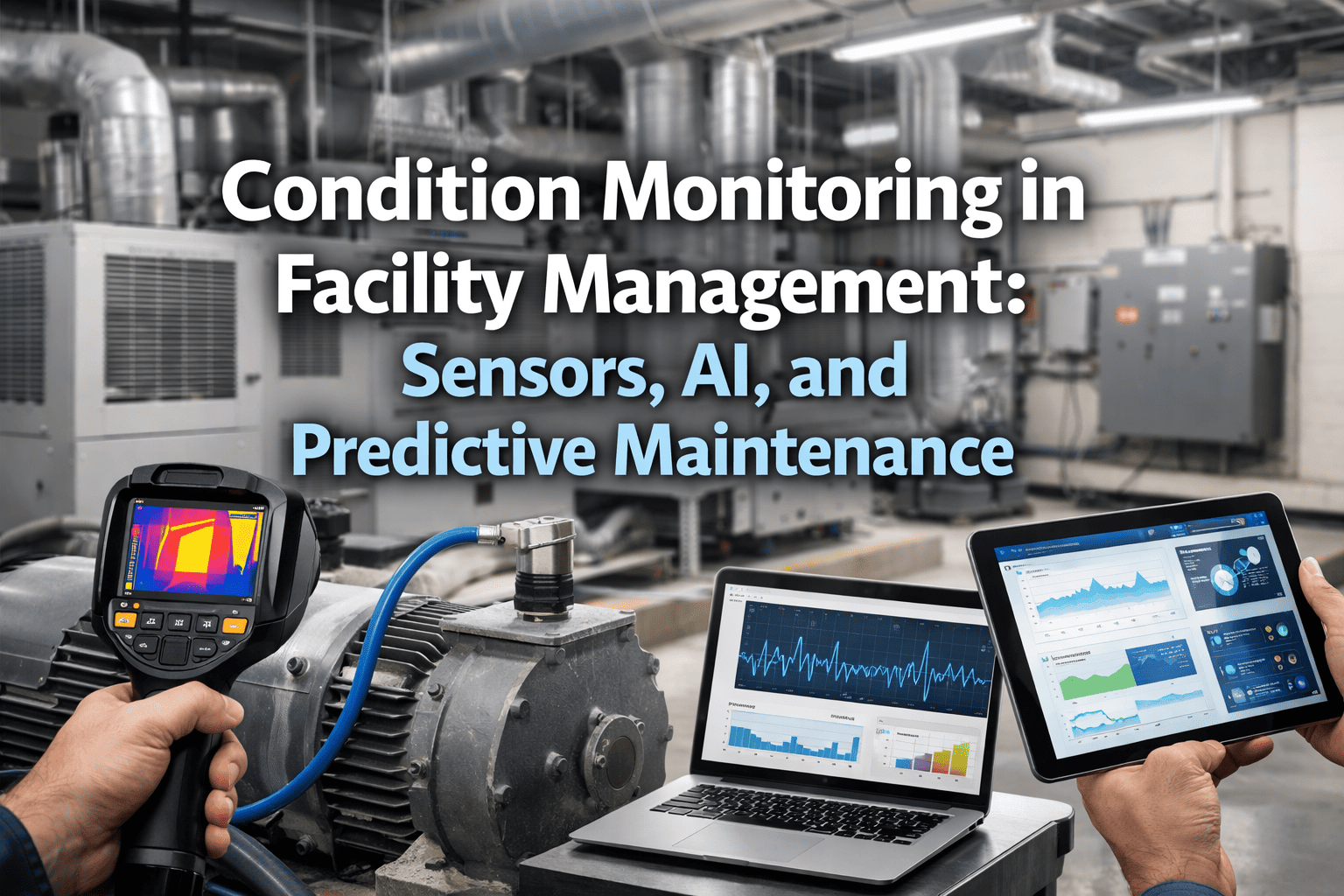
AI-powered condition monitoring transforms elevator and escalator maintenance from calendar-based schedules to condition-based interventions. IoT sensors continuously measure the parameters that precede failures—enabling maintenance teams to address degradation during planned service windows rather than emergency calls.
Critical Condition Monitoring Parameters
| Component | IoT Sensors | Warning Indicators | Failure Timeline |
|---|---|---|---|
| Drive Motor | Temperature, vibration, current draw | Temp +15°F above baseline, vibration +25% | 4-8 weeks to failure |
| Door Operator | Cycle time, motor current, obstruction events | Cycle time +20%, current spikes | 2-4 weeks to failure |
| Brake System | Wear sensors, engagement time, temperature | Engagement delay +15%, wear threshold | 1-3 weeks to failure |
| Guide Rails/Rollers | Vibration analysis, acoustic sensors | Harmonic changes, noise increase | 6-12 weeks to failure |
| Control System | Error logs, response latency, I/O status | Error rate increase, latency drift | 2-6 weeks to failure |
| Escalator Steps/Chain | Chain tension, step alignment, motor load | Tension variance +10%, alignment drift | 4-8 weeks to failure |
Risk Scoring for Vertical Transport Systems
AI analytics aggregate sensor data into actionable risk scores that prioritize maintenance interventions across elevator banks and escalator systems. Risk scoring enables facility teams to allocate limited resources to highest-impact equipment while maintaining audit trail documentation for facility management compliance requirements.
Condition: Safety system anomaly, brake degradation, or entrapment risk indicators
Response: Immediate shutdown, emergency service call within 2 hours
Example: Brake engagement time exceeds safety threshold by 20%
Condition: Component degradation trending toward failure within 2 weeks
Response: Schedule priority service within 48-72 hours
Example: Door operator current draw 35% above baseline with cycle delays
Condition: Early warning indicators, 4-8 weeks to potential failure
Response: Include in next scheduled preventive maintenance visit
Example: Drive motor temperature trending upward, vibration slight increase
Condition: All parameters within normal operating ranges
Response: Continue standard monitoring, scheduled PM only
Example: All sensors reporting baseline values, no anomalies detected
Predictive vs. Reactive Maintenance Comparison
Making Audits Painless — A Facility Management Lifecycle with Analytics
Elevator and escalator compliance requires meticulous documentation—annual safety inspections, five-year load tests, monthly firefighter service tests, and continuous ADA compliance verification. AI-integrated work order automation creates audit trail records automatically, eliminating manual documentation while ensuring facility management CMMS best practices.
State/local code inspections, certificate renewals, deficiency tracking and resolution documentation
Full-load and safety device testing per ASME A17.1, certified contractor documentation
Phase I recall, Phase II operation, firefighter communication verification with timestamps
OEM-specified service intervals, component inspections, lubrication schedules per OEM manuals
Mobile Inspections Workflow
Technician scans equipment tag to load asset history, open work orders, and inspection checklist
Mobile inspections facility management prompts ensure consistent data capture across all technicians
Timestamped images attached to work orders provide visual audit trail for compliance verification
Technician and supervisor sign-off creates tamper-proof completion records
KPI Dashboard
Percentage of operating hours without unplanned downtime
Average operating time between unplanned service interruptions
Percentage of service calls requiring repeat visits within 30 days
Preventive maintenance tasks completed on schedule
Passenger entrapment incidents per month
Total maintenance cost divided by annual trip count
Implementation Roadmap
Document all elevators, escalators, components, and current maintenance contracts
Evaluate current condition, failure history, and establish performance benchmarks
Install IoT monitoring on critical components—motors, doors, brakes, controllers
Connect sensor data to maintenance software facility management for automated alerts
Configure work order automation triggers based on risk scores and thresholds
Refine prediction models using operational data, expand to additional systems
ROI Summary — 6-Elevator Mixed-Use Tower
Stop waiting for elevator failures to disrupt your tenants. Start predicting problems before they impact operations.