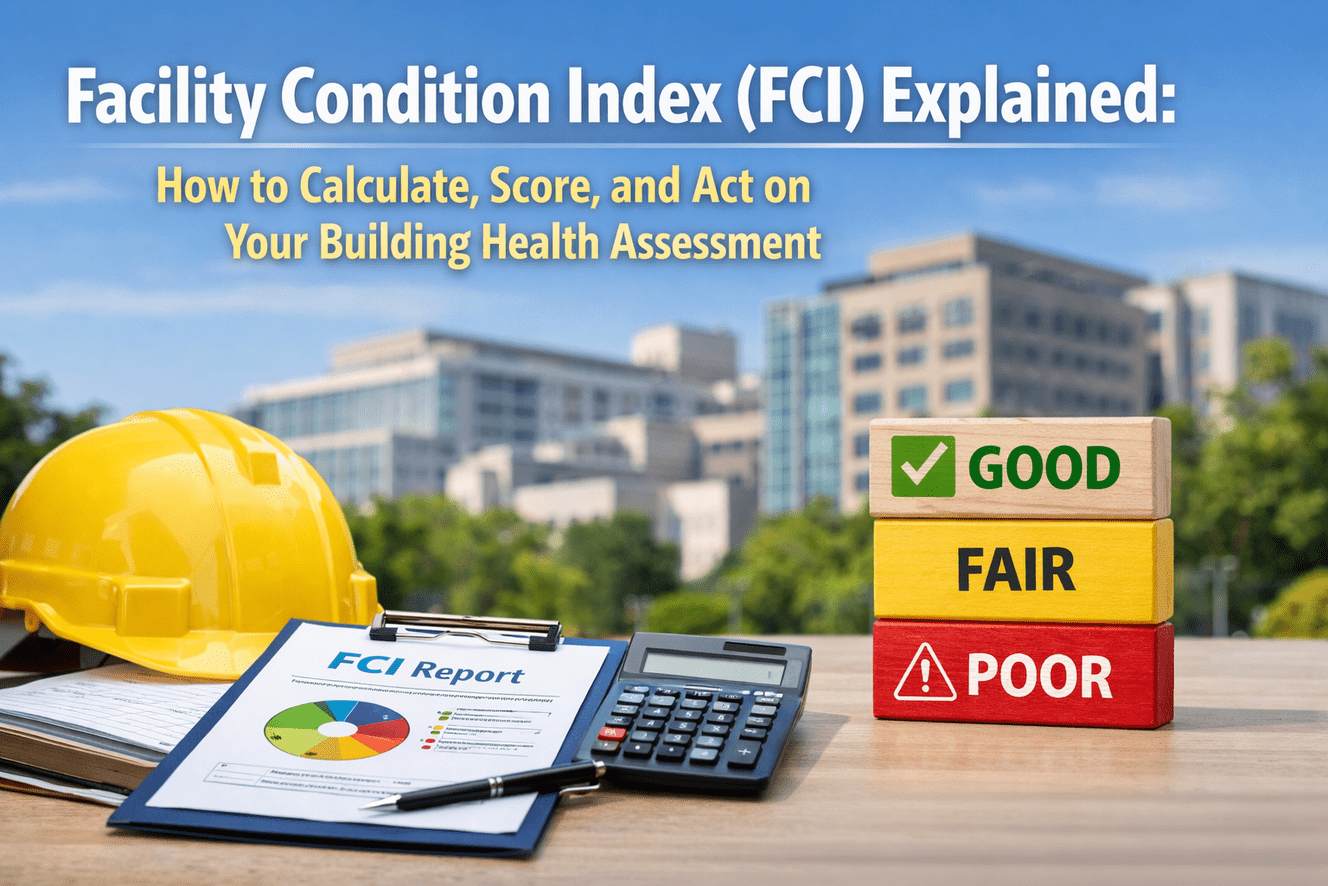
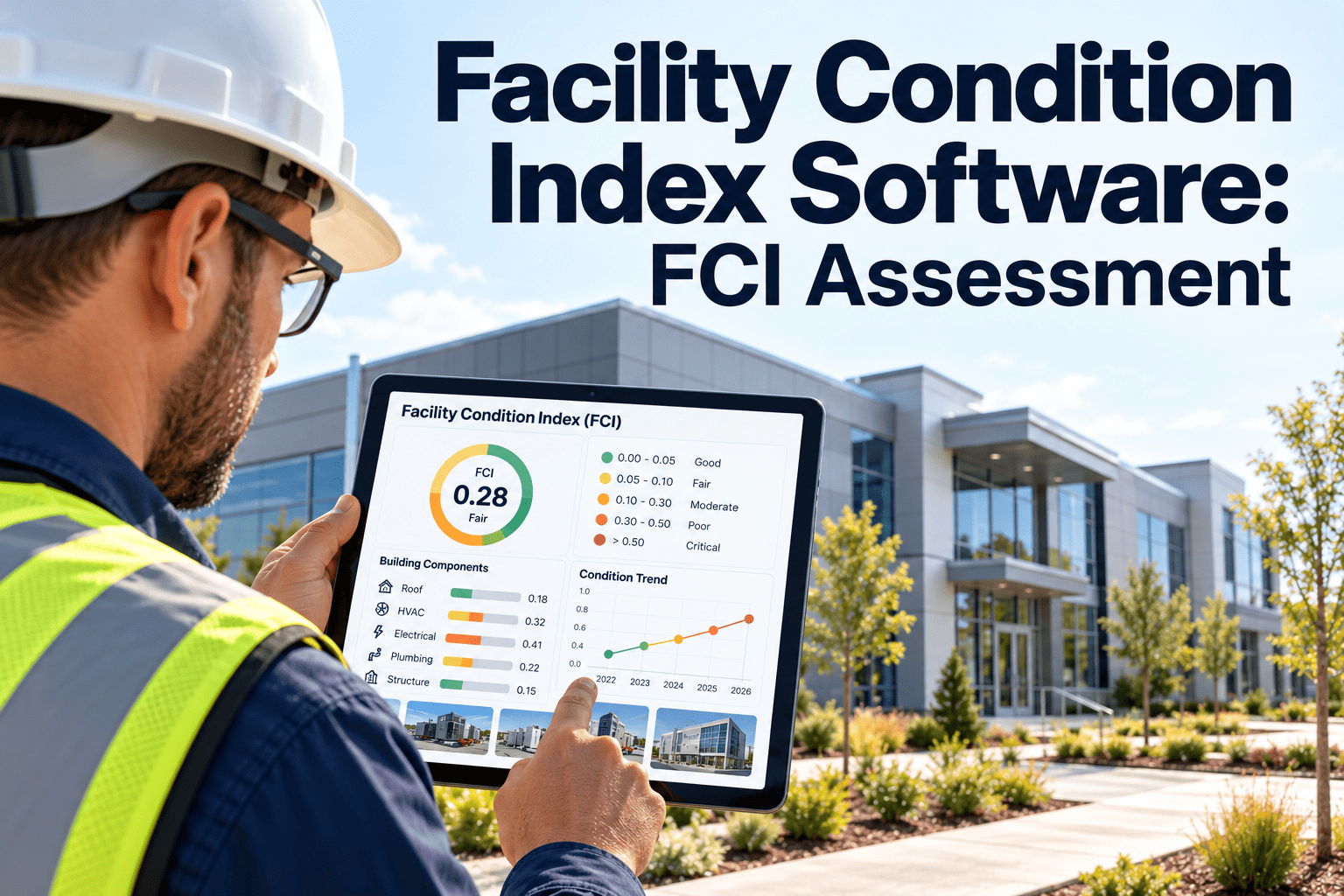
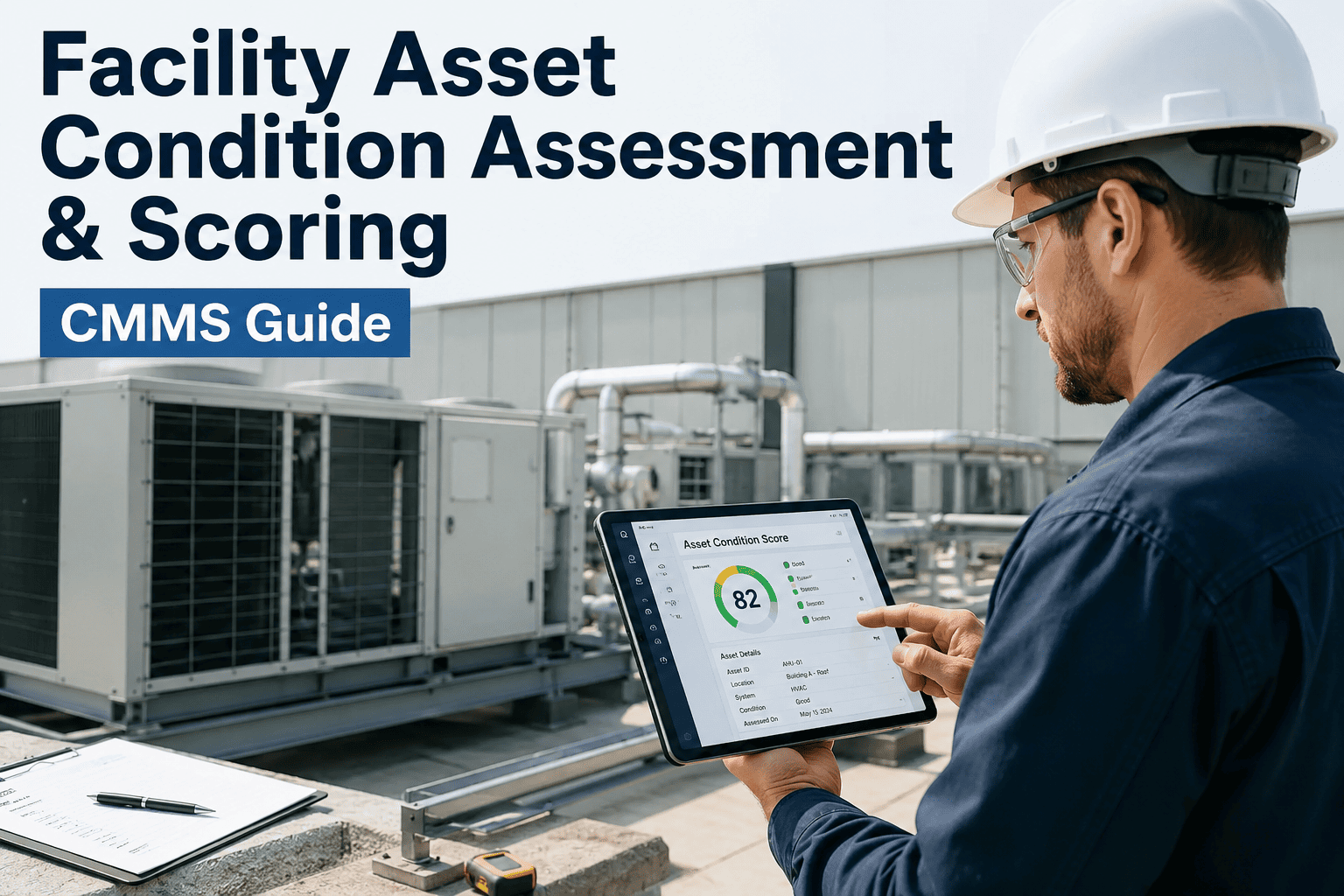
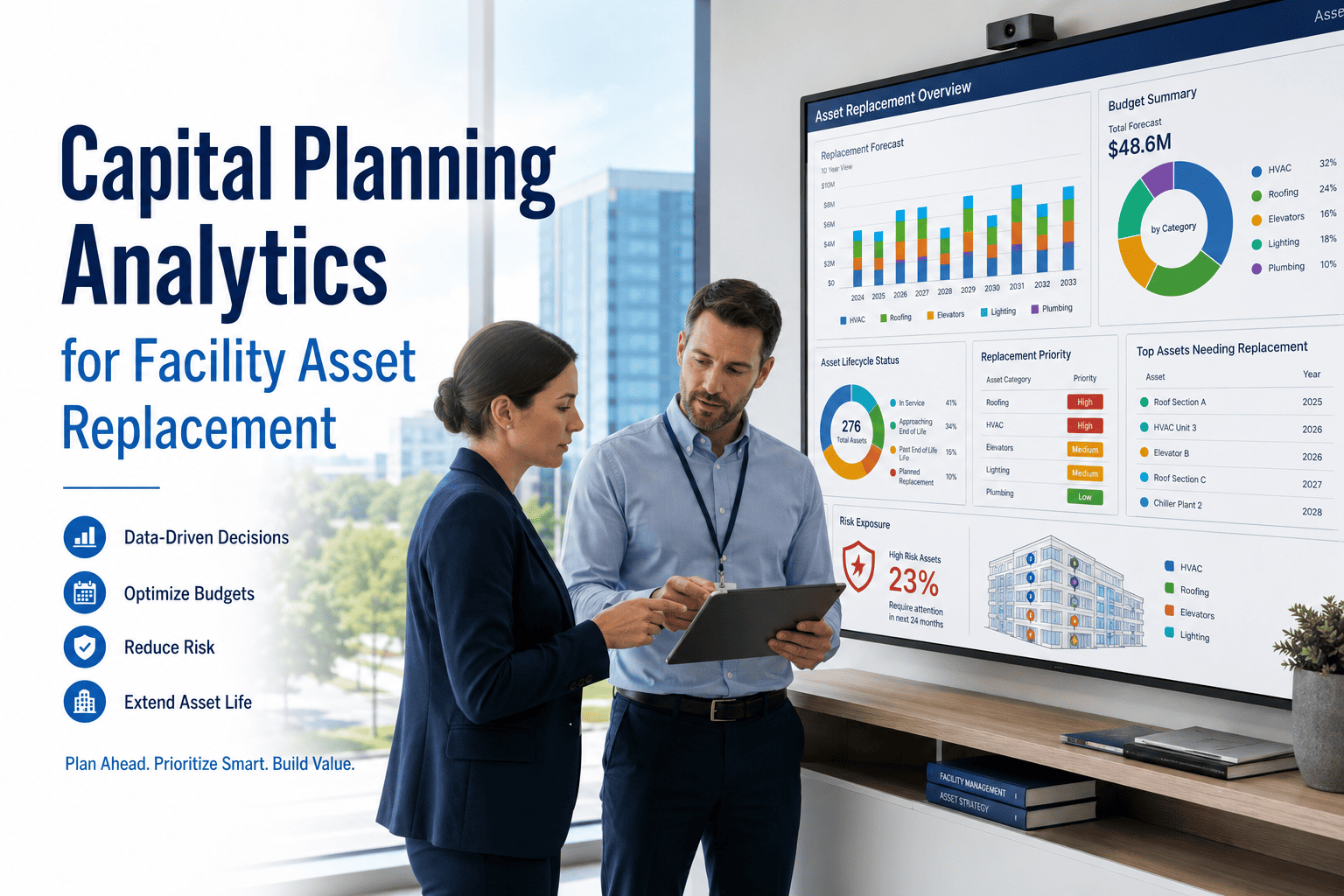
The Facility Condition Index is the single most powerful number in facilities management — yet most FM teams still calculate it once every 3–5 years from a static spreadsheet assessment and then watch it go stale before the capital plan is even approved. Sign up for Oxmaint free and turn FCI from a point-in-time snapshot into a living, continuously updated asset health score. The FCI formula is deceptively simple — Deferred Maintenance Cost divided by Current Replacement Value — but its power is in what you do with the number. Organizations that use FCI as a dynamic portfolio management tool, updating it continuously as work orders close and conditions change, make capital allocation decisions 40% faster and achieve CapEx budget variance under 15%. Those that treat it as an annual compliance exercise continue to experience the same budget surprises, the same emergency capital requests, and the same credibility gap when presenting to their CFO. This guide covers every dimension of FCI: the formula, the scoring benchmarks, the system-level breakdown, how to build it from asset condition data, and how Oxmaint's asset management platform keeps your FCI current across every building in your portfolio. Book a demo to see your portfolio's FCI calculated live from real asset data.
$1 Trillion+
Estimated deferred maintenance backlog across US commercial and government facilities — the FCI crisis driving capital planning reform in 2026
Under 10%
FCI threshold for "Good" condition per APPA and NACUBO benchmarks — the target every FM capital plan should be built toward
4.8x
Emergency repair cost premium vs. planned maintenance — the core financial consequence of high FCI left unaddressed
40%
Faster capital allocation decisions for organizations using dynamic FCI tracking vs. static annual assessments
Oxmaint · Asset Management · FM Core & Strategy
Your FCI Score Should Update Every Time a Work Order Closes — Not Once Every 3 Years. Oxmaint Makes It Dynamic.
Asset condition scoring. Deferred maintenance cost tracking. Current Replacement Value per system. Rolling FCI by building, by system, by portfolio. Capital improvement plan integration. All updated automatically as maintenance data accumulates — free to start.
Under 15%CapEx budget variance
5–10 yrRolling forecasts
PortfolioLevel FCI dashboard
DaysTo deploy Oxmaint
FCI Scoring Benchmarks
FCI Score Interpretation — Good, Fair, Poor, and Critical: What Each Threshold Means for Capital Action
The original NACUBO/APPA benchmark thresholds remain the most widely cited. Many organizations customize thresholds based on building type, mission criticality, and portfolio strategy — but these are the industry-standard starting points.
0% – 5%
Excellent
Well-maintained asset. Minor routine maintenance only. No significant capital need in the near term. Annual reserve contributions should be maintained to prevent drift into Fair territory.
Action: Maintain current PM programme. Monitor annual FCI drift.
5% – 10%
Good
APPA/NACUBO target range. Some deferred maintenance accumulating but manageable within normal capital budgets. Buildings in this range should be prioritized for selective investment to prevent drift toward Fair.
Action: Selective capital investment. 5-yr plan established.
10% – 30%
Fair
Meaningful deferred maintenance backlog. Multiple systems approaching end of useful life. Occupant experience and operational efficiency degrading. Capital prioritization required — not all deficiencies can be addressed simultaneously.
Action: Structured CIP required. Prioritize by system criticality.
30% – 60%
Poor / Needs Attention
Significant deferred maintenance. Building systems failing or near-failed. Emergency repairs becoming the norm. Occupant safety risk increasing. Requires urgent capital appropriation or phased renovation programme to avoid further deterioration.
Action: Urgent capital appropriation. Emergency PM escalation.
60%+
Critical / Consider Replacement
Deferred maintenance cost approaching or exceeding 60% of replacement value. Economic analysis typically favors replacement over repair at this threshold. Building utility and functional adequacy in question. Refurbish-versus-replace analysis mandatory before further capital investment.
Action: Refurbish vs. replace analysis. Possible disposition.
Important
Threshold Customization
Many organizations set tighter thresholds for mission-critical buildings. Hospitals, data centers, and emergency services facilities commonly target FCI under 5% and treat 10%+ as poor regardless of APPA benchmarks. Oxmaint allows per-building threshold configuration to match your portfolio strategy.
Oxmaint: Custom thresholds per building type and mission.
System-Level FCI
How to Calculate FCI by Building System — The Detail Behind the Portfolio Number
A portfolio-level FCI score tells you where to prioritize capital. A system-level FCI breakdown tells you what to fix. Every building system should have its own FCI calculated separately — HVAC, roofing, electrical, plumbing, envelope, life safety — so capital planning can target the highest-cost deficiencies within the building rather than simply ranking buildings against each other.
HVAC Systems
Typical CRV contribution: 25–35%
Design life: 15–25 years
Highest emergency cost risk when deferred. System-level FCI driven by unit age, efficiency decline, and deferred component replacement (compressors, coils, controls). Single aging chiller can dominate building FCI score.
Roofing Systems
Typical CRV contribution: 8–15%
Design life: 20–30 years
Deferred roof replacement multiplies total project cost 1.5–2.2x through cascade damage to insulation, decking, and interior. FCI impact accelerates rapidly in final 5 years of design life without proactive waterproofing maintenance.
Electrical Distribution
Typical CRV contribution: 10–18%
Design life: 30–40 years
Switchgear and panel replacement drives major FCI events. Insurance carriers specifically scrutinize electrical system age and condition at renewal. 40-year-old panels significantly increase both FCI score and insurance premium exposure.
Plumbing and Domestic Water
Typical CRV contribution: 10–15%
Design life: 40–70 years (varies by material)
Cast iron drain systems in 40+ year buildings frequently show deterioration creating significant FCI exposure. Water heaters (10–15 yr) and boilers (20–35 yr) are short-lifecycle components that recur regularly in FCI calculations.
Building Envelope
Typical CRV contribution: 15–25%
Design life: 30–50 years (varies by element)
Windows (20–30 yr), facade cladding (30–50 yr), and building sealants (5–10 yr) have very different lifecycles within the same system. System-level FCI must track each sub-element separately to produce actionable capital timing.
Life Safety and Fire Protection
Typical CRV contribution: 5–10%
Design life: 20–30 years (system-dependent)
Zero tolerance for high FCI in life safety systems regardless of portfolio prioritization. Code compliance deficiencies in fire suppression, alarm, and emergency egress carry liability exposure that categorically overrides cost-based capital prioritization.
Elevators and Conveyance
Typical CRV contribution: 5–12%
Design life: 25–35 years
Mandatory inspection cycles create known FCI events. Modernization components (controls, hydraulics, cab equipment) have shorter lifecycles than the structural cab, requiring system-level FCI to separate modernization from full replacement capital.
Structural and Foundation
Typical CRV contribution: 20–30%
Design life: 50–100 years
Low frequency, high consequence. Foundation and structural deficiencies rarely appear in routine FCI calculations but dominate the score when they do. Structural FCI issues typically trigger disposal or comprehensive renovation analysis.
The 5-Step Process
How to Build an Accurate FCI — Step by Step From Condition Assessment to Capital Action
An FCI score is only as useful as the data behind it. An FCI calculated from a 5-year-old paper assessment is not a capital planning tool — it is a liability. This is the process for building FCI data that CFOs and boards will act on.
01
Conduct the Facility Condition Assessment (FCA)
A Facility Condition Assessment is the structured evaluation of every building system — structural, mechanical, electrical, plumbing, envelope, life safety, and finishes — that identifies all deficiencies, quantifies their repair cost, and establishes remaining useful life per component. Conducted by a qualified assessor (engineer, architect, or certified FM professional), the FCA is the data source that makes FCI calculation possible. Oxmaint's digital inspection platform captures FCA findings directly into the asset registry — condition scores, deficiency costs, and system notes linked to specific asset records as they are assessed, building the FCI dataset in real time rather than in a post-assessment spreadsheet.
Qualified assessor required
All systems covered
Deficiency costs quantified
Digital capture in Oxmaint
02
Quantify All Deferred Maintenance Costs
Deferred maintenance cost is the numerator of the FCI formula — and it must include every identified deficiency, not just the ones on the current year's repair list. Include: end-of-life system replacements not yet budgeted, code compliance upgrades required but unfunded, safety deficiencies identified in previous assessments, recurring repair items that signal approaching system failure, and accessibility compliance gaps. Apply a 5–7% annual inflation escalation to any deficiency cost estimated more than 12 months ago. Oxmaint's deferred maintenance tracking aggregates these costs per building and per system automatically from work order history, inspection findings, and asset condition scores — updated continuously rather than assembled manually at budget season.
All deficiencies included
5–7% inflation escalation
Auto-aggregated in Oxmaint
System-level breakdown
03
Establish Current Replacement Value (CRV)
CRV is the cost to replace the building with a new equivalent facility at current construction costs — not the historical cost, not the tax-assessed value, and not the insurance replacement value (which typically includes contents and is calculated differently). Use RS Means construction cost data as your primary CRV source, adjusted for regional cost factors. CRV must be updated annually — construction cost inflation of 5–7% per year means a 3-year-old CRV denominator understates your building's replacement value, making your FCI appear worse than it actually is. For large portfolios, Oxmaint stores CRV per building with annual escalation reminders to maintain denominator accuracy across the entire portfolio.
RS Means data source
Annual update required
Regional cost adjustment
Stored per building
04
Calculate FCI and Score by Building and System
Apply the formula: FCI = (Total Deferred Maintenance ÷ CRV) × 100. Calculate at three levels: portfolio-level (all buildings combined), building-level (each property individually), and system-level (each building system within each property). Portfolio FCI tells you your overall capital exposure. Building FCI tells you which properties to prioritize. System FCI tells you what to fix within each building. A building with a 14% overall FCI driven entirely by an aging HVAC system has a fundamentally different capital plan than one with 14% spread across six deteriorating systems. Oxmaint's analytics dashboard calculates all three levels automatically from asset condition data — updating dynamically as work orders close and deferred maintenance items are resolved.
Portfolio FCI
Building FCI
System-level FCI
Auto-calculated in Oxmaint
05
Build the Capital Improvement Plan From FCI Data
FCI without a capital improvement plan is a diagnostic without a treatment. Use FCI scores to prioritize capital investment across your portfolio: first, address all life safety and code compliance deficiencies regardless of FCI rank; second, prioritize buildings in Poor/Critical territory (FCI over 30%) with the highest consequence of failure; third, schedule Fair-condition buildings for phased investment that prevents further deterioration; fourth, maintain Good-condition buildings with structured PM and annual reserve contributions. Oxmaint's CapEx forecasting module generates the multi-year capital improvement plan directly from FCI data — with project cost, timing, and cumulative FCI impact projections that show the CFO exactly what each capital investment achieves in building condition improvement over a 5–10 year horizon.
Life safety first always
Prioritize by consequence
5–10 yr CIP generated
FCI impact projected
Before vs. After
Static FCI Assessment vs. Oxmaint Dynamic FCI Tracking
Results and ROI
What Dynamic FCI Tracking Delivers — Quantified Outcomes for FM Teams
Under 15%
CapEx Budget Variance
Versus 40–65% variance for FM teams without current FCI data. Dynamic FCI aligned to actual condition eliminates the surprise capital events that destroy budget accuracy.
40%
Faster Capital Decisions
Organizations using dynamic FCI tracking make capital allocation decisions 40% faster — because the data is current, the system-level breakdown is clear, and the CFO presentation is already built.
52%
Emergency Repair Cost Reduction
Within 18 months of deploying structured asset management and FCI-driven capital planning — emergency repairs drop from 38–52% of maintenance budget to under 17% as proactive investment replaces reactive response.
3.2x
Return on Asset Management Investment
ROI achieved within 18 months across Oxmaint commercial facility deployments. Primary drivers: emergency repair cost reduction, deferred maintenance cost avoidance, and CapEx timing optimization across the portfolio.
5–7%
Annual CRV Inflation Exposure
Organizations without annual CRV updates are understating their building values and overstating FCI severity — leading to unnecessary disposal analyses on buildings that are actually in better relative condition than their stale FCI suggests.
$2.4M
Average Annual Savings
Average annual maintenance savings per large commercial portfolio from emergency repair reduction and planned capital efficiency — documented across Oxmaint deployments in multi-site facility management operations.
Oxmaint · Asset Management Platform
See Your Portfolio's FCI Calculated Live From Real Asset Data — Not a 3-Year-Old Spreadsheet.
Oxmaint's asset management dashboard calculates FCI at the portfolio, building, and system level — updated automatically as work orders close and conditions are assessed. Rolling 5–10 year CapEx plans generated from live FCI data. Investor-grade capital reporting without manual assembly. Free to start. No implementation fees.
Frequently Asked Questions
FCI Calculation, Scoring, and Asset Management — What FM Leaders Ask First
What is the correct FCI formula and what inputs are required to calculate it accurately?
The FCI formula is: FCI = (Total Deferred Maintenance Cost ÷ Current Replacement Value) × 100. The result is expressed as a percentage — the lower the better. Three inputs are required for an accurate calculation. First, Deferred Maintenance Cost: the cumulative cost of all identified maintenance, repair, and replacement deficiencies that have not yet been completed. This includes end-of-life system replacements, code compliance gaps, safety deficiencies, and recurring repair items signaling system failure. Any deficiency cost estimated more than 12 months ago should be escalated at 5–7% annually for inflation before inclusion. Second, Current Replacement Value (CRV): the cost to build an equivalent new facility at today's construction costs — not historical cost, tax value, or insurance value. RS Means regional construction cost data is the industry standard CRV source, and it must be updated annually. Third, completeness of the deficiency inventory: an FCI calculated from an incomplete assessment systematically understates the building's capital needs and produces false confidence in the score. Oxmaint's asset management platform tracks all three inputs per building with automated CRV escalation reminders and deferred maintenance cost aggregation from work order data.
Sign up free to start building your FCI dataset, or
book a demo to see FCI calculated live from asset condition data.
What FCI score is considered good, and how do I set appropriate thresholds for different building types in my portfolio?
The original APPA/NACUBO benchmark thresholds are the most widely cited starting points: Good (under 10%), Fair (10–30%), Poor (30–60%), Critical/Consider Replacement (60%+). Some frameworks further subdivide Good into Excellent (under 5%) and Good (5–10%). However, these are portfolio-wide benchmarks, not universal absolutes — appropriate FCI thresholds vary significantly by building type and mission criticality. For mission-critical facilities — hospitals, data centers, emergency operations centers, laboratories — many organizations set a stricter Good threshold of under 5% and treat anything over 10% as Poor regardless of the APPA benchmark. For secondary or administrative buildings, the standard thresholds may be appropriate. For aging historic buildings with structural constraints that prevent achieving low FCI scores economically, higher thresholds with specific system exclusions are common. Oxmaint allows per-building FCI threshold configuration, so your mission-critical buildings are evaluated against stricter criteria than general office space while using the same underlying data model.
Book a demo to see portfolio-level FCI with custom thresholds, or
sign up free to configure your building registry.
How often should FCI be recalculated — and how do I keep it current between formal facility condition assessments?
FCI should be recalculated continuously, not just at the time of a formal third-party facility condition assessment. The fundamental problem with the traditional 3–5 year assessment cycle is that FCI becomes meaningless within 12–18 months of the assessment: completed repairs reduce deferred maintenance but are not reflected in the static score; new deficiencies emerge that are not captured until the next assessment; and CRV increases with construction cost inflation while the denominator stays fixed. Dynamic FCI tracking keeps the score current between formal assessments through three mechanisms. First, work order closure: when a repair or replacement is completed, the deferred maintenance cost for that item should automatically reduce — Oxmaint does this automatically as work orders close against the asset record. Second, inspection findings: every preventive maintenance inspection and routine condition check that identifies a new deficiency adds it to the deferred maintenance register, updating FCI dynamically. Third, annual CRV escalation: the denominator should be updated annually to reflect current construction costs. Together, these three practices mean your FCI is always accurate — not annually accurate at best.
Sign up free to start dynamic FCI tracking, or
book a demo to see the automation in action.
How do I use FCI to prioritize capital projects across a multi-building portfolio — and how does Oxmaint support this?
FCI enables portfolio-wide capital prioritization through a structured decision framework that replaces subjective advocacy with objective data. The prioritization process follows four levels of analysis applied sequentially. First, absolute priority regardless of FCI: life safety, code compliance, and occupant safety deficiencies always take priority over economic optimization — no FCI score justifies deferring a fire suppression system deficiency or a structural safety issue. Second, building-level FCI ranking: among buildings without absolute-priority items, prioritize capital investment in the buildings with the highest FCI scores weighted by building size, mission criticality, and occupancy to identify where investment yields the greatest portfolio FCI improvement per dollar spent. Third, system-level FCI within priority buildings: within each priority building, focus capital on the systems with the highest system-level FCI — a 35% HVAC FCI in a building with a 14% overall FCI identifies where the capital should go. Fourth, refurbish-versus-replace analysis for buildings at or approaching 30%+ FCI: at this threshold, economic analysis should compare continued capital investment against disposition or comprehensive renovation to determine the financially optimal path. Oxmaint's analytics dashboard presents all four levels simultaneously — portfolio FCI ranking, building FCI by system, and CapEx impact projections for each proposed investment — enabling the CFO-ready capital prioritization conversation that most FM teams currently struggle to have.
Book a demo to see the multi-building FCI prioritization dashboard, or
sign up free to start building your portfolio FCI baseline today.
What is the difference between FCI, FCA, and a property condition assessment (PCA) — and when does each apply?
These three terms describe related but distinct components of building health evaluation, and confusing them leads to using the wrong tool for the wrong purpose. A Facility Condition Assessment (FCA) is the physical inspection process — a trained assessor evaluates every building system, identifies deficiencies, and quantifies repair costs. The FCA is the data-collection activity. The Facility Condition Index (FCI) is the output metric — the ratio calculated from FCA data (and updated dynamically between FCAs) that produces the percentage score used for capital planning and portfolio benchmarking. The FCI is the analytical result. A Property Condition Assessment (PCA) is a due-diligence tool used specifically in real estate transactions — lenders and buyers commission PCAs to identify material defects, code violations, and capital reserve requirements before completing a purchase or refinancing. PCAs follow ASTM E2018 standards and focus on lender-relevant risks rather than comprehensive FM capital planning. FCAs and FCI are primarily internal planning tools; PCAs are externally focused due-diligence documents. Oxmaint supports the FCA data capture and FCI calculation process — not the PCA, which is a regulatory document produced by licensed third-party assessors. The asset condition records and deferred maintenance cost data Oxmaint maintains between FCAs significantly reduce the cost and time required to prepare for the next formal FCA or PCA by having current baseline data available.
Sign up free to start building your FCA data infrastructure in Oxmaint, or
book a demo to see how the platform supports your assessment lifecycle.
Oxmaint · Asset Management · FM Core & Strategy
Your FCI Score Should Be Working Every Day — Not Sitting in a PDF From 4 Years Ago. Oxmaint Makes the Difference.
Portfolio FCI dashboard. Building-level and system-level FCI calculated automatically. Deferred maintenance cost tracking updated as work orders close. CRV maintained with annual escalation reminders. 5–10 year CapEx plans generated from live FCI data. Board-level capital reporting without manual assembly. Free to start. No implementation fees. No IT project required.