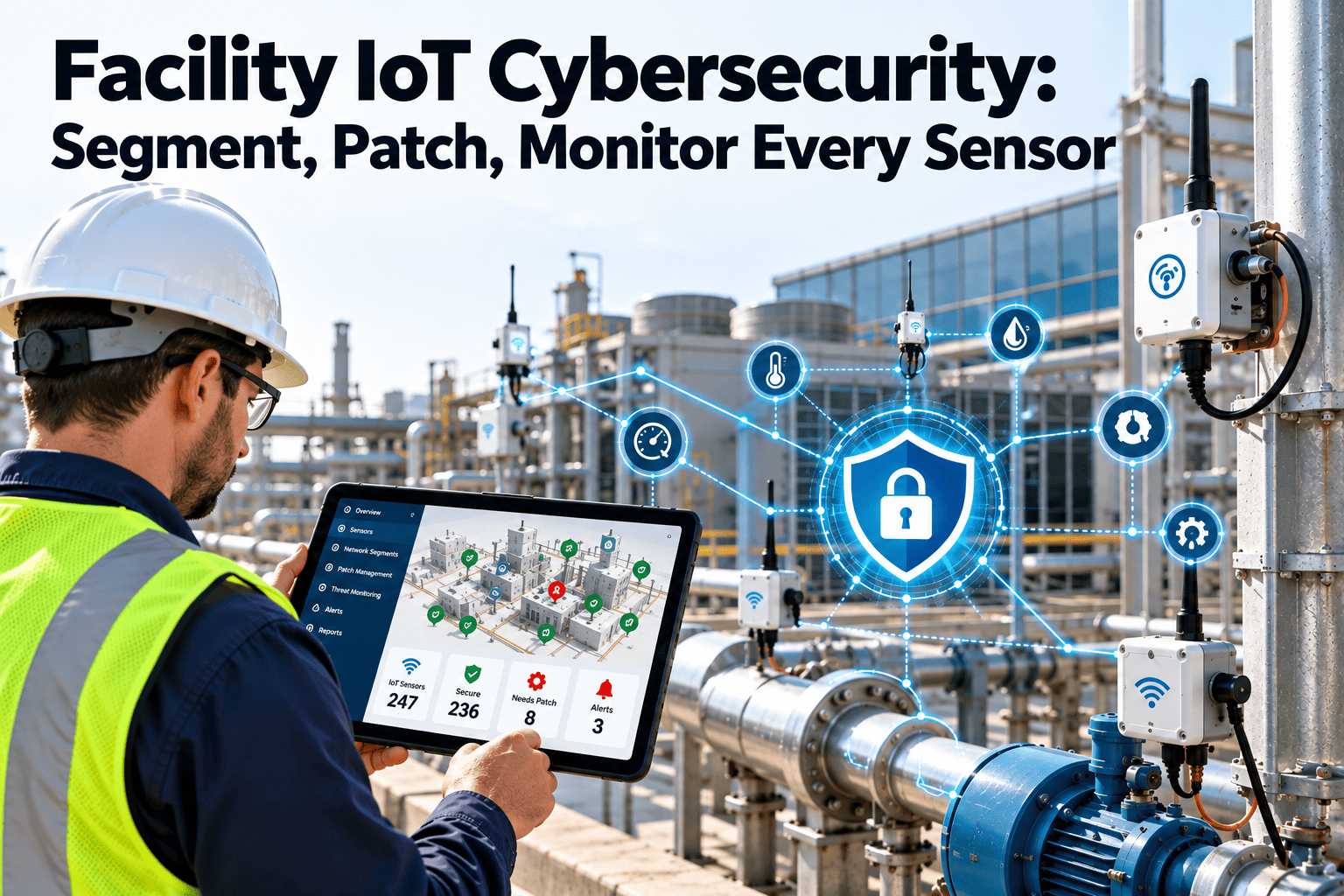
Every sensor a facility adds to its building automation system is also a new device on a network, and most were never designed with enterprise security in mind. A thermostat, a vibration sensor on a pump, or a smart electrical meter typically runs firmware that is rarely patched, uses default credentials more often than it should, and sits on the same flat network as production systems if nobody has deliberately separated it. This is now recognized as operational technology security, not a niche IT concern, and it follows guidance such as NIST SP 800-82 and IEC 62443 that were built for exactly this kind of environment. The segmentation, patching, and monitoring model below is how a facility keeps that sensor sprawl from becoming its weakest link, and Oxmaint's IoT and BMS integrations are built to sit inside that model rather than work around it.
Facility IoT Cybersecurity: Segment, Patch, and Monitor Every Sensor
A practical NIST SP 800-82 and IEC 62443 aligned model for keeping building sensors off the enterprise network without losing the data they provide.
Building Sensors Are an Attack Surface, Not Just a Data Source
Recent industry surveys of OT and ICS security teams found that roughly one in five organizations experienced an OT cyber incident in the past year, and close to half of those incidents disrupted operations. Building automation is explicitly inside that scope now, alongside industrial control systems, after NIST expanded SP 800-82 to cover building automation, physical access control, and environmental monitoring systems directly.
Unauthorized remote access accounts for roughly half of reported OT incidents, which is telling: the weakest point is rarely the sensor's own firmware, it is the access path a vendor, integrator, or technician uses to reach it. A facility that segments its network but leaves remote access loosely controlled has addressed only part of the exposure.
Which Framework Governs What
Facility teams often hear NIST SP 800-82 and IEC 62443 mentioned interchangeably, but they serve different roles and a mature program references both rather than picking one.
| Framework | Scope | What It Gives a Facility Team |
|---|---|---|
| NIST SP 800-82 Rev 3 | OT security guide covering ICS, building automation, physical access control, environmental monitoring | Risk management practices, secure architecture guidance, alignment with the broader NIST Cybersecurity Framework |
| IEC 62443 | International standard for industrial automation and control system security | The zones and conduits model and specific foundational requirements used to design segmentation |
| NIST SP 800-53 | General federal control catalog | The underlying control families that SP 800-82 reinterprets for OT operating conditions |
The two frameworks map bidirectionally in practice: IEC 62443 supplies the architectural pattern, and NIST SP 800-82 supplies the risk management and lifecycle guidance that sits around it.
OT Security Prioritizes Uptime Over Confidentiality
The instinct to apply standard IT security tooling directly to facility OT networks causes more outages than it prevents. Availability, not confidentiality, is the top priority in an OT environment, since a chiller plant or access control system going offline because of an overzealous security scan is often a worse outcome than the vulnerability the scan was checking for.
Segmentation: Building the Zones and Conduits Model
Segmentation is the foundation everything else depends on. Following the IEC 62443 zones and conduits approach, a facility groups devices by function and risk into distinct network zones, then tightly controls the specific communication paths — conduits — allowed between them, instead of relying on one flat network where any device can reach any other.
Field sensors sit in their own zone, separate from the controllers that act on their data, because a compromised sensor should never have a direct path to a control system even if it shares the same building.
Patching: A Realistic Plan for Devices That Cannot Be Patched Like IT Assets
A facility IoT patching program cannot assume every device supports remote updates, because most do not. The realistic goal is a tiered plan that patches what can be patched and applies compensating controls to everything else. Treating every device as either "fully patched" or "vulnerable" ignores the middle ground most facility fleets actually live in.
| Device Category | Patch Reality | Recommended Control |
|---|---|---|
| Modern IP-connected sensors | Vendor firmware updates available, often manual | Scheduled patch window logged as a maintenance work order |
| BAS servers and controllers | Periodic vendor patches, tested before deployment | Staged rollout in a test zone before production update |
| Legacy field controllers | No patch path, end of vendor support | Network isolation plus strict conduit rules as a compensating control |
| Third-party / vendor-managed devices | Patch responsibility unclear or contractually vendor-owned | Written patching SLA in the service contract, verified on a schedule |
An Unpatched Sensor Doesn't Have to Be an Unmonitored One
Oxmaint logs every IoT and BMS-connected asset, its firmware status, and its maintenance history in one record, so compensating controls are tracked with the same discipline as a physical work order.
Monitoring: Seeing What Moves on the OT Network
Segmentation and patching reduce the attack surface, but monitoring is what catches the incident that gets through anyway. Half of reported OT incidents start with unauthorized external or remote access, which makes visibility into who and what is connecting to the OT zone one of the highest-value controls a facility can add. Nearly a fifth of incidents take more than a month to fully remediate, a delay that usually traces back to monitoring gaps rather than the initial breach itself.
Where to Focus First on a Mixed Facility Network
Not every device class deserves the same urgency. Ranking devices by exposure and the operational consequence of a compromise gives a facility a defensible order to work through instead of trying to secure everything simultaneously.
A Realistic First 90 Days
A full OT security program is a multi-year effort, but the first ninety days should focus on the handful of actions that reduce the most risk without disrupting operations, since a stalled program provides no protection at all.
None of these steps require replacing existing controllers or sensors. They are organizational and network changes layered on top of equipment a facility already owns, which is why they can move faster than a hardware refresh cycle ever could.
How Oxmaint Fits Into an OT-Aware Facility Program
Oxmaint does not replace a dedicated OT security stack, but it gives facility teams the asset-of-record and maintenance discipline that segmentation, patching, and monitoring all depend on. Security tooling can flag an anomaly on a device; it usually cannot tell a technician what that device is, who owns it, or when it was last serviced, which is exactly the gap a maintenance-focused asset record closes.
Frequently Asked Questions
Does NIST SP 800-82 apply to building automation, or only industrial control systems?
Revision 3 explicitly expanded scope to include building automation, physical access control, and environmental monitoring systems, so facility IoT falls squarely inside it.
Why not just put every building sensor on the corporate IT network?
A flat network lets a single compromised sensor reach systems far beyond its function; zones and conduits contain the blast radius of any one device being compromised.
What if a legacy controller genuinely cannot be patched?
Isolate it behind strict conduit rules and document the compensating control; this is standard practice for OT devices with no vendor patch path. Start a free trial to track that documentation in one place.
Who is usually responsible for facility IoT security — IT or facilities?
Effective programs are shared, with facilities owning device lifecycle and IT or security owning network controls; a common asset record is what keeps both teams aligned.
Can Oxmaint help track compliance with IEC 62443 or NIST SP 800-82?
Oxmaint tracks the asset, patch, and compensating-control records that support these frameworks, though it is not a substitute for a dedicated OT security platform. Book a demo to see how it fits your stack.
Get Every Sensor Into One Auditable Asset Record
Oxmaint tracks facility IoT and BMS devices alongside physical assets, so segmentation, patching, and compensating controls all have a system of record behind them.