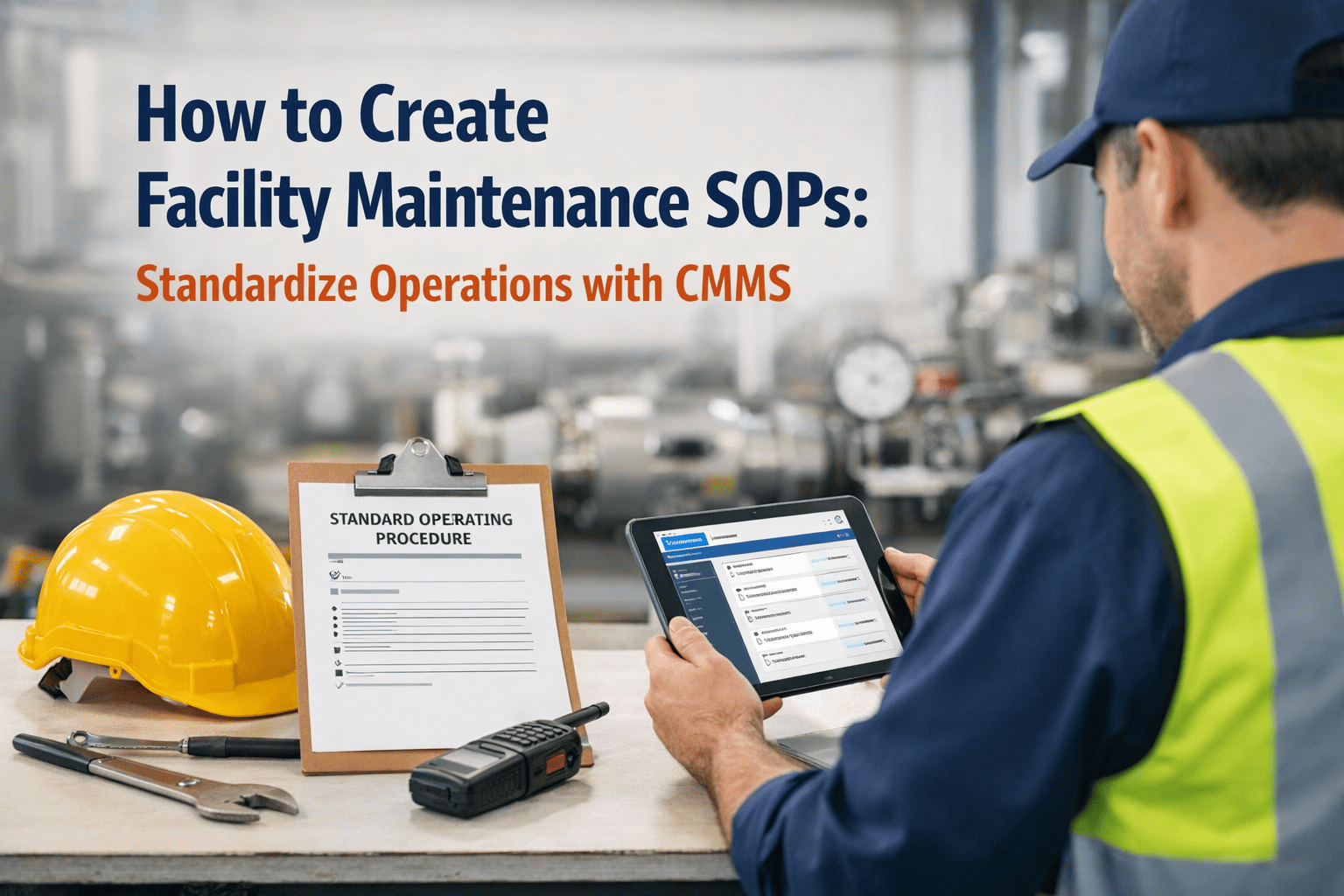
The difference between a maintenance team that consistently performs and one that consistently firefights is rarely about people — it is about whether standard operating procedures exist, are accessible, and are actually followed. Nearly 70% of maintenance issues stem from personnel's lack of awareness of maintenance requirements, and the primary cause is not negligence — it is the absence of documented, accessible procedures that guide the right action at the right time. A CMMS that embeds SOPs directly into work orders transforms procedures from documents that sit in binders into live instructions that govern every maintenance task, on every shift, across every technician. Start building your digital SOP library in OxMaint — free.
Why SOPs Fail Without a CMMS
01Stored in binders or shared drives — not accessible at the point of work
02Outdated versions used because no version control exists
03Verbal handover replaces documented procedure on night shifts
04Compliance depends on individual technician memory, not system enforcement
05No record that the SOP was followed — only that the work order was closed
How CMMS Fixes This
01SOPs embedded in work orders — visible on mobile at task start
02Version-controlled procedures — update once, applies everywhere instantly
03Step-by-step guided completion — technician confirms each step before advancing
04Mandatory sign-off captures compliance evidence, not just task closure
05Timestamped SOP adherence record produced automatically per work order
SOP Framework
What a Facility Maintenance SOP Must Contain
A maintenance SOP is not a description of what a task involves — it is a structured instruction set that a technician can follow without ambiguity, at any experience level, on any shift. Each element below is a required component, not optional guidance.
Purpose & Scope
What system or asset this SOP covers, what it achieves, and which roles are authorised to execute it. Prevents the SOP from being applied to the wrong asset type or by untrained personnel.
Safety Requirements
Mandatory PPE, lockout/tagout requirements, isolation procedures, and permit-to-work requirements before any step begins. Non-negotiable — must appear before step 1 of every SOP.
Tools & Materials
Complete list of tools, spare parts, and consumables required. Prevents mid-task interruptions that lead to shortcuts or incomplete work.
Step-by-Step Procedure
Sequential numbered steps with acceptance criteria at each stage. Each step should have a measurable or observable outcome — not just an action description.
Acceptance Criteria
Defines what a successfully completed task looks like — the readings, conditions, or states that must be confirmed before the work order is closed. Prevents premature sign-off.
Escalation Triggers
Conditions under which the technician must stop, escalate, or seek approval before proceeding — fault conditions found during PM, readings outside tolerance, or safety anomalies detected.
SOP by Maintenance Type
SOP Requirements Across Maintenance Categories
| Maintenance Type |
SOP Priority Elements |
Key Compliance Trigger |
CMMS Integration Point |
| Preventive Maintenance |
Sequence, acceptance criteria, measurement recording fields |
Scheduled frequency; certification expiry |
Auto-triggered PM work order with embedded SOP |
| Corrective / Reactive |
Fault diagnosis checklist, root cause fields, safety isolation steps |
Response time SLA; supervisor sign-off |
Work order created from fault report; SOP loaded by asset type |
| Shutdown / LOTO |
Energy isolation steps, lock-out points, clearance verification |
OSHA 1910.147; NFPA 70E |
Permit-to-work linked to work order before execution |
| Inspection / Audit |
Pass/fail criteria per point; photograph requirement; escalation triggers |
Regulatory inspection frequency; auditor evidence |
Inspection checklist work order with mandatory photo capture |
| Emergency Response |
Decision tree; contact escalation; containment steps; post-incident documentation |
Incident reporting requirements; insurance documentation |
Emergency work order with mandatory RCA closure fields |
OxMaint lets you build, version, and embed SOPs directly into work orders — so every technician, every shift, follows the same documented procedure automatically.
Building SOPs
How to Create and Deploy Facility Maintenance SOPs with OxMaint
1
Audit Current Procedures
Document every maintenance task currently performed — whether written down or not. Interview senior technicians to capture undocumented institutional knowledge before it walks out the door.
2
Prioritise by Risk and Frequency
Build SOPs for high-frequency tasks and high-risk systems first. An HVAC PM SOP performed 12 times per year delivers more standardisation value than an annual generator inspection SOP written first.
3
Build in OxMaint with Acceptance Criteria
Write each SOP step with a measurable outcome — not just an action. "Check refrigerant pressure" is an action. "Verify suction pressure between 65–75 PSI and record reading" is an acceptance criterion. Link the SOP to all relevant asset types in the CMMS.
4
Test, Review, and Version Control
Run each SOP with a technician and identify where steps are ambiguous or missing. Update and version the SOP in OxMaint — all previous versions are archived, the active version is pushed automatically to all future work orders of that type.
Expert Perspective
What Facility Management Professionals Say
"The SOP compliance problem is not that technicians refuse to follow procedures — it is that in most facilities, the procedure is not visible when the work is being done. A printed binder in the workshop helps nobody when the technician is on the roof at 2am. When the SOP loads automatically on the phone with the work order, compliance rates change overnight. It is an access problem, not a culture problem."
Head of Facility Operations, multi-site commercial property group — 15 years in maintenance process standardisation
"The most valuable thing a CMMS adds to SOP management is the audit trail. When a regulator asks whether a specific procedure was followed on a specific date, the answer should take seconds — not hours of archive searching. Mandatory step sign-off in a digital work order means every compliance question has a documented answer without any additional effort from the team."
Facilities Compliance Manager, healthcare operator — 12 years in regulatory audit and maintenance documentation
FAQs
Frequently Asked Questions
What is the difference between a maintenance SOP and a work order?
A work order defines what maintenance task needs to be done, when, on which asset. An SOP defines how the task should be performed — the specific steps, safety requirements, acceptance criteria, and escalation triggers. In a CMMS, the two are linked: the work order schedules and assigns the task, while the embedded SOP guides execution. Without the SOP embedded in the work order, task completion is verified but procedure compliance is not.
OxMaint links SOPs directly to work orders — see how it works free.
How often should facility maintenance SOPs be reviewed and updated?
SOPs should be reviewed annually at minimum, and immediately when: equipment is replaced, regulatory standards change, an incident or near-miss occurs, or a technician identifies a procedure gap during execution. In OxMaint, updating an SOP is version-controlled — the new version is applied to all future work orders immediately, and the previous version is archived. This means the review cycle actually happens because the update process is not burdensome.
Book a demo to see OxMaint's SOP version control workflow.
How does embedding SOPs in a CMMS help with compliance audits?
When an SOP is embedded in a work order with mandatory step sign-off, every completed work order becomes a compliance record — proving that the documented procedure was followed, by which technician, on which date, on which specific asset. This is exactly the evidence structure that regulatory auditors and ISO certification bodies require. A facility running OxMaint can answer any compliance question instantly by filtering work order history, without manual document retrieval.
Start building your compliance-ready SOP library in OxMaint free.
Standardise Every Task. Document Every Step. Audit Any Day.
OxMaint embeds SOPs directly into work orders — so every technician follows the same documented procedure and every completed task produces compliance-ready evidence automatically.