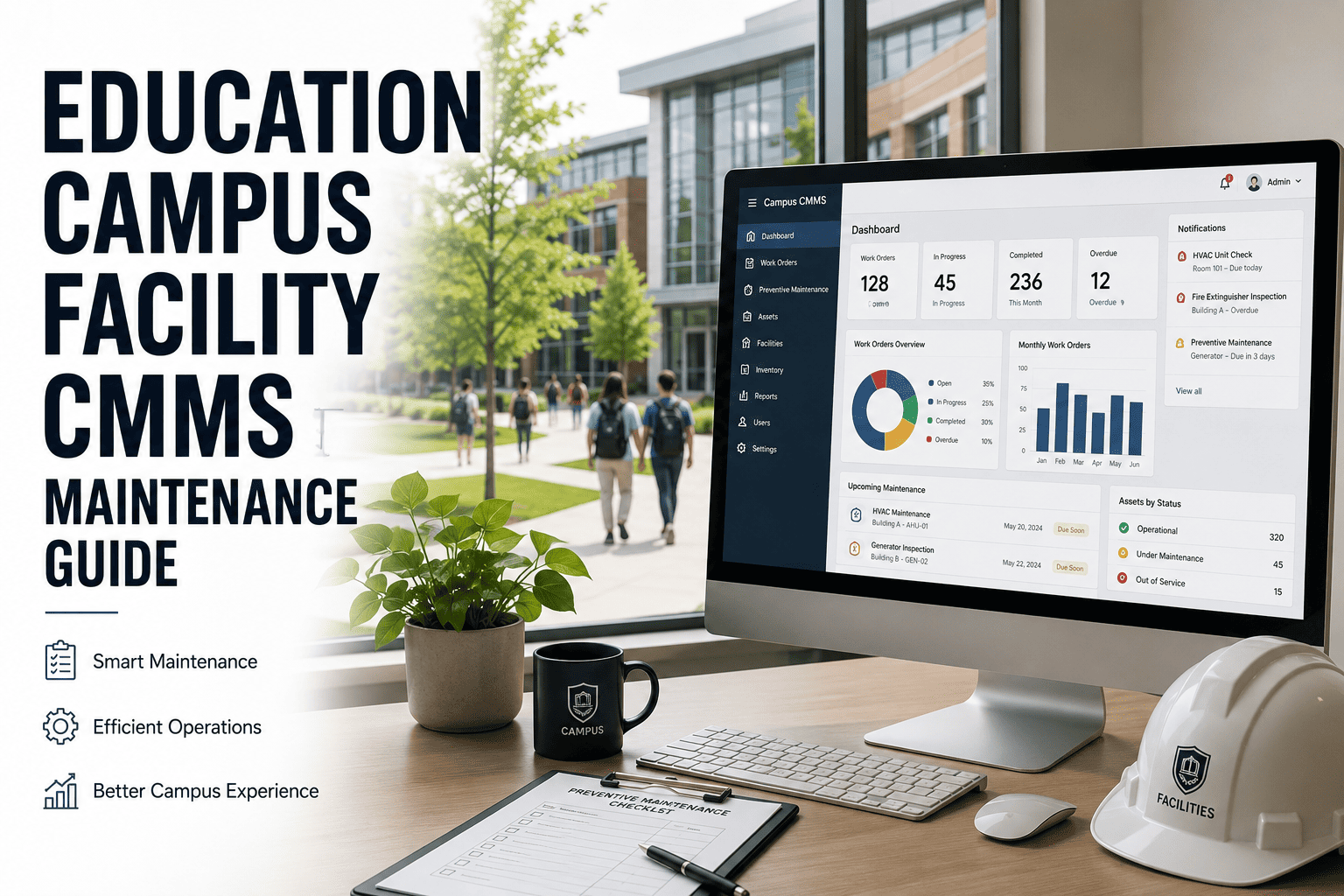
U.S. higher education faces a $112 billion deferred maintenance backlog. Campus buildings average nearly 50 years old. Facilities teams manage 25% more square footage per worker than they did in 2007. And beginning in 2026, an enrollment cliff will reduce tuition revenue while facilities expectations remain high. Meanwhile, K-12 schools face a cycle where every Monday morning starts with dozens of open work orders, a boiler complaint, a roof leak that was reported two weeks ago, and an HVAC failure that pulls three technicians off their PM schedule. By Friday, 12 preventive maintenance tasks have been deferred and the backlog is bigger than before. CMMS adoption in education cuts emergency work orders by up to 40% and increases PM completion from under 50% to over 90% — while creating the documented compliance trail that federal, state, and accreditation auditors require. This guide covers how smart campus maintenance works in 2026. Book a demo to see Oxmaint running on campus facility data.
Industry Verticals
Work Order Management
K-12 & Higher Education
The Campus Maintenance Crisis — 2025–2026 Data
$112B
U.S. higher education deferred maintenance backlog
50 yrs
Average age of campus buildings
+25%
More sq ft managed per worker vs. 2007
2026
Enrollment cliff begins — less revenue, same facilities pressure
The Problem
The Monday Morning Cycle That CMMS Breaks
Without CMMS — The Reactive Cycle
94 open work orders; no priority ranking; triage takes 2.5 hours
HVAC failure pulls 3 technicians off PM schedule mid-week
12 PM tasks deferred by Friday — backlog grows every week
Roof leak reported 2 weeks ago; still unassigned; now worsening
Compliance audit in 3 weeks; documentation assembled in panic
Outcome: 40%+ emergency ratio. Backlog grows $2M–$8M annually.
With CMMS — Controlled Operations
Work orders auto-prioritized by urgency, building, and safety tag
PM schedule protected; HVAC failure generates its own work order without disrupting PM queue
PM completion above 90%; no deferrals without documented authorization
Roof leak auto-escalated after 24 hours without assignment; resolved Day 3
Compliance report generated in one click; audit ready at all times
Outcome: Emergency ratio under 15%. PM compliance above 95%.
Key CMMS Features for Campus Facilities
What Smart Campus Maintenance Looks Like in 2026
01
Academic Calendar Integration
Disruptive maintenance — roof work, HVAC shutdowns, floor refinishing — auto-schedules to breaks, evenings, and summer. Classroom work orders escalate to same-day during finals and move-in week. Zero classroom disruptions from planned maintenance.
02
Multi-Building Work Order Management
AI routing clusters work orders by building proximity, batching 4–6 tasks per trip instead of dispatching single visits across the district. For K-12 with 15–50 buildings spread across a city, this recovers 1.5–2.0 FTE equivalent at zero hiring cost.
03
Compliance Documentation
OSHA, EPA (AHERA asbestos/lead), ADA, NFPA, and state education facility standards all require documented maintenance records. Oxmaint auto-tags compliance work orders and tracks deadlines with escalation alerts. 1-click compliance reports for any audit.
04
Mobile Field Access
Technicians complete work orders from any device on campus — no trips back to the office. Platforms with sub-90-second mobile work order completion recover 30% of technician productive time. Designed for teams ranging from 28-year-old new hires to 61-year-old lead technicians.
05
Capital Budget Evidence
Bond referendums and capital requests fail without data. Oxmaint generates asset condition scores, failure frequency, maintenance cost trending, and remaining useful life projections — evidence-based capital requests that school boards approve 25–40% more often.
06
Preventive Maintenance Scheduling
Automated PM schedules for HVAC, boilers, electrical panels, elevators, and lab equipment across every building. PM completion rate climbs from below 50% to over 90% — while emergency work order ratio drops below 15% within the first academic year.
Campus Asset Types
What CMMS Manages Across a Campus — Asset Register by Building Type
Oxmaint Is Built for the Way Campuses Actually Work
Academic calendar scheduling, multi-building routing, compliance auto-tagging, and mobile access for every generation of technician. Schools using Oxmaint report 30% boost in maintenance productivity and 20% reduction in equipment downtime.
ROI Data
What CMMS Delivers for Education Facilities — Measured Results
40%
Reduction in emergency work orders — first year CMMS deployment
90%+
PM completion rate vs. below 50% manual — consistent finding across districts
$2.34/sq ft
Automated campus maintenance cost vs. $2.85/sq ft manual — 18% reduction
30%
Increase in maintenance productivity — Oxmaint school deployments 2025
Expert Review
What Campus Facilities Leaders Say
"The deferred maintenance backlog in higher education is not a funding problem at its core — it is a documentation problem. School boards and legislators will not fund what they cannot see. CMMS gives facilities directors the asset condition data, failure frequency history, and remaining useful life projections that turn a capital budget request from an estimate into evidence. Campuses using data-backed bond requests approve them at 25–40% higher rates."
VP of Facilities
Regional University — 47 Buildings, 12,000 Students
"K-12 facility managers are managing the equivalent of a mid-size commercial real estate portfolio with a fraction of the staff. The difference between a district that controls its maintenance and one that is controlled by it comes down to whether they have a system that routes, prioritizes, and tracks work — or whether they're running on email, whiteboard, and radio. A CMMS does not add staff. It makes the staff you have equivalent to 1.5× their current headcount."
Director of Facilities
K-12 School District — 28 Schools, Southeast U.S.
Frequently Asked Questions
Campus Facility Management CMMS — Common Questions
How does a CMMS handle the compliance requirements unique to educational facilities?
Educational facilities face overlapping compliance obligations: OSHA workplace safety, EPA environmental standards (AHERA asbestos, lead paint), ADA accessibility, NFPA fire/life safety, Clery Act campus security reporting, and state education facility standards. Oxmaint auto-tags every work order with its regulatory domain, tracks compliance deadlines with automatic escalation alerts, and generates 1-click audit-ready reports for any standard — eliminating the manual documentation assembly that costs facilities coordinators 10–15 hours per audit.
Book a demo to see the compliance tracking dashboard for educational facilities.
Can CMMS work across multiple campuses or buildings spread across a district?
Multi-site management is a core Oxmaint capability. Each campus, school building, or facility is set up as a separate site with its own asset register, PM schedules, work order queue, and compliance record — while giving district-level administrators a unified dashboard showing performance, backlog, and spending across all locations simultaneously. AI routing clusters technician assignments by geographic proximity to reduce travel time and recover productive hours.
Start a free trial to set up your multi-building campus structure in Oxmaint.
How does academic calendar integration work in practice?
Oxmaint's calendar integration allows facilities teams to define no-disruption windows (class hours, exams, graduation) and priority windows (move-in week, first day of school). Maintenance work orders are automatically scheduled to comply with these windows — so HVAC shutdowns, roof work, and floor refinishing are placed in summer or break periods automatically, not discovered as conflicts the day work is scheduled. During high-priority periods, safety and comfort work orders escalate to same-day response automatically.
Book a demo to see academic calendar scheduling configured for your institution type.
What is the typical implementation timeline for CMMS in a school district or university?
For a district or campus choosing a modern cloud CMMS, basic deployment (asset import, work order routing, PM schedules for priority assets) is operational within 1–2 weeks. Full deployment including compliance tracking, multi-building routing, mobile access, and reporting typically completes within 4–6 weeks. Legacy CMMS migrations from outdated systems take longer due to data cleaning but are fully supported. Districts using Oxmaint have their campus asset registry loaded within the first week.
Start a free trial and have your priority assets in Oxmaint within 48 hours.
Your Campus Deserves a Maintenance System Built for How Education Actually Works
Oxmaint manages multi-building work orders, academic calendar scheduling, compliance documentation, and mobile field access for campus maintenance teams of any size — from a single K-12 school to a 50-campus university system.


.jpeg)